Last Updated: March 2026 | Reading Time: 9 minutes | ~2,000 words
Sickle cell disease (SCD) is India’s most prevalent inherited haemoglobin disorder — a group of autosomal recessive conditions caused by a point mutation in the beta-globin gene (HBB gene — glutamic acid → valine substitution at position 6) resulting in the production of haemoglobin S (HbS). When two copies of the HbS mutation are inherited (HbSS — sickle cell anaemia, the most severe form), red blood cells become crescent/sickle-shaped under low oxygen tension, leading to chronic haemolytic anaemia, recurrent vaso-occlusive crises (VOC — painful episodes from capillary occlusion by sickled cells), and progressive multi-organ damage. India carries the world’s second-largest burden of SCD: approximately 20 million sickle cell trait carriers (HbAS — silent carriers) and approximately 300,000–400,000 patients with SCD (HbSS + other compound heterozygous states). SCD in India is concentrated in specific tribal and indigenous communities — the highest prevalence occurs in Odisha, Jharkhand, Madhya Pradesh, Maharashtra, Gujarat, Chhattisgarh, Andhra Pradesh, and Tamil Nadu among Scheduled Tribe populations (prevalence of HbS trait in certain tribes: 15–40%). The Government of India launched the National Sickle Cell Anaemia Elimination Mission (2023) — targeting universal newborn screening, carrier testing for 7 crore tribal population by 2047, and free hydroxyurea access at all health sub-centres in endemic districts. Sickle cell disease represents India’s most significant and most neglected genetic disease burden — with diagnosis rates in affected communities historically below 5–10%.
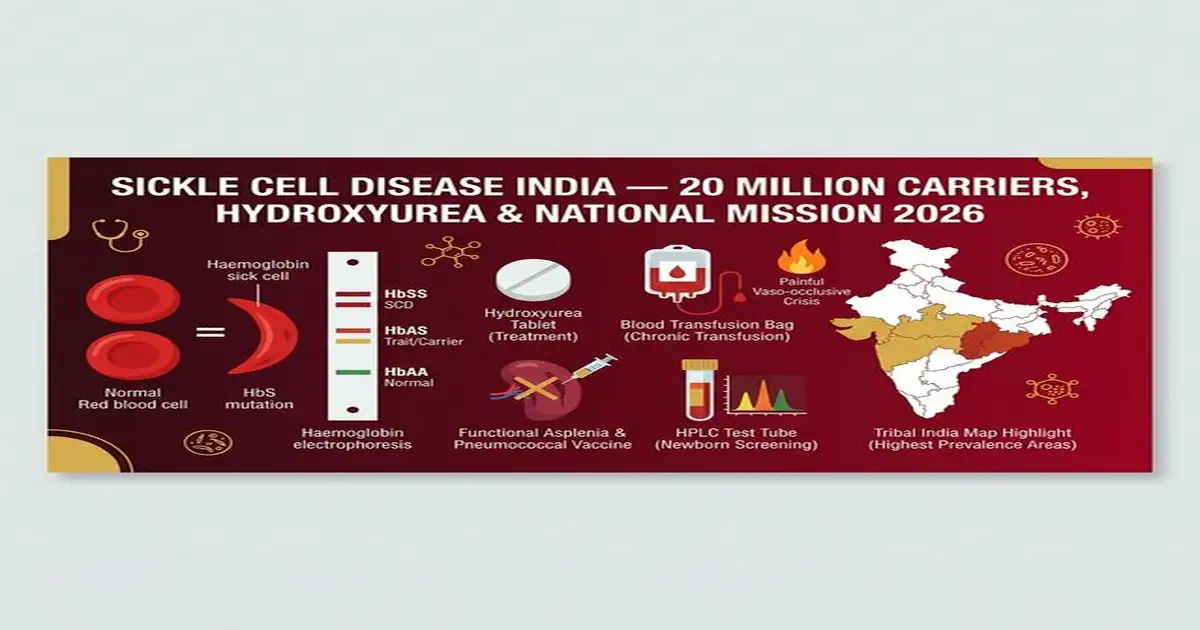
Sickle Cell Disease — Genotypes, Crises, Treatment and Prevention
| Genotype / Complication | Description & Mechanism | Management India | India Context |
|---|---|---|---|
| HbSS (Sickle Cell Anaemia — Most Severe) | Homozygous — two copies of HbS; HbS polymer forms under deoxygenation → rigid crescent cells occlude microvasculature; haemolytic anaemia (Hb 6–9 g/dL chronically); elevated LDH, indirect bilirubin, reticulocyte count; functional asplenia (from repeated splenic infarcts): by age 5, spleen autoinfarcts → no splenic function → vulnerable to encapsulated bacteria (Streptococcus pneumoniae — pneumococcal sepsis, HaemophilusinfluenzaType b, Meningococcus → “overwhelming postsplenectomy infection — OPSI”); average lifespan (untreated India): 25–30 years; with modern treatment: 50–60+ years | Hydroxyurea (HU): mainstay of SCD disease-modifying therapy; increases HbF (foetal haemoglobin) production — HbF inhibits HbS polymerisation → fewer sickled cells, fewer crises, reduced hospitalisation; dose: 15–20 mg/kg/day orally; MSH (Multicenter Study of Hydroxyurea) trial: 44% reduction in VOC frequency; 50% reduction in ACS (acute chest syndrome); responses at 3–6 months (blood HbF % rises); toxicities: myelosuppression (monitor CBC monthly — if ANC <2000/µL or platelets <80,000 → withhold/reduce dose); Folic acid 5mg daily (all SCD patients — prevents megaloblastic change from haemolysis); Hydroxyurea: listed in India National Essential Medicines List (NLEM 2022); free under National SCD Elimination Mission at district/CHC level | India: HU access historically extremely poor in tribal areas; National SCD Elimination Mission (2023): free HU at all sub-centres in 17 high-prevalence states (Odisha, MP, CG, Gujarat, Maharashtra, AP, TN, Jharkhand); Sickle cell newborn screening (NBS): heel-prick HPLC at birth — detects HbSS/HbAS/HbAC within 1 week; NBS allows early penicillin prophylaxis by 2 months → prevents 90% of pneumococcal sepsis deaths; India NBS: launched in phased manner from 2023 under mission; prior to mission: most SCD patients diagnosed only at first VOC (often age 2–5 — already after first pneumococcal sepsis risk peak) |
| HbSC Disease & HbS-beta Thalassaemia (Compound Heterozygous) | HbSC: one HbS + one HbC (another beta-globin mutation); milder than HbSS but significant complications (retinopathy — higher than HbSS; avascular necrosis hip — high; splenomegaly persists longer — does not autoinfarct as early — splenomegaly + SCD); HbS-beta+ thalassaemia: one HbS + reduced beta-globin production (some normal HbA present — milder); HbS-beta0 thalassaemia: one HbS + absent beta-globin production (no HbA — clinically equivalent to HbSS — severe); India: HbS-beta thalassaemia common in areas where thalassaemia trait and HbS trait coexist (Gujarat — both thalassaemia belt + sickle belt; AP); HbSC more common in West Africa diaspora communities — less common native Indian | HbSC: same hydroxyurea therapy; regular retinal examination (retinopathy — annual; laser photocoagulation if proliferative); hip USS/MRI annually (avascular necrosis of femoral head — orthopaedic referral, core decompression, total hip replacement when advanced); HbS-beta thal: HPLC essential to characterise exactly; management similar to HbSS for beta0; hydroxyurea effective across all SCD genotypes; Blood transfusion: chronic transfusion programme (CTP) for specific high-risk situations — prior stroke, TCD (transcranial Doppler) screening for stroke risk (velocity >200 cm/s → high stroke risk → start CTP); exchange transfusion (for ACS, priapism, acute stroke) | HPLC (high performance liquid chromatography): gold standard India for haemoglobin characterisation (HbSS vs SC vs S-beta thal vs AS trait); widely available at tertiary hospitals (AIIMS Delhi/Bhopal/Nagpur, NIMHANS, CMC Vellore, IPGME Kolkata); solubility test (Sickledex): only identifies presence of HbS — cannot distinguish HbSS from HbAS trait or SC — inadequate for definitive diagnosis; peripheral blood smear: sickle cells visible in HbSS (not in HbAS trait); sickling targets (target cells) in HbSC; WHO recommendation: HPLC for all SCD diagnosis (replace solubility test) |
| Vaso-Occlusive Crisis (VOC) — Acute Pain Crisis | Most common acute complication (90% of SCD hospitalisations); mechanism: deoxygenation (cold, infection, dehydration, altitude, stress, exertion) → HbS polymerisation → sickle cell formation → microvascular occlusion → ischaemia → severe pain; sites: bones/joints (most common — long bones, back, chest, hip, knee), abdomen (mesenteric vascular occlusion — mimics acute abdomen); precipitants in India: cold exposure (especially tribal winter Odisha/MP), dehydration (hot summer without oral hydration), infections, menses (female SCD patients); clinical: fever + severe pain (NRS 8–10/10) + localised tenderness; distinguish VOC from infection (both can cause fever + raised WCC) | VOC analgesia ladder: Mild VOC (manageable outpatient): oral paracetamol + ibuprofen (short-term NSAID only if renal function normal — avoid in CKD SCD); codeine phosphate 30–60mg 4-hourly; Moderate–Severe VOC (inpatient): IV morphine 0.1mg/kg every 20min titrated (PCA — patient-controlled analgesia optimal); IV ketorolac (30mg IV — NSAID if renal function normal — but use with caution in CKD); avoid pethidine (meperidine — norpethidine metabolite causes seizures — particularly dangerous in SCD); Adjuncts: IV hydration (normal saline — avoid dextrose solutions); oxygen only if SpO2 <95% (routine O2 does NOT help VOC — MSH trial); warmth; treating precipitating infection; discharge: when pain NRS <6, oral analgesia sufficient, able to drink | India VOC management: most district hospitals lack morphine PCA; IV tramadol used as substitute (weaker than morphine — inadequate for severe VOC); oral tramadol 50–100mg 4-6 hourly: reasonable outpatient step; India SCD patients often undertreated for pain (cultural biases, staff reluctance to prescribe opioids, opioid availability restriction at district hospitals); SCD pain is REAL — not drug-seeking behaviour; SCD patients know their pain pattern better than treating doctors; Sickle Cell Society India (advocacy organisation): pushing for mandatory morphine availability at district hospitals in endemic areas; hydration: ORS if mild VOC — prevents dehydration trigger |
| Acute Chest Syndrome (ACS) — Life-Threatening Complication | Most common cause of death in SCD; NEW pulmonary infiltrate on CXR + fever + respiratory symptoms (cough, chest pain, hypoxaemia) in SCD patient; mechanism: fat embolism (from bone marrow infarction → fat globules enter pulmonary circulation), in-situ sickling in pulmonary microvasculature, infection (pneumococcal, Mycoplasma, Chlamydia, RSV), pulmonary infarction; mimic: ACS can be initially indistinguishable from pneumonia — in SCD patient with new CXR infiltrate + fever: treat for BOTH ACS and infection simultaneously; SpO2 <94%: serious sign; severe: rapidly progressive bilateral infiltrates, severe hypoxaemia — can progress to ARDS/respiratory failure within 24–48h | ACS management (EMERGENCY): Hospitalise all ACS → high-flow oxygen; Incentive spirometry (prevent atelectasis — simple plastic spirometer — ₹200 India); Empirical antibiotics: cephalosporin (ceftriaxone 1g IV) + azithromycin 500mg (atypical coverage) — covers pneumococcal + Mycoplasma; Simple blood transfusion: HbS% <30% if initial Hb <9 AND deteriorating → gives normal RBCs to dilute sickle cells → rapidly improves gas exchange; Exchange transfusion: if severe ACS (SpO2 <90% despite O2; rapid deterioration; bilateral infiltrates; impending respiratory failure) → exchange reduces HbS% to <30% within hours; ICU/ARDS management if required; Hydroxyurea: prevents future ACS (reduces ACS frequency 50% in MSH trial) — start after recovery | India ACS recognition gap: many SCD patients in India die from ACS that was not recognised as distinct from ordinary pneumonia; the key difference: SCD patient + new CXR infiltrate + fever → ACS must be in differential → do NOT give fluids aggressively (pulmonary oedema risk in ACS), start simple transfusion early; blood transfusion access in rural endemic areas (Odisha/MP tribal areas): critical challenge — nearest blood bank may be 50–100km away; SCD patients should be registered with nearest blood bank (Type and Screen on file) for emergency access |
| Stroke, Splenic Sequestration & Newborn Screening | Stroke in SCD: ischaemic stroke (most common — HbSS age 2–16 years); caused by large vessel vasculopathy (internal carotid/MCA stenosis from chronic endothelial damage by sickled cells); TCD (transcranial Doppler) velocity >200 cm/s = high stroke risk → chronic transfusion programme (CTP) required; MRI/MRA brain for stroke diagnosis; Splenic sequestration crisis: acute life-threatening — massive sudden spleen enlargement + rapid Hb fall + hypovolaemic shock (spleen sequesters large volume of blood intrasplenicly); typically age 3 months–5 years (before autosplenectomy); Hb can fall from 9 to 3 g/dL in hours → cardiovascular collapse; treatment: emergency blood transfusion; Newborn screening (NBS) HPLC: early diagnosis allows: penicillin V prophylaxis from age 2 months (prevents pneumococcal sepsis — 90% reduction in mortality); BCG + all EPI vaccines + HBV + PCV (pneumococcal conjugate vaccine) on schedule; parental education on splenic sequestration emergency signs; hydroxyurea from early childhood | TCD screening: all HbSS children aged 2–16 → annual TCD; velocity >200 cm/s → CTP (monthly transfusion → maintain HbS% <30%); STOP2 trial: TCD screening + CTP reduces stroke by 90%; Splenic sequestration: parents/family must be taught to palpate abdomen at home — sudden rapid spleen enlargement = emergency → go to hospital immediately for blood transfusion; India NBS programme: launched 2023–24 in pilot states (MP, Gujarat, Odisha) under National SCD Elimination Mission; target: universal NBS all tribal births + semi-urban/rural hospital births in endemic districts by 2026; Penicillin V prophylaxis: 125mg twice daily age <5; 250mg twice daily age 5+; free at government hospitals under SCD Elimination Mission; Pneumococcal conjugate vaccine (PCV 13): added to India UIP NW 2017; critical for SCD patients — functional asplenia → MANDATORY PCV 13 + PPV 23 (polysaccharide) | India progress: National SCD Mission 2023 — Rs 10,000 crore commitment; target 2047 (India@100): eliminate SCD as public health problem; 7 crore tribal population to be screened for HbAS carrier status; all affected births to receive free NBS + HU + penicillin; prenatal diagnosis (PND): available at CMC Vellore, AIIMS Delhi — HPLC + molecular genetics on CVS sample (10–12 weeks) for at-risk couples (both HbAS carriers); counselling: HbAS × HbAS couple: 25% risk each pregnancy of HbSS child; 50% chance of HbAS carrier (healthy); 25% chance normal HbAA |
Frequently Asked Questions
How does hydroxyurea work in sickle cell disease — and who should take it in India?
Hydroxyurea (HU) is the most important and transformative drug in sickle cell disease management — a cheap, generically available, orally administered tablet that has changed SCD from a relentlessly progressive condition to a manageable chronic disease in patients who take it consistently: The mechanism — how HU works: Hydroxyurea is a ribonucleotide reductase inhibitor — it inhibits DNA synthesis → preferentially kills rapidly dividing cells; in SCD, the key therapeutic effect is HbF (foetal haemoglobin) induction; HbF (gamma-globin chains) does not participate in HbS polymerisation — it physically DILUTES and INHIBITS HbS polymer formation within the red blood cell; as HbF% increases (from baseline 2–5% → 15–30% on HU): fewer cells sickle under deoxygenation; less microvascular occlusion; fewer VOC episodes (reduced by 40–50%); fewer ACS episodes (reduced by 50%); fewer blood transfusions required; longer red cell survival; additional HU effects: reduces neutrophil count (adherent neutrophils contribute to vascular occlusion) and platelet count (both elevated and hyperactivated in SCD — contribute to vascular injury); improves red cell hydration and deformability; reduces expression of adhesion molecules on sickled cells. Who should receive hydroxyurea in India — the indications: HbSS (sickle cell anaemia): ALL patients ≥9 months of age — WHO 2020 and India National SCD Mission guidelines recommend HU for ALL HbSS patients regardless of disease severity (primary prevention of crises, not just rescue therapy when already severe); HbS-beta0 thalassaemia: same as HbSS; HbS-beta+ thalassaemia with significant symptoms; HbSC disease with frequent crises (less responsive than HbSS but still beneficial); Specific HIGH-PRIORITY indications for HU if not already on it: ≥3 VOC episodes requiring hospitalisation per year; ≥1 ACS episode; priapism (painful sustained erection in male SCD — emergency; HU reduces recurrence); symptomatic anaemia (Hb <7 g/dL despite iron/folate); history of stroke or TCD high velocity. Starting and monitoring HU in India — practical guidance: Start: 15 mg/kg/day as single daily dose orally (with or without food); titrate up by 5 mg/kg/day every 8 weeks to maximum tolerated dose (MTD) — maximum 35 mg/kg/day; target: ANC 2,000–4,000/µL (myelosuppression indicates HU working — but not too suppressed); HbF%: rising (check at 3 months — should see HbF% rise); monitor CBC: monthly initially (titration phase), every 3 months when stable; if ANC <2,000 or platelets <80,000 or Hb falls acutely → hold HU 1–2 weeks → restart at lower dose; FERTILITY: HU is teratogenic → do NOT use in pregnancy (may harm foetus); men: HU can temporarily reduce sperm count (partially reversible on stopping); counsel young adults on fertility preservation before HU; WOMEN: effective contraception mandatory while on HU; if SCD patient becomes pregnant → switch to supportive management during pregnancy (HU stopped at conception). India HU availability: Generic hydroxyurea tablets: ₹200–400 for 30 tablets (500mg); National SCD Elimination Mission: free HU supply at all sub-health centres, PHCs, CHCs in 17 endemic states; private: Droxia/Hydrea branded: ₹1,500–3,000/month; generic Cytocarb, Hydroxurea-500 (Cipla, Zydus): ₹300–500/month; compliance is the major challenge — daily tablet for a young tribal child requires strong family health literacy and ASHA follow-up.
What is the India government’s National Sickle Cell Anaemia Elimination Mission — and what does it mean for tribal communities?
The National Sickle Cell Anaemia Elimination Mission (NSCAEM) — launched by Prime Minister Modi in July 2023 — is one of the most ambitious genetic disease control programmes in Indian and global public health history: Why it was needed — the scale of the problem: India has approximately 300,000–400,000 people with SCD (HbSS/SC/S-beta thal) and 20 million carriers (HbAS); until 2023, there was no national programme for SCD; diagnosis rates: less than 5–10% of affected tribal population had ever been diagnosed; treatment (hydroxyurea): available only at tertiary hospitals in major cities; tribal SCD patient from Bastar (Chhattisgarh) needed to travel to Raipur (200km) for HU prescription; NBS: virtually non-existent outside CMC Vellore and a few state programmes; outcomes: life expectancy of tribals with SCD in India — often <25–30 years (fatal complications, uncontrolled VOC, untreated ACS, pneumococcal sepsis from functional asplenia, stroke). NSCAEM — the key components: Universal newborn screening (NBS): HPLC at birth for all children born in hospitals in SCD-endemic districts of 17 states; target: 100% hospital birth NBS coverage by 2026–2027; community-based screening: HPLC for 7 crore (70 million) tribal population by 2047 (India at 100 — Viksit Bharat 2047 target); village-level ASHA-based screening camps using point-of-care rapid HbS tests (HemoTypeSC — Ghana-originated lateral flow assay — now being validated India); confirmatory HPLC at PHC/block level; Treatment cascade: diagnosed HbSS → HPLC confirmed → started on HU free (at sub-health centre level) + folic acid + penicillin V + PCV 13/23 vaccines; ASHA/ANM: monthly tablet delivery at village level + adherence monitoring; VOC emergency protocol: every taluk/block hospital to have SCD emergency kit (IV morphine, blood type on file, transfusion protocol); Genetic counselling + prenatal diagnosis: at district hospital level for at-risk couples (both HbAS carriers); Sickle cell centres of excellence: 17 state-level SCD centres at medical college hospitals (established 2023–2025); IT system: SCD patient digital ID card (HbSS UDID card — registered patients eligible for disability benefits + free treatment). Impact targets (NSCAEM 2023–2047): Newborn mortality from SCD: target 90% reduction by 2030; SCD prevalence at birth (through prenatal counselling/diagnosis): reduce by 50% by 2047; life expectancy of SCD patients: target 50+ years by 2030 (from current <30 years in many tribal areas); hospitalisation from VOC: reduce by 50% with universal hydroxyurea access; challenges: supply chain for HU + penicillin at sub-health centre — stock-outs; health literacy in tribal communities — acceptance of genetic counselling; prenatal diagnosis and termination of affected pregnancies — ethical/cultural sensitivities in tribal communities requiring culturally sensitive communication.
What to Read Next
- Anaemia — SCD Anaemia vs Iron Deficiency Anaemia: HbF + HbS on HPLC; Never Give IV Iron in Haemolytic Anaemia Without Iron Deficiency Testing; Different Aetiologies
- Pregnancy & SCD — Sickle Cell Crisis in Pregnancy: Stop Hydroxyurea (Teratogenic); Folate 5mg; Transfusion for ACS; Preterm Labour Risk;
- Kidney & SCD — Sickle Cell Nephropathy: Papillary Necrosis, Haematuria, FSGS; eGFR Monitoring; ACE Inhibitor Reduces Proteinuria in SCD
- Stroke & SCD — SCD Stroke in Children: Most Common Cause of Childhood Stroke India; TCD Screening + Chronic Transfusion Prevents 90% of SCD Stroke
- Mental Health & SCD — Chronic Pain + Social Stigma = High Depression in SCD Patients; Hydroxyurea Reduces Pain Crises → Improves QoL Significantly
A 6-year-old Gondi tribal boy from Bastar, Chhattisgarh is brought to the Mission Hospital with his 4th painful crisis in 6 months. His Hb: 6.8 g/dL. HPLC: HbSS. His parents had never heard the words “sickle cell.” Under the National SCD Elimination Mission, his district now runs a sub-health centre with free hydroxyurea. He starts HU 15mg/kg/day. His ASHA worker brings his tablets monthly. At 12 months: HbF% 18% (from 3%); Hb: 8.1 g/dL. He has had zero hospital admissions. His 4-year-old sister is screened: HbAS carrier — healthy, no treatment needed but genetic counselling given. His parents both carry HbAS — they did not know until now. Their next pregnancy: prenatal HbS testing at the district hospital. The Mission: 7 crore tribal Indians to be screened. One village at a time.
About This Guide: Written by the StudyHub Health Editorial Team (studyhub.net.in) based on India National Sickle Cell Anaemia Elimination Mission Guidelines 2023, WHO SCD Management Guidelines 2020, ASH SCD Guidelines 2020, and ICMR Task Force Report on Haemoglobinopathies India 2022. Last updated: March 2026.
🧬 Tribal Community? Get Free Sickle Cell Screening: Under the National SCD Elimination Mission, free HPLC sickle cell testing is available at all PHCs and district hospitals in 17 endemic states. All children born in these areas should have HPLC newborn screening. If HbSS diagnosed: free hydroxyurea, folic acid, and penicillin at your sub-health centre. If HbAS carrier: no treatment needed but inform your partner before marriage/pregnancy.
💊 Already Diagnosed with Sickle Cell Disease? Ask for Hydroxyurea: Hydroxyurea (HU) reduces painful crises by 50%, prevents lung complications (ACS), and reduces the need for blood transfusions. It is free at government hospitals under the National SCD Mission. ONE tablet daily. HbF rises in 3 months. Ask your doctor or ASHA worker about free hydroxyurea access in your district.
⚕️ Medical Disclaimer: This article provides general educational information about sickle cell disease. All diagnosis (HPLC), treatment (hydroxyurea dosing, transfusion), complication management (ACS, stroke, VOC), and genetic counselling require qualified haematologist/paediatrician assessment. Hydroxyurea should not be used in pregnancy — effective contraception mandatory for women on HU.