Constitutional Framework for Division of Legislative Authority
The Constitution of India lays down a well-defined framework for distributing legislative powers between the Union (Central Government) and the State Governments. This division is primarily governed by Articles 245 and 246, which serve as the cornerstone provisions determining the scope and extent of law-making authority at both levels of governance.
To operationalize this distribution, the Constitution incorporates the Seventh Schedule, which systematically classifies subjects into distinct categories, thereby delineating the precise areas over which the Union and the States may exercise their legislative competence.
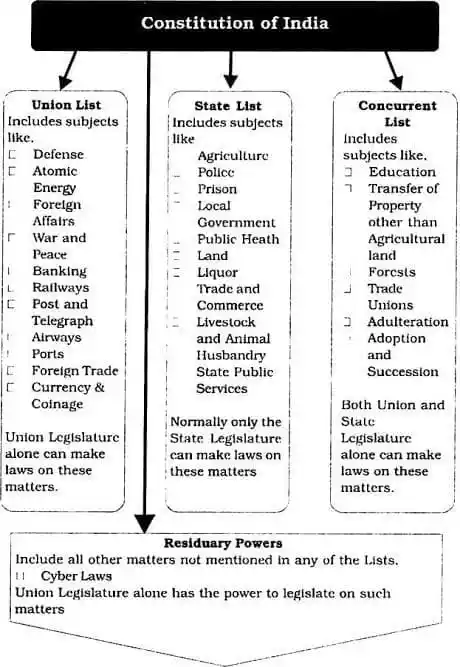
Article 246 specifically corresponds to the Seventh Schedule and organizes all legislative subjects into three comprehensive lists:
- Union List – Subjects on which only the Parliament (Central Government) can legislate.
- State List – Subjects on which only the State Legislatures can legislate.
- Concurrent List – Subjects on which both the Parliament and State Legislatures can legislate.
Subject Count at a Glance
| List | Original Count | Present Count |
|---|---|---|
| Union List | 97 subjects | 100 subjects |
| State List | 66 subjects | 61 subjects |
| Concurrent List | 47 subjects | 52 subjects |
Union List – Powers Exclusive to the Central Government
The Union List originally comprised 97 subjects at the time of the Constitution’s commencement. Over the years, through various constitutional amendments, the number has increased to 100 subjects at present.
Key Features of the Union List
- Exclusive Central Authority: The Parliament of India holds the sole and exclusive power to enact legislation on all matters enumerated under the Union List. No State Legislature is permitted to legislate on these subjects under ordinary circumstances.
- Reflection of a Strong Centre: The Union List contains a significantly larger number of subjects compared to the State List, which clearly reflects the constitutional intent of establishing a strong Central Government within India’s federal structure.
- Subjects of National Importance: The Union List encompasses matters that are of paramount importance to the nation as a whole and those that demand uniformity in legislation across the entire country. These include areas such as defence, foreign affairs, atomic energy, banking, currency, and similar subjects of overarching national significance.
- Supremacy Over the State List: The Constitution of India ensures the dominance of the Union List over the State List. In any situation where there is a conflict or overlap between a Union subject and a State subject, the law made under the Union List shall prevail and override the corresponding State law.
- Delegation of Powers to States: A law enacted by the Parliament on any Union List subject is empowered to confer powers and impose duties upon a State Government. Additionally, it may authorize the Central Government to delegate such powers and duties to a State as deemed necessary.
- Exclusive Taxation Authority: Out of the 100 subjects in the Union List, there are 15 subjects on which the Parliament enjoys an exclusive right to levy and collect taxes.
- 88th Constitutional Amendment: This amendment introduced a new entry in the Union List, namely ‘Taxes on Services’, thereby expanding the Centre’s taxation domain further.
- Parliament’s Power Over Supreme Court: The Parliament is constitutionally empowered to enlarge the jurisdiction and powers of the Supreme Court of India with respect to matters falling under the Union List.
State List – Powers Exclusive to the State Governments
The State List presently contains 61 subjects. At the time of the Constitution’s adoption, it originally had 66 subjects. The reduction occurred primarily due to the 42nd Constitutional Amendment Act of 1976, which transferred the following five subjects from the State List to the Concurrent List:
- Education
- Forests
- Protection of wild animals and birds
- Weights and measures
- Administration of justice, constitution, and organisation of all courts except the Supreme Court and the High Courts
Key Features of the State List
- Exclusive State Authority (Under Normal Circumstances): The State Legislatures possess the exclusive right to frame laws on all subjects listed under the State List. However, this exclusivity is applicable only under normal circumstances and is subject to certain constitutional exceptions.
- Parliament’s Overriding Power Under Article 249: Article 249 of the Constitution grants the Parliament the authority to legislate on any subject enumerated in the State List if it is deemed necessary in the national interest. This provision serves as a safeguard to address situations that transcend state boundaries.
- Conditions Under Which Parliament Can Legislate on State Subjects: The Parliament is constitutionally permitted to make laws on State List subjects under the following three specific conditions:
- When the Rajya Sabha passes a resolution by a special majority, declaring that it is necessary or expedient in the national interest for Parliament to legislate on a particular State subject.
- During a National Emergency (Article 250) – When a Proclamation of Emergency is in operation, Parliament acquires the power to legislate on any subject in the State List for the entire territory of India or any part thereof.
- When two or more State Legislatures pass resolutions requesting the Parliament to enact legislation on a specific subject from the State List on their behalf.
Important Notes
- When Parliament legislates on a State subject based on a resolution passed by States, the resulting law is applicable only to those States that passed the resolution. However, any other State may subsequently adopt the same law by passing an identical resolution in its own legislature.
- Any law enacted by the Parliament on the basis of a States’ resolution can be amended or repealed only by the Parliament itself — the State Legislatures do not have the authority to modify or revoke such legislation.
- Parliament can also legislate on State List subjects for the implementation of International Agreements and during the imposition of President’s Rule in a State.
- Subjects of Regional and Local Significance: The State List primarily encompasses matters that are of regional and local importance and those that inherently allow for diversity of interest across different states. These include subjects like public order, police, public health, agriculture, and local governance.
- Exclusive State Taxation Authority: Among the 61 subjects in the State List, there are 20 subjects on which State Legislatures hold the exclusive power to impose and collect taxes.
- Special Provisions for the National Capital Territory of Delhi: Following the 69th Constitutional Amendment Act of 1991, special provisions were introduced for the governance of Delhi. The Delhi Government is restricted from legislating on three specific State List subjects, namely:
- Public Order
- Police
- Land
Concurrent List – Shared Legislative Domain
The Concurrent List presently comprises 52 subjects on which both the Central Government and the State Governments are empowered to legislate.
As mentioned earlier, the 42nd Constitutional Amendment Act of 1976 was instrumental in expanding this list by transferring the following five subjects from the State List:
- Education
- Forests
- Protection of wild animals and birds
- Weights and measures
- Administration of justice, constitution, and organisation of all courts except the Supreme Court and the High Courts
Key Features of the Concurrent List
- Borrowed from Australia: The concept of maintaining a Concurrent List in the Constitution was borrowed from the Constitution of Australia, making it one of the notable features adopted from comparative constitutional studies during the drafting of India’s Constitution.
- Dual Legislative Competence: Both the Central Government (Parliament) and the State Governments (State Legislatures) are competent to enact laws on any subject enumerated under the Concurrent List. This allows for a degree of flexibility in governance, where both tiers of government can address shared concerns.
- Central Law Prevails in Case of Conflict: Although both levels of government can legislate on Concurrent List subjects, in the event of any conflict or inconsistency between a Central law and a State law on the same subject, the law enacted by the Parliament shall prevail, and the conflicting State law, to the extent of the repugnancy, shall be deemed void.
- Desirable but Not Essential Uniformity: The Concurrent List includes subjects on which uniformity of legislation across the country is considered desirable but not absolutely essential. This allows States the freedom to tailor laws to their specific regional needs while maintaining a baseline of legislative coherence at the national level.
- Shared Taxation Authority: Out of the 52 subjects in the Concurrent List, there are 3 subjects on which both the Central Government and the State Governments possess the concurrent power to levy and collect taxes.