Indian Penal Code, 1860
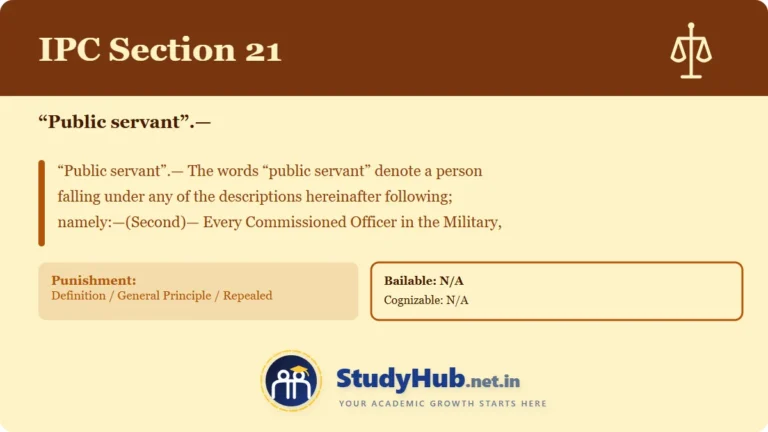
“Public servant”.—
Section
21
Punishment
Definition / General Principle / Repealed
Cognizable
N/A
Bailable
N/A
Compoundable
Non-Compoundable (Refer to CrPC 320 for exceptions)
Trial Court
N/A
Bare Act Text
21. “Public servant”.—
The words “public servant” denote a person falling under any of the descriptions hereinafter following; namely:—(Second)— Every Commissioned Officer in the Military, Naval or Air Forces of India;(Third)— Every Judge including any person empowered by law to discharge, whether by himself or as a member of any body of persons, any adjudicatory functions;(Fourth)— Every officer of a Court of Justice (including a liquidator, receiver or commissioner) whose duty it is, as such officer, to investigate or report on any matter of law or fact, or to make, authenticate, or keep any document, or to take charge or dispose of any property, or to execute any judicial process, or to administer any oath, or to interpret, or to preserve order in the Court, and every person specially authorized by a Court of Justice to perform any of such duties;(Fifth)— Every juryman, assessor, or member of a panchayat assisting a Court of Justice or public servant;(Sixth)— Every arbitrator or other person to whom any cause or matter has been referred for decision or report by any Court of Justice, or by any other competent public authority;(Seventh)— Every person who holds any office by virtue of which he is empowered to place or keep any person in confinement;(Eighth)— Every officer of the Government whose duty it is, as such officer, to prevent offences, to give information of offences, to bring offenders to justice, or to protect the public health, safety or convenience;(Ninth)— Every officer whose duty it is, as such officer, to take, receive, keep or expend any property on behalf of the Government, or to make any survey, assessment or contract on behalf of the Government, or to execute any revenue process, or to investigate, or to report, on any matter affecting the pecuniary interests of the Government, or to make, authenticate or keep any document relating to the pecuniary interests of the Government, or to prevent the infraction of any law for the protection of the pecuniary interests of the Government;(Tenth)— Every officer whose duty it is, as such officer, to take, receive, keep or expend any property, to make any survey or assessment or to levy any rate or tax for any secular common purpose of any village, town or district, or to make, authenticate or keep any document for the ascertaining of the rights of the people of any village, town or district;(Eleventh)— Every person who holds any office in virtue of which he is empowered to prepare, publish, maintain or revise an electoral roll or to conduct an election or part of an election;(Twelfth)— Every person—(a)in the service or pay of the Government or remunerated by fees or commission for the performance of any public duty by the Government;(b)in the service or pay of a local authority, a corporation established by or under a Central, Provincial or State Act or a Government company as defined in section 617 of the Companies Act, 1956 (1 of 1956).IllustrationA Municipal Commissioner is a public servant.Explanation 1.— Persons falling under any of the above descriptions are public servants, whether appointed by the Government or not.Explanation 2.— Wherever the words “public servant” occur, they shall be understood of every person who is in actual possession of the situation of a public servant, whatever legal defect there may be in his right to hold that situation.Explanation 3.— The word “election” denotes an election for the purpose of selecting members of any legislative, municipal or other public authority, of whatever character, the method of selection to which is by, or under, any law prescribed as by election.
What is IPC Section 21 ?
According to the official bare act, this legal offense is defined as: 21. “Public servant”.—
The words “public servant” denote a person falling under any of the descriptions hereinafter following; namely:—(Second)— Every Commissioned Officer in the Military, Naval or Air Forces of India;(Third)— Every Judge including any person empowered by law to discharge, whether by himself or as a member of any body of persons, any adjudicatory functions;(Fourth)— Every officer of a Court of Justice (including a liquidator, receiver or commissioner) whose duty it is, as such officer, to investigate or report on any matter of law or fact, or to make, authenticate, or keep any document, or to take charge or dispose of any property, or to execute any judicial process, or to administer any oath, or to interpret, or to preserve order in the Court, and every person specially authorized by a Court of Justice to perform any of such duties;(Fifth)— Every juryman, assessor, or member of a panchayat assisting a Court of Justice or public servant;(Sixth)— Every arbitrator or other person to whom any cause or matter has been referred for decision or report by any Court of Justice, or by any other competent public authority;(Seventh)— Every person who holds any office by virtue of which he is empowered to place or keep any person in confinement;(Eighth)— Every officer of the Government whose duty it is, as such officer, to prevent offences, to give information of offences, to bring offenders to justice, or to protect the public health, safety or convenience;(Ninth)— Every officer whose duty it is, as such officer, to take, receive, keep or expend any property on behalf of the Government, or to make any survey, assessment or contract on behalf of the Government, or to execute any revenue process, or to investigate, or to report, on any matter affecting the pecuniary interests of the Government, or to make, authenticate or keep any document relating to the pecuniary interests of the Government, or to prevent the infraction of any law for the protection of the pecuniary interests of the Government;(Tenth)— Every officer whose duty it is, as such officer, to take, receive, keep or expend any property, to make any survey or assessment or to levy any rate or tax for any secular common purpose of any village, town or district, or to make, authenticate or keep any document for the ascertaining of the rights of the people of any village, town or district;(Eleventh)— Every person who holds any office in virtue of which he is empowered to prepare, publish, maintain or revise an electoral roll or to conduct an election or part of an election;(Twelfth)— Every person—(a)in the service or pay of the Government or remunerated by fees or commission for the performance of any public duty by the Government;(b)in the service or pay of a local authority, a corporation established by or under a Central, Provincial or State Act or a Government company as defined in section 617 of the Companies Act, 1956 (1 of 1956).IllustrationA Municipal Commissioner is a public servant.Explanation 1.— Persons falling under any of the above descriptions are public servants, whether appointed by the Government or not.Explanation 2.— Wherever the words “public servant” occur, they shall be understood of every person who is in actual possession of the situation of a public servant, whatever legal defect there may be in his right to hold that situation.Explanation 3.— The word “election” denotes an election for the purpose of selecting members of any legislative, municipal or other public authority, of whatever character, the method of selection to which is by, or under, any law prescribed as by election.
What is the punishment for Dhara 21 ?
The punishment for this specific offense is outlined under the law as: Definition / General Principle / Repealed
Is IPC 21 bailable or non-bailable?
Under the Indian Penal Code, this specific offense is classified as a N/A offense.
Is Dhara 21 a cognizable offense?
The legal status regarding police arrest without a warrant is that this offense isN/A.
Which court has the jurisdiction to try IPC 21 cases?
Cases pertaining to this specific IPC section are triable by the N/A.
Can IPC Section 21 be compromised (Compoundable)?
The compoundable nature of this offense, meaning whether the parties can settle it out of court, is classified as: Non-Compoundable (Refer to CrPC 320 for exceptions).
Pramod Editor-in-Chief
Pramod is the Founder and Editor-in-Chief of StudyHub. He holds a Master's degree and is currently pursuing a Ph.D. in Geology, alongside more than 7+ years spent building and verifying competitive exam content for Indian aspirants. He leads StudyHub's editorial process across Indian Polity, the Constitution, Indian Economy, History, Geography, Science, and the platform's other subject areas — checking every article against primary sources (bare act text and Gazette notifications for constitutional topics, government and Economic Survey data for economy content, standard reference material elsewhere) and flagging it for re-verification whenever a relevant amendment, policy, or data update makes an earlier version outdated.