Indian Penal Code, 1860

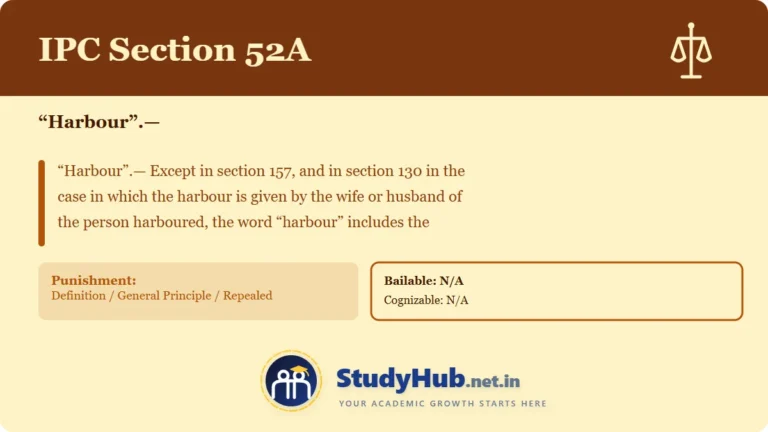
“Harbour”.—

Section

52A

Punishment

Definition / General Principle / Repealed

Cognizable

N/A

Bailable

N/A

Compoundable

Non-Compoundable (Refer to CrPC 320 for exceptions)

Trial Court

N/A

Bare Act Text

52A. “Harbour”.— Except in section 157, and in section 130 in the case in which the harbour is given by the wife or husband of the person harboured, the word “harbour” includes the supplying a person with shelter, food, drink, money, clothes, arms, ammunition or means or conveyance, or the assisting a person by any means, whether of the same kind as those enumerated in this section or not, to evade apprehension.
According to the official bare act, this legal offense is defined as: 52A. “Harbour”.— Except in section 157, and in section 130 in the case in which the harbour is given by the wife or husband of the person harboured, the word “harbour” includes the supplying a person with shelter, food, drink, money, clothes, arms, ammunition or means or conveyance, or the assisting a person by any means, whether of the same kind as those enumerated in this section or not, to evade apprehension.
The punishment for this specific offense is outlined under the law as: Definition / General Principle / Repealed
Under the Indian Penal Code, this specific offense is classified as a N/A offense.
The legal status regarding police arrest without a warrant is that this offense isN/A.
Cases pertaining to this specific IPC section are triable by the N/A.
The compoundable nature of this offense, meaning whether the parties can settle it out of court, is classified as: Non-Compoundable (Refer to CrPC 320 for exceptions).

Leave a Comment

Scroll to Top