Indian Penal Code, 1860

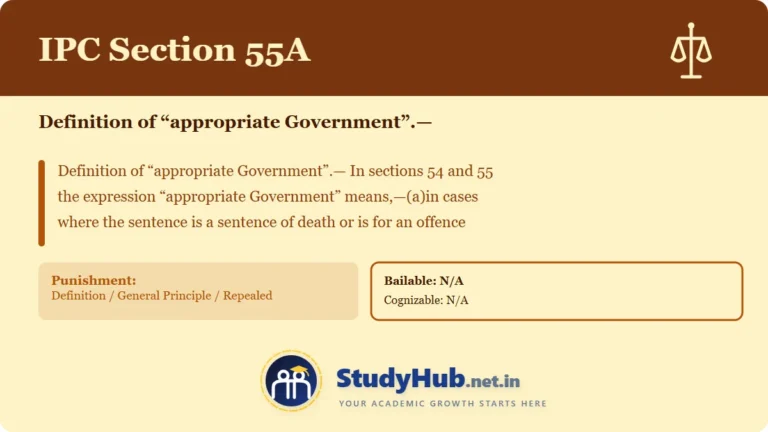
Definition of “appropriate Government”.—

Section

55A

Punishment

Definition / General Principle / Repealed

Cognizable

N/A

Bailable

N/A

Compoundable

Non-Compoundable (Refer to CrPC 320 for exceptions)

Trial Court

N/A

Bare Act Text

55A. Definition of “appropriate Government”.— In sections 54 and 55 the expression “appropriate Government” means,—(a)in cases where the sentence is a sentence of death or is for an offence against any law relating to a matter to which the executive power of the Union extends, the Central Government; and(b)in cases where the sentence (whether of death or not) is for an offence against any law relating to a matter to which the executive power of the State extends, the Government of the State within which the offender is sentenced.
According to the official bare act, this legal offense is defined as: 55A. Definition of “appropriate Government”.— In sections 54 and 55 the expression “appropriate Government” means,—(a)in cases where the sentence is a sentence of death or is for an offence against any law relating to a matter to which the executive power of the Union extends, the Central Government; and(b)in cases where the sentence (whether of death or not) is for an offence against any law relating to a matter to which the executive power of the State extends, the Government of the State within which the offender is sentenced.
The punishment for this specific offense is outlined under the law as: Definition / General Principle / Repealed
Under the Indian Penal Code, this specific offense is classified as a N/A offense.
The legal status regarding police arrest without a warrant is that this offense isN/A.
Cases pertaining to this specific IPC section are triable by the N/A.
The compoundable nature of this offense, meaning whether the parties can settle it out of court, is classified as: Non-Compoundable (Refer to CrPC 320 for exceptions).

Leave a Comment

Scroll to Top