Indian Penal Code, 1860

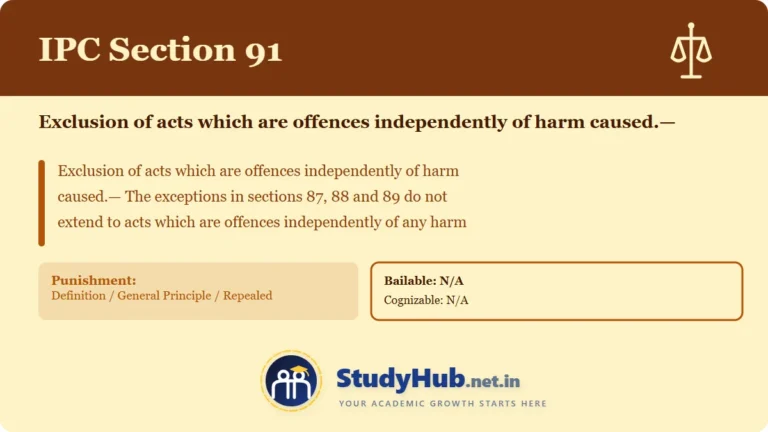
Exclusion of acts which are offences independently of harm caused.—

Section

91

Punishment

Definition / General Principle / Repealed

Cognizable

N/A

Bailable

N/A

Compoundable

Non-Compoundable (Refer to CrPC 320 for exceptions)

Trial Court

N/A

Bare Act Text

91. Exclusion of acts which are offences independently of harm caused.— The exceptions in sections 87, 88 and 89 do not extend to acts which are offences independently of any harm which they may cause, or be intended to cause, or be known to be likely to cause, to the person giving the consent, or on whose behalf the consent is given.IllustrationCausing miscarriage (unless caused in good faith for the purpose of saving the life of the woman) is an offence independently of any harm which it may cause or be intended to cause to the woman. Therefore, it is not an offence “by reason of such harm”; and the consent of the woman or of her guardian to the causing of such miscarriage does not justify the act.
According to the official bare act, this legal offense is defined as: 91. Exclusion of acts which are offences independently of harm caused.— The exceptions in sections 87, 88 and 89 do not extend to acts which are offences independently of any harm which they may cause, or be intended to cause, or be known to be likely to cause, to the person giving the consent, or on whose behalf the consent is given.IllustrationCausing miscarriage (unless caused in good faith for the purpose of saving the life of the woman) is an offence independently of any harm which it may cause or be intended to cause to the woman. Therefore, it is not an offence “by reason of such harm”; and the consent of the woman or of her guardian to the causing of such miscarriage does not justify the act.
The punishment for this specific offense is outlined under the law as: Definition / General Principle / Repealed
Under the Indian Penal Code, this specific offense is classified as a N/A offense.
The legal status regarding police arrest without a warrant is that this offense isN/A.
Cases pertaining to this specific IPC section are triable by the N/A.
The compoundable nature of this offense, meaning whether the parties can settle it out of court, is classified as: Non-Compoundable (Refer to CrPC 320 for exceptions).

Leave a Comment

Scroll to Top