Last Updated: March 2026 | Reading Time: 9 minutes | ~2,100 words
Endometriosis — the condition where endometrial-like tissue grows outside the uterus (on ovaries, fallopian tubes, pelvic peritoneum, bowel, bladder) — is one of the most common yet chronically under-diagnosed conditions in Indian gynaecology. Affecting an estimated 10–15% of women of reproductive age in India (25–40 million women), endometriosis causes severe dysmenorrhoea (painful periods), chronic pelvic pain, dyspareunia, and in 30–50% of affected women, subfertility or infertility. The average diagnostic delay in India is 6–11 years — a scandalously long period during which women are repeatedly told their pain is “normal,” dismissed as psychosomatic, or treated symptomatically without definitive investigation. Adenomyosis — the related condition where endometrial glands invade the uterine myometrium — frequently co-exists (30–50% of endometriosis patients have adenomyosis) and amplifies pain and heavy menstrual bleeding. Understanding endometriosis is critical for all Indian women with dysmenorrhoea that impairs daily function, and for every clinician who sees them.
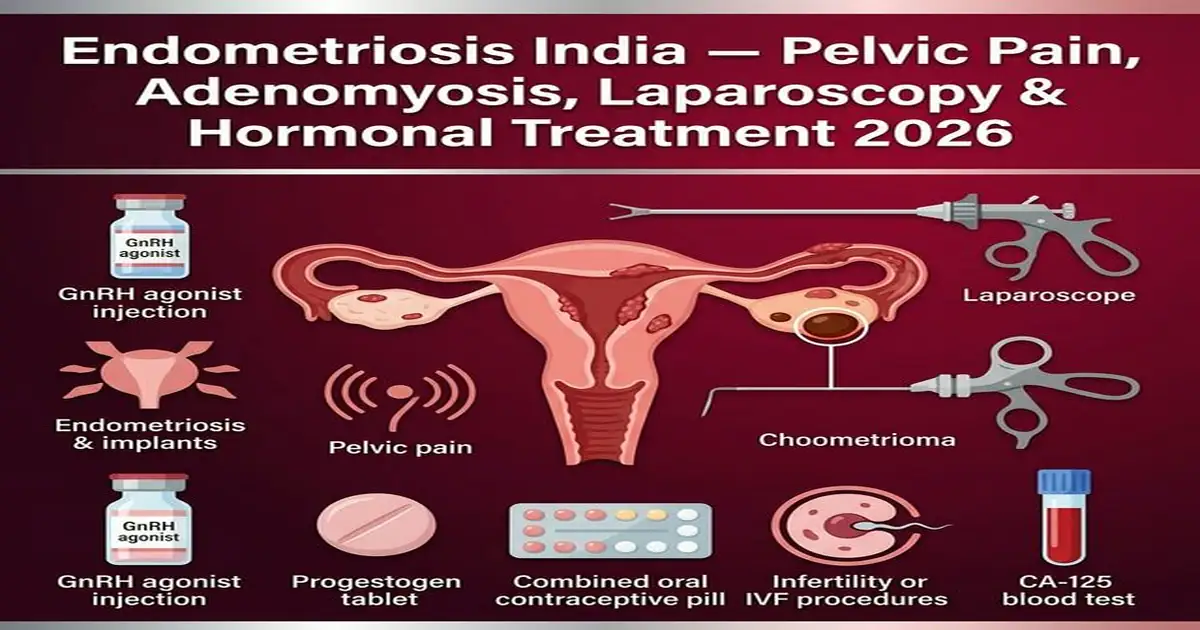
Endometriosis — Staging, Diagnosis and Treatment Options
| Aspect | Details | India-Specific Notes |
|---|---|---|
| ASRM Staging (I–IV) | Stage I (Minimal): superficial peritoneal implants only; Stage II (Mild): deeper implants + few endometriomas; Stage III (Moderate): multiple endometriomas + adhesions; Stage IV (Severe): large endometriomas + dense adhesions + distorted anatomy; staging by laparoscopy — does NOT correlate well with pain severity (Stage I can cause severe pain; Stage IV may be asymptomatic) | Most Indian patients are diagnosed at Stage III–IV due to diagnostic delay (6–11 years); Stage I–II endometriosis contributes to adolescent dysmenorrhoea — rarely investigated at this stage in India; a young woman with severe dysmenorrhoea unresponsive to NSAIDs should be assumed to have endometriosis until proven otherwise |
| Diagnosis — gold standard | Laparoscopy with biopsy: only definitive diagnosis; visualise implants, endometriomas, adhesions; take biopsy for histological confirmation (endometrial glands + stroma outside uterus); non-invasive diagnosis: transvaginal ultrasound (TVS) — highly sensitive and specific for: ovarian endometrioma (chocolate cyst — classic ground-glass appearance); deep infiltrating endometriosis (DIE — bladder, rectovaginal); MRI (better than TVS for deep DIE — rectovaginal, bowel endometriosis); CA-125: elevated in advanced endometriosis but NOT diagnostic (poor specificity — elevated in ovarian cancer, inflammatory conditions); not recommended as standalone diagnostic test | A negative pelvic ultrasound does NOT exclude endometriosis (superficial peritoneal disease not visible on USS); most Indian private clinics stop at “USS normal” — and dismiss patient; clinical suspicion + persistent dysmenorrhoea unresponsive to NSAIDs = refer for gynaecology + laparoscopy; skilled endometriosis laparoscopy (non-expert laparoscopy may miss subtle lesions) available at major centres: AIIMS Delhi, CMC Vellore, Lilavati Mumbai, Fortis |
| Hormonal treatment — first-line for pain | Combined oral contraceptive pill (COCP): continuous (no pill-free week) suppresses menstruation → reduces cyclical pain; effective for superficial endometriosis; Progestogens: medroxyprogesterone acetate 10–20mg/day; norethisterone 5mg/day; dienogest 2mg/day (best evidence — VISANNE — superior to other progestogens; reduces endometrioma progression); levonorgestrel IUS (Mirena) — excellent for pain + allows fertility when desired (removed for conception); GnRH agonists (goserelin, leuprorelin, triptorelin): highly effective — create medical menopause (oestrogen suppression → endometriosis regression); add-back oestrogen (tibolone or low-dose HRT) to prevent menopausal side effects and bone loss; use for 3–6 months; GnRH antagonists (elagolix, relugolix): oral — faster onset/offset; avoid GnRH agonist flare; India: limited availability currently | India: dienogest (Visanne, Dienogest brand) increasingly available at tertiary centres and urban gynaecologists; ₹800–1,500/month (more expensive than COCP); superior evidence for endometriosis pain vs other progestogens; Mirena IUS (LNG-IUS): ₹15,000–20,000 insertion (5-year device) — cost-effective long-term; GnRH agonist (goserelin implant — Zoladex): ₹3,000–5,000/monthly implant; generic leuprorelin ₹2,000–4,000/injection; add-back oestrogen essential if GnRH agonist >3 months |
| Surgical treatment | Laparoscopic surgical excision/ablation: removes endometriotic lesions, endometriomas, divides adhesions; removes 70–80% of deep infiltrating endometriosis (DIE); significantly reduces pain (NRS score reduces 4–5 points); improves fertility — surgical treatment of endometrioma before IVF improves retrieval; conservative surgery (uterus/ovaries preserved) for women wishing fertility; radical surgery (hysterectomy ± bilateral oophorectomy): last resort for severe refractory adenomyosis/endometriosis when family complete; post-surgical recurrence rate: 20–40% at 5 years without post-operative hormonal suppression → add post-surgical dienogest/COCP to suppress recurrence | Endometriosis excision surgery (deep DIE) requires specialist laparoscopic skill — not available at all hospitals; India referral centres: AIIMS New Delhi (Dr Nutan Agarwal team), Lilavati Hospital Mumbai, Apollo Chennai, Cloudnine Bengaluru; Da Vinci robotic surgery for complex DIE: available at major private centres; Endometrioma drainage + ethanol sclerotherapy: alternative to surgery for isolated endometrioma; post-surgical dienogest dramatically reduces recurrence |
| Endometriosis and infertility | Mechanism: endometriosis impairs fertility via: ovarian reserve damage from endometrioma; pelvic adhesions distorting tubal anatomy; inflammatory peritoneal environment toxic to oocytes/embryos; impaired endometrial receptivity; Management: Stage I–II: laparoscopic treatment improves spontaneous conception (ESHRE: surgery doubles pregnancy rate in minimal/mild endo); Stage III–IV: IVF preferred over further surgery (additional surgery risks ovarian reserve); GnRH agonist downregulation before IVF improves outcomes in endometriosis; oocyte freezing (fertility preservation) before planned surgery or GnRH agonist in young women with endometrioma | IVF in India for endometriosis: major centres (Nova IVF, Milann, Nova Southend) experienced in endometriosis-associated infertility; PMJAY does not cover IVF; private IVF cycle ₹1.5–2.5 lakh; cumulative live birth rate Endo Stage III–IV: 35–45% per IVF cycle age <35; anti-Müllerian hormone (AMH) must be measured before any ovarian surgery for endometrioma (baseline reserve assessment — surgery damages ovarian cortex → reduces AMH) |
Frequently Asked Questions
Why is period pain being dismissed in India — and when is dysmenorrhoea “not normal”?
The normalisation of severe menstrual pain in India — “periods are supposed to be painful,” “my mother and grandmother also had this pain, it is family” — is one of the most damaging cultural narratives in Indian women’s health, enabling 6–11 year diagnostic delays in endometriosis: Primary vs secondary dysmenorrhoea: Primary dysmenorrhoea: painful periods with NO underlying pelvic pathology; caused by prostaglandin-driven uterine contractions; begins within 1–3 years of menarche (first period); typically crampy lower abdominal pain — first 1–2 days of period; manageable with NSAIDs (ibuprofen/mefenamic acid/naproxen); secondary dysmenorrhoea: painful periods WITH underlying pelvic pathology (endometriosis in 70–90% of cases; adenomyosis; pelvic inflammatory disease; fibroids); worsens progressively — pain used to be manageable, now severe and disabling; pain may begin days before period (pre-menstrual pelvic pain → hallmark of endometriosis); extends beyond days 1–2; non-menstrual pelvic pain, dyspareunia, dyschezia (painful defaecation — suggests rectovaginal endometriosis); does NOT fully respond to standard NSAIDs. Red flags — endometriosis more likely: Dysmenorrhoea requiring absence from school/work/daily activities (pain ≥ moderate WSAS impairment); dysmenorrhoea worsening progressively over time (NOT stable mild pain); pain beginning >2 days before period; pelvic pain between periods; dyspareunia (painful sex — particularly deep penetration); dyschezia (painful opening bowels during period); bleeding from rectum or bladder at period; dysmenorrhoea that does NOT adequately respond to NSAIDs + COCP; sister or mother with confirmed endometriosis (strong genetic risk — 7–10× higher risk). What Indian women should do: Severe dysmenorrhoea impairing daily function = seek gynaecology review, NOT just more NSAIDs from pharmacy; COCP given empirically for suspected endometriosis (if pain improves → supports diagnosis; if pain uncontrolled → laparoscopy referral); pain diary (record pattern, severity, timing) before gynaecology appointment; advocate for laparoscopy if clinical suspicion high and TVS normal; do not accept “USS normal = nothing wrong” as a complete answer for severe secondary dysmenorrhoea.
What is adenomyosis — and how is it different from endometriosis?
Adenomyosis — endometrial glands and stroma invading the uterine myometrium (muscle wall) — is a closely related but distinct condition from endometriosis, increasingly recognised as a major contributor to heavy menstrual bleeding (HMB) and pelvic pain in Indian women: How adenomyosis differs from endometriosis: Location: adenomyosis is WITHIN the uterine wall (myometrium); endometriosis is OUTSIDE the uterus (ovaries, peritoneum, bowel); adenomyosis causes HMB (heavy periods — due to enlarged uterus with poor contractility → less effective haemostasis) + dysmenorrhoea; endometriosis primarily causes pelvic pain ± infertility ± endometrioma; 30–50% of endometriosis patients have adenomyosis concurrently; adenomyosis prevalence: 20–35% of women; typical patient profile: multipara, 35–50 years (historically — now recognised increasingly in nulliparous younger women); diagnosis: MRI gold standard (junctional zone thickness >12mm on T2W; adenomyotic “islands”); transvaginal ultrasound: enlarged globular uterus, “venetian blind” pattern, myometrial cysts (skilled sonologist required). Treatment of adenomyosis — hormone suppression: Progestogens: dienogest 2mg/day (first-line — reduces adenomyosis volume and pain); medroxyprogesterone acetate; Levonorgestrel IUS (Mirena): highly effective for HMB from adenomyosis; reduces periods by 80–90%; reduces pain; first-line where fertility not immediately needed; GnRH agonist (goserelin/leuprorelin): temporary shrinkage; used before surgery or IVF; COCP: continuous; NSAIDs (mefenamic acid) for acute pain; Surgical: UAE (uterine artery embolisation) — for adenomyosis with HMB in women who have completed fertility; adenomyomectomy (surgical excision of adenomyotic focus — specialised procedure); hysterectomy: definitive cure for adenomyosis — for women with complete family. Adenomyosis and fertility India: Adenomyosis significantly impairs endometrial receptivity → reduces implantation rates in both natural conception and IVF; pre-IVF GnRH agonist downregulation (3–6 months) strongly recommended for adenomyosis before IVF; significant improvement in IVF outcomes post-GnRH agonist suppression; AMH checks before GnRH agonist (extended GnRH agonist may temporarily suppress AMH — rebounds after stopping).
What to Read Next
- IVF & Infertility — Endometriosis Stage III–IV: IVF Superior to Repeat Surgery; GnRH Agonist Downregulation Improves IVF Outcomes
- PCOS — PCOS and Endometriosis Can Coexist; Both Cause Cycle Irregularity and Subfertility but Very Different Mechanisms
- High-Risk Pregnancy — Adenomyosis in Pregnancy: Risk of Miscarriage, Preterm Birth and Ectopic; Monitor Closely with Specialist Team
- Menopause — Endometriosis and POI: Bilateral Oophorectomy for Severe Endo Causes Surgical Menopause; HRT Needed
- Iron Deficiency — Heavy Menstrual Bleeding from Adenomyosis Causes Severe Iron Deficiency Anaemia; Treat Both Simultaneously
A 28-year-old woman in Chennai has been warned she needs a hysterectomy by the third gynaecologist she has seen. She has had severe, disabling period pain since age 16. She has never been able to work on days 1–3 of her period. She has been prescribed painkiller after painkiller, told her pain is psychological, told it is “just her uterus”. She has Stage IV endometriosis with bilateral endometriomas. Twelve years of pain. Twelve years before anyone looked. Laparoscopic excision by a skilled endometriosis surgeon + post-operative dienogest would have controlled her disease at 18. At 28, she is facing dramatically compromised fertility and complex surgery. The delay was not inevitable. It was a failure to listen.
About This Guide: Written by the StudyHub Health Editorial Team (studyhub.net.in) based on ESHRE Endometriosis Guidelines 2022, ACOG Practice Bulletin on Endometriosis 2022, Indian Society of Reproductive Medicine (ISRM) recommendations, and FOGSI guidelines. Last updated: March 2026.
🚨 Severe Period Pain Is NOT Normal: Dysmenorrhoea that stops you going to school, college, or work — or worsens every cycle — is NOT normal and is NOT something you must “just endure.” This is a medical symptom requiring investigation. Seek a gynaecology opinion. Push for a laparoscopy if the ultrasound is normal but pain is severe. Endometriosis cannot wait 6–11 years.
💊 Post-Surgery Suppression is Mandatory: After laparoscopic excision of endometriosis, immediately start dienogest 2mg/day or COCP continuously to suppress recurrence. Without post-operative hormonal suppression, endometriosis recurs in 20–40% within 5 years. Surgery alone is not sufficient — it is excision plus suppression.
⚕️ Medical Disclaimer: This article provides general educational information about endometriosis and adenomyosis. Diagnosis requires gynaecological assessment and in most cases laparoscopy. Infertility management and surgical decisions require specialist reproductive gynaecology input.