Last Updated: March 2026 | Reading Time: 9 minutes | ~2,100 words
Hepatitis B virus (HBV) infection is one of India’s most widespread and silently deadly chronic diseases — India has approximately 40 million people living with chronic Hepatitis B (CHB), making it the world’s second-largest pool of HBV carriers after China. Despite the existence of a safe, effective, and affordable vaccine and highly effective antiviral treatments, Hepatitis B continues to cause enormous harm in India: approximately 115,000–120,000 Indians die annually from HBV-related complications — predominantly from liver cirrhosis and hepatocellular carcinoma (HCC — primary liver cancer). India’s prevalence of HBV surface antigen (HBsAg) positivity is approximately 2–4% of the general population (intermediate endemicity), with higher prevalence in tribal communities (4–8%), injecting drug users (30–50%), and healthcare workers (pre-vaccination). The majority — estimated 70–80% — of India’s chronically infected individuals are unaware of their infection, as CHB is typically asymptomatic for decades while progressive liver damage accumulates silently. HBV is predominantly transmitted in India through perinatal (mother-to-child — vertical) transmission (the primary driver of chronic infection establishing), unsafe injection practices (street injections, multi-dose insulin vials, tattooing), and sexual transmission. India’s Universal Immunisation Programme (UIP) introduced HBV vaccine in 2002 (at birth + 6 weeks + 10 weeks + 14 weeks — 3-dose schedule + birth dose for PMTCT), and has dramatically reduced new paediatric infections — but the enormous existing reservoir of chronically infected adults will continue to drive HCC deaths for decades.
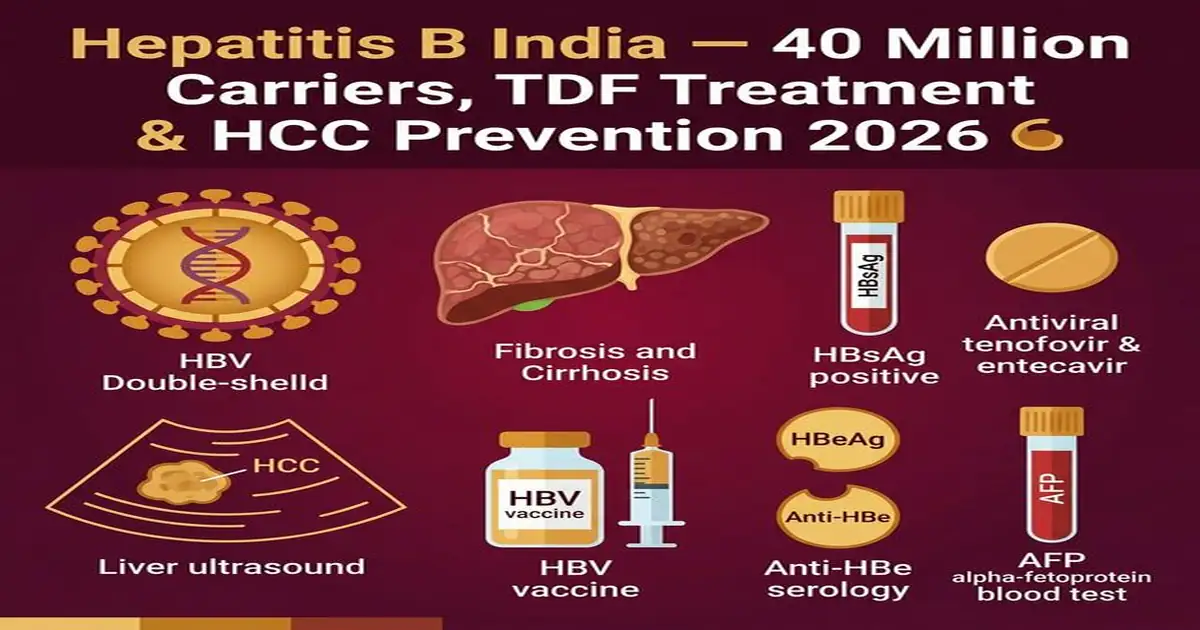
Hepatitis B — Serology, Disease Phases and Treatment Framework
| Phase / Marker | Serology Pattern | HBV DNA / ALT | Treatment Decision | India Notes |
|---|---|---|---|---|
| Immune Tolerant Phase (HBeAg-positive chronic infection) | HBsAg+; HBeAg+; anti-HBe–; anti-HBs– | HBV DNA very high (>1 million IU/mL — often >10^8 IU/mL); ALT NORMAL (immune tolerance — no inflammatory activity); liver biopsy: minimal fibrosis | Generally NO treatment in immune tolerant phase (WHO/AASLD/EASL guidelines); immune system not attacking hepatocytes → minimal liver damage ongoing; treatment in immune tolerant phase: no evidence of benefit + risk of resistance; EXCEPTION: consider treatment if HBV DNA >200,000 IU/mL in pregnant woman (third trimester TDF to prevent PMTCT); regular monitoring: ALT every 6–12 months; transition to immune active phase may occur any time | Most perinatally-infected Indian HBV carriers (from HBeAg+ mothers) go through prolonged immune tolerant phase (may last 20–30 years); appears “healthy” with normal LFTs → false reassurance; education essential: even with normal ALT → remain HBsAg positive, infectious to others, at risk of HCC in future; birth dose vaccination + HBIG (for infants of HBeAg+ mothers) prevents perinatal transmission |
| Immune Active Phase (HBeAg-positive CHB with hepatitis) | HBsAg+; HBeAg+; anti-HBe–; anti-HBs–; anti-HBc IgG+ | HBV DNA high (>20,000 IU/mL); ALT ELEVATED (>2× ULN) — immune-mediated hepatocyte damage active; liver biopsy: significant inflammation + fibrosis (F2–F4) | TREAT: antiviral therapy indicated; First-line agents (WHO/EASL 2023): Tenofovir disoproxil fumarate (TDF) 300mg once daily — most widely used; Tenofovir alafenamide (TAF) 25mg once daily — less renal/bone toxicity, preferred in renal dysfunction (creatinine clearance <60); Entecavir 0.5mg once daily (1mg if prior lamivudine-resistant); Duration: long-term (often lifelong) — achieve HBsAg loss or HBeAg seroconversion; HBsAg loss = functional cure (rare — 1–3%/year); HBeAg seroconversion + HBV DNA suppression: treatment endpoint for some; avoid interferon alfa in decompensated cirrhosis (causes acute decompensation) | TDF generic (Tenofovir): widely available India at ₹150–300/month (generic = same efficacy as branded Viread ₹3,000+/month → massive affordability advantage); Entecavir generic: ₹200–400/month; TAF: ₹2,000–4,000/month (limited generic availability India); NVHCP (National Viral Hepatitis Control Programme — 2018): provides free TDF + entecavir through government facilities at district/CHC/PHC level in many states; MOHAN-B India foundation: patient assistance programmes for HBV/HCV |
| Inactive Carrier / Immune Control Phase (HBeAg-negative) | HBsAg+; HBeAg–; anti-HBe+; anti-HBs–; anti-HBc IgG+ | HBV DNA LOW (<2,000 IU/mL) or undetectable; ALT NORMAL; liver biopsy: minimal fibrosis | NO antiviral treatment (inactive carrier — low replication, minimal liver damage); MONITORING mandatory — ALT every 6 months + HBV DNA yearly + AFP + liver USS every 6 months (HCC surveillance — even inactive carriers have baseline HCC risk, particularly males >40 with cirrhosis); Reactivation risk: HBsAg+ inactive carriers can reactivate if immunosuppressed (corticosteroids, chemotherapy, biologics, TNF-α inhibitors, rituximab → HBV reactivation can be fatal); Prophylactic antiviral (TDF/entecavir) MANDATORY before ALL immunosuppressive therapy in HBsAg+ patients — 4 weeks before, continue 12 months after | India problem: many HBsAg+ patients labelled “HBV carrier — no treatment needed” are never enrolled in HCC surveillance → present with advanced HCC; HCC surveillance critical even in “inactive” HBsAg+ patients — particularly males, age >40, family history of HCC, cirrhosis; reactivation with corticosteroids (commonly used in India for many conditions — asthma, nephrotic syndrome, RA) is a major clinical risk in undetected HBsAg+ patients; all patients starting steroids should have HBsAg screening first |
| HBeAg-negative CHB (Active — Mutant Strain) | HBsAg+; HBeAg–; anti-HBe+; anti-HBs– | HBV DNA ELEVATED (>2,000 IU/mL); ALT ELEVATED (>2× ULN); pre-core/basal core promoter mutation in HBV — virus cannot produce HBeAg but replicates actively; this form is more difficult to treat as HBeAg seroconversion cannot be used as treatment endpoint | TREAT with TDF or entecavir — same as HBeAg+ active phase; treatment endpoint: HBV DNA suppression to undetectable + ALT normalisation; HBsAg loss (functional cure) remains goal; long-term therapy usually required; regular HCC surveillance + liver stiffness monitoring (FibroScan); HBeAg-negative CHB has higher risk of progression to cirrhosis and HCC than HBeAg+ phase | HBeAg-negative CHB common in India — particularly in adult males; higher propensity to develop cirrhosis + HCC even with apparent HBeAg-negativity; easily missed as HBeAg test is negative (appears “resolved”) but HBV DNA + elevated ALT reveals active disease; HBV DNA testing essential — cannot rely on HBeAg alone to determine disease activity in India |
| Hepatocellular Carcinoma (HCC) — HBV-related Prevention & Surveillance | HBsAg+ (active or inactive); particularly: male sex; age >40; cirrhosis (Child-Pugh B/C); family history of HCC; alcohol + HBV co-exposure; HCV + HBV co-infection; high HBV DNA; core promoter mutations; HBsAg quantification high (>1000 IU/mL) | AFP (alpha-fetoprotein): HCC screening marker; AFP >200 ng/mL + liver mass = highly suspicious HCC; AFP can be normal in early HCC (20–30% of HCC AFP-normal — USS essential); AFP-L3 fraction and PIVKA-II: more sensitive markers at AIIMS/tertiary India | HCC surveillance: liver USS + AFP every 6 months (WHO/EASL recommendation — all CHB patients); FibroScan (transient elastography): non-invasive liver fibrosis staging (F0–F4) — widely available India private (₹2,000–4,000); kPa values: F0-1 <7, F2 7-9.5, F3 9.6-12.4, F4 (cirrhosis) >12.5; antiviral therapy reduces HCC risk 50–70% in CHB patients (landmark studies — Liaw 2004, Chang 2004 — entecavir/TDF); HCC treatment: surgical resection (solitary small HCC <2cm — curative); TACE (trans-arterial chemoembolisation — intermediate HCC); sorafenib (advanced HCC — molecular targeted therapy); atezolizumab + bevacizumab (IMbrave150 — 1st-line advanced HCC — OS 19.2 vs 13.4 months); India HCC survival: 5-year OS <15% due to late presentation (60–70% present at BCLC Stage C/D) | AIIMS, Tata Memorial, PGIMER Chandigarh: major HCC referral centres India; sorafenib generic: ₹8,000–15,000/month vs ₹50,000 branded; atezolizumab + bevacizumab: ₹1,00,000+/cycle — limited access; free NVHCP antiviral therapy (TDF) prevents progression to HCC — most impactful India intervention for HCC prevention is treating CHB before cirrhosis develops; NVHCP by 2025: tested 1.5 crore Indians for HBV/HCV; treated 6+ lakh patients with free antivirals |
Frequently Asked Questions
If I test HBsAg positive in India — what do I do next, and do I need treatment?
A positive HBsAg test is one of the most life-changing — and most commonly mishandled — laboratory findings in Indian clinical practice. The correct response is neither panic nor dismissal: Step 1 — Confirm and understand what HBsAg+ means: HBsAg (Hepatitis B surface antigen) = HBV protein present on the surface of the hepatitis B virus; a positive test means you are infected with HBV; confirms current (not past) infection; persistence beyond 6 months = chronic HBV infection (CHB); if newly positive: repeat at 6 months (acute vs chronic determination); acute HBV (most adults who get infected clear the virus within 6 months — >95% of immunocompetent adults); chronic HBV: fails to clear → HBsAg+ >6 months → CHB (more common from perinatal acquisition — 90% become chronic if infected at birth vs 5% if infected as adult). Step 2 — Comprehensive HBV workup (what you need AFTER HBsAg+): HBeAg and anti-HBe (replication markers — determines immune phase); HBV DNA (viral load — quantitative PCR — essential for treatment decision; most important single test after HBsAg+); anti-HBc IgM (recent acute infection) vs IgG (remote infection/CHB); anti-HBs (surface antibody — if positive = immunity from vaccination or recovery; if negative = no immunity); LFTs — ALT/AST (inflammation); bilirubin; GGT; liver USS (fibrosis, cirrhosis, HCC signs); FibroScan (non-invasive fibrosis staging — superior to liver biopsy for staging in most patients): cost ₹2,000–4,000 private; AIIMS/government hepatology free; coinfection screening: anti-HCV; HIV screening (HBV + HIV coinfection requires special management — TDF-based combo ART treats both); AFP baseline (HCC marker). Who needs treatment — the decision algorithm: Treat if ANY of: ALT >2× ULN + HBV DNA >2,000 IU/mL (HBeAg+ or negative); FibroScan ≥F2 (significant fibrosis) regardless of ALT; cirrhosis (any phase — any HBV DNA level → treat to suppress to reduce HCC risk); HBV DNA >20,000 IU/mL + HBeAg+ with normal ALT in older patient (>30) — individualise; family history of HCC + any HBV replication; immunosuppression planned (steroids/chemo/biologics — treat regardless of ALT/DNA); pregnancy (3rd trimester — HBV DNA >200,000 IU/mL → TDF to prevent perinatal transmission); Do NOT treat: inactive carrier (HBsAg+; HBeAg–; HBV DNA <2000; normal ALT; minimal fibrosis) — monitor every 6 months. Treatment in India — what to expect on TDF: TDF (Tenofovir DF 300mg) once daily with food; suppresses HBV DNA to undetectable in 90%+ patients at 12 months; does NOT cure HBV (HBsAg does not disappear in most — “functional cure” rare); prevents cirrhosis progression and HCC development; well-tolerated; monitor creatinine + phosphate (TDF can cause Fanconi syndrome — proximal tubular toxicity in rare cases → switch to TAF or entecavir if renal impairment); free under NVHCP at government hepatology/ID clinics; do NOT stop TDF without consultation (stopping causes rebound hepatitis — can be fatal in cirrhosis); duration: typically lifelong.
How does HBV vaccination work in India — and what should unvaccinated adults do?
HBV vaccination is one of medicine’s greatest success stories — a vaccine that prevents liver cancer. India’s experience with it spans a complex rollout history with major remaining gaps in adult immunity: India’s HBV vaccination timeline: 2002: HBV vaccine added to Universal Immunisation Programme (UIP) in select states; 2011: National roll-out (all states); current UIP schedule — 4 doses: Birth dose (within 24 hours of birth — critical for PMTCT prevention, as even birth dose alone reduces perinatal transmission by 70–95% without HBIG); 6 weeks (DPT-HBV pentavalent vaccine — Penta 1); 10 weeks (Penta 2); 14 weeks (Penta 3); birth dose coverage India: improved from 30–40% (2012) to 75–80% (2023–24) — still leaving 20–25% of births unprotected from perinatal transmission; target: >95% birth dose coverage by 2030. What unvaccinated adults should do: Adults born before 1990 in India (before vaccine introduction): likely unvaccinated → HBsAg test first; if HBsAg negative + anti-HBs negative → vaccinate (3-dose: 0, 1, 6 months); if already HBsAg positive → do NOT vaccinate (no benefit + won’t clear infection); if anti-HBs positive (>10 mIU/mL) → already immune (from prior infection or vaccination — no booster needed unless immunocompromised); high-risk adults needing priority vaccination: healthcare workers (HBV vaccination mandatory India — OSHA notification; needle-stick injury risk); sexual contacts of HBsAg+ persons; injecting drug users; renal dialysis patients (3–4× standard dose — accelerated schedule + titer check post-vaccination — dialysis patients respond poorly); HIV positive (vaccinate early when CD4 >200); immigrants from HBV-endemic countries. HBV vaccine immunogenicity and monitoring: Standard 3-dose schedule (Recombivax/Engerix B — recombinant HBsAg): anti-HBs >10 mIU/mL in 90–95% of adults; lower response in: obesity, smokers, immunocompromised, elderly, males; post-vaccination anti-HBs titer check (1–2 months after 3rd dose): only recommended for healthcare workers, dialysis, immunocompromised; if non-responder (<10 mIU/mL): repeat 3-dose series → check titer; double-dose schedule considered for obese/immunocompromised; immune memory: anti-HBs titre may fall below 10 mIU/mL over years but anamnestic response intact → no routine booster needed in immunocompetent individuals; immunocompromised: annual titer monitoring + booster when <10. HBIG (Hepatitis B Immunoglobulin) for perinatal transmission prevention: HBIG given to newborns of HBeAg+ mothers at birth (within 12 hours) + birth dose HBV vaccine → reduces perinatal transmission risk from 70–90% to <5%; HBIG available India: ₹1,500–3,000/vial at government hospitals under NVHCP; TDF in 3rd trimester (from 28 weeks) if HBV DNA >200,000 IU/mL → further reduces perinatal transmission risk; India challenge: many rural births still occur without HBsAg screening of mother → missed PMTCT opportunity.
What to Read Next
- Liver Cirrhosis — HBV-Related Cirrhosis: TDF Prevents Progression; Child-Pugh/MELD Scoring; Varices Screening Essential in All HBsAg+ Cirrhosis
- Fatty Liver — NAFLD + HBV Coinfection: Synergistic HCC Risk; Weight Loss + TDF; FibroScan Monitoring for Both
- Diabetes — Diabetic Patients Have Higher HBV Reactivation Risk on Steroids; Screen HBsAg Before Immunosuppression; SGLT2i Liver Safety in HBV
- Cancer Awareness — HBV Vaccine = World’s First Liver Cancer Vaccine; HCC Prevention by Treating CHB; AFP Surveillance Every 6 Months
- Diarrhoea — Unsafe Injection = HBV Transmission Route; Avoid Multi-Use Vials; Safe Needle Practice Prevents Both HBV and HIV
A 45-year-old truck driver from Punjab attends a routine medical camp. HBsAg: positive. He has had it for decades — since birth, most likely. He has never been tested. His ALT is 2.5× upper normal limit. HBV DNA is 250,000 IU/mL. FibroScan: 11 kPa (F3 — advanced fibrosis). He starts TDF 300mg once daily — free at the district civil hospital under NVHCP, ₹0 to him. At 12 months, HBV DNA is undetectable. ALT is normal. At 2 years, FibroScan: 8.2 kPa (regression). His risk of progressing to HCC has been cut by 65%. His family is screened: his wife is HBsAg-negative and anti-HBs-negative — she is vaccinated. His 18-year-old son is HBsAg-positive — he was born before the birth dose era. He too starts monitoring. Forty million Indians like him. Most of them unaware. The medicine is free. The testing is available. Finding them is the challenge.
About This Guide: Written by the StudyHub Health Editorial Team (studyhub.net.in) based on EASL Clinical Practice Guidelines: HBV Management 2023, WHO Hepatitis B Report 2024, India NVHCP Programme Report 2023, and AASLD Hepatitis B Guidance 2023. Last updated: March 2026.
🧪 HBsAg Test is Free — Get Tested If You Have Never Been: If you have never been tested for Hepatitis B — especially if born before 1990, have had unsafe injections, or have a family member with HBV — ask for a free HBsAg test at any government hospital or NVHCP centre. If positive: get HBV DNA, HBeAg, and LFT tests done. Free TDF treatment is available at government hepatology clinics under NVHCP.
💉 Get Vaccinated If HBsAg Negative and Unvaccinated: HBV vaccine (3 doses — 0, 1, 6 months) is available at government hospitals for adults. It is the world’s only vaccine that prevents cancer (hepatocellular carcinoma). If you are a healthcare worker, it is mandatory. Cost at private: ₹200–400/dose. Free at government health facilities. Test HBsAg first — do not vaccinate if already infected.
⚕️ Medical Disclaimer: This article provides general educational information about Hepatitis B. All treatment decisions (TDF/entecavir initiation, monitoring, HBIG in newborns, HCC surveillance) require qualified hepatologist or gastroenterologist assessment. Do not self-initiate or stop antiviral therapy without medical supervision.