Every earthquake happens along a fault — a fracture or zone of fractures in Earth’s crust where rocks on either side have moved relative to each other. Understanding the types of faults is fundamental to understanding why earthquakes occur where they do, why the Himalayas are rising, why the East African Rift Valley is spreading, and why California’s San Andreas Fault is so dangerous. This complete guide covers all four main fault types with diagrams, examples, and exam-ready notes.
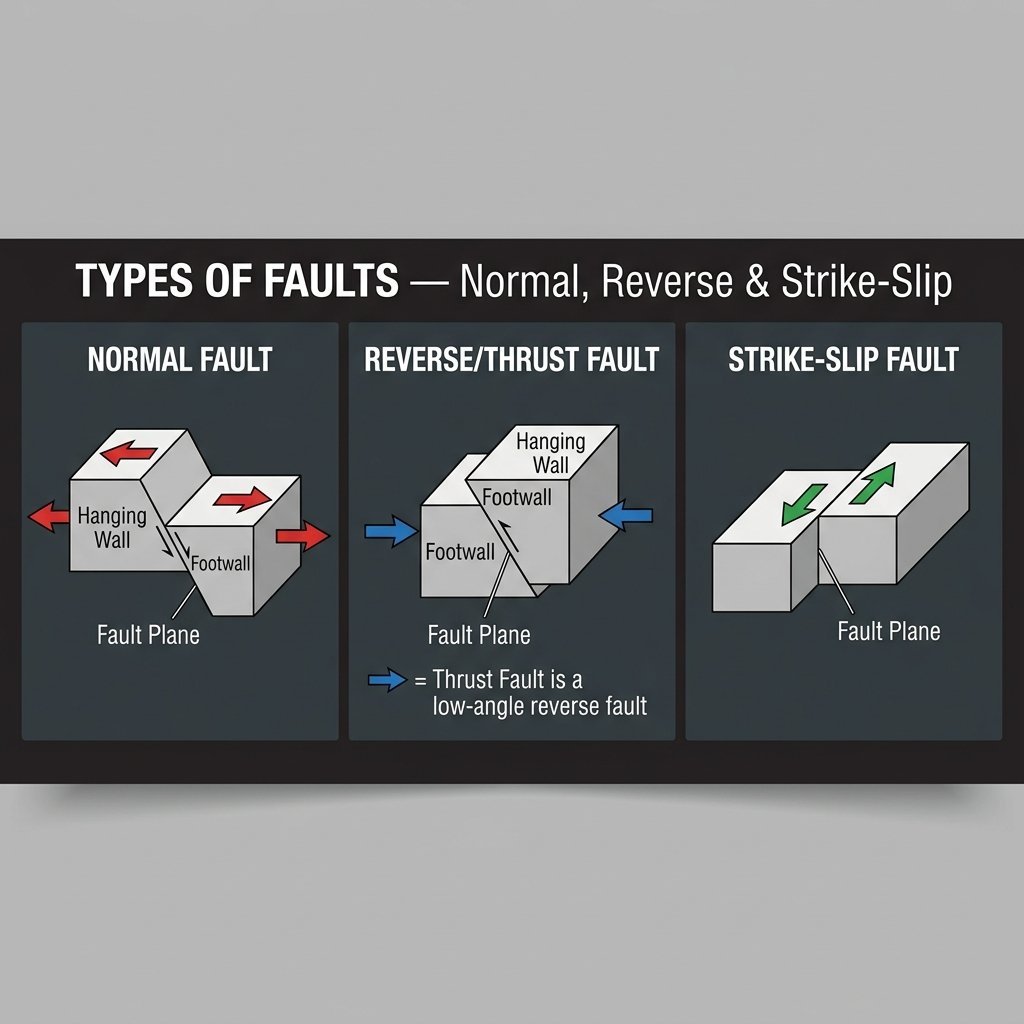
What is a Fault? — Definition
A fault is a planar fracture or discontinuity in a volume of rock, across which there has been significant displacement (movement) as a result of Earth-movement. Faults are caused by tectonic stress accumulating over time until the rock breaks suddenly — releasing seismic energy as an earthquake.
Key Fault Terminology
| Term | Definition |
|---|---|
| Fault Plane | The surface along which the two blocks of rock move relative to each other |
| Hanging Wall | The rock block above the fault plane (the one that “hangs” over the fault) |
| Footwall | The rock block below the fault plane (the one you stand on) |
| Strike | The horizontal direction that the fault plane runs (compass bearing) |
| Dip | The angle of the fault plane from horizontal |
| Slip | The actual displacement along the fault |
| Rake/Pitch | Direction of slip on the fault plane |
| Focus (Hypocentre) | Underground point where rupture starts |
| Epicentre | Point on Earth’s surface directly above the focus |
Types of Faults — The Four Main Categories
Faults are classified based on the direction of relative movement between the two rock blocks and the type of tectonic stress causing them:
1. Normal Fault (Dip-Slip Fault — Extensional)
In a normal fault, the hanging wall moves downward relative to the footwall. This happens when the crust is under tensional (extensional) stress — being pulled apart.
- 📐 Motion: Hanging wall drops DOWN relative to footwall
- ⬅️➡️ Stress type: Tension / Extension — crust being stretched and pulled apart
- 📍 Where found: Divergent plate boundaries, rift zones, continental rifts
- 🔴 Dip angle: Typically 45–90° (steep faults)
Examples of Normal Faults
- 🌍 East African Rift System — Africa is splitting apart along a series of normal faults, creating rift valleys. In millions of years, the Horn of Africa will separate from the continent.
- 🇺🇸 Basin and Range Province, USA — Nevada, Arizona and Utah show block-faulted topography from crustal extension. Mountains (horsts) alternate with valleys (grabens).
- 🇮🇳 Narmada Rift Valley, India — The Narmada River flows through a graben (rift valley) formed by normal faulting between the Vindhya Ranges (north) and Satpura Ranges (south). This is why Narmada flows west — the graben tilts westward.
- 🌋 Mid-Ocean Ridges — Normal faults are common along ridge crests where plates diverge.
🇮🇳 India Connection: The Narmada-Tapti rift valley (central India) is a classic graben formed by two sets of parallel normal faults. This explains why the Narmada and Tapti rivers flow WEST toward the Arabian Sea instead of east like all other peninsular rivers.
2. Reverse Fault (Dip-Slip Fault — Compressional)
In a reverse fault, the hanging wall moves upward relative to the footwall. This is the opposite of a normal fault and happens when the crust is under compressional stress — being squeezed together.
- 📐 Motion: Hanging wall moves UP relative to footwall
- ⬅️⬅️ Stress type: Compression — crust being squeezed and shortened
- 📍 Where found: Convergent plate boundaries, collision zones, subduction zones
- 🔴 Dip angle: Typically 30–60°
- 🏔️ Effect: Causes crustal thickening and mountain building
Examples of Reverse Faults
- 🇮🇳 Main Central Thrust (MCT), India — Major reverse fault/thrust system along which the Greater Himalayas ride up over the Lesser Himalayas. One of India’s most seismically active structures.
- 🇮🇳 2001 Bhuj Earthquake, Gujarat — Caused by movement on blind reverse faults (faults that don’t reach the surface) beneath the Kutch region. M 7.7, ~20,000 deaths.
- 🇮🇳 1993 Latur Earthquake, Maharashtra — Another blind reverse fault on the stable Deccan Plateau. Proved that even “tectonically stable” areas can have active hidden faults.
- 🇯🇵 Japan subduction zone — Megathrust reverse faults where the Pacific Plate subducts under Eurasia caused the 2011 M 9.0 earthquake.
3. Thrust Fault (Low-Angle Reverse Fault)
A thrust fault is a special type of reverse fault with a very gentle dip angle (less than 30°, often 10–20°). Thrust faults allow older rocks to be pushed horizontally over younger rocks for long distances — sometimes tens or hundreds of kilometres.
- 📐 Dip angle: Less than 30° (very shallow, nearly horizontal)
- 🏔️ Key feature: Allows enormous horizontal displacement — older rocks can travel 100+ km over younger rocks
- 🌍 Importance: Major mountain building mechanism — Himalayas, Alps, Rockies all formed partly by thrust faulting
Indian Thrust Fault Systems
| Thrust System | Location | Significance |
|---|---|---|
| Main Central Thrust (MCT) | Greater Himalaya–Lesser Himalaya boundary | Major tectonic boundary; pushed crystalline rocks southward; Zone V seismicity |
| Main Boundary Thrust (MBT) | Lesser Himalaya–Sub-Himalayan boundary | Separates Lesser Himalayas from Siwalik Hills |
| Himalayan Frontal Thrust (HFT) | Siwalik Hills–Indo-Gangetic Plain boundary | Southernmost active thrust; marks leading edge of Himalayan deformation |
These three thrust systems are essentially a stack of giant overthrust sheets — each sheet of rock has been pushed southward over the one below it as the Indian Plate continues to collide with Eurasia at 5 cm/year.
4. Strike-Slip Fault (Lateral Fault — Transform)
In a strike-slip fault, the two rock blocks move horizontally past each other — neither up nor down, but sideways. The movement is parallel to the fault’s strike (direction). These faults are caused by shear stress.
- ↔️ Motion: Horizontal — blocks slide past each other laterally
- 🔀 Stress type: Shear stress — rocks sliding alongside each other
- 📍 Where found: Transform plate boundaries, within plates along major shear zones
- 🔴 Dip angle: Nearly vertical (80–90°)
Right-Lateral vs Left-Lateral Strike-Slip
- Right-lateral (dextral): If you stand on one side of the fault and look across — the other side has moved to the RIGHT. Example: San Andreas Fault, California
- Left-lateral (sinistral): If you stand on one side and look across — the other side has moved to the LEFT. Example: Altyn Tagh Fault, Tibet-China
Famous Strike-Slip Faults
- 🇺🇸 San Andreas Fault, California — 1,300 km long right-lateral transform fault; moves at 2–5 cm/year; caused the 1906 San Francisco earthquake (M 7.9, ~3,000 deaths)
- 🇳🇿 Alpine Fault, New Zealand — Right-lateral; caused 2016 Kaikōura earthquake (M 7.8)
- 🇮🇳 Karakoram Fault, India/Pakistan — Right-lateral; active fault in Ladakh-Karakoram region
- 🌍 North Anatolian Fault, Turkey — Right-lateral; consistently produces M 7+ earthquakes westward along its length (series of 1939, 1942, 1999 earthquakes)
Oblique-Slip Faults
Many real-world faults show combined dip-slip and strike-slip movement — these are called oblique-slip faults. The 2015 Nepal Gorkha earthquake (M 7.8, 9,000 deaths) involved oblique-slip movement on a thrust fault with a lateral component.
Fault Types at Plate Boundaries — Summary
| Plate Boundary | Stress Type | Fault Type | Landform Produced | India Example |
|---|---|---|---|---|
| Divergent | Tension | Normal Fault | Rift valley, graben, horst | Narmada–Tapti Rift |
| Convergent (collision) | Compression | Reverse / Thrust | Mountain ranges, nappes | MCT, MBT, HFT (Himalayas) |
| Convergent (subduction) | Compression | Megathrust | Trenches, island arcs | Andaman Trench |
| Transform | Shear | Strike-Slip | Linear valleys, offset rivers | Karakoram Fault |
Horst and Graben — Block Fault Landforms
Normal faulting in parallel sets creates characteristic block-fault topography:
- 🏔️ Horst: An uplifted block bounded by normal faults on both sides — forms a ridge or plateau. Example: Vindhya Range, Satpura Range (India’s horsts)
- 🏞️ Graben: A down-dropped block between two normal faults — forms a rift valley or low basin. Example: Narmada Valley, Rhine Graben (Germany), Jordan Rift Valley, Dead Sea
- 🌊 Half-Graben: A one-sided rift basin with one normal fault and a tilted block.
🇮🇳 India Connection: The Vindhya Range and Satpura Range are classic horsts flanking the Narmada graben. The Deccan Plateau itself shows extensive horst-and-graben topography from ancient rifting events.
Blind Faults — Hidden Killers
A blind fault is a fault that does not reach Earth’s surface — it terminates beneath the surface. These are particularly dangerous because:
- ❌ They leave no visible surface expression (no scarp, no obvious crack)
- ❌ They were not identified before causing major earthquakes
- ❌ Urban areas built over them unknowingly
- 🇮🇳 Bhuj 2001 — caused by blind reverse fault under the Kutch Mainland Fault
- 🇮🇳 Latur 1993 — caused by blind fault on the Deccan Plateau (was not on any hazard map)
- 🇺🇸 1994 Northridge, California (M 6.7) — caused by a previously unknown blind thrust fault under Los Angeles
Key Takeaways
| Fault Type | Motion | Stress | Boundary | India Example |
|---|---|---|---|---|
| Normal | Hanging wall DOWN | Tension | Divergent | Narmada Graben |
| Reverse | Hanging wall UP | Compression | Convergent | Bhuj, Latur faults |
| Thrust | Hanging wall UP (low angle) | Compression | Convergent | MCT, MBT, HFT |
| Strike-Slip | Horizontal (lateral) | Shear | Transform | Karakoram Fault |
Frequently Asked Questions (FAQs)
1. What type of fault caused the Himalayan mountains?
The Himalayas were formed primarily by thrust faults (low-angle reverse faults). As the Indian Plate collided with Eurasia, rocks were compressed and stacked up along the Main Central Thrust (MCT), Main Boundary Thrust (MBT), and Himalayan Frontal Thrust (HFT). Each thrust sheet represents older, deeper rocks pushed southward over younger ones — creating the multi-layered structure of the Himalayan ranges.
2. Why does the San Andreas Fault cause earthquakes but not build mountains?
The San Andreas Fault is a strike-slip fault — plates slide horizontally past each other without significant vertical movement. Mountains form through reverse/thrust faulting where one block is pushed up. The San Andreas does create some topographic features (linear valleys, offset streams), but the dominant motion is horizontal, causing frequent earthquakes rather than mountain building.
3. Why did the 1993 Latur earthquake in the “stable” Deccan Plateau surprise geologists?
The Deccan Plateau was considered a geologically stable craton — ancient, hard, crystalline Precambrian rocks with supposedly low earthquake risk (Zone II–III). The 1993 Latur (Killari) earthquake (M 6.2, 9,748 deaths) happened on a hidden blind reverse fault that was not identified on any seismic hazard map. It proved that ancient fault systems within stable cratons can still activate under regional tectonic stress from the ongoing Himalayan collision. This led to India revising its seismic zonation maps.
4. What is the difference between a fault and a fold?
Both are caused by tectonic stress but behave differently:
Fault = rock breaks and the two sides move (brittle deformation — common in cold, near-surface rocks).
Fold = rock bends without breaking (ductile deformation — common in hot, deep rocks or soft sedimentary layers). Anticlines and synclines are fold structures. In the Himalayas, the deeper rocks fold while shallower rocks fault.
5. What is a fault scarp?
A fault scarp is a steep cliff or slope on Earth’s surface formed directly by movement along a fault. It is the visible surface expression of fault displacement. Fresh fault scarps appear after large earthquakes — for example, after the 2001 Bhuj earthquake, fault scarps appeared in the Kutch region. Fault scarps erode over time and can become unrecognizable in geologically old terrains.
⭐ Important for Exams — Quick Revision
- 🔑 Normal fault: Hanging wall DOWN; Tension/Extension; Divergent boundary; Forms grabens (rift valleys)
- 🔑 Reverse fault: Hanging wall UP; Compression; Convergent boundary; Forms mountains
- 🔑 Thrust fault: Reverse fault with dip < 30°; greatest horizontal displacement
- 🔑 Strike-slip fault: Horizontal motion; Shear stress; Transform boundary
- 🔑 MCT, MBT, HFT = three major thrust systems of the Himalayas (convergent compression)
- 🔑 Narmada-Tapti graben = normal faulting → why both rivers flow WEST
- 🔑 Sardar Sarovar / Vindhya / Satpura = horsts (uplifted blocks between faults)
- 🔑 San Andreas = right-lateral strike-slip; 1906 San Francisco earthquake
- 🔑 Blind fault = doesn’t reach surface; Bhuj 2001 and Latur 1993 both on blind faults
- 🔑 Horst = uplifted block; Graben = down-dropped block (rift valley)
- 🔑 Fault plane = surface of movement; Hanging wall = block above; Footwall = block below
Related Geology Articles on StudyHub
- ➡️ Seismic Zones of India — Zone 1 to 5, Earthquake Risk States & BIS Map
- ➡️ How Himalayas Formed — Indian Plate Collision with Eurasian Plate
- ➡️ What is Plate Tectonics? — Types of Boundaries & Plate Movement
- ➡️ What is a Tsunami? — Causes, 2004 Indian Ocean & Warning Systems
- ➡️ Volcanoes — Types, Structure, Barren Island & Deccan Traps