India is the world’s 3rd largest energy consumer, and its rapidly growing economy demands an ever-expanding energy supply. India’s energy mix spans conventional sources (coal, petroleum, natural gas, hydropower, nuclear) and fast-growing renewable energy (solar, wind, biomass). Understanding the geography of energy resources — where petroleum is extracted, where solar and wind potential exists, and how India’s nuclear programme works — is critical for UPSC, SSC, State PSC, and competitive geography exams.
India’s Energy Mix — Overview 2024
| Energy Source | Share in Electricity Generation | Trend |
|---|---|---|
| Coal (Thermal) | ~70% | Declining slowly; still dominant |
| Renewable (Solar+Wind+Hydro+Biomass) | ~22% | Rapidly rising |
| Hydropower | ~10% | Stable; new projects in Himalayas |
| Nuclear | ~3% | Expanding (Kudankulam Units 3–6 coming) |
| Solar | ~7% | Fastest growing; India = 5th largest solar |
| Wind | ~5% | 4th largest wind capacity globally |
1. Petroleum (Crude Oil) — India’s Critical Deficit Resource
India is the world’s 3rd largest oil importer and 3rd largest oil consumer, but only a small domestic producer. India meets only ~15% of its crude oil needs from domestic production; the remaining ~85% is imported — primarily from Russia, Iraq, Saudi Arabia, UAE, and USA.
Major Oil Fields in India
| Oilfield | Location | Operator | Notes |
|---|---|---|---|
| Mumbai High (Bombay High) | Offshore, Arabian Sea (200 km from Mumbai) | ONGC | India’s largest oilfield; discovered 1974; ~40% of India’s domestic production |
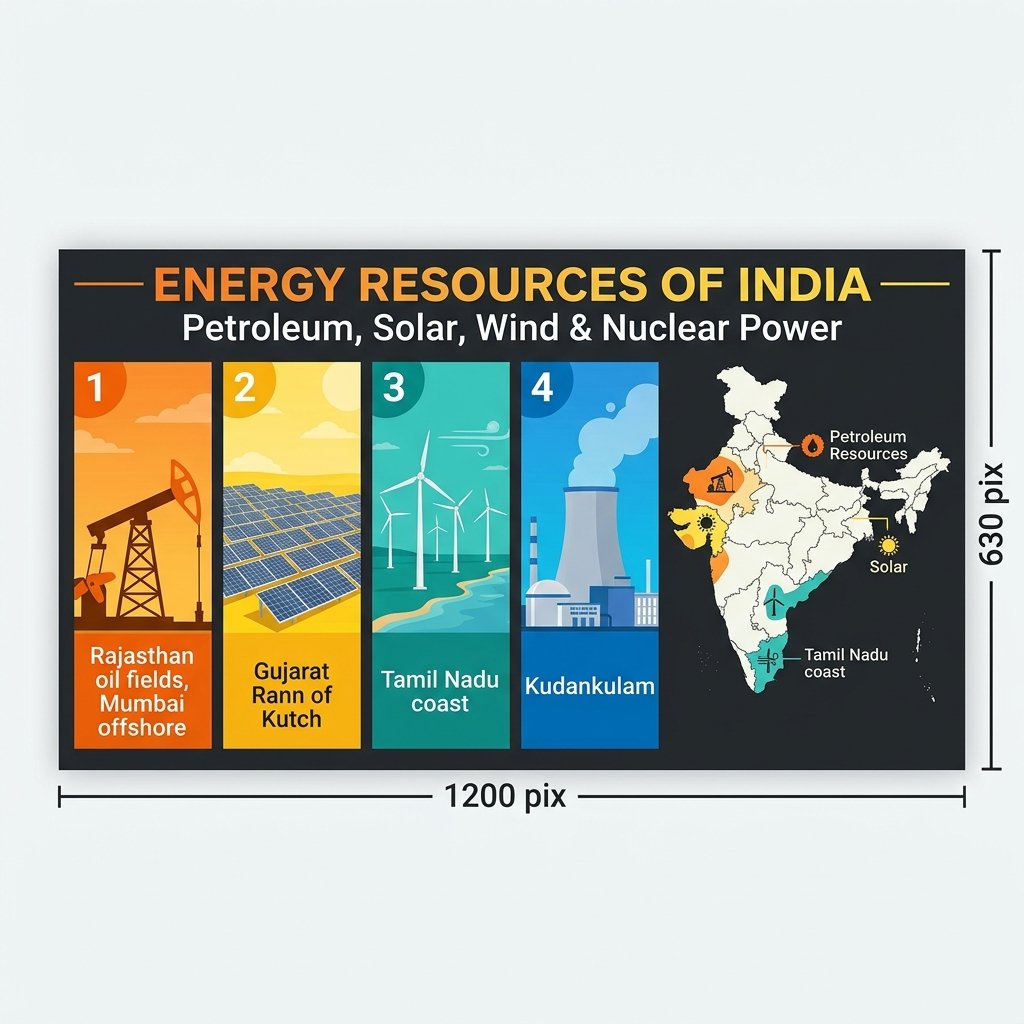
| Mangala, Bhagyam, Aishwariya | Barmer district, Rajasthan | Cairn India (Vedanta) | India’s largest onshore oilfield discovered 2004; “Barmer oil belt”; ~25% domestic production |
| Digboi | Upper Assam | IOCL | Asia’s oldest oilfield (1889); India’s first oil well; still producing |
| Naharkatia, Moran | Upper Assam | ONGC/OIL | Major producing fields in Assam-Arakan basin |
| Krishna-Godavari Basin (KG Basin) | Offshore, Bay of Bengal | Reliance Industries (KG-D6) | Major natural gas discovery 2002; gas production declining; potential for oil |
| Cambay Basin | Gujarat | ONGC | Ankleshwar, Kalol fields; Gujarat’s oil production |
Major Oil Refineries in India
- 🏭 Jamnagar (Gujarat) — Reliance Industries; world’s largest single-location oil refinery complex; 1.24 million barrels/day capacity
- 🏭 Koyali / Vadodara Refinery — IOCL, Gujarat
- 🏭 Mathura Refinery — IOCL, UP (inland refinery serving northern India)
- 🏭 Panipat Refinery — IOCL, Haryana
- 🏭 Bongaigaon / Digboi — Assam refineries (oldest)
- 🏭 Vizag Refinery — HPCL, Andhra Pradesh
- 🏭 Chennai / Manali Refinery — CPCL, Tamil Nadu
- 🏭 Kochi / Ambalamugal Refinery — BPCL, Kerala
2. Natural Gas
- 📍 KG Basin (Krishna-Godavari) — Offshore Bay of Bengal; Reliance’s KG-D6 block (major gas discovery 2002; peak 2010, declining since)
- 📍 Bombay High / Arabian Sea — associated gas from oil production (ONGC)
- 📍 Assam fields — significant gas in upper Assam
- 📍 Rajasthan — gas from Barmer basin
- 🌊 LNG imports: India imports significant LNG (Liquefied Natural Gas) at Dahej (Gujarat), Hazira (Gujarat), Kochi (Kerala), Dabhol (Maharashtra) terminals
3. Hydropower — India’s Green Colonial Legacy
India has the world’s 5th largest hydropower potential (~150,000 MW theoretical) but has tapped only about 40% of it. Most remaining potential lies in the Himalayas (Arunachal Pradesh, Uttarakhand, J&K, Himachal Pradesh) and the Western Ghats.
| Dam / Project | River | State | Capacity (MW) |
|---|---|---|---|
| Tehri Dam | Bhagirathi (Ganga) | Uttarakhand | 1,000 MW; India’s tallest dam (260.5 m) |
| Sardar Sarovar | Narmada | Gujarat | 1,450 MW; largest dam by volume in India |
| Bhakra-Nangal | Sutlej | HP/Punjab | 1,325 MW; India’s 1st major multi-purpose project (Nehru: “Temples of Modern India”) |
| Nagarjuna Sagar | Krishna | Telangana/AP | 816 MW; world’s largest masonry dam |
| Sharavathi / Jog Falls | Sharavathi | Karnataka | 890 MW; uses Jog Falls waterfall; largest waterfall in India |
| Koyna | Koyna | Maharashtra | 1,960 MW; largest hydropower in Maharashtra; 1967 earthquake on Koyna reservoir |
| Subansiri Lower | Subansiri | Arunachal/Assam | 2,000 MW; India’s largest under-construction hydropower project |
4. Nuclear Power — India’s Three-Stage Programme
India has one of the world’s most unique and ambitious nuclear power programmes, designed specifically to utilize India’s vast thorium reserves (world’s largest) as the ultimate fuel source.
India’s Three-Stage Nuclear Programme (Dr Homi Bhabha)
- 🔵 Stage 1 — Pressurised Heavy Water Reactors (PHWRs): Uses natural uranium (U-235) as fuel; heavy water as moderator. Produces electricity + plutonium as byproduct. Currently operational. India has 22 nuclear reactors.
- 🟡 Stage 2 — Fast Breeder Reactors (FBRs): Uses plutonium (from Stage 1) + depleted uranium. “Breeds” more plutonium + converts Thorium-232 into Uranium-233. India’s PFBR (Prototype Fast Breeder Reactor) at Kalpakkam, Tamil Nadu — commissioned 2024.
- 🔴 Stage 3 — Advanced Heavy Water Reactors (AHWRs): Uses U-233 (from Stage 2) + Thorium-232 directly. India’s ultimate goal: energy independence using its world-record thorium reserves for centuries.
Major Nuclear Power Plants in India
| Plant | State | Capacity | Notes |
|---|---|---|---|
| Kudankulam | Tamil Nadu | 2,000 MW (expanding to 6,000) | India’s largest nuclear plant; built with Russian (Rosatom) cooperation; VVERs |
| Tarapur | Maharashtra | 1,400 MW | India’s FIRST nuclear plant (1969); US-built BWRs originally |
| Rawatbhata / RAPS | Rajasthan | 1,180 MW | 6 PHWRs; NPCIL; indigenous design |
| Kaiga | Karnataka | 880 MW | 4 PHWRs; in Western Ghats |
| Kalpakkam / MAPS | Tamil Nadu | 440 MW + PFBR | India’s first indigenously designed reactor + prototype FBR location |
| Narora | Uttar Pradesh | 440 MW | On Ganga; 2 PHWRs |
| Kakrapar | Gujarat | 440 MW | On Tapti; 2 PHWRs |
5. Solar Energy — India’s Renewable Revolution
- ☀️ India’s installed solar capacity (2024): ~90 GW — 5th largest in the world
- 🎯 Target: 500 GW renewable by 2030 (National Solar Mission)
- 🌞 Best solar regions: Rajasthan (Thar Desert — highest solar irradiance), Gujarat (Rann of Kutch), MP, Andhra Pradesh, Karnataka
| Solar Park | State | Capacity | Notes |
|---|---|---|---|
| Bhadla Solar Park | Rajasthan | 2,245 MW | World’s largest solar park; Jodhpur district; desert surface |
| Pavagada (Shakti Sthala) | Karnataka | 2,050 MW | World’s 2nd largest; built on unused scrubland; farmers lease land |
| Kurnool Solar Park | Andhra Pradesh | 1,000 MW | One of India’s largest single-location parks |
| Rewa Ultra Mega Solar | Madhya Pradesh | 750 MW | Powers Delhi Metro; innovative cross-state power purchase |
6. Wind Energy
- 💨 India’s installed wind capacity (2024): ~46 GW — 4th largest globally
- 🎯 Offshore wind potential: Huge potential in Gujarat coast and Tamil Nadu coast — largely untapped
- 🌬️ Best wind regions: Tamil Nadu (Kanyakumari, Tirunelveli, Coimbatore — highest wind energy density in India), Gujarat, Rajasthan, Maharashtra, Andhra Pradesh, Karnataka
| Wind Farm | State | Notes |
|---|---|---|
| Muppandal Wind Farm | Tamil Nadu | Kanyakumari district; India’s largest onshore wind farm; consistent high-speed winds year-round |
| Jaisalmer Wind Park | Rajasthan | Large cluster; desert plains; Suzlon turbines |
| Brahmanvel | Maharashtra | Dhule district; large wind installation |
Key Takeaways
| Energy Source | India’s Status | Key Location |
|---|---|---|
| Coal (electricity) | ~70% of India’s power; 4th reserves world | Jharia, Singrauli, Korba |
| Petroleum | ~85% imported; 3rd largest consumer | Mumbai High, Barmer (Rajasthan) |
| Natural Gas | KG Basin; LNG imports at Dahej, Kochi | KG-D6 (Reliance), Bombay High |
| Hydropower | 5th world potential; 40% tapped | Bhakra-Nangal, Tehri, Koyna |
| Nuclear | 22 reactors; 3-stage programme | Kudankulam (#1), Tarapur (oldest) |
| Solar | ~90 GW; 5th world; target 500 GW by 2030 | Bhadla (world’s largest solar park) |
| Wind | ~46 GW; 4th world | Muppandal (Tamil Nadu), Jaisalmer |
⭐ Important for Exams — Quick Revision
- 🔑 Mumbai High = India’s largest oilfield; offshore Arabian Sea; ONGC; 40% domestic oil
- 🔑 Barmer (Rajasthan) = India’s largest ONSHORE oilfield; Cairn/Vedanta; discovered 2004
- 🔑 Digboi (Assam) = Asia’s OLDEST oilfield (1889); India’s first oil well
- 🔑 Jamnagar Refinery = world’s largest single-location refinery; Reliance; Gujarat
- 🔑 KG Basin = India’s largest natural gas discovery (Reliance, 2002); offshore Bay of Bengal
- 🔑 India imports ~85% of crude oil; from Russia, Iraq, Saudi Arabia, UAE
- 🔑 Bhakra-Nangal = India’s first major multi-purpose project; Sutlej River; HP; Nehru: “Temples of Modern India”
- 🔑 Tehri Dam = India’s tallest dam (260.5m); Bhagirathi/Ganga; Uttarakhand
- 🔑 Tarapur = India’s FIRST nuclear plant (1969); Maharashtra
- 🔑 Kudankulam = India’s largest nuclear plant; Tamil Nadu; Russian VVER reactors
- 🔑 Kalpakkam = India’s PFBR (Prototype Fast Breeder Reactor); Stage 2 nuclear; Tamil Nadu
- 🔑 India’s 3-stage nuclear: PHWRs (uranium) → FBRs (plutonium) → AHWRs (thorium)
- 🔑 Bhadla Solar Park = world’s largest; 2,245 MW; Rajasthan (Jodhpur)
- 🔑 Muppandal Wind Farm = India’s largest onshore wind; Tamil Nadu (Kanyakumari)
- 🔑 India = 4th largest wind globally; 5th largest solar globally; target = 500 GW renewable by 2030
Frequently Asked Questions (FAQs)
1. Why does India import 85% of its oil despite having domestic oilfields?
India’s domestic oil reserves are limited and its consumption is enormous (3rd largest in the world). Mumbai High — discovered in 1974 — is now a maturing field with declining production despite enhanced recovery techniques. The Barmer discovery in Rajasthan added significant production, but India’s total domestic production (~700,000 barrels/day) cannot meet its consumption of ~5 million barrels/day. India’s sedimentary basins — the main geological settings for oil — cover ~3.14 million km², and only ~25% has been thoroughly explored, suggesting significant undiscovered potential. Deep-water blocks in the KG Basin, Andaman offhsore, and east coast have major potential yet to be fully tapped.
2. What makes Jamnagar the world’s largest refinery?
Reliance Industries built its initial Jamnagar refinery in 1999, then doubled its capacity with a second refinery in 2008 — the two complexes together process 1.24 million barrels of crude oil per day. The strategic location on Gujarat’s coast (near Kandla and Sikka ports) allows super-tankers to deliver crude oil. The refinery is deep in the private sector with no legacy technology constraints — built at once with the latest processing units. Unlike public sector refineries that grew incrementally, Jamnagar was designed from scratch at world-scale. It processes crude oil from the Middle East, Africa, and Americas into a full range of petroleum products exported globally.
3. Why is India building the world’s largest solar parks in Rajasthan’s desert?
Rajasthan’s Thar Desert has India’s — and one of the world’s — highest Global Horizontal Irradiance (GHI): 5.5–6.5 kWh/m²/day of solar energy. Additionally: land is cheap and largely unused (arid scrubland); flat terrain = easy panel installation; minimal cloud cover; population density is low. The Bhadla Solar Park (Jodhpur district) — at 2,245 MW — became the world’s largest solar park partly because Rajasthan offered these geographic advantages AND the state government provided single-window clearances. However, extreme summer temperatures (50°C+) actually reduce solar panel efficiency slightly — engineers counteract this with tracking systems and panel spacing.
Related Geology Articles on StudyHub
- ➡️ Mineral Resources India — Coal, Bauxite & Mica Geology
- ➡️ River Systems India — Hydropower Potential on Himalayan Rivers
- ➡️ Pangaea & Gondwana — Why India Has Gondwana Coal
- ➡️ Thar Desert — India’s Solar Energy Capital
- ➡️ Koyna 1967 Earthquake — Reservoir-Induced Seismicity