India became the world’s most populous nation in April 2023, surpassing China with a population exceeding 1.44 billion people. India holds 17.5% of the world’s population on just 2.4% of the world’s land area. This extreme concentration of humanity — with its extraordinary diversity of languages, religions, literacy levels, and economic conditions — makes India’s population geography one of the most complex and fascinating studies in the world. Understanding India’s census data, population distribution, density patterns, growth rate history, demographic transition, and the demographic dividend is essential for UPSC, SSC, and all geography and economy examinations.
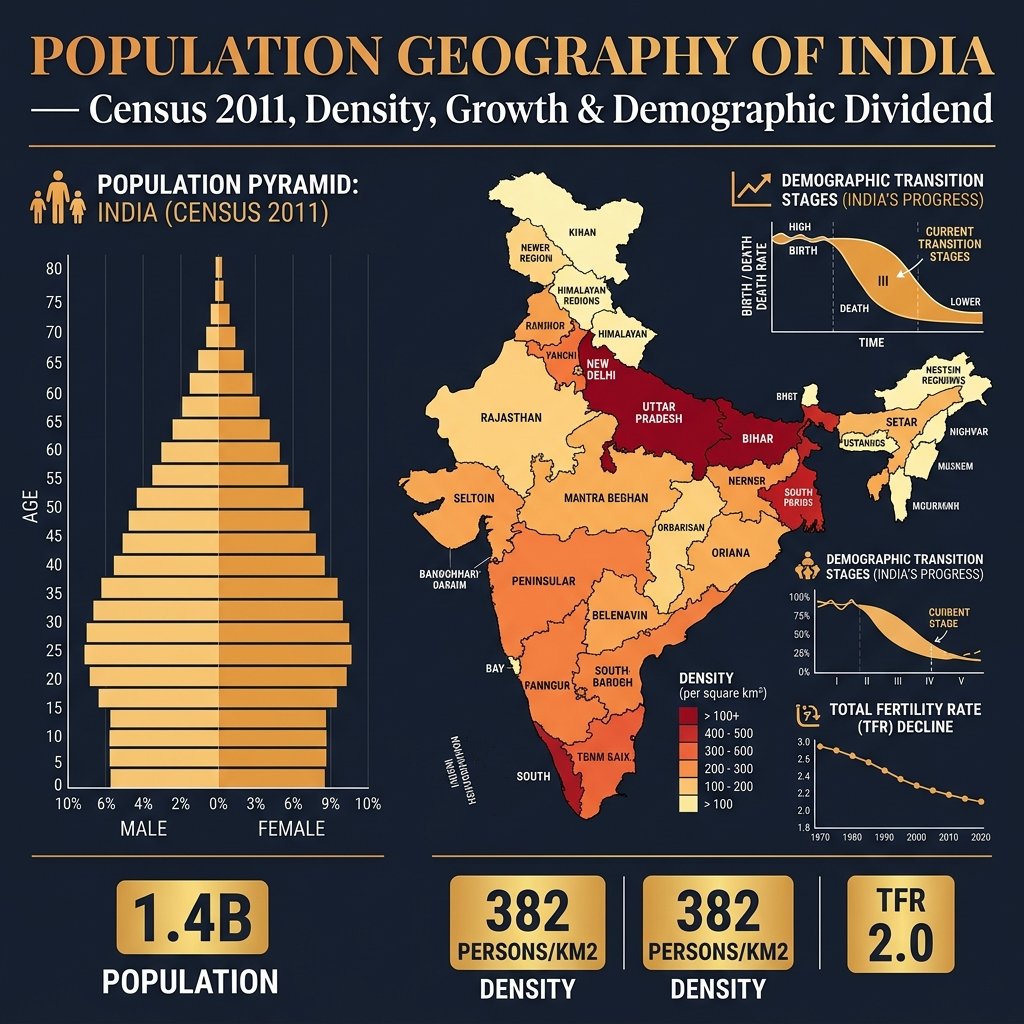
India’s Population — Key Statistics (Census 2011 + Projections)
| Indicator | Census 2011 | Estimated 2024 |
|---|---|---|
| Total Population | 1,210.9 million (1.21 billion) | 1.44 billion+ (world’s largest, surpassed China April 2023) |
| Decadal Growth Rate | 17.64% (2001–2011) | ~12–14% projected (2011–2021) |
| Population Density | 382 persons/km² | ~430 persons/km² |
| Sex Ratio | 943 females per 1000 males | ~950 (slowly improving) |
| Child Sex Ratio (0–6 yrs) | 914 (alarming; down from 927 in 2001) | ~920 (improving slowly) |
| Literacy Rate | 74.04% (Male: 82.14%; Female: 65.46%) | ~78% (estimated) |
| Urban Population | 31.16% | ~36–38% |
| TFR (Total Fertility Rate) | 2.4 | 2.0 (at replacement level — 2.1) |
Population Distribution — Who Lives Where & Why
Most Populated States (Census 2011)
| Rank | State | Population | % of India |
|---|---|---|---|
| 1st | Uttar Pradesh | 199.8 million | 16.5% |
| 2nd | Maharashtra | 112.4 million | 9.3% |
| 3rd | Bihar | 104.1 million | 8.6% |
| 4th | West Bengal | 91.3 million | 7.5% |
| 5th | Andhra Pradesh (undivided) | 84.6 million | 7.0% |
| Least | Sikkim | 0.61 million | 0.05% |
Population Density — Extremes
| Category | State/UT | Density |
|---|---|---|
| Highest density (State) | Bihar | 1,106 persons/km² |
| Highest density (UT) | Delhi (NCT) | 11,320 persons/km² |
| 2nd highest (State) | West Bengal | 1,028 persons/km² |
| Lowest density (State) | Arunachal Pradesh | 17 persons/km² |
| Lowest density (UT) | Andaman & Nicobar Islands | 46 persons/km² |
| India average | — | 382 persons/km² |
Why Population is Concentrated in Certain Areas
- 🌾 Fertile plains (Indo-Gangetic Plain): UP, Bihar, West Bengal — alluvial soil + reliable rivers → agriculture → high rural population density
- 🏭 Industrial regions: Mumbai Metropolitan Region, Delhi-NCR, Kolkata, Chennai, Bengaluru — economic opportunities → urban migration
- 🌧️ Good rainfall: Kerala, West Bengal, coastal states — adequate water → dense settlement
- 🏔️ Sparse in: Arunachal Pradesh (dense forests + mountains), Rajasthan (Thar Desert, low water), J&K/Ladakh (high-altitude cold desert), Uttarakhand (Himalayan terrain)
Historical Growth of India’s Population
| Census Year | Population | Decadal Growth Rate | Key Event |
|---|---|---|---|
| 1901 | 238.4 million | — | Plague, famines; high death rate |
| 1921 | 251.3 million | −0.31% (1911–21) | “Year of the Great Divide” — lowest population growth; influenza pandemic 1918 killed 12–17M Indians |
| 1951 | 361.1 million | 13.31% | Post-independence; improving healthcare |
| 1981 | 683.3 million | 24.66% | Peak growth era; Green Revolution raising survival rates |
| 2001 | 1,028.7 million | 21.54% | India crosses 1 billion |
| 2011 | 1,210.9 million | 17.64% | Decelerating growth; TFR declining |
| 2023 (est.) | 1,440+ million | ~12% | India = world’s most populous nation |
📅 1921 — “Year of the Great Divide”: The 1921 Census recorded India’s first ever population DECLINE decade (−0.31% from 1911–1921), caused primarily by the catastrophic 1918 Spanish Influenza pandemic which killed 12–17 million Indians — the worst pandemic death toll of any country in the world during that outbreak. After 1921, India’s population began its sustained upward growth. This is why 1921 is called the “year of the great divide” or “demographic divide.”
Demographic Transition Theory
The Demographic Transition Model (DTM) describes how countries’ birth rates and death rates change as they develop economically. India has moved through multiple stages over the 20th–21st centuries.
| Stage | Birth Rate | Death Rate | Growth | India Period |
|---|---|---|---|---|
| Stage 1 — Pre-industrial | High | High | Very Low (stable) | Pre-1920s India |
| Stage 2 — Early Transition | High | Falling rapidly | Very HIGH (population explosion) | 1921–1981 India (independence + healthcare) |
| Stage 3 — Late Transition | Falling | Low | Moderate (decelerating) | 1981–2020s India (education + urbanization) |
| Stage 4 — Low stationary | Low | Low | Very low (near replacement) | South India today; Kerala, TN, AP, Telangana |
| Stage 5 — Declining | Very Low | Low | Negative | Western Europe/Japan; some fear India heading here |
India’s Demographic Dividend
India’s population has an exceptionally young age structure — the median age is about 28 years (compared to China 38, Japan 48, USA 38). This creates a unique economic opportunity called the Demographic Dividend.
- 📊 What is it? When the working-age population (15–64 years) grows faster than dependents (children + elderly) → more workers, fewer dependents per worker → higher savings, investment, economic growth potential
- ⏰ India’s window: India’s demographic dividend window is estimated to last until approximately 2040–2055 — if India can productively employ its massive working-age population
- 📈 India adds ~12–13 million new workers to the labour force every year — the world’s largest annual labour force addition
- ⚠️ The challenge: The dividend only works if working-age people have jobs, education, and skills. India faces the risk of a “demographic disaster” if this workforce is unemployed/underemployed
North-South Demographic Divide
| Indicator | South India (Kerala, TN, AP, Karnataka) | North India (UP, Bihar, MP, Rajasthan) |
|---|---|---|
| TFR (Fertility) | 1.5–1.8 (below replacement) | 2.5–3.0+ (still high) |
| Literacy | 85–90%+ | 65–75% |
| Female Literacy | 80–90% | 50–65% |
| Sex Ratio | 1050–1084 (Kerala highest: 1084) | 850–900 (very skewed) |
| IMR (Infant Mortality) | 6–12 per 1000 | 40–55 per 1000 |
| Demographic Stage | Stage 4 (near stabilised) | Stage 2–3 (still transitioning) |
Literacy — India’s Critical Human Development Gap
- 📚 Most literate state: Kerala (94%) — Left movement, strong public education tradition since 19th century; first fully literate district = Ernakulam (1990)
- 📚 Most literate UT: Lakshadweep (91.85%)
- 📚 Least literate state: Bihar (61.8%) — poverty, early marriage, low female school attendance
- 📚 Fastest improving: Rajasthan (female literacy: 52% in 2011 vs 20% in 1981)
- 📚 Gender gap: National male literacy (82%) vs female literacy (65%) = 17% gap; closing slowly
Urbanisation in India
- 🏙️ Urban population 2011: 377.1 million (31.16%) — world’s 2nd largest urban population
- 📈 India has 53 cities with 1M+ population (Census 2011); now likely 60+
- 🏙️ Largest Urban Agglomerations: Mumbai (20.7M), Delhi (16.3M), Kolkata (14.1M), Chennai (8.7M), Bengaluru (8.5M)
- 🌆 India’s urban share is expected to reach 50% by 2050 — adding 400M+ urban residents over next 25 years = largest urban migration in history
- ⚠️ Urban challenges: Slums (Dharavi, Mumbai = Asia’s largest slum); traffic, water, sanitation, housing; Delhi remains world’s most polluted capital
⭐ Important for Exams — Quick Revision
- 🔑 India 2023: World’s most populous nation (1.44B+); surpassed China April 2023; 17.5% of world on 2.4% land
- 🔑 Census 2011: Population = 1,210.9M; density = 382/km²; literacy = 74%; sex ratio = 943; urban = 31.16%
- 🔑 Most populous state: Uttar Pradesh (199.8M = 16.5% of India)
- 🔑 Highest density state: Bihar (1,106/km²); UT = Delhi (11,320/km²)
- 🔑 Lowest density state: Arunachal Pradesh (17/km²)
- 🔑 1921 = “Year of the Great Divide” — first decadal population decline; caused by 1918 influenza (12–17M Indian deaths)
- 🔑 Decadal growth: Peak = 24.66% (1971–81); declining since; 17.64% (2001–2011)
- 🔑 Demographic Transition Stage 2 = “population explosion” (high birth rate + falling death rate); India 1921–1981
- 🔑 TFR (2024): ~2.0 nationally; South India = 1.5–1.8 (below replacement 2.1); North India = 2.5–3.0+
- 🔑 Demographic Dividend: Working-age (15–64) growing faster than dependents; India’s window until 2055; 12M new workers/year
- 🔑 Median age India: ~28 years (vs China 38, Japan 48) — youngest large economy
- 🔑 Most literate: Kerala (94%); first fully literate state; Ernakulam = first literate district (1990)
- 🔑 Least literate: Bihar (61.8%); Child Sex Ratio worst state = Haryana (834)
- 🔑 Sex ratio: Highest = Kerala (1084); Lowest = Haryana (877) (Census 2011)
- 🔑 India expected 50% urban by 2050 — largest urban migration in human history
Frequently Asked Questions (FAQs)
1. Will India’s population keep growing or will it stabilise/decline?
India’s population growth is in a clear decelerating trend. The Total Fertility Rate (TFR) has fallen from 5.9 (1950) to about 2.0 (2024) — right at or just below the replacement fertility level of 2.1. South Indian states (Kerala, Tamil Nadu, Andhra Pradesh, Telangana, Goa, Himachal Pradesh, Punjab) already have TFRs below 2.0 — their populations will eventually shrink if current trends continue. North Indian states (UP, Bihar, MP, Rajasthan) are still above 2.5 and continue driving national growth. UN projections suggest India’s population will peak around 2060–2064 at approximately 1.67–1.70 billion, then begin slowly declining — assuming current fertility trends continue. Urban residence, female education, and women’s economic participation are the strongest predictors of fertility decline; policies accelerating these factors will hasten stabilisation.
2. Why is Kerala’s demographic achievement so remarkable?
Kerala’s demographic achievement is distinctive because it achieved developed-world demographic indicators at developing-world income levels. As of 2011: Kerala’s TFR = 1.8 (below replacement); literacy = 94% (highest India); female literacy = 92%; infant mortality = 12/1000 (one of India’s lowest); sex ratio = 1084 (most female-friendly in India). Kerala achieved this through: (1) Historical investment in education — Travancore kingdom mandated female education in the 1800s; Christian missionaries built schools; SNDP and NSS movements spread education; (2) Women’s agency — Kerala’s matrilineal traditions in Nair community gave women property rights and social status; (3) Public healthcare system — dense distribution of government hospitals; high doctor-to-population ratio; (4) Political awareness — high newspaper readership; strong Left movement promoted social equity. Kerala’s model is studied globally as proof that development outcomes don’t require rich GDP per capita — they require smart social investment.
3. What is the BIMARU problem and has the situation improved?
BIMARU is an acronym coined by economist Ashish Bose in the 1980s from the first letters of Bihar, Madhya Pradesh, Rajasthan, and Uttar Pradesh (बीमार = “sick” in Hindi) — referring to these four large North Indian states that were lagging badly in demographic and development indicators. The original BIMARU states had: very high fertility (TFR 4.5+), very high infant mortality, low female literacy, poor healthcare, and high poverty. The situation has significantly improved since the 1980s: Rajasthan has dramatically improved female literacy; MP has improved infant mortality; UP and Bihar have slowly reduced TFR. However, the gap with South India remains large. After Chhattisgarh and Jharkhand were carved from MP and Bihar respectively, some analysts now refer to “BIMARU Plus” states. The demographic burden of BIMARU states means they will have large young populations needing jobs for decades even as South India ages — creating a complex internal migration dynamic.
Related Geology Articles on StudyHub
- ➡️ Settlements of India — Rural-Urban Population Distribution
- ➡️ Natural Vegetation India — Relationship with Population Pressure
- ➡️ Energy Resources India — Powering 1.4 Billion People
- ➡️ Agriculture India — Feeding 1.4 Billion People
- ➡️ Natural Disasters India — Population Vulnerability & Exposure