Jammu & Kashmir and Ladakh — reorganised into two separate Union Territories on October 31, 2019 following the abrogation of Article 370 on August 5, 2019 — occupy India’s northernmost geography and its most sensitive strategic terrain. Together they cover approximately 2,22,236 km² (including Pakistan-occupied Kashmir of ~78,932 km² and Aksai Chin under Chinese control of ~37,555 km²) — making undivided J&K larger than many European countries. The region is where India’s three great mountain systems converge — the Himalayas, Karakoram, and Hindu Kush — and where India shares contested borders with both Pakistan (Line of Control) and China (Line of Actual Control), giving it unparalleled geopolitical complexity. The Kashmir Valley is one of the most beautiful and most militarised landscapes on Earth. Ladakh is the world’s largest high-altitude cold desert, straddling the Indus and Shyok river systems at elevations of 3,000–7,672 metres. The Siachen Glacier is the world’s highest battlefield. Understanding J&K and Ladakh’s physical geography, cultural landscape, strategic significance, and post-2019 Constitutional transformation is essential for UPSC, SSC, and all competitive examinations.
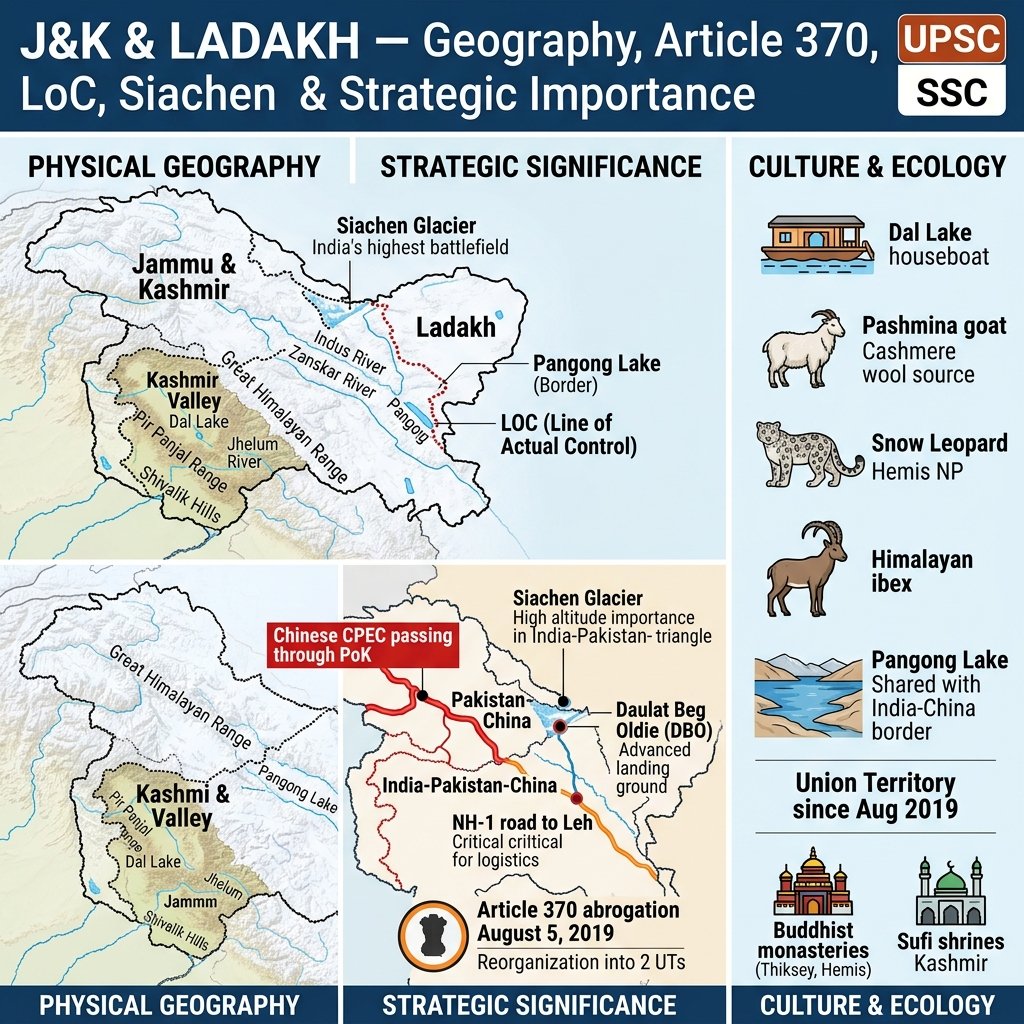
Physical Geography — Three Distinct Regions
| Region | Area & Terrain | Rivers | Climate | Key Features |
|---|---|---|---|---|
| Jammu Division | Outer Himalayas (Shivaliks), Pir Panjal Range; transitional plains near Punjab border; elevation 300–4,500m; rolling hills, subtropical lower areas | Chenab, Tawi, Ravi (tributaries); Chenab = largest river of Jammu region; flows southwest into Pakistan | Sub-tropical humid in lower Jammu plains (38°C summer, with monsoon June–Sep); alpine in higher elevations; receives southwest monsoon unlike Kashmir Valley | Vaishno Devi shrine (Trikuta hills, Reasi — 80 lakh pilgrims/year = India’s 2nd most visited shrine); Banihal Pass and Banihal Tunnel (road/rail link to Kashmir); Udhampur rail headquarters; Hindu majority region |
| Kashmir Valley | Oval-shaped valley (~135km long, 32km wide) surrounded by Great Himalayas (north) and Pir Panjal (south); elevation = 1,580m at floor; world’s largest inhabited Himalayan valley | Jhelum River — forms the central river of Kashmir valley; flows from Verinag spring (Anantnag) via Dal Lake, Wular Lake to Pakistan; Wular Lake = India’s largest freshwater lake; Dal Lake = famous houseboat destination | Temperate continental (Mediterranean-type influence via Western Disturbances in winter); snowfall Oct–March; warm summers (25°C); harsh winters (-5°C to -15°C); NO southwest monsoon penetration (rain shadow behind Pir Panjal) | Dal Lake + Dall houseboats; Mughal gardens (Shalimar Bagh, Nishat Bagh, Chashme Shahi); Saffron cultivation (Pampore = world’s premium saffron); Pashmina wool; Chinars in autumn; Gulmarg skiing; Sonamarg glacier; Pahalgam; Amarnath Cave (13,000 ft, annual pilgrimage) |
| Ladakh | High-altitude cold desert plateau; Trans-Himalayan region; elevation 3,000–7,672m (K2 = 8,611m, 2nd highest globally, in Karakoram under PoK); Zanskar mountains separate western Ladakh from Rupshu and Changthang plateau | Indus River — enters India at Demchok (LAC); flows northwest through Leh; Zanskar River (tributary); Shyok River; Nubra Valley (Siachen meltwater); annual rainfall at Leh only 50–100mm (extreme arid) | Cold desert — harsh winters (-30°C at Leh, -50°C on Siachen), surprisingly warm summers (30°C at Leh, May–August); virtually no precipitation (rain shadow of massive Himalayas and Karakoram); snowfall only at higher elevations; vegetation = sparse desert scrub | Pangong Tso Lake (pangong = “high grassland lake” in Tibetan; 134km long, only 45km in India, rest in China; the 2020 India-China standoff epicentre); Nubra Valley (sand dunes + Bactrian camels = surreal cold-desert-dune combo); Hemis NP (Snow Leopard, ~300 individuals); K2 (under PoK); Siachen Glacier (world’s highest battlefield at 5,400m+) |
Article 370 — History, Provisions & Abrogation
Background: Accession of J&K to India (1947)
- 📜 Dogra Kingdom: J&K was a Princely State under Maharaja Hari Singh (a Hindu) governing a Muslim-majority population (77%); at Independence, Maharaja hesitated between accession to India, accession to Pakistan, or independence
- 📜 Tribal invasion (October 1947): Pakistan-supported Pashtun tribal militias (Kabailees) invaded Kashmir on October 22, 1947, advancing on Srinagar; they looted towns and terror-marched toward the capital
- 📜 Instrument of Accession (October 26, 1947): Maharaja Hari Singh signed the Instrument of Accession to India; in return, India airlifted troops to Srinagar on October 27 (now commemorated as Indian Army Day); the war ended with a UN-brokered ceasefire on January 1, 1949; the ceasefire line later became the Line of Control (LoC) under Simla Agreement 1972; Pakistan retains western J&K (PoK = Pakistan-occupied Kashmir; Pakistan calls it Azad Kashmir) and Gilgit-Baltistan
- 📜 Nehru’s UN reference: PM Nehru referred the Kashmir issue to the UN Security Council in January 1948 — a decision he later considered a mistake; UNSC Resolution 47 (1948) called for a plebiscite after Pakistan’s forces withdrew — never implemented as Pakistan never withdrew; India’s position: Instrument of Accession is legally unconditional and complete; plebiscite conditions never met
Article 370 — Special Status (1949–2019)
- 📜 Provisions: Inserted in 1949 as temporary measure (Part XXI — Temporary, Transitional and Special Provisions); gave J&K special autonomous status: only “Defence, Foreign Affairs, Finance and Communications” of the Indian Constitution applied automatically; all other laws required J&K legislature’s concurrence; J&K had its own Constitution (1956), its own flag (Hafeez Qureshi’s design, the Sadar-e-Riyasat title for Governor), and its own citizen rights (no outsider could buy land or settle permanently)
- 📜 Article 35A: Derived from Article 370; empowered J&K legislature to define “permanent residents” of the state and grant them exclusive rights to buy land, seek government employment, and get scholarships — effectively barring all other Indians from purchasing property in J&K
- 📜 Erosion over time: Despite the “temporary” label, Article 370 was progressively eroded — by 1994, most Indian laws (200+ Central laws) had been extended to J&K through Presidential Orders with state concurrence; however, the land rights (35A) and symbolic autonomy provisions remained sensitive
Abrogation — August 5, 2019
- 🔴 Presidential Proclamation: President Ram Nath Kovind issued a Constitutional Order on August 5, 2019 (acting on advice of Parliament, invoking Governor’s Rule then President’s Rule in J&K) that read Article 370(3) — the provision empowering the President to abrogate Article 370 — was invoked; simultaneously Article 35A was nullified; all provisions of the Indian Constitution now apply to J&K
- 🔴 Reorganisation Act 2019: Parliament passed the J&K Reorganisation Act; effective October 31, 2019 (Sardar Patel’s birth anniversary): J&K was bifurcated into (1) Union Territory of J&K (with legislature — like Delhi) and (2) Union Territory of Ladakh (without legislature — directly administered by Centre, like Chandigarh); the first time in Indian history that a full state was downgraded to UT status
- 🔴 Security measures: 35,000+ additional troops deployed; Section 144 imposed; political leaders (Omar Abdullah, Mehbooba Mufti, Shah Faesal) detained under PSA (Public Safety Act); internet shutdown for months (longest ever in democratic country); landline/mobile communications cut
- 🔴 Supreme Court verdict (December 2023): SC upheld abrogation of Article 370 (5-0 verdict); ruled J&K lost its sovereignty when it signed Instrument of Accession; directed restoration of J&K statehood “as soon as possible”; directed elections to J&K assembly by September 30, 2024; elections held September–October 2024; NC-Congress alliance won (Omar Abdullah became CM)
Strategic Geography — Line of Control & LAC
| Boundary | Length | Origin | Status | Key Areas |
|---|---|---|---|---|
| Line of Control (LoC) | ~740 km | Ceasefire line from 1948 India-Pakistan war; renamed LoC under Simla Agreement 1972; both countries agreed to peacefully resolve disputes bilaterally | Contested; Pakistan claims all of J&K (as Muslim-majority territory under Two-Nation Theory); India claims entire undivided J&K including PoK and Gilgit-Baltistan; heavy military deployment both sides; periodic cross-LoC firing and infiltration by Pakistan-backed militants (Lashkar-e-Taiba, Jaish-e-Mohammed) | Uri (Kargilab sector; Uri attack 2016 = 18 soldiers killed, triggered Surgical Strike); Kupwara (northern infiltration route); Jammu sector (2021 drone attacks = India’s first drone attack on military base) |
| Line of Actual Control (LAC) | ~1,597 km (full India-China LAC; Ladakh sector ~800 km) | Emerged after 1962 India-China war; not formally demarcated; both sides patrol and claim disputed areas; the “LAC” is where each side claims the other should not be — differing interpretations of where it runs create friction zones | Contested; China claims Aksai Chin (37,555 km² under Chinese control since 1962; building infrastructure including G219 highway through it); 2020 Galwan Valley clash = first combat deaths on LAC since 1975 (20 Indian soldiers, 40+ Chinese casualties); multiple friction points in Eastern Ladakh | Galwan Valley (June 2020 clash); Pangong Tso Lake (2020 standoff; Indian forces captured Kailash Range heights Aug 2020); Depsang Plains; Daulat Beg Oldie (DBO — India’s northernmost airstrip at 16,700 ft = strategic for Siachen logistics) |
| Pakistan-occupied Kashmir (PoK) | ~78,932 km² (Mirpur, Muzaffarabad + Gilgit-Baltistan) | Occupied by Pakistan after 1947 tribal invasion; administered as “Azad Kashmir” and Gilgit-Baltistan | India claims it as its own territory; PoK hosts CPEC (China-Pakistan Economic Corridor) infrastructure; China’s investment in PoK is a major India-China friction point; CPEC bypasses Indian sovereignty claims | Baltistan (near Siachen); Gilgit (key Chinese road access); Muzaffarabad (PoK “capital”); Mangla Dam (on Jhelum, Pakistan’s 2nd largest dam, in PoK) |
Siachen Glacier — World’s Highest Battlefield
- 🏔️ Location: Eastern Karakoram Range; 76 km long (India’s largest glacier; world’s 2nd largest non-polar glacier by area); elevation = 5,400m at base to 7,000m+ at upper reaches; separates India-controlled Ladakh from Pakistan-controlled Gilgit-Baltistan; NJ9842 = the northernmost point of the old CFL (Cease Fire Line) from 1949 — beyond this, the line was not demarcated (neither side expected anyone to operate there)
- 🏔️ Operation Meghdoot (April 13, 1984): Pakistan was planning to occupy the Siachen glacier (its maps showed the territory as Pakistani, Western maps agreed); India’s DGMO Lt. Gen. P.N. Hoon and NSG got intelligence about Pakistan’s timeline; on April 13, 1984, Indian Army’s Kumaon Regiment troops were paradropped/airlifted to the glacier by Indian Air Force — capturing the key Bilafond La and Sia La passes just hours before Pakistani troops arrived; India has held the Siachen glacier since; Pakistan’s major attack attempts (1987 Operation Ababeel, 1989 re-attempts) were repulsed
- 🏔️ Cost of holding Siachen: India spends approximately ₹7–8 crore per day to maintain Siachen deployment (logistics by IAF helicopters and air supply); 35% of Indian soldier deaths there are from frostbite, HAPE (High Altitude Pulmonary Edema), HACE, avalanches — not enemy action; Pakistan has ~3,000 troops on their side; over 2,000 soldiers have died from both sides combined (weather/altitude casualties); HAAWS (High Altitude Warfare School) at Gulmarg trains Indian soldiers; 2012 Gayari Tragedy = Pakistani avalanche killed 140 soldiers in their base camp
- 🏔️ Why India holds Siachen: Controlling Siachen means India controls all mountain passes between PoK and China — Karakoram Pass, Sia La, Bilafond La; losing Siachen to Pakistan could allow Pakistan-China land contiguity through these passes = tactical encirclement of Ladakh; Siachen also provides India with surveillance of the entire Baltoro area and potential to monitor CPEC construction in Gilgit-Baltistan
- 🏔️ Environmental concern: The massive military presence (both sides) is causing significant glacial degradation — fuel spills, waste disposal, helicopter hover effects; geologists and environmentalists have flagged Siachen as an ecological concern alongside the military one
Ladakh — Ecology, Culture & Economy
- ❄️ Trans-Himalayan ecosystem: Ladakh lies in the “rain shadow” of both the Himalayas and Karakoram; annual rainfall at Leh = 50–100mm making it a true cold desert; vegetation = sparse Artemesia, cushion plants at altitude; Changthang Plateau (eastern Ladakh) is one of the world’s highest inhabited plateaus (4,500m+), home to Chang Pa nomads herding Pashmina goats (the source of the world’s finest cashmere wool)
- ❄️ Hemis National Park: India’s largest national park by area (~4,400 km²); home to ~300 Snow Leopards (among world’s highest densities); also Tibetan Wolf, Himalayan Brown Bear, Eurasian Lynx, Ladakhi Urial, Marco Polo Sheep (in Depsang area); the Hemis Festival (Buddhist mask dance) = most important cultural event of Ladakh
- ❄️ Pangong Tso Lake: 134 km long; width 5 km; elevation 4,350m; no fish (too brackish/saline for freshwater); 45 km in India, remaining 89 km in China; LOC / LAC runs through the lake; famous from Bollywood film “3 Idiots” (final scene); the 2020 standoff involved China advancing to Finger 4 (of 8 finger-shaped rocky spurs) on India’s claimed side; India built roads to Fingers; by Feb 2021 both sides withdrew to Finger 8+
- ❄️ Ladakh’s strategic infrastructure: Daulat Beg Oldie (DBO) = world’s highest airstrip (16,700 ft); critical for supply of Siachen and Depsang sector; DSDBO Road (Darbuk-Shyok-Daulat Beg Oldie) = 255 km; completed 2019; strategic road enabling Indian supplies to reach DBO by road; Zojila Pass Tunnel (under construction; 14.2 km; will provide all-weather road from Srinagar to Leh bypassing Zojila Pass closed 6 months/year)
- ❄️ Tourism: Leh-Ladakh attracts ~5 lakh tourists/year; adventure tourism (trekking, biking the Manali-Leh highway, frozen Chadar Trek on Zanskar River in winter); Buddhism tourism (Thiksey Monastery, Hemis Monastery, Shey Palace, Diskit Monastery); significant local employment; however, tourism is straining fragile high-altitude ecology (plastic waste, water scarcity, habitat disturbance near Snow Leopard territory)
Kashmir Valley — Economy & Culture
- 🌷 Saffron (Kesar): Kashmir produces India’s only significant saffron; Pampore town near Srinagar = “Saffron Town of World”; ~3,800 tonnes saffron produced annually; GI (Geographical Indication) tag awarded; Kashmir saffron = most expensive spice in the world (Rs 2–3 lakh per kg); cultivated at 1,600m elevation in late October bloom; has declined significantly due to groundwater depletion; National Saffron Mission (2010) supports revival
- 🌷 Pashmina: Ultra-fine cashmere wool from the underbelly of Changthangi goat (Pashmina goat) raised on Ladakh’s Changthang Plateau at 4,000m+; natural colour = beige or grey; hand-spun and hand-woven by Kashmiri artisans into famous shawls; GI tag; one genuine Pashmina shawl requires 3 goats’ annual wool yield + 70–80 hours of handwork; mass market “Pashmina” is often synthetic; real Pashmina costs Rs 20,000–10 lakh
- 🌷 Horticulture: Apple orchards = Kashmir’s largest agricultural employer; ~1.5 million MT apple annually (concentrated in Sopore, Budgam); also cherry, almond, walnut (Kashmiri walnut = world’s finest for wood carving); apricot orchards of Ladakh (dried apricots = significant Ladakhi export); Kashmiri cuisine: Rogan Josh, Wazwan (30-course feast), Kahwa (saffron tea)
- 🌷 Craft traditions: Persian-influenced carpet weaving (Kashmiri carpet = among world’s most valuable handmade carpets); hand-carved walnut wood furniture; Papier-mâché (paper pulp painted with intricate floral patterns); Sozni embroidery (needle embroidery on Pashmina); Kani shawl (woven on a special loom using kani sticks for multi-colour intricate patterns — UNESCO heritage recognition)
⭐ Important for Exams — Quick Revision
- 🔑 J&K reorganised: August 5, 2019 (Art 370 abrogated) + October 31, 2019 (effective; 2 UTs: J&K with legislature + Ladakh without legislature)
- 🔑 Article 370: “Temporary” provision; Part XXI of Constitution; inserted 1949; gave J&K special status (own constitution, flag, PM title); only Defence/Foreign/Finance/Communications applied directly; now abrogated
- 🔑 Article 35A: Defined “permanent residents” of J&K; gave them exclusive land rights barring other Indians; derived from Art 370; also abrogated in 2019
- 🔑 Instrument of Accession: Signed October 26, 1947 by Maharaja Hari Singh; triggered by Pakistani-sponsored tribal invasion October 22, 1947; legal basis for J&K being part of India
- 🔑 SC verdict on Art 370 (Dec 2023): 5-0 unanimous; abrogation upheld; J&K statehood to be restored; elections ordered by Sep 2024; NC won (Omar Abdullah CM)
- 🔑 LoC = 740 km; 1949 ceasefire line; renamed LoC under Simla Agreement 1972; J&K-Pakistan boundary; Kargil War (1999) fought near LoC
- 🔑 LAC (Ladakh) = ~800 km; India-China; NJ9842 = northern terminal of Simla line (beyond which LAC runs through Siachen); 2020 Galwan clash = 20 Indian soldiers killed
- 🔑 PoK = ~78,932 km²; occupied by Pakistan since 1947; CPEC corridor runs through it; India claims as its territory
- 🔑 Siachen Glacier: 76 km long; world’s 2nd largest non-polar glacier; 5,400–7,000m; India’s largest glacier; held by India since Operation Meghdoot (April 13, 1984)
- 🔑 K2 = 8,611m (world’s 2nd highest); located in Karakoram; under PoK control
- 🔑 Pangong Tso Lake: 134km long; 4,350m elevation; no fish (brackish); 45km India, 89km China; 2020 standoff epicentre
- 🔑 Daulat Beg Oldie (DBO): India’s northernmost airstrip; 16,700 ft = world’s highest; critical for Siachen/Depsang supply; DSDBO Road (255km) completed 2019; all-weather Zojila Tunnel under construction
- 🔑 Hemis NP: India’s largest national park (4,400 km²); 300 Snow Leopards; Ladakh; also Tibetan Wolf, Eurasian Lynx, Marco Polo Sheep
- 🔑 Jhelum River: Main river of Kashmir Valley; flows Verinag spring-Dal Lake-Wular Lake-Pakistan; Wular Lake = India’s largest freshwater lake
- 🔑 Indus River: Enters India at Demchok (LAC); flows through Leh; exits India at Batalik (near LoC); Indus Water Treaty (1960) governs India-Pakistan share
- 🔑 Saffron GI: Kashmir saffron (Pampore); Rs 2–3 lakh/kg; India’s only commercial saffron; National Saffron Mission; declining due to groundwater issues
- 🔑 Pashmina GI: Changthangi goat of Ladakh Changthang Plateau (4,000m+); hand-spun; Rs 20,000–10 lakh/shawl
- 🔑 Kargil War (May–July 1999): Pakistan-backed infiltrators + Pakistani Army units captured heights near Kargil; India launched Operation Vijay (ground) + Operation Safed Sagar (air); all peaks recaptured by July 26, 1999 (Kargil Vijay Diwas); ~527 Indian soldiers killed
Frequently Asked Questions (FAQs)
1. What was Article 370 — and why did its abrogation in 2019 remain controversial?
Article 370 of the Indian Constitution was simultaneously India’s most discussed, most politically charged, and most legally misunderstood Constitutional provision — a provision that existed for 70 years in Part XXI (Temporary, Transitional and Special Provisions) while its political stakes ensured it could never be easily resolved. What it actually said: Article 370, as originally drafted by Sheikh Abdullah and Gopalaswami Ayyangar in 1949, provided that the Indian Constitution would apply to J&K only in limited areas initially — specifically that Parliament’s legislative authority over J&K would extend only to matters specified in the Instrument of Accession (Defence, Foreign Affairs, Communications, Finance) plus any additional matters on which the J&K Constituent Assembly concurred. All other Central legislation would require the concurrence of the “Government of the State” (defined in the article). Article 370(3) empowered the President to “declare that this Article shall cease to be operative” but only with the recommendation of the J&K Constituent Assembly — which had been dissolved in 1956 after adopting the state’s own Constitution. The 70-year erosion: Despite being “temporary,” Article 370 was progressively hollowed out yet remained symbolically intact. By 1994, over 260 Central Acts had been extended to J&K through Presidential Orders (issued with the State Government’s concurrence). The Supreme Court’s Prem Nath Kak judgment (1959) had already held that the President could substitute the “Constituent Assembly” with the “State Legislative Assembly” for Article 370(3) purposes after the Constituent Assembly’s dissolution. Kashmir had its own Constitution (1956), its own flag, its own citizenship provisions (Article 35A, 1954), and its own PM title (changed to Chief Minister only in 1965). The 2019 abrogation: The legal mechanism used on August 5, 2019 was intricate: (1) President’s Rule was in place in J&K (state government dismissed); (2) A Constitutional Order (CO 272) was issued, applying all provisions of the Indian Constitution to J&K — including the interpretation that “Governor” (standing in for J&K government under President’s Rule) and “Parliament” (standing in for the J&K legislature) could give the required concurrences; (3) Simultaneously, Parliament passed the J&K Reorganisation Act 2019, bifurcating the state into two UTs. Critics (Congress, NC, PDP, and many constitutional lawyers) argued that: Presidential Rule cannot give the state’s consent for its own dissolution; the phrase “Acting on the recommendation of the Constituent Assembly” in 370(3) cannot be circumvented by substituting Parliament; the correct procedure was amendment via Article 368 requiring 50%+ state legislature ratification; using Presidential Rule + Parliament was, in their view, a constitutional sleight of hand rather than legitimate process. The Supreme Court’s December 2023 judgment (5-0) found the abrogation valid on the ground that J&K had surrendered sovereignty upon signing the Instrument of Accession, Parliament’s sovereignty over J&K was always plenary, and the Article 370 arrangement was always temporary (per its own text). Three separate pathways were taken by the SC’s five-judge bench — they differed in reasoning but agreed on outcome — while mandating restoration of statehood and elections. Post-abrogation effects: All Indians can now buy land in J&K; CBI, NIA, RTI, CAG, IPC, and other Central Acts apply; IAS officers posted directly; J&K High Court now under the Supreme Court’s normal jurisdiction; elections held in September–October 2024 with Omar Abdullah (NC) winning. Whether the economic integration and infrastructure investment that Delhi promised delivers growth to Kashmiri communities — or whether the political settlement holds — will determine the long-term outcome of the 2019 decision.
2. What is the Kargil War — and why is it strategically significant for India?
The Kargil War (May–July 1999) — officially called Operation Vijay on the Indian side — was a limited but intense armed conflict along the Line of Control in the Kargil and Drass sectors of Ladakh, fought between India and Pakistan. It is significant not only as one of the largest military operations on the LoC since 1971 but for what it revealed about India’s strategic vulnerabilities, the evolution of Indian military doctrine, and the nature of nuclear-armed conflict. What happened: In winter 1998–99, Pakistani regular forces (from the Northern Light Infantry — NLI) disguised as “Kashmiri militants” infiltrated Indian positions on the Himalayan ridgelines overlooking NH-1 (the Srinagar-Leh National Highway) — India’s only road link to Ladakh. India’s winter practice was to vacate these high-altitude posts (above 5,000m) during winter and reoccupy in spring. The NLI troops occupied approximately 150+ Indian pickets (observation posts) over the winter at heights of 15,000–18,000 feet — including critical peaks: Tiger Hill (Point 4660), Tololing (Point 4590, Drass sector), Point 5140, Batalik heights, Jubar heights. From these positions, Pakistani forces could shell NH-1 directly — potentially cutting Ladakh off from the rest of India (including from supply to Siachen). India’s army discovered the infiltration in early May 1999 when local Gujjar shepherds reported “unknown armed men” on the heights. India’s military response: Operation Vijay launched; ground assault on the heights began late May 1999; Infantry (Grenadiers, Rajputana Rifles, JAK Rifles, Bihar Regiment, 18 Grenadiers) attacked uphill against fortified Pakistani positions — one of the most difficult combat tasks in military history (uphill assault on entrenched positions in extreme altitude); Operation Safed Sagar (IAF) launched air strikes (first combat use of IAF in the Himalayas since 1971); MiG-21s, MiG-27s, Mirage 2000s used; Wing Commander K. Nachiketa was shot down and captured by Pakistan (later returned); Kargil complex retaken peak by peak; NH-1 restored; by July 26 India had recaptured essentially all peaks; declared Kargil Vijay Day (celebrates annually). Casualties: India: ~527 officers and soldiers killed; ~1,363 wounded. Pakistan: estimates 357–4,000 casualties (denied involvement for long; only acknowledged later). Strategic lessons: (1) Pakistan’s nuclear shield theory: Pakistan went to war believing India would not escalate due to both sides having nuclear weapons (tested in 1998); India proved it would escalate conventionally while making clear no nuclear use would be tolerated; Pakistan’s calculation was wrong. (2) Intelligence failure: India completely missed the winter infiltration; RAW and Army intelligence failed; the Kargil Review Committee (chaired by K. Subrahmanyam) recommended a complete intelligence overhaul, leading to creation of NTRO, DIA, and intelligence coordination mechanisms. (3) India’s diplomatic success: India carefully avoided crossing the LoC itself (all fighting on India’s side of LoC); gained international moral high ground; US (Clinton administration) pressured Pakistan to withdraw; Pakistan’s PM Nawaz Sharif flew to Washington begging Clinton to intervene with India — a humiliating diplomatic moment; Musharraf (Army Chief) was blamed by Sharif for initiating the operation without political approval. (4) Infrastructure trigger: Kargil directly caused India to fast-track all-weather connectivity to Ladakh — eventually producing the Atal Tunnel (Rohtang, 2020), DSDBO Road, and the Zojila Tunnel (under construction) — ensuring that NH-1 can never be the sole Indian lifeline to Ladakh again.
3. What makes Ladakh geologically and ecologically unique — and how does climate change threaten it?
Ladakh is one of the world’s most geologically dramatic landscapes — a place where three of Earth’s great mountain building events (the Himalayan, Karakoram, and Zanskar orogeny systems) intersect, where the Indian Plate’s ongoing push northward is still measurably deforming the landscape, and where the intersection of extreme aridity, altitude, and glacial hydrology creates ecological conditions found nowhere else on Earth. Geological character: Ladakh sits on three distinct geological terranes: (1) The Ladakh Batholith — a massive granite intrusion formed when subducting oceanic crust melted and magma cooled underground approximately 50–70 million years ago during the initial collision of the Indian and Asian plates; today exposed as the barren Ladakh Range north of Leh; (2) The Zanskar Sequence — ancient Mesozoic limestones and marine sediments representing the Tethys Ocean floor that once separated India from Asia, now pushed skyward to 6,000m+ at Zanskar range; fossils of Tethys marine organisms (ammonites!) found here are direct evidence of the Himalayan collision’s oceanic origin; (3) The Indus Suture Zone (ISZ) — the actual line of collision between Indian and Asian plates, running along the Indus River valley through Leh; this 100m-wide zone of highly deformed, mixed rock types is geologically extraordinary — the scar of the plate collision visible in road cuts along NH-1 near Leh; geologists visit Ladakh specifically to study Tethys fossils and the ISZ as living evidence of the Himalayan orogeny process. Hydrological uniqueness: Ladakh has virtually no monsoon rain, yet three major glacier-fed river systems originate or flow through it — the Indus, Shyok, and Zanskar. Annual snowmelt from glaciers (Siachen, Zemu, dozens of smaller glaciers) provides the freshwater that makes human habitation of Ladakh’s valleys possible. The traditional zings (storage tanks) and yakhul (water channels) of Ladakhi villages are engineered systems that maximise use of limited glacial meltwater. The ingenious “Ice Stupas” concept (created by Chewang Norphel and elaborated by engineer Sonam Wangchuk = real-life inspiration for “Phunsukh Wangdu” in 3 Idiots) — freezing meltwater in winter into cone-shaped artificial glaciers that melt slowly in spring when villages need irrigation before the main glacier melt arrives — represents Ladakhi hydraulic engineering adaptation to extreme aridity. Climate change threat: Ladakh is heating at approximately 2x the global average rate — the “Himalayan amplification” effect. The consequences are cascading: (a) Glacier retreat: The Siachen Glacier has retreated ~125 metres in the past 30 years; smaller valley glaciers in Zanskar have lost 15–20% of volume since 1970; as glaciers shrink and eventually disappear, the spring meltwater pulse that Ladakhi agriculture depends on will first intensify (more runoff as glaciers melt faster) and then catastrophically decline (when the ice is gone); by 2100, scientists project 50–70% glacier volume loss in Karakoram if warming continues at current rates; (b) GLOF risk: Glacial Lake Outburst Floods — sudden discharge of water from a glacier-dammed lake as warming causes structural failure of ice barriers; the 2023 GLOF from a glacial lake in Sikkim (Teesta basin) killed 100+ people and destroyed a large dam; Ladakh has multiple similar glacial lakes now forming; (c) Permafrost thaw: Ladakh’s subsoil is permafrost (permanently frozen ground); as it thaws, it destabilises slopes, causes landslides, changes drainage patterns, and releases stored carbon dioxide and methane; (d) Snow Leopard habitat compression: Snow Leopards require cold, rugged mountain terrain at 3,000–5,000m; as temperatures rise, their optimal habitat zone shifts upward — eventually running out of mountain to occupy; Ladakh’s ~300 Snow Leopards face long-term habitat compression as the alpine zone warms.
Related Geology Articles on StudyHub
- ➡️ Physiographic Divisions — Himalayas Geology & J&K
- ➡️ Himalayan Formation — Plate Tectonics & J&K Geology
- ➡️ Glaciers — Siachen Glacier & Himalayan Ice Systems
- ➡️ Natural Disasters — GLOF Risk & Ladakh Earthquake Zones
- ➡️ Tribal Communities — Gujjar Bakarwal & Chang Pa Nomads