When surveyors measuring India’s position for the Great Trigonometrical Survey of India in the 1840s found that their plumb bobs deflected less than expected as they approached the Himalayas, they stumbled upon one of the most profound insights into Earth’s structure: the mountain ranges that tower kilometres above the plains have an equally massive hidden root extending deep into the mantle below — like the submerged bulk of an iceberg. This phenomenon, called isostasy (from the Greek isos = equal, stasis = standing), is the mechanism by which Earth’s rigid surface crust maintains gravitational equilibrium by “floating” on the denser, more viscous mantle beneath — just as wood floats on water, or icebergs float in the ocean. Isostasy explains why the Himalayas have not collapsed under their own weight, why Scandinavia is still rising decades after the last ice age ended, why ocean basins are lower than continents, and why gravity measurements above mountain ranges are paradoxically lower than expected. The two competing models of isostasy — the Airy model (mountains have deep roots) and the Pratt model (mountains have lower density) — explain different geological settings and remain fundamental to understanding Earth’s surface topography. Understanding isostasy is essential for UPSC, SSC, and all competitive examinations in physical geography and geology.
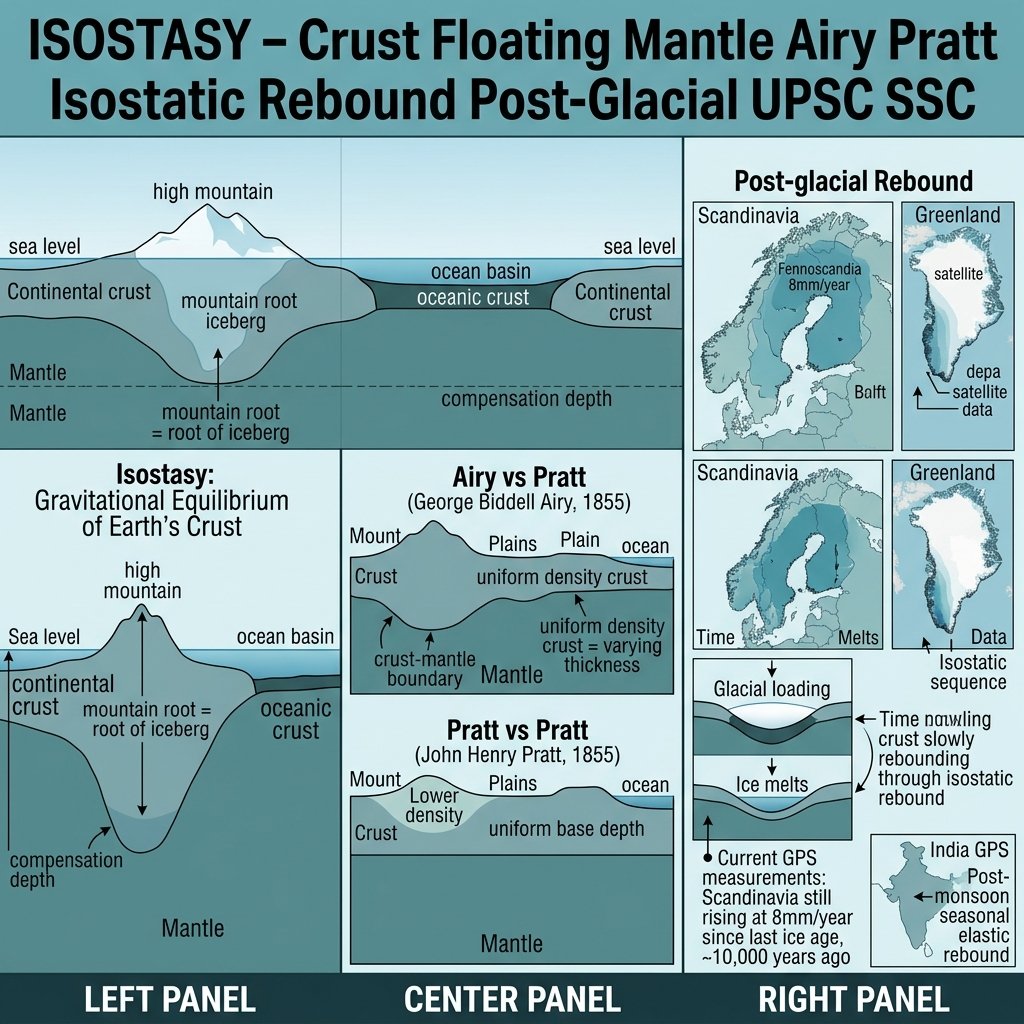
What is Isostasy?
- ⚖️ Definition: Isostasy is the gravitational equilibrium of Earth’s crust — a state in which large crustal blocks reach a condition of hydrostatic balance by floating at different elevations in the underlying mantle, depending on their density and thickness; heavier/thinner crust sinks deeper; lighter/thicker crust floats higher; the mantle behaves as a very viscous fluid on geological timescales (though solid on human timescales), allowing the crust to gradually rise or sink over thousands to millions of years
- ⚖️ The iceberg analogy: An iceberg floats in seawater because ice is less dense (~917 kg/m³) than water (~1,025 kg/m³); approximately 90% of the iceberg is submerged below the waterline and only 10% is visible above; the higher an iceberg protrudes above water, the deeper its submerged root extends below; continental crust (~2,700–2,800 kg/m³) is less dense than oceanic mantle (~3,200–3,300 kg/m³), so continental crust “floats” with both a surface portion above sea level and a deeper “root” in the mantle; the taller the mountain range, the deeper its crustal root
- ⚖️ The compensation depth: The level below which pressure is equal everywhere (regardless of what topography exists above) = the depth of isostatic compensation; at this depth and below, the weight of a vertical column of material (from the surface down) is the same everywhere — high mountains compensated by deep roots; ocean basins compensated by thin crust with denser mantle filling in from below; typically ~100–150 km depth; below the compensation depth, pressure gradients are horizontal = no buoyancy forces driving vertical motion
- ⚖️ The Great Indian Survey discovery (1840s): George Everest (Surveyor-General of India) and John Henry Pratt noticed that plumb bobs near the Himalayas showed less gravitational deflection toward the mountains than the mountains’ calculated mass should produce; Archdeacon J.H. Pratt and Astronomer Royal George Biddell Airy independently developed their competing explanations in 1855; the discrepancy was explained by isostasy: the mountains’ gravitational excess is underground compensated by a deficit (low-density root or lower density material under mountains)
Airy vs Pratt Models of Isostasy
| Feature | Airy Model (1855) | Pratt Model (1855) |
|---|---|---|
| Proposed by | George Biddell Airy (British Astronomer Royal, Greenwich Observatory) | John Henry Pratt (Archdeacon of Calcutta; working for the Great Indian Trigonometrical Survey) |
| Core assumption | All continental crust has the same density but variable thickness; mountains are tall because the crust is thick; the Moho (crust-mantle boundary) is irregular — dipping deep below mountains and rising close to surface below ocean basins | All continental crust has the same depth to its base (uniform lower boundary) but variable density; mountains are tall because their crust is less dense and therefore more buoyant; ocean basins are lower because their crust is denser |
| Mountain model | Mountain has a deep “crustal root” punching down into the mantle; the root is equal in thickness to the mountain’s height above the surrounding crust (scaled by density ratio); Himalayas (8,849 m peak) have crustal thickness ~70 km vs ~35 km on plains; the root = ~35 km of extra crust punching into mantle | Mountain is tall because it is made of less dense rock; the base of all crust is at the same depth; mountain rock has density ~2,600 kg/m³; plain rock ~2,750 kg/m³; ocean basaltic crust ~2,900 kg/m³; density variation compensates for height variation |
| Ocean basin model | Oceanic crust is thin; the Moho is very shallow below oceans; denser mantle material (peridotite ~3,300 kg/m³) fills in where crust is thin, making the column heavy enough to sit at lower elevation | Oceanic crust is denser rock (basalt vs granite); because it is denser, it floats lower into the mantle; the base is still at the uniform isostatic compensation depth |
| Key evidence for this model | Seismic refraction studies confirm thicker crust under mountains (Himalayan crust thickness reaches 70+ km confirmed by seismology); MOHO depth varies from 5 km (ocean) to 70 km (Himalayas); Airy’s model is CORRECT for most mountain ranges | Mid-ocean ridge topography (ridges are high despite thin crust = hot, less dense mantle material buoying them up); thermal isostasy of oceanic crust; some regions where crust density varies independently of thickness (South America’s Altiplano plateau) |
| Where each applies best | Fold mountain regions (Himalayas, Alps, Andes, Rockies) where crustal collision has thickened the crust with a deep root; most continental mountain belts | Ocean ridges (hot, low-density mantle material = thermally buoyed crust); regions of igneous intrusion with altered rock density; some continental plateau regions |
Vening Meinesz Model — Flexural Isostasy
- 🔬 Third model: Dutch geodesist Felix Vening Meinesz (1931) proposed a third model combining elements of Airy and Pratt: the lithosphere (rigid outer layer including crust and uppermost mantle) acts as an elastic plate that flexes (bends) under load rather than sinking locally; a surface load (ice sheet, mountain, volcanic island chain) causes a broad regional downward flexure of the lithosphere, with a surrounding moat (flexural depression) and an outer rise (flexural bulge) beyond the load; this is flexural isostasy
- 🔬 Examples of flexural isostasy: Hawaiian Islands chain: each volcanic island loads the lithosphere; a moat encircles each island (submerged outer flank lowered by flexure); a subtle arch (rise) forms beyond the moat; the Hawaiian Arch is a measurable bathymetric feature around the Hawaiian chain; Indo-Gangetic Plain: the Himalayan mountain system loads the Indian plate lithosphere; the Gangetic Plain represents the flexural depression (the “moat”) in which Indo-Gangetic alluvial sediments accumulate; this is why the river plain is so deep (~5–8 km of sediment fill in the Gangetic Basin); the flexural amplitude depends on the lithosphere’s elastic thickness (EET = Effective Elastic Thickness) — a measure of the lithosphere’s rigidity
Post-Glacial Rebound — Isostasy in Action
- 🏔️ What it is: During the Last Glacial Maximum (LGM, ~20,000 years ago), continental ice sheets (the Laurentide Ice Sheet over North America; the Fennoscan dian Ice Sheet over Scandinavia; the Patagonian Ice Sheet over Southern South America) were up to 3–4 km thick and pressed the underlying lithosphere downward into the mantle by hundreds of metres — a process called glacioisostatic depression; when the ice melted (~10,000–15,000 years ago), the load was removed; the lithosphere is slowly rebounding back to its pre-glacial elevation = post-glacial isostatic rebound (also called glacioisostatic rebound or post-glacial uplift)
- 🏔️ Scandinavia / Fennoscandia: Most dramatic and best-studied example; the Scandinavian Peninsula is currently rising at 8–10 mm per year (measured by GPS and tide gauge data) in central Fennoscandia (Sweden, Finland); since the ice melted ~10,000 years ago, Scandinavia has already risen ~300 m; it is expected to rise another ~100–200 m before reaching isostatic equilibrium in another ~10,000–20,000 years; the Baltic Sea is gradually shallowing and shrinking due to this ongoing uplift; the Gulf of Bothnia between Sweden and Finland will eventually become dry land; ancient Viking harbour sites are now significantly above present sea level (archaeological evidence of rebound)
- 🏔️ Canada (Laurentide rebound): Hudson Bay = a remnant of the crustal depression caused by the Laurentide Ice Sheet; currently rising at 6–10 mm/year in the Hudson Bay coastline area; James Bay is slowly emerging from the sea floor; the Great Lakes basin shoreline is differentially uplifting (northern shorelines rising faster than southern, causing lake tilting)
- 🏔️ India’s seasonal mass changes: GPS networks across India detect seasonal elastic deformation of the crust; the Himalayan glaciers and snowpack gain mass in winter = load the crust down by a few mm; melt in summer = crust springs back up; the monsoon water loading of the Indo-Gangetic Plain in July-September also causes measurable transient crustal depression (a few mm) that elastic rebounds after monsoon; these are short-timescale elastic responses, not permanent viscous isostatic adjustment but illustrate the same fundamental principle
- 🏔️ Rate of rebound and mantle viscosity: The rate of post-glacial rebound is controlled by the viscosity of the mantle — how quickly the mantle material can flow to allow crust movements; typical upper mantle viscosity = ~10²⁰–10²¹ Pascal-seconds (an enormously viscous material — water is ~10⁻³ Pa·s; glass is ~10²⁵ Pa·s; the mantle is in-between); at this viscosity, large-scale isostatic adjustment takes thousands to tens of millions of years; smaller-scale elastic responses (seismic timescales) = instantaneous; intermediate-scale responses (glacial cycles = 10,000s of years) = viscous creep of the asthenosphere; mountain erosion timescale isostatic adjustment = millions of years
Gravity Anomalies & Isostasy
- 📡 Free-air gravity anomaly: The difference between observed gravity and the theoretical gravity expected at that point’s elevation (if Earth were a smooth ellipsoid); a large free-air anomaly means the observed gravity differs from expected — indicating mass excess (positive anomaly) or mass deficit (negative anomaly) at that location
- 📡 Bouguer anomaly: Free-air anomaly corrected for the gravitational attraction of the rock mass between the surface and the reference ellipsoid; if a mountain has a Bouguer anomaly close to zero, it is isostatically compensated (the mountain’s visible mass is balanced by a root of lower density); a large negative Bouguer anomaly over a mountain = isostatic undercompensation (mountain is being supported by crustal strength, not floating); a large positive Bouguer anomaly = isostatic overcompensation
- 📡 Himalayas’ negative Bouguer anomaly: The Himalayas show one of Earth’s most pronounced negative Bouguer gravity anomalies: -250 to -500 milligals (mGal) under the high Himalayan ranges; this confirms the Airy isostatic model = a massive crustal root (crust reaching 70+ km thickness) is providing the isostatic support; the gravity over the mountain is much lower than a non-isostatically-compensated mountain of the same height would produce = the root’s low-density mass pulls gravity down
- 📡 Mid-ocean ridges: Show near-zero Bouguer anomalies despite being 2–2.5 km higher than the surrounding ocean floor; explained by thermally expanded, less dense mantle material beneath the ridges (Pratt-style isostasy = density variation compensating the height); the hot mantle beneath ridges is ~3,100 kg/m³ vs ~3,300 kg/m³ for normal cold oceanic mantle
Isostasy and Plate Tectonics Connections
- 🌍 Mountain formation and erosion cycle: As tectonic collision builds mountains (e.g., India-Eurasia collision building Himalayas), the growing crustal thickness allows the range to stand tall (Airy isostasy maintains it); as weathering and rivers erode the mountain tops, the reduced surface load causes the crust to isostatically rebound upward — bringing fresh material from depth to the surface; this is why river incision (cutting deeper gorges) and tectonic uplift can occur simultaneously; it is also why the Himalayas have been keeping pace with erosion for 40–50 million years — the isostatic rebound of the root replenishes what erosion removes from the top
- 🌍 Oceanic slab subduction and isostasy: As oceanic crust ages and cools after forming at mid-ocean ridges, it becomes denser and sinks lower into the mantle (thermal subsidence — a Pratt-type isostatic response to density change); by the time oceanic crust is ~80–100 million years old (~180 km depth to its base at mid-ocean reference), it is dense enough to become negatively buoyant and sink into the mantle spontaneously (initiating subduction); “slab pull” (the weight of dense, sinking oceanic lithosphere) is the dominant driving force for plate motion
- 🌍 Continental collision and crustal thickening: When two continents collide (India-Eurasia collision began ~50 million years ago), neither can subduct (continental crust is too buoyant to sink into the mantle); instead, the crust thickens by folding, thrusting, and underthrusting; the thickened crust reaches isostatic equilibrium by developing a deeper root (Airy model); this explains why continental collision zones (Himalayas, Tibetan Plateau) have the world’s thickest crust (up to 80+ km in Tibet) and highest elevations
⭐ Important for Exams — Quick Revision
- 🔑 Isostasy: Gravitational equilibrium of Earth’s crust; crust “floats” in the denser mantle; from Greek = equal standing; compensation depth = ~100–150 km
- 🔑 Great Survey of India discovery: 1840s; plumb bobs deflected less than expected near Himalayas; led to Airy and Pratt models (both 1855)
- 🔑 Airy model (1855): George Biddell Airy (Astronomer Royal); uniform crust density, variable thickness; mountains have DEEP CRUSTAL ROOTS; Moho is irregular; Himalayan crust = 70+ km thick; CORRECT for most mountain ranges
- 🔑 Pratt model (1855): John Henry Pratt (Archdeacon of Calcutta); uniform depth to crust base; variable density; mountains = lower-density rock; ocean = higher-density rock; applies to ocean ridges and thermal features
- 🔑 Vening Meinesz (1931): Flexural isostasy; lithosphere as elastic plate bending under load; moat (depression) and outer rise (flexural bulge) around loads; Hawaiian Arch; Indo-Gangetic Plain = flexural depression from Himalayan load
- 🔑 Indo-Gangetic Plain: Flexural depression caused by Himalayan loading on Indian plate; 5–8 km deep sediment fill; classic flexural isostasy example in India
- 🔑 Post-glacial rebound: Isostatic uplift after ice sheet removal; Scandinavia rising 8–10 mm/year (still rebounding from LGM 10,000 yrs ago); Canada/Hudson Bay rising 6–10 mm/year
- 🔑 Last Glacial Maximum (LGM): ~20,000 years ago; ice sheets 3–4 km thick; depressed crust by hundreds of metres; melt ~10,000–15,000 years ago; rebound ongoing
- 🔑 Mantle viscosity: 10²⁰–10²¹ Pa·s; controls pace of isostatic adjustment; large-scale rebound takes thousands to millions of years; explains slow Scandinavian uplift
- 🔑 Bouguer anomaly: Gravity measurement corrected for rock mass above reference; near-zero Bouguer = isostatically compensated; strong negative Bouguer over Himalayas (-250 to -500 mGal) = confirms deep Airy root
- 🔑 Mid-ocean ridges: Near-zero Bouguer anomaly despite high elevation = thermally less dense mantle = Pratt-type isostasy; hot mantle ~3,100 vs cold ~3,300 kg/m³
- 🔑 Himalayan erosion + rebound: Rivers erode mountain tops; load reduces; crust isostatically rebounds upward; keeps Himalayas tall for 40–50 million years despite erosion
- 🔑 Continental buoyancy: Continental crust (~2,700–2,800 kg/m³) less dense than mantle (~3,200–3,300 kg/m³); cannot subduct; when two continents collide = crust thickens = Airy root develops = Himalayan-type collision zone
- 🔑 Oceanic slab pull: Aging oceanic crust cools, becomes denser, sinks = slab pull = dominant plate driving force; thermal subsidence = Pratt isostasy (density increases with age/cooling)
- 🔑 India seasonal elastic rebound: Himalayan snowpack loads crust in winter (down a few mm); summer melt = rebound; monsoon water loads IGP in Jul-Sep; GPS-detectable elastic fluctuation
Frequently Asked Questions (FAQs)
1. What is the Airy model of isostasy — and what did Indian survey data reveal about the Himalayas?
The discovery that led to the Airy model of isostasy is one of the most satisfying detective stories in the history of geophysics — a measurement discrepancy noticed during the mapping of India that unexpectedly revealed a fundamental property of Earth’s interior. The Great Trigonometrical Survey of India (GTS): The GTS — one of the most ambitious scientific undertakings of the 19th century — was mapping the Indian subcontinent with extraordinary precision from the 1800s onward, ultimately producing the first accurate measurement from which the height of Mount Everest was calculated in 1852. The survey used two independent methods to determine geographic position: astronomical observation (measuring the angles of stars above the horizon to find latitude) and triangulation from baseline measurements (measuring angles and distances on the ground to calculate positions geometrically). In a correctly functioning survey, both methods should give the same geographical coordinates for any point. But near the Himalayas, there was a persistent discrepancy: the astronomical latitude readings were systematically offset from the triangulation-calculated latitudes by up to 15 arc-seconds when the survey party was near Kalianpur (about 600 km south of the Himalayas). J.H. Pratt’s analysis: Archdeacon John Henry Pratt — working in Calcutta and deeply interested in surveying problems — calculated in 1855 what the gravitational deflection of a plumb bob (the instrument that defines “vertical” for astronomical observations) should be if the Himalayas were a simple block of solid rock sitting on a uniform crust. The Himalayas contain an immense mass of rock — towering 8 km above the plains over a width of hundreds of kilometres. This extra mass should produce a significant gravitational pull on a plumb bob, deflecting it toward the mountains (northward) by about 28 arc-seconds at Kalianpur. But the actual observed deflection was only about 5 arc-seconds — less than one-fifth of what theory predicted. Pratt recognised this must mean the visible mass of the Himalayas is not as gravitationally significant as it appears — something must be compensating for the expected gravitational pull. His proposed explanation (the Pratt model) was that the rock under the Himalayan region is less dense than elsewhere, reducing the net excess gravity downward to near the observed level. George Biddell Airy’s competing explanation: Astronomer Royal George Biddell Airy, working independently at the Greenwich Observatory (without access to the Indian survey data that inspired Pratt), proposed in the same year 1855 a completely different mechanism. Airy’s starting point was the iceberg analogy: if icebergs of different heights above water all consist of the same type of ice (same density), then a higher iceberg must have a proportionally deeper submerged keel. He proposed that similarly, the crust under mountain ranges must have a deeper “root” projecting down into the slightly denser mantle. The root, being made of lower-density crustal material (~2,700 kg/m³) displacing higher-density mantle material (~3,300 kg/m³), has a mass deficit (it is lighter than the mantle it replaced). This mass deficit beneath the mountains partially cancels the mass excess of the mountains above the surface — reducing the net gravitational anomaly to near zero. The Himalayan gravitational discrepancy is therefore explained by an Airy crustal root: the mountains have a “mirror image” root punching downward approximately 5–7 times the mountain’s height above the surrounding crust (scaled by the density contrast between crust ~2,700 kg/m³ and mantle ~3,300 kg/m³; the density ratio gives the root-to-height ratio). For the Himalayas with average height ~5 km above the plains, the crustal root extends approximately ~35 km deeper than the normal 35 km Moho depth under the surrounding plains = Himalayan Moho is at ~70 km depth. Modern seismic confirmation: Starting in the 1970s, deep seismic reflection and refraction surveys (including the INDEPTH project — Indian National Deep Profiling of Transects through the Himalayas) directly measured the Himalayan crustal thickness using seismic waves. These surveys confirmed that crustal thickness beneath the high Himalayas and the Tibetan Plateau reaches 70–80 km — in exact agreement with the Airy isostatic model. By comparison, the Indian shield south of the Himalayas has normal crustal thickness of ~35–40 km. The crustal root is real, measurable, and exactly as large as Airy’s model predicts.
2. Why is Scandinavia still rising after the last ice age — and what does this tell us about isostasy?
One of the most dramatic demonstrations that isostasy is a real ongoing geophysical process — not just a theoretical concept for textbooks — is happening right now in Scandinavia, where the land surface is measurably rising at rates visible in human lifetimes. Local fishermen in the Gulf of Bothnia have noticed over generations that the sea is “getting shallower” — harbours that served their grandparents’ fishing boats are now too shallow for modern vessels. Ancient Viking Age ports that were at sea level a thousand years ago are now several metres above the water. And modern GPS instruments record the Scandinavian crust rising at 8–10 mm per year in central Fennoscandia. This ongoing uplift is entirely explained by isostatic rebound from the weight of the last ice age. The loading phase (before 20,000 years ago): During the Last Glacial Maximum approximately 20,000 years ago, the Fennoscandian Ice Sheet covered all of Scandinavia, Finland, the Baltic states, and extended into northern Germany, Denmark, and the British Isles. At its maximum, the ice sheet was approximately 3 km thick over central Scandinavia (modern-day Bothnia). This ice — with density ~917 kg/m³ — exerted a pressure on the underlying lithosphere of approximately 30 million Pascals (300 times atmospheric pressure) at its thickest point. This load was more than sufficient to push the lithosphere down into the underlying mantle viscously: the asthenosphere (partially molten upper mantle, viscosity ~10¹⁸–10²⁰ Pa·s) gradually flowed laterally away from under the loaded region, allowing the lithosphere above to subside. At maximum ice thickness, the Scandinavian lithosphere had been depressed approximately 800 m below its ice-free equilibrium position. The unloading phase (15,000–10,000 years ago): The Fennoscandian Ice Sheet began melting rapidly after ~15,000 years ago, with most of the ice gone by ~10,000 years ago. As the ice load decreased to zero, the lithospheric load was removed. The mantle, which had been displaced laterally during loading, now needed to flow back toward the unloaded region to allow the crust to rebound upward. The rate of this return flow depends on mantle viscosity. Why rebound is still happening 10,000 years later: Mantle viscosity (~10²⁰ Pa·s under Fennoscandia’s upper mantle) means the material flows extremely slowly — even though it has flowed substantially over 10,000 years of rebound (the centre of Fennoscandia has risen ~300 m since the ice melted), there is still a “rebound deficit” of approximately 200–300 m remaining before full isostatic equilibrium is reached. At the current rate of 8–10 mm/year, full equilibrium would be reached in roughly another 10,000–20,000 years. The rate of rebound is not constant — it was faster in the early post-glacial period (when the pressure gradient was larger) and is slowing over time asymptotically approaching zero as equilibrium is reached. Geophysical information from rebound data: Critically, the pattern and rate of post-glacial rebound across Scandinavia, combined with models of the ice sheet’s shape, extent, and melting history, allows geophysicists to determine the viscosity profile of the mantle beneath Scandinavia — depth-dependent viscosity structure. This is one of the most powerful constraints on mantle rheology available, independent of seismic studies. The Post-glacial rebound data suggest: upper mantle viscosity under Fennoscandia ~4 × 10²⁰ Pa·s; lower mantle viscosity ~10²² Pa·s — significantly higher in the lower mantle. This viscosity layering is important for understanding how plates move and how convection operates in Earth’s mantle. Implications for sea level: Scandinavia’s uplift has the counterintuitive effect of lowering relative sea level in the Baltic region even as global sea levels are rising from climate change. The local emergence of land (isostatic rebound) exceeds the rise in eustatic sea level in central Fennos candia. In Stockholm, relative sea level is actually falling at ~4 mm/year because isostatic rebound (8 mm/year) exceeds global sea level rise (~3–4 mm/year). By contrast, in regions far from the former ice margin (e.g., the British Isles’ southern coast, the US East Coast), the outer flexural bulge that formed around the ice sheet during glaciation is now collapsing (the forebulge subsides as the mantle material that maintained it flows northward into the rebounding Scandinavia region = known as forebulge collapse) — causing relative sea level rise in addition to eustatic rise.
3. How does isostasy control the height of mountain ranges — and why haven’t the Himalayas eroded away?
The Himalayas have been rising and eroding for approximately 50 million years. In that time, rivers have carved canyons through them, glaciers have sculpted their peaks, and chemical and physical weathering has delivered billions of tonnes of sediment to the Bengal Fan (the world’s largest submarine sediment fan in the Bay of Bengal, which contains deep-sea sediment from Himalayan erosion stretching back to the collision’s beginning). Yet the Himalayas today remain the world’s highest mountain range — with 14 peaks above 8,000 m and hundreds above 7,000 m. Why haven’t 50 million years of aggressive erosion worn them flat? The answer is isostatic rebound from erosion — one of the most elegant feedback mechanisms in Earth science. The erosion-rebound cycle: When erosion removes mass from the top of a mountain range (rock removed by rivers, glaciers, and weathering), the total mass load on the underlying lithosphere decreases. By Airy’s isostatic model, the crust was at equilibrium with its crustal root when the mountain was at its equilibrium height. When erosion removes rock from the top, the mass above the compensation depth is reduced, creating an isostatic imbalance: the crustal root is now too large for the reduced surface mass; the system is out of equilibrium; residual buoyancy of the root pushes the entire crustal block upward. This upward isostatic rebound brings fresh, deep crustal rock to the surface to replace what was eroded away — maintaining the mountain’s height. The key parameter is the ratio of crustal density to mantle density: if erosion removes 1 km of mountain surface, isostatic rebound brings up approximately (ρ_crust/Δρ) × 1 km of fresh rock from depth = approximately (2,700/(3,300 – 2,700)) × 1 km = 2,700/600 × 1 km ≈ 4.5 km of rebound for every 1 km eroded. Wait — 4.5 km of rebound for 1 km eroded means the mountain height actually increases by 3.5 km? No — because the 4.5 km of new rock brought up from depth is in addition to the 1 km that was removed, so net change in height = new rock exposed (4.5 km rebound) – original height before erosion (5.5 km rebound and erosion combined, but only 1 km is removed from surface, so net = 4.5 km rebound – 1 km eroded = net 3.5 km increase in surface elevation after removing 1 km). But crucially: the eroded material is carried away (to river deltas, ocean floors), removing mass from the system permanently. The crustal root slowly shrinks as the mountain approaches a lower equilibrium height — the system converges to a dynamic steady state where erosion rate equals the uplift rate driven by tectonic compression. The Himalayan dynamic equilibrium: In the Himalayas, the ongoing India-Eurasia collision is still actively thickening the crust (adding new material to the root from below by underthrusting of the Indian Plate). Simultaneously, erosion is removing material from the surface. The two processes — tectonic input and erosional removal — have been roughly balanced for tens of millions of years, maintaining Himalayan height at approximately the current elevation range. Studies of thermochronology (measuring the cooling history of rocks using isotopic systems like apatite fission track dating) show that rocks currently exposed at the surface of the High Himalayas were 10–15 km deep in the crust only 5–10 million years ago — they were brought to the surface by the combination of tectonic uplift and isostatic rebound from erosion, with rivers cutting deeply enough to access and expose this once-deep rock. The spectacular gorges of the Arun (Nepal), Brahmaputra, and Indus rivers cutting through the highest Himalayan ranges at elevations below the peaks are evidence of this “river antecedence” — rivers that existed before the mountains and cut down through them as the mountains rose below them, maintained by the same isostatic dynamics. When will the Himalayas be eroded away: If the India-Eurasia collision stopped today (ceased adding new crustal material from below), the Himalayas would gradually collapse under their own weight and erode to a peneplain — but this would take approximately 20–40 million years, not thousands of years, because the isostatic rebound from erosion would continually replenish the surface from depth. The rate of collapse without tectonic input would be controlled by erosion rates (~0.5–2 mm/year) and the isostatic rebound factor (roughly 80% of eroded height is replaced by rebound) — meaning only ~20% of each erosion cycle results in net height loss; 50 million years of erosion at 1 mm/year would lower mountains by only ~10,000 m net if tectonic input ceases completely. Since the Indian Plate is still moving northward at ~5 cm/year and the collision is still active, the Himalayas will remain the world’s highest mountain system for tens of millions of years into the future.
Related Geology Articles on StudyHub
- ➡️ Himalayan Formation — India-Eurasia Collision & MCT MBT
- ➡️ Plate Tectonics — Slab Pull & Ridge Push Forces
- ➡️ Lehmann Discontinuity — Earth’s Interior Structure
- ➡️ Himalayan Glaciers — Glacioisostatic Rebound & GLOFs
- ➡️ Rivers & Fluvial Geomorphology — Himalayan River Antecedence