When tectonic plates pull apart — stretching the crust under tension — the ground does not simply separate cleanly. Instead, the crust fractures along steep normal faults, and a central block collapses downward between two outward-tilting fault blocks, forming an elongated depression called a rift valley or graben. Rift valleys are among Earth’s most dramatic geological features: they can stretch thousands of kilometres, drop thousands of metres below the surrounding plateau, host the world’s deepest lakes, trigger intense volcanic activity, and — if rifting continues long enough — split continents apart and birth entirely new oceans. The East African Rift System is the world’s largest active continental rift, stretching 6,400 km from the Afar Triangle in Ethiopia to Mozambique, and contains 30% of the world’s freshwater in its rift lakes. In India, the Narmada-Son Lineament is an ancient rift valley reactivated multiple times, along which the Narmada and Son rivers flow, flanked by the Vindhya and Satpura ranges acting as horsts. Understanding rift valleys — their formation, types, examples, and geological significance — is essential for UPSC, SSC and competitive examinations.
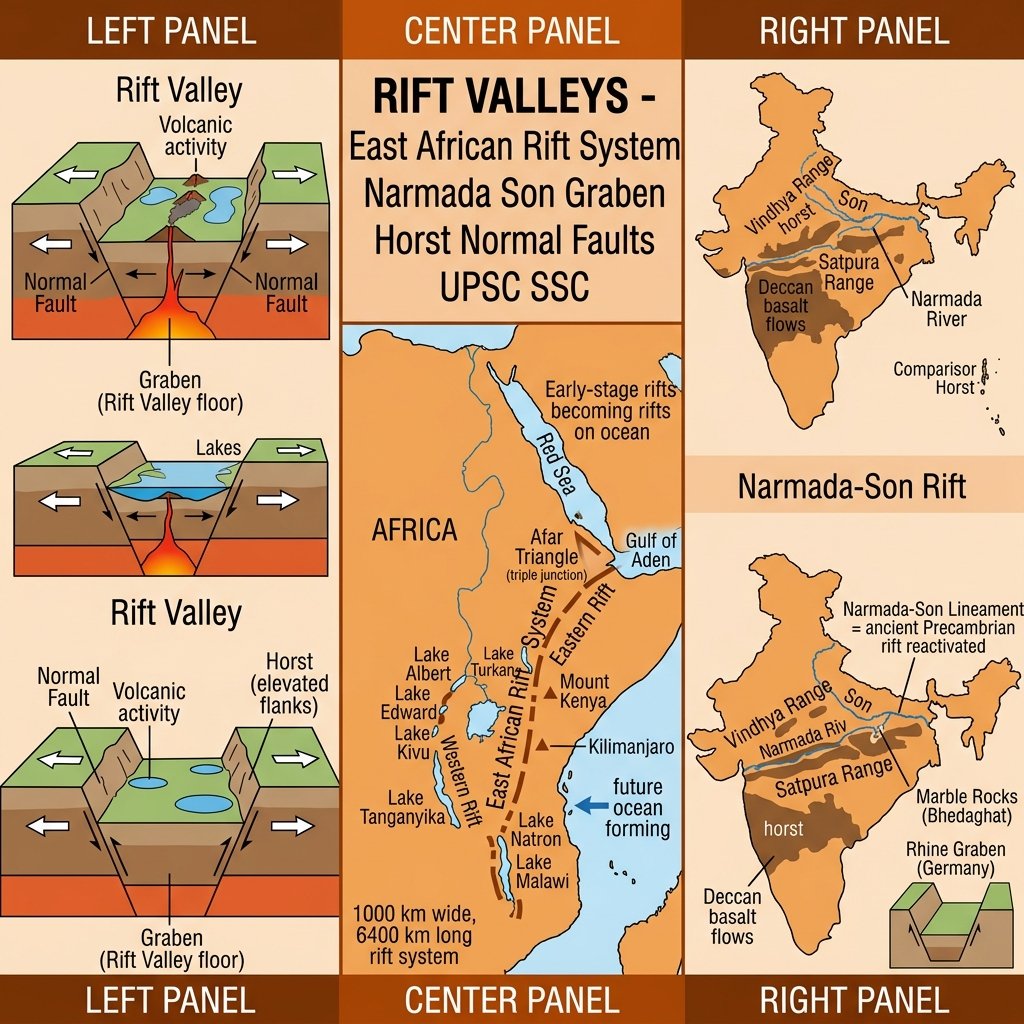
What Is a Rift Valley? — Formation Mechanism
- 🏔️ Definition: A rift valley (also called a graben) is a linear depressed region bounded on either side by parallel normal faults, formed when the crust is pulled apart under tensional stress; the central block drops down while the flanking blocks (horsts) remain elevated or rise relatively
- 🏔️ Normal faults: Rift valleys form along normal faults — faults where the hanging wall (block above the fault plane) moves down relative to the footwall (block below); this is the reverse of thrust/reverse faults (which form under compression); normal faults indicate extensional (tensional) tectonic stress; fault planes typically dip at 50–70°
- 🏔️ Graben vs horst: Graben = the downthrown central block between two inward-dipping normal faults = the rift valley floor; Horst = the upthrown block on either side of the graben = the elevated flanks or ridges flanking the rift valley; together, alternating grabens and horsts create the typical “basin and range” topography of rift zones
- 🏔️ Heat and volcanism: As the crust thins through extension, the hot asthenosphere rises closer to the surface; this decompression causes partial melting and volcanic activity along the rift axis; rift volcanism produces alkali basalts and sometimes highly explosive phonolites and trachytes (as seen in the East African Rift’s Rift Valley volcanoes); the Afar region has some of the most active rift volcanism on Earth
- 🏔️ Rift lakes: As the valley floor drops below drainage divides, rivers drain into the rift basin with no outlet to the sea; enclosed rift lakes form — often very deep (Lake Tanganyika = 1,470m deep, world’s second deepest lake), long (Lake Tanganyika = 673 km long), and old (Lake Tanganyika contains unique fauna evolved over millions of years of isolation)
Stages of Rift Development — From Crack to Ocean
| Stage | Description | Modern Example | Duration |
|---|---|---|---|
| Stage 1 — Embryonic Rift | Mantle plume or far-field tension begins doming and cracking the crust; initial normal faults form; modest subsidence; rivers reorient toward the developing depression; volcanic activity begins along the rift axis | East African Rift (Eastern Branch — Kenya Rift); Rhine Graben (Germany); Rio Grande Rift (USA) | Millions of years |
| Stage 2 — Young Rift | Deep rift valley established with steep fault scarps; rift lakes develop; thinning crust brings hot mantle closer; volcanic activity intensifies; proto-ocean conditions beginning at lowest points | Afar Depression (Ethiopia) — partially below sea level; Lake Tanganyika Western Rift; Dead Sea Rift (transform-related) | Tens of millions of years |
| Stage 3 — Narrow Ocean | Rifting has split the continent; new oceanic crust forming at a mid-ocean ridge; narrow seaway; evaporites may deposit in early stages; continental margins form on either side | Red Sea (Arabia-Africa separation began ~30 Ma; narrow ocean 300–360 km wide with active spreading); Gulf of Aden (slightly older) | 30–50 million years from initial rift |
| Stage 4 — Mature Ocean | Continued seafloor spreading; wide ocean; passive continental margins (thick sediment accumulations); mid-ocean ridge in centre; hotspot trails on ocean floor record plate motion | Atlantic Ocean (opened from ~180 Ma; product of Pangaea rifting; still widening at 2.5 cm/yr; India’s eastern margin = passive margin) | 100–200+ million years |
| Failed Rift (Aulacogen) | One arm of a triple rift junction fails to develop into an ocean while the other two arms do; the failed arm becomes an aulacogen — a fossil rift arm buried under sediment; rivers often follow these ancient lineaments | Narmada-Son Lineament (India) = ancient Precambrian aulacogen; Mississippi Embayment (USA) = failed arm of Gulf of Mexico rift; Benue Trough (Nigeria) = failed arm of South Atlantic opening | Permanently arrested |
East African Rift System — The World’s Greatest Active Rift
- 🌍 Overview: The East African Rift System (EARS) stretches ~6,400 km from the Afar Triple Junction in Ethiopia/Djibouti/Eritrea southward through Ethiopia, Kenya, Tanzania, and Mozambique; it is the world’s largest active continental rift; it is splitting the African Plate into two future plates: the Somali Plate (eastern portion) and the Nubian Plate (western portion); the rift is approximately 30–100 km wide
- 🌍 The Afar Triple Junction: At the northern end of the EARS, three rift arms meet in the Afar (Danakil) Depression of Ethiopia/Eritrea/Djibouti: (1) the Red Sea Rift (opening northward between Arabia and Africa, already a narrow ocean); (2) the Gulf of Aden Rift (opening eastward, already a narrow ocean); (3) the Main Ethiopian Rift (opening southward through Africa, still a continental rift); this is a classic RRR triple junction (Ridge-Ridge-Ridge) and is one of very few places on Earth where a continental rift-to-ocean transition is occurring in real time and can be directly observed
- 🌍 Eastern Rift Branch (Gregory Rift): Runs through Ethiopia and Kenya; contains the Kenyan Rift Valley (famous for Homo sapiens and hominin fossil sites — Olduvai Gorge, Turkana Boy discovery); contains Lake Turkana (world’s largest permanent desert lake), Lake Natron (highly alkaline, home to 75% of world’s lesser flamingoes), Lake Nakuru (flamingo lake); bounded by volcanic highlands including Mount Kenya (5,199m, extinct) and Mount Kilimanjaro (5,895m, dormant stratovolcano, Africa’s highest peak, located just east of the rift)
- 🌍 Western Rift Branch (Albertine Rift): Runs along the western border of Uganda, DRC, Rwanda, Burundi, Tanzania; contains the deepest and oldest rift lakes: Lake Tanganyika (1,470m deep, 673 km long, world’s second deepest, holds 18% of world’s liquid freshwater), Lake Malawi/Nyasa (706m deep), Lake Albert, Lake Edward, Lake Kivu; the Western Rift lakes are older and deeper than the Eastern Rift lakes; Lake Tanganyika contains over 1,000 endemic fish species (cichlids) evolved in isolation over ~9–12 million years
- 🌍 Volcanic activity: The EARS hosts numerous active volcanoes: Nyiragongo (DRC) = one of world’s few permanent lava lakes, erupted catastrophically 2002 and 2021; Erta Ale (Ethiopia) = another permanent lava lake in the Afar Depression; Ol Doinyo Lengai (Tanzania) = world’s only active carbonatite volcano (erupts black lava made of sodium carbonate, not silicate); Oldoinyo Sambu; the volcanic activity reflects the rising asthenosphere under the thinning rift crust
Major Rift Valleys of the World
| Rift Valley | Location | Length | Key Features |
|---|---|---|---|
| East African Rift System | East Africa (Ethiopia to Mozambique) | 6,400 km | World’s largest active rift; Lake Tanganyika (1,470m deep); Afar Triple Junction; splitting Africa in two; hominin fossil sites |
| Red Sea Rift | Between Arabian Peninsula and Africa | 1,900 km | Stage 3 rift (narrow ocean); active spreading at ~1.6 cm/yr; deepest point 2,211m; strategically vital shipping lane |
| Dead Sea Transform (Rift) | Jordan-Israel-Palestine | 1,020 km | Lowest exposed land on Earth (Dead Sea surface −430m below sea level); technically a transform fault, not a pure rift; flanked by Jordan Rift Valley |
| Rhine Graben | Germany-France-Switzerland | 350 km | Classic graben; Black Forest (horst) on east; Vosges Mountains (horst) on west; Rhine River flows along rift floor; minor seismicity; initiated ~35 Ma |
| Rio Grande Rift | Colorado to Texas, USA | ~1,000 km | Active rift; Rio Grande River follows rift floor; Basin and Range Province; initiated ~35 Ma; Basin and Range extension |
| Baikal Rift | Siberia, Russia | 1,600 km | Lake Baikal = world’s deepest lake (1,642m), oldest lake (~25 Ma), holds 20% of world’s unfrozen fresh surface water; active seismicity; initiated ~25 Ma |
| Narmada-Son Lineament | Central India | ~1,400 km | Ancient Precambrian rift (aulacogen); Narmada and Son rivers follow rift floor; Vindhya Range (N horst) and Satpura Range (S horst); Marble Rocks gorge (Bhedaghat); reactivated multiple times; Gondwana coal deposits in Son Valley |
The Narmada-Son Lineament — India’s Rift Valley
- 🇮🇳 What it is: The Narmada-Son Lineament (NSL) is a major east-west trending structural zone in central India, approximately 1,400 km long, that represents an ancient rift valley (aulacogen) formed during the Precambrian (possibly ~1,600–1,000 Ma) and reactivated multiple times through India’s geological history; it forms one of the most important tectonic boundaries in the Indian subcontinent, separating the Vindhyan Platform (north) from the Deccan Trap basalts and Satpura ranges (south)
- 🇮🇳 Rivers flowing in the rift: Both the Narmada River (flows westward, 1,312 km, into Gulf of Khambhat) and the Son River (flows eastward, 784 km, into Ganga) follow this ancient rift lineament; the two rivers flow in opposite directions along the same rift valley — a classic example of a divide controlling drainage direction; the Narmada is one of India’s five major rivers that flow west and drain into the Arabian Sea rather than eastward
- 🇮🇳 Horsts flanking the rift: The Vindhya Range to the north and the Satpura Range to the south are both horst blocks — upthrown fault blocks flanking the downthrown graben of the Narmada-Son valley; the Vindhyas reach ~300–400m; the Satpura peaks at Dhupgarh (1,352m, highest point in Madhya Pradesh); the Vindhyas historically formed the cultural divide between North India and South India (mentioned in Puranas)
- 🇮🇳 Marble Rocks (Bhedaghat): The Narmada River cuts through a spectacular marble gorge at Bhedaghat near Jabalpur (Madhya Pradesh); the Marble Rocks are metamorphic limestone (marble) that lines the gorge walls; the Dhuandhar Falls (Smoke Cascade Falls) on the Narmada at Bhedaghat drop 30m; a UNESCO Tentative World Heritage Site
- 🇮🇳 Seismic significance: The NSL is one of India’s most seismically active intraplate zones; historical earthquakes include the 1938 Satpura earthquake and numerous moderate events; the zone is classified as Seismic Zone III in BIS 1893; the 1997 Jabalpur earthquake (Mw 5.8) caused significant damage in this zone; the lineament is a major crustal weakness repeatedly reactivated by far-field plate tectonic stresses
- 🇮🇳 Gondwana coalfields in Son Valley: The upper Son Valley contains important Gondwana-age coalfields (Permian, ~250–280 Ma) deposited in Gondwana grabens along the rift; Singrauli coalfield (Madhya Pradesh) = one of India’s largest coalfields with reserves exceeding 21 billion tonnes; also Johilla, Sohagpur, and Umaria coalfields
⭐ Important for Exams — Quick Revision
- 🔑 Rift valley: Linear depression formed by central block (graben) dropping between two normal faults; flanked by elevated horsts; formed under tensional stress at divergent plate boundaries or continental rifts
- 🔑 Graben: Downthrown block between normal faults = rift valley floor; opposite of horst
- 🔑 Horst: Upthrown block flanking a graben = elevated ridges or plateaus beside a rift valley
- 🔑 Normal fault: Hanging wall moves DOWN relative to footwall; forms under extension (tension); dips at 50–70°; characteristic of rift zones
- 🔑 Rift stages: Embryonic rift → Young rift with lakes → Narrow ocean (Red Sea stage) → Mature ocean (Atlantic stage)
- 🔑 Failed rift (aulacogen): One arm of a three-armed rift system that fails; remains as fossil rift buried under sediment; example: Narmada-Son Lineament, Benue Trough (Nigeria), Mississippi Embayment
- 🔑 East African Rift System: 6,400 km long; splitting Africa into Somali and Nubian plates; two branches: Eastern (Gregory Rift — Kenya, Lake Turkana) and Western (Albertine Rift — Lake Tanganyika)
- 🔑 Afar Triple Junction: Ethiopia/Eritrea/Djibouti; Red Sea Rift + Gulf of Aden Rift + Main Ethiopian Rift = RRR triple junction; embryonic ocean forming in Afar Depression; Dallol = hottest inhabited place on Earth
- 🔑 Lake Tanganyika: Western Rift; 1,470m deep (world’s second deepest); 673 km long; 18% of world’s liquid freshwater; 1,000+ endemic fish species (cichlids); 9–12 Ma old
- 🔑 Lake Baikal: Siberia, Russia; Baikal Rift; 1,642m deep (world’s deepest lake); holds 20% of world’s unfrozen fresh surface water; 25 Ma old
- 🔑 Red Sea: Stage 3 rift (narrow ocean); Arabia-Africa separation began ~30 Ma; spreading at 1.6 cm/yr; strategically vital: Suez Canal connects Red Sea to Mediterranean
- 🔑 Narmada-Son Lineament: Ancient Precambrian rift/aulacogen, central India; Narmada flows west, Son flows east along the same rift; Vindhya Range (N horst), Satpura Range (S horst); Bhedaghat Marble Rocks; Singrauli coalfield
- 🔑 Narmada River: 1,312 km; flows west into Gulf of Khambhat (Arabian Sea); flows along NSL rift; perennial; importance = drinking water + Sardar Sarovar Dam + cultural significance (Narmada Parikrama)
- 🔑 Nyiragongo (DRC): Western Rift; permanent lava lake; erupted 2002 (killed 147, 400,000 displaced) and 2021; high-speed low-viscosity carbonatite lava = extremely dangerous
- 🔑 Ol Doinyo Lengai (Tanzania): World’s only active carbonatite volcano; erupts black sodium carbonate lava (not silicate); located in Eastern Rift; the lava hardens white on exposure to air
- 🔑 Rhine Graben: Germany-France; classic textbook graben; Black Forest (E horst) + Vosges (W horst); Rhine River flows along graben floor; initiated ~35 Ma
Frequently Asked Questions (FAQs)
1. How does a rift valley form — and what is the difference between a graben and a horst?
The Extensional Stress Setting
Rift valleys form where tectonic plates or sections of continental crust are being pulled apart under extensional (tensional) stress. This can happen at divergent plate boundaries (where two plates move away from each other) or within a continental plate where deep mantle processes — such as a mantle plume doming the crust upward and causing it to crack — create localised extension.
Normal Fault Formation
When the crust is stretched, it fractures along normal faults — faults where the rock above the fault plane (the “hanging wall”) slides downward relative to the rock below the fault plane (the “footwall”). Normal faults typically dip at 50–70° and accommodate extension by allowing vertical displacement — some blocks drop, others rise relatively. This is the opposite of the thrust faults that form under compression (like the Main Boundary Thrust of the Himalayas).
Graben and Horst
- Graben (German: “grave” or “ditch”): The central downthrown block between two inward-dipping normal faults; this is the rift valley floor — it drops relative to the surrounding terrain, creating the characteristic steep-walled valley. The floor may drop hundreds to thousands of metres below the surrounding plateau surface
- Horst (German: “thicket”): The upthrown block on either side of the graben; horsts form the high flanking ridges or plateaus that tower above the rift valley; in the East African Rift, the Eastern and Western Rift walls are horsts; in India’s Narmada-Son Lineament, the Vindhya Range (north) and Satpura Range (south) are classic horsts flanking the Narmada graben
- Half-graben: Many real rift systems are asymmetric — the subsidence is controlled primarily by one major fault on one side rather than symmetric faults on both sides; the valley floor tilts toward the master fault; Lake Tanganyika occupies a series of half-grabens arranged in alternating polarity along the Western Rift
Volcanism in Rift Valleys
As the crust thins in a rift, the hot asthenosphere rises closer to the surface. The reduction in pressure as the asthenosphere decompresses causes partial melting — producing magma. This magma erupts along the rift axis as volcanic activity. Rift volcanoes typically produce alkali basalts enriched in sodium and potassium (unlike the water-rich andesites of subduction zones). In the East African Rift, carbonatite lavas (made of calcium carbonate, not silicate minerals) at Ol Doinyo Lengai are unique to this rift environment globally.
2. Is East Africa really splitting apart — will there be a new ocean?
Yes — But on Geological Timescales
The East African Rift System is a real, active, and ongoing geological process that is gradually splitting the African continent in two. The Somali Plate (east of the rift) is moving away from the Nubian Plate (west of the rift) at approximately 6–7 mm per year (0.6–0.7 cm/yr) — far slower than, say, the Red Sea (1.6 cm/yr) but unambiguously diverging. At this rate, it will take approximately 50 million years for East Africa to fully separate.
The Afar Depression — An Ocean Being Born
The best place to see the ocean-forming process in action is the Afar (Danakil) Depression in Ethiopia/Eritrea/Djibouti. Parts of the Afar Depression are already below sea level (the lowest point is approximately −155m at the Danakil Depression near Dallol). The thin crust here is producing true oceanic basalt from fissure eruptions — the same type of basalt that forms the ocean floor at mid-ocean ridges. In September 2005, a dramatic rifting episode in the Afar region opened a 60 km-long, up to 8 m-wide crack in the crust over just a few days, accompanied by over 160 earthquakes — visually demonstrating the rift opening in real time.
What the Future Ocean Will Look Like
- Short term (~1–2 million years): The Afar Depression will flood with seawater from the Red Sea, creating a new shallow inland sea in northern Ethiopia and Eritrea
- Medium term (~10 million years): A narrow ocean similar to the present Red Sea will extend southward through the Ethiopian and Kenyan Rifts; the rift lakes will drain into this new ocean as the rift deepens below sea level
- Long term (~50 million years): A mature ocean comparable to today’s Atlantic Ocean will separate East Africa (Somali Plate) from the African mainland (Nubian Plate); Madagascar and the East African coastline will become passive continental margins accumulating thick sediment sequences
- Analogy: The Red Sea and Gulf of Aden represent exactly what the East African Rift will look like in ~15–20 million years — young, narrow oceans with active spreading ridges in their centres
3. What is the Narmada-Son Lineament — and why is it important for India?
What the Narmada-Son Lineament Is
The Narmada-Son Lineament (NSL) is one of the most geologically significant structural features of the Indian subcontinent — a major east-west trending zone of ancient faults, shear zones, and rift structures extending approximately 1,400 km across central India from the Gulf of Khambhat (Gujarat) in the west to the Rajmahal Hills (Jharkhand) in the east. It has been active — on and off — for over a billion years, making it one of India’s oldest and most repeatedly reactivated tectonic structures.
Origin and Geological History
- Precambrian origin (~1,600–1,000 Ma): The NSL formed as a major rift during the late Proterozoic, possibly as a failed arm of a triple junction during the assembly or breakup of an ancient supercontinent
- Gondwana reactivation (~280–250 Ma): During the Permian, Gondwana-age river systems deposited coal-bearing sediments in the NSL grabens; the Son Valley Gondwana coalfields (Singrauli, Jharia outliers) are a direct result
- Deccan Traps interaction (~66 Ma): The NSL may have acted as a conduit for Deccan Trap basalt eruptions; fissure eruptions along the lineament contributed to the extraordinary thickness of Deccan basalts in western India
- Modern seismicity: The NSL remains seismically active today; moderate earthquakes occur periodically along the lineament; classified as Seismic Zone III under BIS IS 1893
Importance for India’s Geography and Economy
- River systems: The Narmada (1,312 km, flows west) and Son (784 km, flows east) both follow the NSL graben — an unusual case of two rivers flowing in opposite directions along the same structural valley; the Narmada is the largest west-flowing river of India
- Agricultural divide: The Vindhya-Satpura system historically formed the boundary between North India and South India, affecting trade routes, cultural diffusion, and the spread of languages and kingdoms
- Water resources: The Sardar Sarovar Dam on the Narmada (Gujarat) is one of India’s largest dams — 1,210m long, reservoir capacity 9.47 km³; part of the Narmada Valley Development Project involving 30 large dams and 135 medium dams
- Coal reserves: Singrauli (Madhya Pradesh) on the Son River = one of India’s largest coalfields (~21 billion tonnes reserves); key to India’s thermal power generation; also Johilla, Sohagpur, and Umaria coalfields in the Son Valley
- Heritage: Bhedaghat Marble Rocks and Dhuandhar Falls near Jabalpur = UNESCO Tentative World Heritage Site; culturally sacred river (Narmada Parikrama = circular pilgrimage around the entire Narmada basin)
Related Geology Articles on StudyHub
- ➡️ Mantle Plumes — Driving Force Behind Rifting
- ➡️ Plate Boundaries — Divergent Rifts vs Convergent Zones
- ➡️ Types of Faults — Normal, Reverse and Strike-Slip
- ➡️ Water Resources of India — Narmada Valley Projects
- ➡️ Ring of Fire — Comparison with Continental Rifts