Beneath every ocean, running for a combined 70,000 kilometres — nearly twice the circumference of Earth — lies the planet’s longest and most continuous mountain chain: the mid-ocean ridge system. These underwater mountain ranges, rising 2–3 km above the surrounding ocean floor, are the birthplace of all oceanic crust. At their summits, tectonic plates pull apart, the mantle decompresses and partially melts, and fresh basaltic lava erupts continuously to create new ocean floor in a process called seafloor spreading. The mid-ocean ridges also host some of Earth’s most extraordinary environments: hydrothermal vents — superheated geysers reaching 350–400°C that support chemosynthetic ecosystems independent of sunlight, discovered only in 1977 and representing one of the greatest biological discoveries of the 20th century. The symmetric magnetic anomaly stripes recorded in ocean floor basalt on either side of every ridge provided the decisive evidence confirming continental drift and the theory of plate tectonics in 1963. The mid-ocean ridges are Earth’s construction zone: they have built and are continuing to build the ocean floor on which 71% of Earth’s surface rests. Understanding mid-ocean ridges — their structure, spreading rates, hydrothermal systems, and magnetic evidence — is essential for UPSC, SSC and competitive examinations in geology and physical geography.
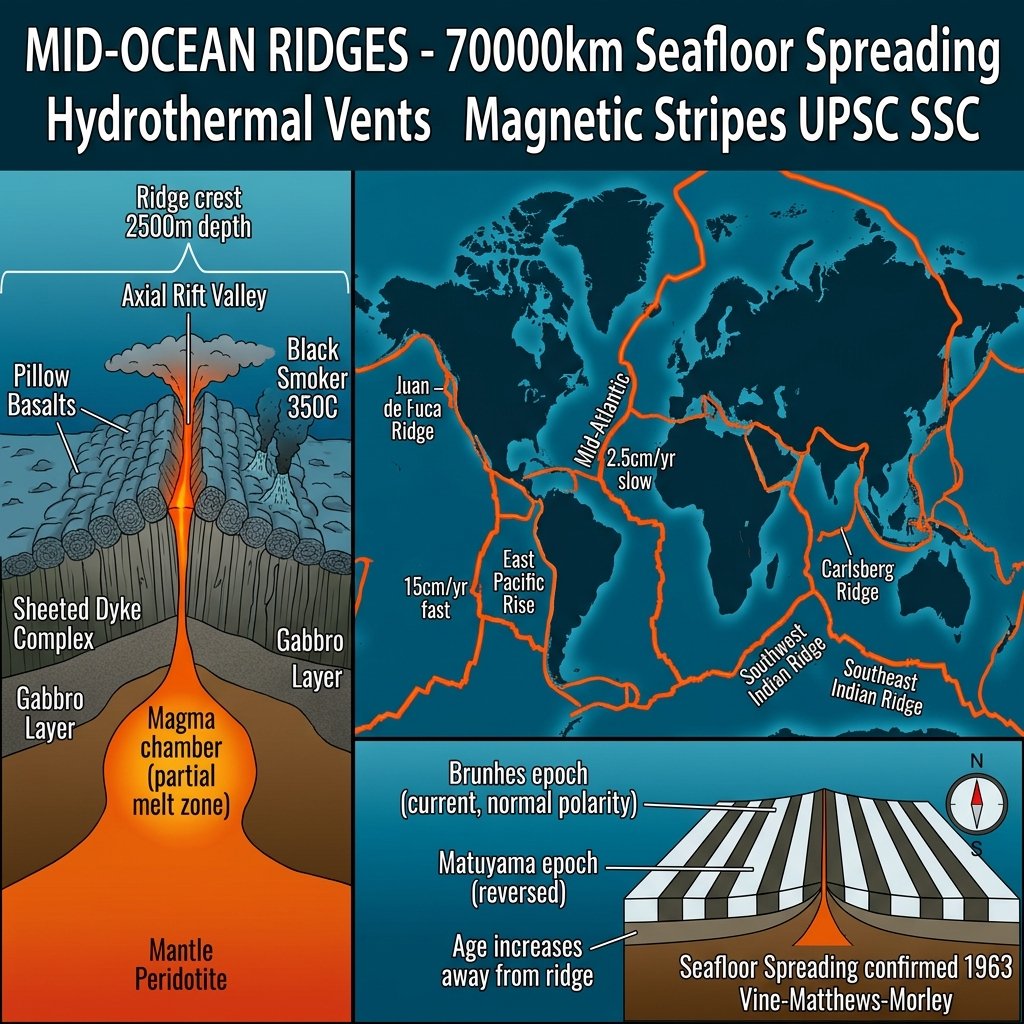
What Are Mid-Ocean Ridges? — Structure and Formation
- 🏔️ Definition: Mid-ocean ridges are underwater mountain chains that form at divergent plate boundaries where two oceanic plates (or an oceanic plate and a continental plate during rifting) move apart; at the separation, hot asthenospheric mantle rises, depressurises, partially melts (decompression melting), and erupts as basalt to form new oceanic crust; the newly formed crust is hot and buoyant, standing 2–3 km above the surrounding older, cooler, denser ocean floor
- 🏔️ Global extent: The mid-ocean ridge system is the longest continuous mountain chain on Earth: ~70,000 km total length; it encircles the entire globe like the seams of a baseball; it occupies approximately 23% of Earth’s total surface area; it is responsible for creating virtually all of the 300 million km² of oceanic crust currently on Earth’s surface; the global ridge system includes the Mid-Atlantic Ridge, East Pacific Rise, Indian Ocean Ridges (Carlsberg, Southwest Indian, Southeast Indian, Central Indian), Juan de Fuca Ridge, and several smaller systems
- 🏔️ Ridge morphology and spreading rate: Ridge morphology (shape) is directly controlled by spreading rate: Slow-spreading ridges (1–5 cm/yr) — have a prominent axial rift valley (a graben) at the summit up to 1–2 km deep and 20–40 km wide; rugged topography with large fault scarps; example: Mid-Atlantic Ridge (2.5 cm/yr); Fast-spreading ridges (10–15+ cm/yr) — no axial rift valley; smooth, broad, dome-shaped crest; example: East Pacific Rise (10–15 cm/yr at its fastest segments)
- 🏔️ Internal structure (ophiolite sequence): The internal structure of a mid-ocean ridge (from top to bottom) is known from ophiolites — sections of ancient ocean floor that were thrust onto land and can be studied directly; from top to bottom: (1) Pillow lavas (basalt that erupted underwater, quenched into pillow shapes by cold seawater); (2) Sheeted dyke complex (vertical intrusions feeding lava to surface); (3) Gabbro (coarse-grained basalt equivalent, crystallised slowly in the magma chamber); (4) Mantle peridotite (ultramafic rock of the depleted mantle below the crust)
Major Mid-Ocean Ridge Systems
| Ridge System | Ocean | Length | Spreading Rate | Key Features |
|---|---|---|---|---|
| Mid-Atlantic Ridge (MAR) | Atlantic | ~16,000 km | 2–2.5 cm/yr (slow) | Runs N-S through Atlantic; Iceland sits on it (volcanic island formed by MAR + Iceland hotspot); prominent axial rift valley; Azores, Ascension Is., Tristan da Cunha volcanic islands on it; offset by many transform faults |
| East Pacific Rise (EPR) | Pacific | ~8,000 km | 10–15 cm/yr (ultrafast) | Fastest-spreading ridge on Earth; no axial rift valley (spreads too fast to sag); generates large volumes of basalt rapidly; Easter Island hotspot sits on it; spreading destroyed much of it = Pacific seafloor is subducting on all sides |
| Carlsberg Ridge | Indian Ocean (NW) | ~2,000 km | ~2.5 cm/yr (slow) | Runs NW from the Central Indian Ridge through the Arabian Sea; named after Carlsberg Brewery (funded the expedition); separates the Indian Plate from the African/Arabian Plate; relevant to India’s plate tectonics; connects to the spreading that opened the Indian Ocean |
| Southwest Indian Ridge | Indian Ocean (S) | ~7,700 km | ~0.8–1.6 cm/yr (ultra-slow) | World’s slowest major spreading ridge; separates African Plate from Antarctic Plate; extremely rugged topography; exposes large amounts of mantle peridotite at the seafloor (due to very thin crust formed at ultra-slow spreading) |
| Southeast Indian Ridge | Indian Ocean (SE) | ~6,200 km | ~5–7 cm/yr (intermediate) | Separates Australian Plate from Antarctic Plate; south of Australia; intermediate spreading rate; connects to East Pacific Rise via Pacific-Antarctic Ridge |
| Juan de Fuca Ridge | Pacific (NE) | ~500 km | ~5–6 cm/yr (intermediate) | Small ridge off the US Pacific Northwest; creates the Juan de Fuca Plate (subducting under North America at Cascadia Subduction Zone); best-studied ridge for hydrothermal vents; NEPTUNE Canada cabled seafloor observatory |
| Mid-Indian Ridge System | Indian Ocean (central) | ~3,000 km | ~3–5 cm/yr (slow) | Triple junction at Rodrigues Triple Junction (23°S) where Carlsberg, Southwest Indian, and Southeast Indian Ridges meet; separates African, Antarctic, and Australian plates |
Seafloor Spreading — Harry Hess and the Evidence
- 🔬 Harry Hess’s hypothesis (1960–1962): American geologist Harry Hess proposed the theory of seafloor spreading in his landmark paper “History of Ocean Basins” (1962, initially circulated 1960 as a “geopoetry” preprint); he proposed that mid-ocean ridges are the sites where new oceanic crust is continuously created by upwelling mantle material, and that the ocean floor spreads outward from the ridges like a conveyor belt, eventually plunging back into the mantle at ocean trenches; this elegantly explained the youth of oceanic crust (never older than ~200 Ma) compared to continental crust (up to 4,000 Ma) and the relatively thin sediment layer on the ocean floor
- 🔬 Vine-Matthews-Morley hypothesis (1963): The decisive evidence for seafloor spreading came from magnetic anomaly stripes on the ocean floor: Frederick Vine, Drummond Matthews (Cambridge), and independently Lawrence Morley (Canada) recognised in 1963 that the symmetric pattern of normally and reversely magnetised ocean floor basalt on either side of every mid-ocean ridge could only be explained if: (a) new basalt erupts at the ridge, preserving the current direction of Earth’s magnetic field as it cools through the Curie temperature (~580°C for magnetite); (b) the new crust spreads away from the ridge symmetrically; (c) as the geomagnetic field reverses periodically, successive stripes of normal and reversed magnetisation are recorded in the spreading crust; the resulting symmetric “barcode” pattern of magnetic stripes on either side of every ridge is the fingerprint of seafloor spreading
- 🔬 Age of ocean floor: By dating the magnetic stripes using the known timescale of geomagnetic reversals (established from continental lava flows), scientists can determine the age of any point on the ocean floor; the ocean floor is youngest at ridge crests (0 Ma) and gets progressively older away from ridges; the oldest ocean floor (up to ~180–200 Ma, Jurassic age) is found in the western Pacific far from the East Pacific Rise; no ocean floor older than ~200 Ma exists anywhere on Earth (all older ocean floor has been subducted)
Hydrothermal Vents — Life Without Sunlight
- ♨️ Discovery (1977): In 1977, geologists diving in the submersible Alvin at the Galapagos Rift (off Ecuador, on the East Pacific Rise system) discovered something completely unexpected: clusters of hydrothermal vents spewing superheated water at ~350°C, surrounded by dense communities of life — giant tube worms (Riftia pachyptila, up to 2m long), clams, mussels, shrimp, crabs — in complete darkness on the ocean floor; this was one of the most significant biological discoveries of the 20th century, revealing the existence of chemosynthetic ecosystems entirely independent of photosynthesis and sunlight
- ♨️ Black smokers vs white smokers: Black smokers — the most dramatic vents; emit superheated water (300–400°C) rich in dissolved minerals (iron sulphide, copper sulphide, zinc sulphide, manganese) that precipitate as black “smoke” when the hot fluid contacts cold (2°C) seawater; the precipitated minerals build up into towering chimney structures up to 60m tall; white smokers — cooler vents (100–300°C) that emit white, milky fluid rich in barium, calcium, and silicon minerals; less mineralised than black smokers; Lost City hydrothermal field (Mid-Atlantic Ridge) has white smoker chimneys up to 60m tall made of calcium carbonate
- ♨️ Vent mechanism: Cold seawater percolates down through cracks in the ocean floor toward the hot magma chamber beneath the ridge; the water heats to 350–400°C (remaining liquid due to extreme pressure suppressing boiling), dissolves minerals from the surrounding rock, becomes buoyant, and rises back to the seafloor to discharge through vent openings; this hydrothermal circulation removes heat from the oceanic crust efficiently; it is estimated that the entire volume of Earth’s oceans passes through the mid-ocean ridge hydrothermal system once every 10 million years
- ♨️ Chemosynthetic ecosystems: Unlike virtually all other ecosystems on Earth that depend on photosynthesis (sunlight), vent ecosystems are powered by chemosynthesis: bacteria oxidise hydrogen sulphide (H₂S) from the vent fluids to produce energy, using that energy to fix CO₂ into organic compounds; these chemoautotrophic bacteria form the base of the food web; giant tube worms (Riftia) have no digestive system — they harbour billions of symbiotic chemosynthetic bacteria in a specialised organ (trophosome) that provides all their nutrition; vent ecosystems have implications for astrobiology — similar chemosynthetic life could exist in the oceans of Europa (Jupiter’s moon) or Enceladus (Saturn’s moon), which are believed to have warm, salty oceans under their icy crusts
- ♨️ Economic significance: Hydrothermal vents create massive polymetallic sulphide deposits (PMSDs) rich in copper, zinc, lead, silver, gold, and cobalt; these seafloor massive sulphide (SMS) deposits are the modern equivalent of ancient volcanic massive sulphide (VMS) deposits mined on land (e.g., the Buchans Mine in Newfoundland, the Kidd Creek Mine in Ontario); deep-sea mining companies (Nautilus Minerals, Deep Sea Mining Finance) have targeted SMS deposits in the territorial waters of Papua New Guinea, Tonga, and Fiji; major controversy over environmental impact vs economic benefit
⭐ Important for Exams — Quick Revision
- 🔑 Mid-ocean ridge: Underwater mountain chain at divergent plate boundary; new oceanic crust formed by decompression melting; total global length ~70,000 km; longest mountain chain on Earth
- 🔑 Seafloor spreading: Proposed by Harry Hess (1960/1962); new ocean floor created at ridges, spreads outward, subducts at trenches; explains why no ocean crust is older than ~200 Ma
- 🔑 Magnetic anomaly stripes: Vine-Matthews-Morley hypothesis (1963); symmetric barcode of normal/reversed magnetised basalt on either side of every ridge; confirmed seafloor spreading; key evidence for plate tectonics
- 🔑 Spreading rates: East Pacific Rise = fastest (10–15 cm/yr, ultrafast); Mid-Atlantic Ridge = slow (2–2.5 cm/yr); Southwest Indian Ridge = ultra-slow (~0.8–1.6 cm/yr); Juan de Fuca = intermediate (5–6 cm/yr)
- 🔑 Ridge morphology: Slow spreading = prominent axial rift valley (graben) + rugged topography; fast spreading = no axial rift valley + smooth dome-shaped crest
- 🔑 Mid-Atlantic Ridge: Runs N-S through Atlantic; 16,000 km; 2.5 cm/yr; Iceland sits on it (MAR + hotspot); Azores, Ascension, Tristan da Cunha islands on it
- 🔑 Iceland: Only place on Earth where a mid-ocean ridge (Mid-Atlantic Ridge) is above sea level; combination of MAR divergence + Iceland hotspot; spreading visible at Thingvellir (UNESCO World Heritage Site)
- 🔑 Carlsberg Ridge: Indian Ocean NW; ~2.5 cm/yr; separates Indian Plate from African/Arabian Plate; named after Carlsberg Brewery; relevant to India’s plate motion history
- 🔑 Ophiolite sequence: Ancient ocean floor thrust onto land; from top to bottom: pillow lavas, sheeted dykes, gabbro, mantle peridotite; India’s Andaman Islands ophiolite = fragment of ancient ocean floor
- 🔑 Hydrothermal vents discovered: 1977 by Alvin submersible at Galapagos Rift (East Pacific Rise); one of greatest biological discoveries of 20th century
- 🔑 Black smokers: 300–400°C; emit black mineral-rich fluid (iron, copper, zinc sulfides precipitating in cold seawater); build chimneys up to 60m tall; most economically valuable (SMS deposits)
- 🔑 White smokers: 100–300°C; emit white milky fluid (barium, calcium, silicon minerals); Lost City (MAR) = white smoker chimneys up to 60m tall of calcium carbonate
- 🔑 Chemosynthesis: Bacteria oxidise H₂S from vents to fix CO₂; base of vent food web; independent of sunlight; giant tube worms (Riftia pachyptila, 2m long) harbour chemosynthetic bacteria in trophosome
- 🔑 Astrobiology link: Vent chemosynthetic ecosystems show life can exist without sunlight; Europa (Jupiter) and Enceladus (Saturn) may have similar vent systems in their subsurface oceans
- 🔑 Seafloor massive sulphide deposits: Hydrothermal vents create polymetallic sulphide deposits (Cu, Zn, Au, Ag, Co); deep-sea mining controversy; Papua New Guinea, Tonga, Fiji territorial waters
- 🔑 Ocean floor age: Youngest at ridge crests (0 Ma); oldest in western Pacific (~180–200 Ma, Jurassic); no ocean floor older than 200 Ma exists (all subducted); continental crust up to 4,000 Ma
Frequently Asked Questions (FAQs)
1. How does decompression melting work at mid-ocean ridges — why does the mantle melt without being heated?
The Paradox: Melting Without Adding Heat
The most counterintuitive aspect of mid-ocean ridge volcanism is that the mantle melts not because it is being heated, but because the pressure on it is being reduced. This process — decompression melting — is the dominant mechanism producing magma at mid-ocean ridges, hotspots, and rift zones. Understanding it requires understanding the relationship between melting point and pressure in mantle rocks.
Pressure and Melting Point
The melting point of mantle peridotite (the dominant rock of the mantle) increases with pressure. At 100 km depth, peridotite melts at approximately 1,500°C under dry conditions. At 50 km depth, the melting point drops to ~1,400°C. At the surface, peridotite would melt at ~1,100–1,200°C. The mantle at 100 km depth is typically at approximately 1,300–1,400°C — hot enough to be solid at that pressure, but close to its melting point.
The Decompression Process
- Step 1 — Plates diverge: At a divergent plate boundary, the two plates move apart; as the plates separate, the solid mantle below must flow upward to fill the gap (to maintain isostatic equilibrium); this upward flow is passive — the mantle is not being pushed up, it flows up because the plates above it are moving apart
- Step 2 — Pressure decreases as mantle rises: As the mantle rock rises from 100 km to 50 km depth, the overlying rock column becomes shorter and the pressure drops dramatically; the mantle rock’s temperature stays approximately constant during this rise (the thermal diffusivity of rock is very low — it cools much more slowly than it decompresses)
- Step 3 — Melting point decreases below actual temperature: At some depth, the decreasing melting point (caused by decreasing pressure) drops below the actual temperature of the rising mantle rock; the rock begins to melt — not because it got hotter, but because the pressure holding it solid was reduced
- Step 4 — Partial melting: Typically 5–30% of the mantle rock melts (partial melting); the melt fraction is basaltic in composition (enriched in silica and aluminium relative to the residual peridotite); the melt is less dense than the residual mantle and percolates upward through the partially molten zone, eventually pooling in a magma chamber beneath the ridge crest and erupting at the seafloor
Fast vs Slow Spreading
The faster the spreading rate, the more mantle rises per unit time, the more decompression melting occurs, and the thicker the oceanic crust produced. At the fast-spreading East Pacific Rise, oceanic crust is 6–7 km thick. At the ultra-slow Southwest Indian Ridge, oceanic crust is only 3–4 km thick — so thin that in many places the mantle peridotite is exposed directly at the seafloor, uncovered by any basaltic crust at all. This relationship between spreading rate and crustal thickness is one of the clearest confirmations of the decompression melting model.
2. What are magnetic anomaly stripes — and how did they prove continental drift?
Background: Earth’s Geomagnetic Field Reverses
Earth’s magnetic field — generated by convection in the liquid outer core — periodically reverses its polarity. During a normal polarity epoch (like today), a compass points to magnetic north. During a reversed polarity epoch, a compass would point south. These reversals are irregular in timing, occurring roughly every 200,000–500,000 years on average (though they can be as short as 20,000 years apart or as long as 30+ million years). The current normal polarity epoch (the Brunhes Chron) has lasted ~780,000 years.
How Basalt Records Polarity
When basaltic lava erupts at a mid-ocean ridge and cools through approximately 580°C (the Curie temperature of magnetite, Fe₃O₄), the magnetite grains in the basalt align with Earth’s magnetic field at that moment and “freeze” — becoming a permanent record of the field direction at the time of eruption. If Earth’s field was normal at the time of eruption, the basalt records normal polarity. If the field was reversed, the basalt records reversed polarity.
The Vine-Matthews-Morley Hypothesis (1963)
- Observation: When oceanographers towed magnetometers across the Pacific Ocean, they recorded a striking pattern: alternating stripes of high and low magnetic anomalies (areas where the ocean floor basalt was magnetised in the same direction as Earth’s current field = positive anomaly, or opposite direction = negative anomaly), arranged in a strikingly symmetric “barcode” pattern on either side of every mid-ocean ridge
- The hypothesis: Vine, Matthews, and Morley independently proposed in 1963 that these symmetric stripes are produced by seafloor spreading combined with periodic reversals of Earth’s magnetic field; as new basalt erupts at the ridge crest and spreads outward, it preserves the current field polarity; when the field reverses and the next stripe forms at the ridge, it too spreads outward symmetrically; the result is a symmetric pattern of normal and reversed stripes on either side of every ridge
- Confirmation: By comparing the widths of the magnetic stripes to the known timescale of geomagnetic reversals (established from dated lava flows on land — the geomagnetic polarity timescale, GPTS), scientists could calculate spreading rates with remarkable precision; the calculated spreading rates matched perfectly between the magnetic stripe widths and the known reversal timescale; this was the decisive quantitative proof of seafloor spreading — and therefore of plate tectonics
- Why it was important: Before 1963, continental drift (Wegener’s theory) was widely dismissed because no mechanism was known that could move continents; the Vine-Matthews-Morley hypothesis provided the mechanism (seafloor spreading) and the quantitative evidence; within a few years of the 1963 paper, the theory of plate tectonics was accepted by virtually all Earth scientists — one of the fastest scientific revolutions in history
3. What is Iceland — and why is it the only country built on a mid-ocean ridge?
Iceland’s Unique Geological Position
Iceland is the only place on Earth where a mid-ocean ridge — the Mid-Atlantic Ridge — rises above sea level to form a land surface. It sits astride the boundary between the North American Plate (to the west) and the Eurasian Plate (to the east), which are moving apart at approximately 2.5 cm per year. Normally, mid-ocean ridges remain 2,000–2,500m below sea level. Iceland rises above the ocean because it sits on the Iceland Hotspot — a mantle plume producing abnormally large volumes of magma that have built Iceland up above sea level over the past ~60–70 million years.
Evidence of Spreading at Thingvellir
At Thingvellir (Thingvellir) National Park — a UNESCO World Heritage Site and the site of Iceland’s ancient parliament (Althing, established 930 AD) — visitors can literally stand between the North American and Eurasian plates in a rift valley created by the spreading Mid-Atlantic Ridge. The rift valley is approximately 40m deep, 7 km wide, and growing wider by ~2–3 cm each year. The oldest rocks on the western (North American) side are slightly older than those on the eastern (Eurasian) side — consistent with the model of new crust forming at the rift axis and spreading outward. Thingvellir is the only place on Earth where a plate boundary between two major plates is exposed on dry land and accessible to the public.
Iceland’s Volcanism
- Most active volcanic country on Earth: Iceland has approximately 130 volcanoes, 30 of which are active; eruptions occur on average every 4–5 years; Iceland produces approximately one-third of all the lava erupted on Earth’s land surface per century
- Eyjafjallajokull 2010: Erupted under a glacier (subglacial eruption); produced a vast ash cloud that shut down European airspace for 6 days (April 2010); ~10 million passengers affected; estimated economic loss ~$1.3 billion; demonstrated volcanic aviation hazard
- Laki fissure 1783: One of the largest basaltic fissure eruptions in historical times; erupted 14.7 km³ of lava and enormous quantities of SO₂ and HF over 8 months; killed 20% of Iceland’s population (fluorine poisoning of livestock = famine); released SO₂ cloud over Europe = “Laki haze” = unusual weather in 1783–84 = crop failures across Europe contributing to conditions leading to the French Revolution (1789)
- Geothermal energy: Iceland generates ~30% of its electricity and ~90% of its heating from geothermal energy tapped from the ridges volcanic system; one of the world’s leaders in renewable energy use (nearly 100% electricity from renewables)
Related Geology Articles on StudyHub
- ➡️ Subduction Zones — Where Ocean Crust Is Destroyed
- ➡️ Mantle Convection — Ridge Push at Mid-Ocean Ridges
- ➡️ Ocean Trenches — Where Old Seafloor Subducts
- ➡️ Geomagnetic Reversals — Polarity Timescale
- ➡️ Rift Valleys — Continental Rifting to Ocean