
Last Updated: March 2026 | Reading Time: 12 minutes | ~2,800 words | Category: Physical Geography — Physiography of India
India’s physical landscape is one of the most geologically diverse on Earth — shaped by events spanning 3,800 million years of Earth history, from the ancient crystalline shields of the Deccan Plateau (some of Earth’s oldest exposed rocks) to the still-rising youthful Himalayas (formed in the last 50 million years and growing at ~5 mm/year today). The subcontinent’s geography can be divided into five major physiographic divisions, each with distinct geological origin, landform type, soil, drainage, climate, vegetation, and human geography: (1) The Himalayan Mountain System — young fold mountains, new rugged topography, perennial rivers, rich biodiversity; (2) The Northern/Indo-Gangetic Plain — vast alluvial plains built by Himalayan river deposition, India’s agricultural heartland; (3) The Peninsular Plateau — ancient, stable, hard crystalline and lava-capped plateau, mineral-rich; (4) The Coastal Plains — narrow strips along India’s 7,516 km coastline, lagoons, ports, fisheries; (5) The Islands — Andaman-Nicobar (volcanic + coral) and Lakshadweep (coral atolls). Understanding these five divisions — their geological origin, extent, landforms, economic significance, and differences — is foundational for UPSC Civil Services Geography (GS Paper I), SSC CGL General Awareness, and all State PCS examinations. Key UPSC insight: India’s highest peak is Kangchenjunga (8,586m, Sikkim) — NOT Everest, which lies in Nepal! K2 (8,611m) is technically higher but located in Pakistan-controlled PoK (Gilgit-Baltistan). The highest peak entirely within India’s undisputed territory = Kangchenjunga.
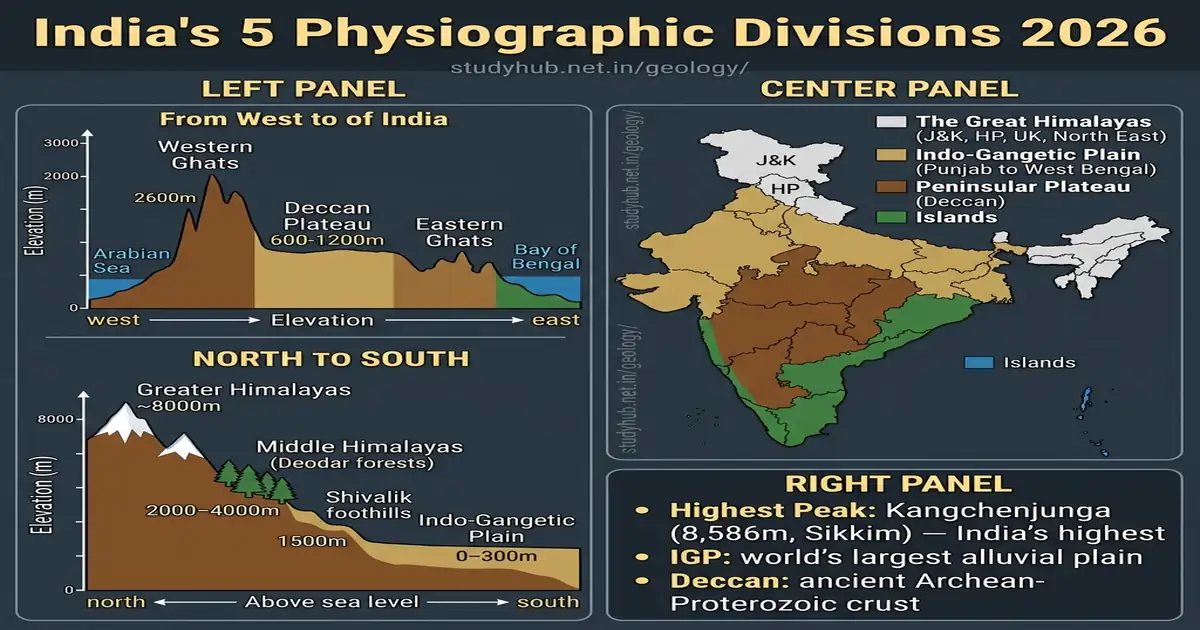
India’s 5 Physiographic Divisions — Himalayan Mountains, IGP, Peninsular Plateau, Coastal Plains & Islands 2026
1. The Himalayan Mountain System
| Sub-Division | Extent & Elevation | Geology & Landforms | Key Facts & Significance |
|---|---|---|---|
| Trans-Himalayas (Tethyan / Tibetan Himalayas) | North of Greater Himalayas: Karakoram Range, Zaskar Range, Ladakh Range, Kailash Range (Tibet). Elevation: 5,000–8,000+ m. Also called “Tibet Himalayas” or “Tethyan Zone.” Includes the Tibetan Plateau (avg 4,500m = “Roof of the World”) | Geological character: sedimentary rocks deposited in the Tethys Sea (Paleozoic–Mesozoic marine sediments — limestone, sandstone, shale with marine fossils). These are the ancient sea floor rocks now uplifted to world’s highest elevations. Glaciers: Karakoram and Ladakh = most active glaciation zone in India. Karakoram has counter-intuitive “Karakoram Anomaly” — some glaciers are advancing despite global warming! Ladakh cold desert: rain shadow of Greater Himalayas. High altitude lake: Pangong Tso (half India, half China, no outlet, brackish), Tso Moriri (Ramsar site, Ladakh) | India’s highest passes: Karakoram Pass (5,540m), Chang La (5,360m = world’s 3rd highest motorable pass), Khardung La (5,359m, near Leh = claimed but disputed as world’s highest motorable road — actually Umling La at 19,300 ft / 5,883m in Ladakh now = verified world’s highest motorable road, 2021). K2 (Godwin-Austen, 8,611m, Karakoram, Pakistan POK = world’s 2nd highest, 2nd deadliest). Siachen Glacier (70 km long, world’s 2nd largest non-polar glacier, highest battlefield in the world at 6,000m, India-Pakistan). Strategic importance: China LAC (Line of Actual Control) dispute — Aksai Chin, Depsang, Galwan Valley, Pangong Tso flashpoints (2020 India-China Galwan clash) |
| Greater Himalayas (Himadri) | Central core of Himalayan range. Elevation: 6,000–8,848m. Average elevation: ~6,000m. Continuous wall of snow-capped peaks throughout the year. Width: 25 km. States: J&K, HP, Uttarakhand, Sikkim, Arunachal Pradesh, NE India borderland | Geology: composed of metamorphic and granitic rocks (Greater Himalayan Crystallines — garnet-kyanite-sillimanite schist, gneiss, migmatite, leucogranite: Geo-29). Formed by India-Eurasia collision (Geo-15). Main Central Thrust (MCT) = base boundary with Lesser Himalayas. Glaciers: Gangotri (Uttarakhand, 30km = source of Ganga/Bhagirathi, retreating 22m/yr), Zemu (Sikkim = India’s largest glacier, 26km), Siachen (J&K/Ladakh = 70km, non-polar 2nd largest globally). High altitude passes: Zoji La (3528m, J&K, NH-1D Srinagar-Leh), Rohtang (3978m, HP, Manali-Keylong), Nathu La (4310m, Sikkim, India-China trade route, reopened 2006) | INDIA’S HIGHEST PEAKS (within India’s undisputed territory): Kangchenjunga (8,586m, Sikkim = India’s No.1, world’s 3rd highest, 5 peaks). Nanda Devi (7,816m, Uttarakhand = India’s 2nd highest, UNESCO WHS biosphere). Kamet (7,756m, Uttarakhand). Saltoro Kangri (7,742m, Ladakh/Siachen area). Saser Kangri (7,672m, Ladakh). Note: Everest (8,849m) = Nepal, NOT India. K2 (8,611m) = Pakistan-controlled PoK. Govind Ballabh Pant (7,006m), Trishul (7,120m, Uttarakhand). Pilgrimages and spiritual significance: Kedarnath, Badrinath, Gangotri, Yamunotri (Uttarakhand Chardham). Amarnath (J&K). Kailash-Manasarovar (Tibet, sacred to Hindus, Buddhists, Jains, Bon). Hemkund Sahib (Uttarakhand, Sikh). Vaishno Devi (J&K, Hindu) |
| Middle / Lesser Himalayas (Himachal) | South of Greater Himalayas. Elevation: 3,700–4,500m. Also called “Himachal” (meaning “place of snow” — giving Himachal Pradesh its name). Include well-known ranges: Pir Panjal (J&K-HP, famous Pir Panjal tunnel on Udhampur-Srinagar-Baramulla Rail Link), Dhauladhar (HP), Mussoorie Range (Uttarakhand), Mahabharat Range (Nepal), Mikir Hills adjacent NE. Doon valleys: longitudinal valleys between Greater and Lesser Himalayas = DUNS (wide, fertile valleys, Dehra Dun most famous) | Geology: complex mixture of metamorphic (crystalline schist, quartzite, limestone) and some sedimentary rocks. Pir Panjal: limestone-rich (speleothems/caves, Amarnath cave). Shivalik-MCT boundary = Main Boundary Thrust (MBT). Kashmir Valley: synclinal graben between Pir Panjal and Zanskar ranges = once a glacial lake (Karewa sediments = ancient lake deposits, ~40m thick, unique fossil pollen record). Karewas = Kashmir Valley silty lake terraces, important for saffron cultivation. Kangra Valley (HP): tea estates. Kulu Valley (HP): apple orchards. Nainital (Uttarakhand): natural lake in a glacial cirque-like hollow. Shillong Plateau (Meghalaya) is a separate fragment (Gondwana-related basement, NE India) | Doons and Valleys: Dehra Dun (Uttarakhand, DEHRADUN = “dun” = intermontane valley). Patli Dun (HP). Kota Dun (Uttarakhand). Kashmir Valley: 135 km long, 32 km wide = most famous Himalayan valley. Dal Lake + Wular Lake (J&K — Wular = India’s largest freshwater lake). Karewa deposits = ancient lake beds = saffron growing area (Pampore saffron, Pulwama district, J&K = India’s only saffron-growing region, world-famous). Hill stations: Shimla (HP), Mussoorie (Uttarakhand), Nainital (UK), Darjeeling (WB), Ooty/Ootacamund (Western Ghats), Munnar (Kerala). Spa and wellness tourism. Famous: the “toy trains” of Darjeeling (DHR, UNESCO WHS), Shimla (KSR), Nilgiri Mountain Railway (NMR, UNESCO WHS), Matheran (MR) |
| Outer Himalayas (Shivaliks) | Southernmost range. Elevation: 900–1,500m. Also called Shivalik Hills (named after Lord Shiva). Width: 10–50 km. Stretch from J&K (Jammu hills) through HP, Uttarakhand, UP, Bihar foothill, to Arunachal Pradesh (here called Mishmi Hills, Patkai Bum, Naga Hills, Lushai Hills/Mizoram, Garo Hills/Meghalaya going south — the NE Himalayan ranges). Southern boundary = Main Frontal Thrust (MFT) / Indo-Gangetic Frontal Fault. The TERAI: narrow, seasonally waterlogged marshy belt at the base of Shivaliks (transition between mountain and plain). Dense forest (now mostly cleared for agriculture) | Geology: youngest Himalayan zone. Composed of semi-consolidated sedimentary rocks (Siwalik Group molasse sediments: conglomerate, sandstone, siltstone, mudstone — deposited by Himalayan rivers in a foreland basin in Miocene-Pleistocene). Rich in vertebrate fossils: Sivapithecus (ape ancestor), Stegodon (extinct elephant relative), Sivatherium (giant giraffe), Hippopotamus, Rhinoceros — Siwalik fossil fauna is one of the most important Neogene vertebrate fossil records in Asia. Dun valleys: between Shivaliks and Lesser Himalayas. Bhabhar: pebble-boulder zone at Shivalik base (rivers lose gradient abruptly → drop boulders + all sediment → groundwater recharges here → rivers “disappear” into porous Bhabhar → re-emerge as springs in Terai). Classic: Haridwar at Siwalik-plain junction (sacred springs) | Siwalik fossil record: discovered in 1830s by British geologists (Hugh Falconer, Proby Cautley). Central State Forest Research Institute, Dehra Dun = premier Siwalik fossil research. Terai: Corbett NP (Uttarakhand Terai), Dudhwa NP (UP), Manas NP (Assam). Once heavily forested; now fragmented by agriculture. The “Dooars” (WB-Assam): floodplain terai zone = tea estates (Dooars tea). Important: Aravalli Range (Rajasthan-Delhi): World’s OLDEST fold mountains (500–2,500 Ma Proterozoic), NOT part of Himalayas. Aravalli = eroded, lowest heights 300–1,000m. Guru Shikhar (Mt Abu, Rajasthan, 1,722m) = highest point of Aravalli. Delhi Ridge = Aravalli quartzite outlier into Delhi (urban forest) |
2. The Northern/Indo-Gangetic Plain, Peninsular Plateau & Other Divisions
| Division | Extent & Formation | Sub-Regions & Landforms | Economic & Geographic Significance |
|---|---|---|---|
| The Indo-Gangetic / Northern Plain | Extent: From Punjab (Pakistan border) east through Haryana, Delhi, UP, Bihar, WB and northeast into Assam Valley (and Brahmaputra plain). Also the Rajasthan Plain (west of Aravalli = alluvial + aeolian). North-to-south width: 150–300 km. Length: ~3,200 km east-west. Area: ~7,00,000 km² (India’s largest physiographic division). Elevation: 0–300m above sea level (very flat — gradient in Ganga plain is just 1m / 6km from Delhi to Bay of Bengal = ~0.017% slope). Formation: FORELAND BASIN filled with Quaternary alluvium (sand, silt, clay deposited by Himalayan rivers over 1–5 million years). Depth of alluvium: 1,000–5,000m (thick). Isostatic compensation: as Himalayas erode and the IGP receives sediment → the basin slowly sinks further under the load = self-filling trough | East-west sub-regions: PUNJAB PLAIN (NW, Punjab-Haryana, Indus-Sutlej rivers = doabs = land between rivers, intensively irrigated, wheat heartland). GANGA PLAIN (largest, from Delhi to Bangladesh border, Ganga-Yamuna Doab most fertile, Upper-Middle-Lower Ganga plains). BRAHMAPUTRA PLAIN (NE India, Assam Valley, very fertile, tea + rice, prone to annual floods). North-south sub-divisions: BHABHAR BELT (Shivalik base, coarse porous cobble-sand, rivers disappear). TERAI BELT (waterlogged, springs re-emerge, formerly swampy jungle). BHANGAR BELT (older alluvium, higher, CaCO₃ kankar nodules, B/C horizon, less fertile). KHADAR BELT (newer alluvium, low-lying river banks, renewed annually, most fertile). DELTA (Bengal delta — Sundarbans + Ganga-Brahmaputra delta) | India’s foodgrain bowl: Punjab, Haryana, UP plains produce 60%+ of India’s wheat. WB-Bihar = major rice zone. UP = India’s most populous state (224 million, 2011 census — 2024 est. ~250 million). ROAD AND RAIL: the IGP’s flat topography made it ideal for dense road and rail networks = India’s most densely populated and economically connected region. Cities: Delhi (NCT, India’s capital, 33 million metro), Lucknow (UP capital), Kanpur (industrial), Varanasi (cultural+spiritual), Patna (Bihar capital), Kolkata (WB capital, port). Rajasthan Plain: THAR DESERT covers most. Luni River. Sambhar Salt Lake (Rajasthan = largest inland saline lake in India, Ramsar). IGNP (Indira Gandhi Nahar Project) transformed western Rajasthan alluvial + aeolian soil to farmland. Key fact: FLAT TOPOGRAPHY OF IGP = reason railways and roads are so efficient here → enabled colonial-era economic integration and modern manufacturing corridors (Delhi-Mumbai Industrial Corridor, Amritsar-Kolkata freight corridor) |
| The Peninsular Plateau | Extent: South of Narmada River and Northern Plains, covering most of peninsular India including Maharashtra, Goa, Karnataka, Andhra Pradesh, Telangana, Tamil Nadu, Kerala (Eastern Ghats and interior), Chhattisgarh, Jharkhand, Odisha, southern MP. Area: ~16 lakh km² (largest physiographic division by area). The plateau is a STABLE CRATON: ancient Archean-Proterozoic basement (3,800–540 Ma old Dharwar craton, Eastern Ghats, Bundelkhand, Aravalli). Geologically OLD and stable — this land fragment was part of GONDWANA (broke off ~100–65 Ma ago). Deccan Traps basalt: covers the NW portion (Geo-16) — Maharashtra, MP, Gujarat: Cretaceous-Paleocene flood basalt eruptions (~6 5Ma). Vindhyan Range: northern boundary. Satpura Range: parallel rift ranges. Eastern Ghats + Western Ghats: eastern and western escarpments | Major sub-regions: DECCAN TRAP PLATEAU (Maharashtra-MP-Gujarat lava plateau, black cotton soil, cotton/soybean). CENTRAL HIGHLANDS (Vindhyan Ranges, Satpura Ranges, Bundelkhand Plateau, Malwa Plateau, Chotta Nagpur Plateau). CHHOTANAGPUR PLATEAU (Jharkhand: Ranchi plateau, 732m, ancient crystalline — world’s richest mineral zone: coal Jharia/Bokaro, iron ore Singhbhum, copper, bauxite Lohardaga, mica Koderma, manganese). EASTERN GHATS (discontinuous, lower, Mahendragiri 1,501m Odisha = highest). WESTERN GHATS (continuous, higher, Anamudi 2,695m Kerala = highest point in India south of Himalayas). Passes: Palakkad Gap (Palghat Pass) = 24 km wide, only significant break in Western Ghats = allows NE monsoon + rail/road. Bhore Ghat (Mumbai-Pune), Thull Ghat, Natuwadi Ghat (Konkan Railway) | MINERAL WEALTH: Chhotanagpur Plateau (Jharkhand) = India’s mineral heartland: coal (Jharia = India’s largest coalfield by reserves, coking coal), iron ore (Noamundi, Kiriburu), copper (Mosaboni, Surda), bauxite (Lohardaga), mica (Giridih, Koderma = India’s mica belt), uranium (Jaduguda = India’s first uranium mine, 1967), manganese (Bonai). Deccan Plateau: diamonds (Panna, MP — Majhgawan mine). Gold (Kolar, Karnataka — now closed; Hutti, Raichur = active). Iron ore (Bellary-Hospet, Karnataka; Bailadila, Chhattisgarh). Manganese (Sandur, Karnataka). WESTERN GHATS: World Biodiversity Hotspot. Anamudi (2,695m, Kerala, highest S of Himalayas). Dodabetta (2,637m, Nilgiris, TN, 2nd highest S of Himalayas). Silent Valley, Agasthyamalai, Mukurthi NPs. Eravikulam NP (Nilgiri Tahr). Tiger reserves: Bandipur, Nagarhole (Karnataka) |
| The Coastal Plains | India has 7,516 km of coastline. Divided into: WESTERN COASTAL PLAIN (Arabian Sea coast, Rann of Kutch to Kanyakumari, 1,600 km). EASTERN COASTAL PLAIN (Bay of Bengal coast, Bengal to Kanyakumari, 2,000 km). Both coasts are different in origin, character, width, and use. The western coast runs along the foot of the Western Ghats; the eastern coast is a wider, gently sloping plain built by river delta deposition. KANNIYAKUMARI: the southernmost tip of mainland India where Arabian Sea, Indian Ocean, and Bay of Bengal meet | WESTERN COASTAL PLAIN subdivisions (N to S): Rann of Kutch (Gujarat — seasonal salt marsh/mudflat, twice flooded annually — largest saline grassland in Asia, flamingo breeding, wild ass). Gujarat Coast (Gulf of Khambhat, Gulf of Kutch). Konkan Coast (Mumbai-Goa-Karwar — narrow, rocky, backwaters, Konkan Railway). Kanara Coast (Karnataka — Mangaluru, fishing, ports). Malabar Coast (Kerala — widest, backwaters=kayals, lagoons, Chilika parallel). EASTERN COASTAL PLAIN (N to S): Mahanadi-Baitarani-Brahmani Delta (Odisha — Panthamas). Krishna-Godavari Delta (AP). Tamil Nadu coastal plain (Kaveri delta, Cauvery delta=rice granary). Chilika Lake (Odisha, 1,100 km² = India’s largest coastal lagoon, Ramsar, flamingo + Irrawaddy dolphin + Olive Ridley). Pulicat Lake (AP-TN border = 2nd largest coastal lagoon). Enambore (Chilka birds) | KEY PORTS: Mumbai (largest container port), JNPT/Nhava Sheva (Mumbai, India’s busiest container port), Kandla (Gujarat = India’s largest port by cargo volume). EAST: Visakhapatnam (Andhra Pradesh = deep port, Indian Navy base), Chennai (TN, 2nd oldest artificial harbour), Kolkata-Haldia (WB, river port-Ganga-Hooghly). Tughlakabad + Mundra (Gujarat = Adani’s Mundra = India’s largest private port). FISHERIES: Kerala (Kochi fish landing), Gujarat, AP = major marine fishing states. Malabar coast: Sardine, mackerel, pomfret (Arabian Sea fishing). Bay of Bengal: hilsa, prawn, tuna. Lakshadweep: tuna fishing (export). Coastal erosion: Indian coast losing land to sea erosion (NATMO reports). Coastal Regulation Zone (CRZ 2019): environmental protection. TOURISM: Goa beaches (highest density), Kerala backwaters, Andaman coral reefs |
| The Islands | India has two major island groups: ANDAMAN & NICOBAR ISLANDS (Bay of Bengal): 572 islands, 38 inhabited. Extent from 6°N to 14°N. Administrative capital: Port Blair (South Andaman). LAKSHADWEEP (Arabian Sea): 36 islands (only 11 inhabited). Coral atolls. Administrative capital: Kavaratti. Smallest union territory of India (32 km² land area). Both = Union Territories of India | ANDAMAN & NICOBAR: Geology: Tertiary-age volcanic arc and sedimentary islands (subduction-related — part of Andaman trench subduction zone, Burmese plate subducting under Indian plate). ACTIVE VOLCANO: Barren Island (only active volcano in India and in South Asia, in Bay of Bengal — last eruption 2020). Narcondam Island (dormant volcano). Saddle Peak (732m, North Andaman = highest point in A&N). Indian Ocean Tsunami 2004: A&N severely impacted (>2,000 dead in islands). Car Nicobar wracked. LAKSHADWEEP: Geology: Coral atolls (raised coral reef + coral sand islands). Built on submarine volcanic ridges of the Chagos-Laccadive Ridge (volcanic hotspot chain). Highest elevation: ~5 m only! (extremely vulnerable to sea level rise → existential climate threat). Coral bleaching: 2016, 2019 bleaching events severely damaged Lakshadweep coral reefs (>90% bleached in 2016). Only ~5% fully recovered | ANDAMAN: Cellular Jail (Kala Pani, Port Blair, colonial-era political prison, now national memorial, museum — where freedom fighters like Bal Gangadhar Tilak’s associate, Veer Savarkar, were imprisoned). Great Andamanese tribes (Andamanese, Onge, Jarawa, Sentinelese): all declining + near-extinction. Sentinelese (North Sentinel Island) = world’s most isolated people, violently reject contact (2018 American missionary John Allen Chau killed). Campbell Bay NP, Galathea Bay, Narcondam sanctuary. India’s only coral reef NP: Mahatma Gandhi Marine NP (Wandur, South Andaman). LAKSHADWEEP: Major economic activity: fishing (tuna export) + coconut production. TOURISM: Agatti, Bangaram (no alcohol), Kadmat atolls. Campaign against plastic pollution (model island system). Pitti Island: frigatebird and booby colony. Amini Island: sea turtle nesting. Archipelago: home of Laccadive languages (Mahl, Jeseri, Bodhi — Dravidian-script). Bharat-LAKSHADWEEP: contested development plans 2021–23 |
Frequently Asked Questions
What is India’s highest peak — and why is it NOT Mount Everest?
This is one of the most commonly confused facts in Indian geography, and UPSC has tested it multiple times. The confusion arises because students know that Mount Everest (8,849m) is the world’s highest peak and associate the Himalayas with India — but Everest is entirely in Nepal. Here is the complete clarification of India’s peaks, including the critically important geopolitical dimension: Mount Everest (Sagarmatha/Chomolungma): Height: 8,849m (revised 2020, Nepali survey; previously 8,848m). Location: Nepal-Tibet border (China). Countries: Nepal and Tibet (China). NOT in India at all. However, the SURVEY OF INDIA (India’s national mapping agency, established 1767) conducted the Great Trigonometric Survey in the 19th century that first identified Peak XV as the world’s highest point, and named it after Sir George Everest (Surveyor General of India, 1830–1843). So India has the historic credit for measuring (but not owning) Everest. K2 (8,611m): Second highest in world. Located in Karakoram Range. Territory: Pakistan-administered Gilgit-Baltistan (which India claims as part of J&K = “Pakistan-Occupied Kashmir / PoK”). Since India claims this territory, India technically claims K2 as “its own” in official Survey of India maps. But in practice K2 is under Pakistan administration and all successful K2 climbs are permitted by Pakistan. Kangchenjunga (8,586m): World’s third highest peak. Located on the Sikkim-Nepal border. Parts of the peak are IN INDIA (Sikkim). Zemu Glacier originates on its slopes (India’s largest glacier, 26 km, Sikkim). Kangchenjunga is under Indian sovereignty. Kangchenjunga Conservation Area (Nepal) + Kangchenjunga NP (Sikkim) together protect the area. Thus: India’s highest peak = Kangchenjunga (8,586m, Sikkim-Nepal border, partially in India). The full ranking of notable Indian peaks within undisputed Indian territory: 1. Kangchenjunga: 8,586m (Sikkim). 2. Nanda Devi: 7,816m (Uttarakhand, UNESCO WHS biosphere reserve boundary forms India’s “inner sanctuary” — protected from mountaineering 1982–2019). 3. Kamet: 7,756m (Uttarakhand, Garhwal). 4. Saltoro Kangri: 7,742m (Siachen Glacier area, Ladakh). 5. Saser Kangri I: 7,672m (Karakoram, Ladakh). 6. Mamostong Kangri: 7,516m (Ladakh Karakoram). 7. Rimo I: 7,385m (Ladakh). Why can’t India claim Everest? Because the 1950 Treaty between India and Nepal delineates Nepal’s sovereignty over the southern slopes of the Himalayas where Everest lies. India-Nepal is an open border (1950 Treaty of Peace and Friendship) — Nepali nationals can work freely in India — but the political boundary is clearly Nepal’s. China-Nepal 1963 boundary treaty: placed the exact summit of Everest on the Nepal-China border (50/50). Tibet (China) claims North Col and the summit. So No part of Everest = India. Key also: India’s highest Union Territory peak = Chhomohori (6,867m) in Arunachal Pradesh (disputed with China). Disputed: China claims the entire eastern Arunachal Pradesh as South Tibet (“Zangnan”). The highest peak if Arunachal is included = Kangto (7,042m) in Arunachal. All of Arunachal Pradesh is India’s (as per India’s Constitution) — China’s claim is not internationally recognised.
Important for Exams — India Physiography UPSC, SSC & State PCS
5 Physiographic Divisions: (1) Himalayan Mountains: Trans-Himalayas (Karakoram-Ladakh, sedimentary Tethyan rocks, K2, Siachen, Pangong Tso, LAC dispute), Greater Himalayas (crystalline, MCT base, Kangchenjunga, Nanda Devi, Gangotri, Zemu), Middle/Lesser Himalayas (MBT boundary, Pir Panjal, Dhauladhar, Mussoorie, Kashmir Valley, karewas-saffron, Doons), Outer/Shivaliks (youngest, Siwalik molasse, Siwalik fossils, Bhabhar-Terai, MFT boundary). NE ranges (Patkai, Naga, Mizo = separate arc, Arakan = part of same chain). (2) Northern Plains (IGP): foreland basin, Quaternary alluvium 1,000–5,000m deep. Bhabhar-Terai-Bhangar-Khadar-Delta. Punjab Plain (doabs, wheat). Ganga Plain (UP-Bihar, most fertile). Brahmaputra Plain (Assam). Rajasthan Plain (Thar + Luni). Area ~7 lakh km². Largest flat alluvial plain in world. (3) Peninsular Plateau: oldest, stable craton (Dharwar, 3,800 Ma). Deccan Traps (NW portion). Western Ghats (continuous, Anamudi 2,695m = highest S of Himalaya). Eastern Ghats (discontinuous, Mahendragiri 1,501m). Chhotanagpur (mineral belt: Jharia coal, Singhbhum iron+copper, Lohardaga bauxite, Jaduguda uranium, Koderma mica). (4) Coastal Plains: West = Konkan-Malabar (narrow, backwaters, fishing, Konkan Railway). East = wider delta coasts (Mahanadi, Godavari, Krishna, Kaveri deltas, Chilika lagoon India’s largest = 1,100 km²). (5) Islands: Andaman-Nicobar (volcanic arc + sedimentary, Barren Island = only active volcano in India, 572 islands, 38 inhabited, Cellular Jail). Lakshadweep (36 coral atolls, 11 inhabited, 32 km² = India’s smallest UT, Chagos-Laccadive Ridge, sea-level rise threat). Key heights: Kangchenjunga = 8,586m (India’s highest, Sikkim). Anamudi = 2,695m (highest S of Himalayas, Kerala). Dodabetta = 2,637m (Nilgiris TN, 2nd highest S of Himalayas). Girnar = 1,117m (Gujarat, highest Saurashtra). Guru Shikhar = 1,722m (Rajasthan, highest Aravalli, Mt Abu). Lakes: Wular (J&K = India’s largest freshwater lake). Chilika (Odisha, 1,100 km² = largest coastal lagoon = largest wetland). Sambhar (Rajasthan = largest inland saline lake). Loktak (Manipur = largest NE lake, phumdis = floating biomass islands). Pangong Tso (Ladakh = highest saltwater lake, 14,270 ft).
What to Read Next
- Himalayan Formation — The India-Eurasia Collision That Built These Mountains 2026
- Indian Drainage — How Himalayan Rivers Built the Indo-Gangetic Plain 2026
- Indian Climate — How the Himalayas Shape the Monsoon System 2026
- Coastal Geomorphology — Barren Island Volcano & India’s Coastal Divisions 2026
- Geological Time Scale — Age of India’s Ancient Rocks vs Young Himalayas 2026
🎔 Exam Quick Reference — India Physiography: 5 DIVISIONS: (1) Himalayan Mountains (Trans-Himalaya/Karakoram=oldest/highest, Greater Himalayas=MCT base=crystalline, Middle Himalayas=MBT, Shivaliks=youngest=Siwalik fossils). (2) Northern Plains (Bhabhar→Terai→Bhangar→Khadar→Delta, Quaternary alluvium 1-5km deep, 7 lakh km²). (3) Peninsular Plateau (ancient craton 3,800 Ma, Deccan Traps NW, Western Ghats=Anamudi 2695m, Eastern Ghats=Mahendragiri 1501m, Chhotanagpur mineral belt). (4) Coastal Plains (West=narrow Konkan-Malabar, East=wider deltas, Chilika=1100km²=largest coastal lagoon India). (5) Islands (A&N=volcanic arc+Barren Island active volcano; Lakshadweep=coral atolls 32km²=smallest UT). PEAKS: India’s highest=Kangchenjunga (8,586m, Sikkim). NOT Everest (Nepal). Anamudi=2,695m (highest S of Himalayas, Kerala). LAKES: Wular=largest freshwater(J&K). Chilika=largest coastal/wetland(Odisha). Sambhar=largest saline inland(Rajasthan). Loktak=largest NE(Manipur, phumdis). Pangong Tso=highest saltwater(Ladakh). PASSES: Zoji La(3528m, J&K). Rohtang(3978m, HP). Nathu La(4310m, Sikkim, trade with China). Banihal(J&K, Jawahar Tunnel). Umling La(5883m, Ladakh=world’s highest motorable road verified). MINERALS: Chhotanagpur=India’s mineral bowl(Jharia coal, Singhbhum iron-copper, Lohardaga bauxite, Jaduguda uranium, Koderma mica). SPECIAL: Siwalik fossils=Sivapithecus+Stegodon+Sivatherium. Karewas(Kashmir)=saffron cultivation. Doons=intermontane valleys. Delhi Ridge=Aravalli quartzite outlier. Barren Island=only active volcano in India, Bay of Bengal. Lakshadweep coral=Chagos-Laccadive Ridge(submarine hotspot chain). Cellular Jail=Port Blair A&N=Kala Pani.
🌍 Mountain Ranges of India — Quick Reference 2026: HIMALAYAN RANGES: Trans-Himalaya: Karakoram (K2 in PoK), Zaskar (J&K), Ladakh Range (Zoji La). Greater Himalayas (Himadri): continuous main range, MCT base boundary. Middle Himalayas: Pir Panjal (J&K-HP), Dhauladhar (HP), Mussoorie Range (UK), Mahabharat (Nepal side). Outer Himalayas: Shivaliks (900-1500m, entire arc). NE ranges: Patkai (Arunachal), Naga Hills (Nagaland), Manipur Hill, Mizo Hills (Mizoram), Lushai Hills, Barail Range, Garo-Khasi-Jaintia Hills (Meghalaya). PENINSULAR RANGES: Aravalli (Rajasthan-Delhi, world’s oldest fold mountains, Guru Shikhar 1,722m). Vindhyan Range (UP-MP-Rajasthan, sedimentary, Vindhyan Supergroup rocks). Satpura Range (MP, N of Narmada-S of rift, Dhupgarh 1,350m = highest point Madhya Pradesh). Western Ghats (Maharashtra-Karnataka-Kerala-TN continuous, Anamudi 2,695m Kerala, Annamalai Hills, Nilgiri Hills, Palani Hills). Eastern Ghats (discontinuous, Mahendragiri 1,501m Odisha, Shevaroy Tamil Nadu, Nallamala AP). South India peaks: Anamudi (2695m, Kerala) → Dodabetta (2637m, TN, Nilgiris) → Makurti (2554m, TN, Nilgiris) → Ootacamund plateau. NORTHEAST: Shillong Plateau (1,962m, Shillong peak, Meghalaya — “Scotland of the East”). ISLANDS: Saddle Peak (732m, North Andaman = highest A&N). Lakshadweep atolls <5m (coral).
About This Guide: Written by the StudyHub Geology Editorial Team (studyhub.net.in/geology/) based on NCERT Class 11 Geography India Chapter 2 (Structure and Physiography), Survey of India topographic series, Geological Survey of India (GSI) National Geologic Map 2021, and Majid Husain “Geography of India” (6th ed., 2023). Last updated: March 2026.