
Last Updated: March 2026 | Reading Time: 12 minutes | ~2,700 words | Category: Hydrology & Drainage Systems
India’s drainage system — the network of rivers, streams, lakes, and their basins — is one of the most complex and vital geographic features of the subcontinent. India has 20 major river basins (catchment area >10,000 km² each) draining approximately 3.29 million km² of land into the Arabian Sea, the Bay of Bengal, and inland drainage areas. The total annual river runoff is approximately 1,869 billion cubic metres (BCM), though only about 690 BCM is utilisable. These rivers are not only the lifelines of agriculture (60% of India’s net irrigation comes from surface water), but also carriers of culture, religion, and history — the Ganga, Yamuna, Godavari, Kaveri, Narmada, Brahmaputra, and Indus are among the world’s most revered rivers. India’s river systems divide into two fundamentally different categories based on their geological origin and hydrological behaviour. Himalayan Rivers — young, powerful, superimposed/antecedent rivers originating in the geologically young fold mountains — are perennial (fed year-round by snow/glacial melt + monsoon rain), carry enormous sediment loads that built the Indo-Gangetic Plain over millions of years, and course through deep gorges (Himalayan V-valleys and I-shaped gorges) before spreading out in alluvial plains. Peninsular Rivers — ancient, mature, flowing on geologically old, hard crystalline/sedimentary basement — are mostly rainfed and seasonal (non-perennial), follow fixed courses in shallow wide valleys carved over hundreds of millions of years, and flow either east (to Bay of Bengal, forming large deltas — Godavari “Ganga of South”, Krishna, Kaveri, Mahanadi) or west (to Arabian Sea through rift valleys — Narmada, Tapti). Understanding this system — river basins, drainage patterns, the west-versus-east flow dichotomy of peninsular rivers, inter-basin water transfer, and the severe water stress India faces — is core UPSC geography content.
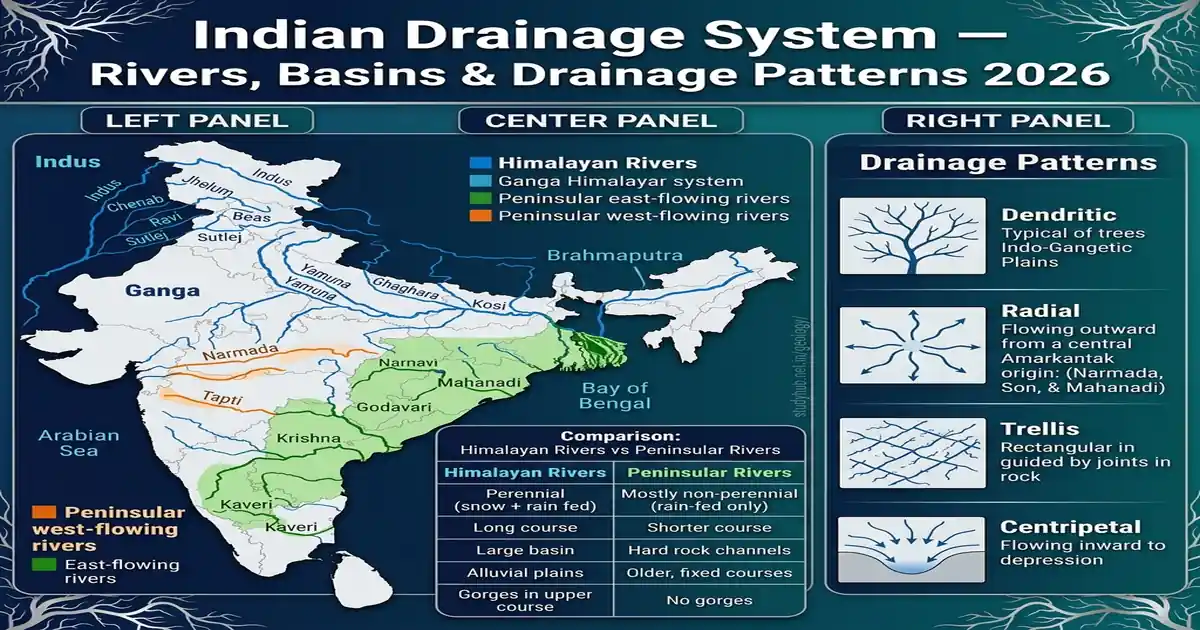
Indian Drainage System — Rivers, Basins & Drainage Patterns 2026
1. Himalayan Rivers vs Peninsular Rivers — Comparative Analysis
| Feature | Himalayan Rivers | Peninsular Rivers |
|---|---|---|
| Geological Origin | Young fold mountains (Himalayas, <50 Ma). Rivers ANTECEDENT (pre-date mountains — they were there before the Himalayas rose, so they cut gorges through rising mountains) or SUPERIMPOSED (descended from old erosion surfaces onto different underlying geology). The classic antecedent rivers: Indus, Sutlej, Brahmaputra — all originate on the TIBETAN PLATEAU (north of Himalayas), cut ACROSS the entire Himalayan range through deep gorges (Indus Gorge 5,200m — deepest gorge in world; Namcha Barwa Gorge of Brahmaputra = world’s deepest canyon at 5,382m) | Very ancient (Archean-Proterozoic crystalline basement of Peninsular India, 2,500–3,800 Ma). Rivers are CONSEQUENT (follow original slope of land) or SUBSEQUENT/OBSEQUENT (adjusted to structure). Rivers flow on old, hard, crystalline rock or sedimentary basin floors — courses fixed for hundreds of millions of years. Peninsular drainage pattern mostly set before Himalayan uplift (pre-50 Ma) |
| Perenniality | PERENNIAL (flow throughout year). Water sources: Glacial/snow melt (April–June: Himalayan snow melt = pre-monsoon peak). Monsoon rainfall (July–September = flood peak). Groundwater baseflow (October–March = low flow). Glacial melt and rain together = double peak. Rivers like Ganga, Yamuna, Brahmaputra never run dry (though flow very low in winter). CRITICAL: As Himalayan glaciers retreat due to climate change, the snow/ice melt component will DECREASE → rivers may become more seasonal by 2070–2100 | Mostly NON-PERENNIAL/SEASONAL. Fed almost entirely by SW Monsoon rainfall (June–September). Dry season (October–May) = greatly reduced flow or even dry. Exceptions: Godavari, Krishna, Kaveri have catchments large enough + tank irrigation storage to maintain some dry-season flow. Rivers in Kerala (SW slopes of Western Ghats + NE Monsoon) may have some dry-season flow. Narmada, Tapti: large enough watershed for some perennial flow |
| Valley Profile | V-shaped gorges in Himalayan zone (young, actively downcutting). Flat alluvial plains in middle and lower courses (aggradation = deposition). Braided channels (multiple channels separated by sand bars) in upper piedmont zone where gradient suddenly decreases (e.g., Ganga near Haridwar). Meandering channels in plains (low gradient, fine alluvium). High suspended sediment load (glacier-fed + active erosion) | Wide, shallow, flat-bottomed valleys cut into hard crystalline rock over long time (peneplaned topography). No gorges in lower courses — rivers in adjustment with old landscape. Graded profiles with falls where rivers cross hard rock bands. Falls: Jog Falls (Sharavathi River, Karnataka, 253m = India’s highest waterfall). Chitrakoot Falls (Indravati River, Chhattisgarh = India’s widest waterfall, “Indian Niagara”). Dhuandhar Falls (Narmada at Bhedaghat, MP) |
| Sediment Load & Delta Formation | Extremely high sediment load (Himalayan river silt = young, easily eroded rock + glacial flour). Ganga-Brahmaputra-Meghna combined = 3rd largest river system by discharge, WORLD’S LARGEST DELTA (Sundarbans, 80,000 km², Bangladesh-India). Ganga alone transports ~1.6 billion tonnes sediment/yr. Delta building = active (Brahmaputra delta = world’s fastest-growing). River shifting: Kosi river (“Sorrow of Bihar”) has migrated 133 km westward in last 200 years due to sediment deposition → floods Bihar annually | Moderate sediment load (hard rock + less erosion). Well-developed large deltas on EAST coast where rivers meet Bay of Bengal (low gradient shelf accommodates delta growth): Mahanadi delta (Cuttack-Paradip), Godavari delta (Rajamahendravaram-Kakinada), Krishna delta (Vijayawada-Machilipatnam), Kaveri delta (Thanjavur-Nagapattinam). West-flowing rivers (Narmada, Tapti) have ESTUARIES (not deltas) because they flow through rift valleys, steep gradients, and narrow continental shelf — no delta formation |
| Drainage Basin Size | Very large basins. Ganga basin: 8,61,404 km² (India’s largest river basin, 26% of India’s geographic area — UP, Bihar, Jharkhand, WB, Uttarakhand, HP, Haryana, Rajasthan). Brahmaputra basin: 1,94,413 km² (India part; total 5,80,000 km² Tibet+India+Bangladesh). Indus basin (India part): ~3,21,290 km² (J&K, HP, Punjab, Haryana, Rajasthan — though 80% of Indus flow goes to Pakistan under Indus Waters Treaty 1960) | Largest peninsular basins (moderate compared to Himalayan): Godavari basin: 3,12,812 km² (India’s LARGEST PENINSULAR river basin; Maharashtra-AP-Telangana-CG-Odisha-MP). Krishna basin: 2,58,948 km². Mahanadi basin: 1,41,589 km². Narmada basin: 98,796 km². Kaveri basin: 81,155 km². Smaller: Tapti, Luni (closed basin, no sea outlet — drains into Rann of Kutch), Sabarmati, Mahi, Damodar (“Sorrow of Bengal”) |
| Course & Direction | Complex courses shaped by antecedence and Himalayan tectonics. Ganga: flows west-to-east across the IGP. Brahmaputra: originates in Tibet as Tsangpo (flows EAST!), then turns sharply WEST around Namcha Barwa, enters India as Dihang, becomes Brahmaputra (flows WEST to EAST in Assam Valley, then joins Ganga). Indus: originates in Tibet as Singi Khamban, flows NORTHWEST, enters India through Ladakh, turns SOUTHWEST, enters Pakistan. Irony: both Indus and Brahmaputra originate NORTH of Himalayas in Tibet, closer to each other on the plateau than their mouths are! | Generally radial outward from Peninsular plateau. East-flowing (majority): drain to Bay of Bengal (90% peninsular drainage). West-flowing (exception, rift rivers): Narmada and Tapti flow WEST through Narmada Valley and Tapti Valley respectively = the two famous exceptions to the east-flowing Peninsular rule. Reason: Narmada and Tapti flow through RIFT VALLEYS (graben structures = down-dropped blocks between faults), NOT through the normal Deccan slope. Luni: flows southwest from Aravalli → disappears in Rann of Kutch (inland drainage, only Peninsular river with no sea outlet in India proper) |
2. Major River Systems — Basin Facts & Key Data
| River / System | Key Facts | Major Tributaries, Dams & Cities | Economic / Environmental Significance |
|---|---|---|---|
| Ganga System (India’s most sacred + most important) | Origin: Gangotri glacier, Uttarakhand (Bhagirathi tributary — meets Alaknanda at Devprayag = Ganga begins). Length: 2,525 km (3rd longest in India). Basin: 8,61,404 km² = India’s LARGEST river basin. Total discharge: ~16,650 m³/s at mouth. Ganga joins Brahmaputra at Bangladesh → Meghna → Bay of Bengal. World’s 3rd largest river system by discharge | Right tributaries: Yamuna (1,376 km, Delhi, meets Ganga at Prayagraj — Triveni Sangam), Chambal (Rajasthan-MP), Son (Jharkhand-MP), Betwa (MP-UP), Ken (MP). Left tributaries: Ramganga (UP), Ghaghara (largest tributary, Nepal-UP), Gandak (Nepal-Bihar border), Kosi (Nepal-Bihar, “Sorrow of Bihar,” migrated 133 km west), Mahananda (N Bengal). Major cities on Ganga: Haridwar, Kanpur, Allahabad/Prayagraj, Varanasi, Patna, Farakka. Dams: Tehri Dam (Bhagirathi, 260m = India’s tallest dam). Farakka Barrage (India-Bangladesh dispute). Rishikesh barrage | Agriculture: Ganga basin = India’s food bowl (wheat, rice, sugarcane, jute). Irrigation: Upper Ganga Canal (1854 = India’s oldest canal). Farakka dispute: India diverts Ganga water to flush silt from Kolkata Port → Bangladesh protests reduced dry-season flow. Pollution: Most polluted river in India (45 tributaries, 1 billion people in catchment, 600 million depend directly). Coliform bacteria, tannery effluent (Kanpur), sewage, industrial. Namami Gange Programme (2014, Rs 37,000 cr): India’s most ambitious river cleaning initiative. National Mission for Clean Ganga (NMCG). Kosi: embankment breach → Nepal Terai floods annually. Triveni Sangam (Prayagraj): confluence Ganga+Yamuna+mythical Saraswati = Kumbh Mela site (world’s largest peaceful gathering) |
| Brahmaputra System | One of world’s largest rivers by discharge (world’s 9th largest). Origin: Angsi glacier, Kailash Range, Tibet (as Tsangpo, 1,625 km in Tibet). Enters India through Arunachal Pradesh as Dihang. Becomes Brahmaputra in Assam Valley. Length in India: ~916 km. Total length: ~2,900 km. Falls 4,500m from origin to India plains = enormous hydropower potential. GREAT BEND around Namcha Barwa (7,782m) = deepest gorge on Earth. Joins Ganga (as Padma) in Bangladesh | Major tributaries in India: Subansiri (Arunachal = “Gold River,” major HEP project controversy), Kameng/Jia Bhoreli, Manas (Bhutan-India, tiger reserve), Dhansiri, Dibang, Lohit (joins near Arunachal-Assam border = technically called Brahmaputra from here). Left bank: Beki, Pagladiya, Puthimari. On Bangladesh side: Tista (from Sikkim-WB). Majuli Island: world’s largest river island (Assam, UNESCO heritage nomination, shrinking from erosion). Dams: Few major dams in India (seismically active, ecological sensitivity). Lower Subansiri HEP (under construction, 2,000 MW contested) | Floods: Assam floods annually (2022 monsoon = 60% Assam flooded). Brahmaputra carries 40% of India’s water but from only 6% of land area. Sediment: highest sediment concentration of any major world river (active Himalayan orogeny). Islands: Majuli (river island, largest in world, Assam). Umananda (smallest inhabited island, Guwahati). Hydropower: enormous untapped potential (India-China competition over diversion for Chinese mega-dam project in Tibet — geopolitical issue). India-China Brahmaputra water dispute: China’s Motuo Dam on Tsangpo = contentious. Ecology: Gangetic dolphin (Platanista gangetica = India’s National Aquatic Animal), Irrawaddy dolphin (Chilika Lake, also in Brahmaputra estuary) |
| Godavari System (India’s largest peninsular river) | “Ganga of the South” / Dakshin Ganga. Origin: Trimbakeshwar, Nashik, Maharashtra (at 910m elevation, just 80 km from Arabian Sea but flows EAST 1,465 km to Bay of Bengal). Length: 1,465 km = India’s 2nd longest river (after Ganga). LARGEST PENINSULAR river basin: 3,12,812 km². Multi-state river (Maharashtra, Chhattisgarh, Telangana, AP, Odisha, MP). Sacred: 12-yearly Pushkaram festival at Rajamahendravaram. Rich biodiversity: Godavari mangroves, Coringa WS (AP = 2nd largest mangrove India) | Tributaries: Pranhita (largest, Wardha+Wainganga+Penganga confluence), Indravati (Chhattisgarh — Chitrakoot Falls on Indravati = “Indian Niagara”), Manjra, Bindusara, Sabari. Cities: Nashik (origin), Nanded, Rajamahendravaram (Rajahmundry — largest river bridge in India — Godavari Rail Cum Road bridge). Major dams: Jayakwadi Dam (Maharashtra, Paithan district = largest earthen dam in Maharashtra). Polavaram Project (AP — India’s national project on Godavari, major political controversy: AP vs Odisha+Chhattisgarh). Srisailam (Tungabhadra tributary Krishna, but Godavari adjacent) | Agriculture: Godavari basin = AP rice bowl (delta = Godavari delta = one of India’s richest agricultural areas). Godavari river linking: Polavaram project will also link Godavari to Krishna river. Water sharing: Bachawat Tribunal (1980) allocated Godavari waters between Maharashtra, AP, MP, Odisha, Karnataka. Fisheries: Godavari estuary = major fishing ground (Hilsa, Prawn). Oil and gas: offshore KG basin at Godavari mouth. Rajahmundry area: natural gas fields. Coringa Wildlife Sanctuary (mangrove, Kakinada): endangered Irrawaddy dolphin, fishing cat. Sileru HEP (border AP-Odisha) |
| Narmada & Tapti (West-flowing exception rivers) | NARMADA: “Reversal of India’s peninsular drainage.” Origin: Amarkantak Plateau (MP-CG border, 1,057m) — same plateau origin as Son River (flows EAST to Ganga) and Mahanadi → RADIAL DRAINAGE from Amarkantak. Length: 1,312 km. Flows WEST (opposite to all other major peninsular rivers) through RIFT VALLEY (graben between Vindhya Ranges to north + Satpura Ranges to south). Empties into Gulf of Khambhat (Gujarat) as ESTUARY (NO DELTA because rift valley + narrow shelf). Total basin: 98,796 km². Sacred: mentioned in all Puranas, older than Ganga in Hindu tradition. TAPTI (Tapi): Origin: Betul district, MP. Length: 724 km. Also flows WEST through Tapti Rift Valley (parallel to Narmada, ~100 km south). Empties near Surat, Gujarat | Narmada tributaries: Tawa (largest, MP), Hiran, Burhner, Banjar, Barnar, Sukta. Major dams: Sardar Sarovar Dam (Gujarat = 163m, India’s 2nd largest concrete gravity dam, 1,450 MW, major controversy → NBA = Narmada Bachao Andolan by Medha Patkar). Bargi Dam (MP). Indira Sagar Dam (MP, largest reservoir in India by capacity = 12,220 Mm³). Omkareshwar Dam (MP). Falls: Dhuandhar Falls (Bhedaghat, near Jabalpur — white smoke waterfall). Tapti: Ukai Dam (Gujarat = HEP). Golden Gate Bridge of India: Surat Tapti Bridge. Cities on Narmada: Amarkantak (origin), Jabalpur (Bhedaghat falls), Bharuch/Broach (mouth) | Narmada = India’s most contested river. NBA (Narmada Bachao Andolan, 1989–ongoing): Medha Patkar + Baba Amte protests against dam building. Supreme Court allowed SSP to continue. 3,000+ villages and 250,000 people displaced. Rehabilitation controversy. SSP (Sardar Sarovar Project): benefits Gujarat (water for drinking, irrigation, Saurashtra-Kutch development = Narmada grid). Also: Rajasthan and Maharashtra get allocated water. Marble Rocks of Bhedaghat: white crystalline Proterozoic marble gorge cut by Narmada = famous tourist site. Geological connection: Narmada-Son Lineament = ancient rift structure = fault separating Vindhyan and Deccan plates. Narmada valley fossils: dinosaur eggs, bones (Late Cretaceous, 65–70 Ma old, near Bagh, MP). Hoshangabad area = Narmada Human fossil (Homo sapiens = Narmada Man, discovered 1982, ~300,000 years old, oldest human fossil in South Asia) |
| Indus System & Water Treaty | Origin: Manasarovar Lake area / Kailash Range, Tibet (as Singi Khamban = “Lion’s Mouth”). Flows northwest through Ladakh (cutting gorges including the world’s 2nd deepest gorge at Skardu, Pakistan). Enters India through Ladakh valley. Joins Pakistan at Attari area. Major tributaries in India/Pakistan: Shyok, Zanskar, Gilgit, Hunza (Pakistan), Jhelum, Chenab, Ravi, Beas, Sutlej. Total length: 3,180 km (longest in subcontinent). Basin: 11,65,000 km² total (87% in Pakistan + Ladakh POK). Indian part: Punjab + Himachal Pradesh + J&K + Ladakh | INDUS WATERS TREATY (IWT, 1960): Negotiated by World Bank. India gets: EASTERN 3 rivers = Beas, Ravi, Sutlej (unrestricted use). Pakistan gets: WESTERN 3 rivers = Indus, Jhelum, Chenab (80% of annual flow). India can use western rivers ONLY for run-of-river HEP and limited irrigation. Major dams: Bhakra Dam + Nangal Dam (Sutlej, HP-Punjab border, 226m = India’s 2nd tallest, largest multi-purpose). Pong Dam (Beas, HP). Ranjit Sagar Dam (Ravi, India’s largest per Ravi). Beas-Sutlej Link Canal (Bhakra Nangal system). Thein/Ranjit Sagar Dam. 2025: India suspended IWT consultations (after Pahalgam attacks) — geopolitical water flashpoint | IWT controversy: Post-1965 and post-1971 wars — treaty survived. Post-Uri 2016 and post-Pulwama 2019 — India renegotiated position. IWT considered most successful international water treaty (survived 3 wars, ongoing tensions). Benefits India: Bhakra-Nangal system = backbone of Punjab-Haryana Green Revolution (Sutlej-Beas irrigation). Rajasthan Canal (Indira Gandhi Canal) via Harike Barrage on Sutlej-Beas confluence. Water security: Punjab Haryana farmers depend entirely on Sutlej-Beas allocation. Pakistan: Indus + Jhelum + Chenab = 80% of Pakistan’s total water use. Climate change: Karakoram glaciers (Pakistan) + Himalayan glaciers (India, Siachen-Gangotri) → reduced future flow → both countries water-stressed |
3. Drainage Patterns & Water Management
| Topic | Details | India Examples |
|---|---|---|
| Drainage Patterns | Dendritic: Tree-like branching pattern, develops on uniform rock with no structural control. Most common pattern. Trellis: Rectangular grid pattern, streams follow joints/faults at right angles. Develops on folded/faulted terrain. Radial: Streams flow outward from a central high point (volcano, dome). Centripetal: Streams flow inward to a central depression (basin/lake). Parallel: Streams flow parallel to each other on steep uniform slopes. Annular: Ring-shaped pattern on domed structures. Pinnate: Feather-like, in very fine soil — rare. Barbed: Tributaries join mainstream at acute angles pointing upstream — indicates river capture/piracy | Dendritic: Indo-Gangetic Plain rivers, most peninsular rivers on uniform Deccan basalt. Trellis: Himalayan rivers (Jhelum, Ravi follow strike vales, then cut across with gorges) — Vindhyan sandstone drainage. Radial: AMARKANTAK plateau (MP-CG): Origin point of Narmada (W), Son (NE), Mahanadi (E) — CLASSIC radial drainage from single point. Vindhyan plateau: minor radial patterns. Centripetal: Loktak Lake (Manipur), Sambhar Lake (Rajasthan), Rann of Kutch. Parallel: Himalayan foothills (uniform westward dip). Annular: Kodaikanal plateau (Tamil Nadu), some Deccan dome structures. Barbed: Damodar River (evidence of river capture in Jharkhand coalfield area) |
| River Capture / Piracy | When one stream erodes headward into another stream’s basin and diverts its flow. The aggressive stream = “pirate.” The captured stream = “beheaded.” Evidence: Barbed tributaries, misfit streams (stream too small for its valley), wind gaps (col/pass), elbow of capture. Rivers with steeper gradients on wetter side of a divide erode headward faster → capture streams on drier divide sides | Classic India river capture: Damodar River (Jharkhand-WB): Geomorphological evidence of stream captures in its headwater area. Son River: partly beheaded by Narmada’s headward erosion? Kosi: Has not been “captured” but has dramatically migrated across Bihar floodplain by avulsion (natural channel switching through deposition) = 133 km west shift = “Sorrow of Bihar.” Western Ghats: Western streams aggressively capture eastern streams due to steep western slope + high rainfall (e.g., Periyar River in Kerala = headward captured Madurai area streams in TN) |
| Interlinking of Rivers (ILR) | India’s most ambitious water management proposal: transfer surplus water from Himalayan rivers (flood-prone, excess water) to deficit peninsular/drought-prone areas via network of canals and reservoirs. Originally proposed in 1970s. National Perspective Plan (1980, National Water Development Agency = NWDA): Himalayan component (14 links) + Peninsular component (16 links) = 30 links total. Proposed to transfer 178 BCM/yr. Estimated cost: ₹5.5 lakh crore (2002 estimates, now much higher) | Current progress: Ken-Betwa Link (MP): FIRST implemented link project. Connects Ken River (excess water, Panna) to Betwa River (deficit, Bundelkhand). Rs 44,605 cr cost. Approved 2021. Parbati-Kalisindh-Chambal Link (Rajasthan-MP). Godavari-Krishna Link (AP-Telangana). Controversies: Displacement (millions affected). Environmental impact on flooding rivers’ ecology. Bangladesh-Nepal objections (Himalayan component). Many criticised as poorly planned. Supreme Court directed expediting certain links. International concerns: Brahmaputra diversion near China’s Motuo Dam (geopolitical + ecological). Nam-ami Gange Priority: river cleaning vs interlinking debate |
| River Pollution & Conservation | India’s rivers are severely polluted: Major sources: (1) Domestic sewage (only 37% of sewage treated — balance raw sewage directly into rivers). (2) Industrial effluents (tanneries: Kanpur Ganga; textile dyeing: Tirupur-Noyyal River TN; paper mills, sugar mills). (3) Agricultural runoff (nitrates, pesticides from Green Revolution farmland). (4) Religious practices (idol immersion, cremation ashes, flower garlands). (5) Solid waste dumping. Ganga: most polluted in India. Biological Oxygen Demand (BOD) = indicator of organic pollution. High BOD → low dissolved oxygen → fish die-off. Coliform bacteria: indicator of sewage contamination (e-coli in Ganga 1,000x above safe limit at Varanasi) | Namami Gange Programme (2014, flagship): Rs 37,000 crore (2021 enhanced). Sewage treatment plants (STPs). Ghat rejuvenation (beautification). Real-time water quality monitoring. Afforestation in Ganga basin. Industrial effluent control. 2022: Ganga water quality IMPROVED at some monitoring stations (DO increased, BOD reduced at Haridwar) — but still far from swimming/bathing standards at Varanasi-Kanpur. National Mission for Clean Ganga (NMCG). National Green Tribunal (NGT): has issued orders on river pollution, regularly fines states. Polluted River Stretch Programme (CPCB): 351 polluted river stretches identified across India (2022). River Festivals (India Water Week): awareness campaigns. Ganga Dolphin Conservation (Project Dolphin 2020) |
Frequently Asked Questions
Why do Narmada and Tapti flow west while all other peninsular rivers flow east — and why do they have estuaries instead of deltas?
This is one of the most frequently asked conceptual questions in UPSC Geography, requiring understanding of both structural geology and geomorphology. The short answer: Narmada and Tapti are rift valley rivers flowing through fault-bounded grabens (down-dropped blocks between parallel faults) — not on the normal westward slope of the Deccan Plateau. Here is the complete geological explanation. Normal Peninsular Drainage: The Peninsular Indian Plateau (the Deccan Plateau) tilts gently towards the east-northeast. The Western Ghats form a steep escarpment on the western margin (close to the Arabian Sea), while the eastern margin slopes gently towards the Bay of Bengal. Thus, the Primary Water Divide of Peninsular India = Western Ghats. Rivers originating on the Eastern slope (east of Western Ghats) drain eastward over the gentle gradient for hundreds of kilometres → reach Bay of Bengal → form wide deltas (Godavari, Krishna, Kaveri, Mahanadi). This is why 90% of peninsular drainage goes to the Bay of Bengal. The Narmada-Tapti Exception — Rift Valleys: In central India, between the Vindhyan Ranges (north) and the Satpura Ranges (south), runs a 1,300 km long tectonic structure called the Narmada-Son Rift System (also called the Narmada-Tapti Graben). This is a set of graben structures where the crust was pulled apart (extensional tectonics) approximately 65–100 Ma ago, roughly contemporaneous with the Deccan Trap volcanism. The rift valley floor (graben) is lower than the surrounding plateaux on both sides (Vindhya to north, Satpura to south). The Narmada River flows through this Narmada Graben — a west-tilted rift valley. The floor of the rift depression tilts slightly westward (downward towards the Arabian Sea) — quite the opposite of the general Deccan eastward tilt. So Narmada, following the graben floor, flows WESTWARD towards the Gulf of Khambhat. The Tapti (Tapi) River flows through a parallel rift graben approximately 100 km south of Narmada (between Satpura and Ajanta-Satmala ranges) — also westward-tilted → also flows WEST. Why Estuaries, Not Deltas?: At the mouth of Narmada and Tapti, the rivers meet the Arabian Sea through estuaries (funnel-shaped tidal inlets) rather than forming deltas. Three reasons: (1) Narrow continental shelf on the western coast: The Arabian Sea shelf is narrow and steep near Gujarat/Maharashtra → river sediment is quickly swept away by longshore currents, preventing delta buildup. (2) No depositional space: The rift valley channels are relatively straight and confined — rivers carry their sediment to the sea rapidly without spreading into distributaries. (3) Tidal dynamics: The Gulf of Khambhat has one of the world’s highest tidal ranges (up to 12m at Bhavnagar) — strong tides sweep sediment away and excavate the river mouth, creating estuary-form rather than delta-form. By contrast, the Bay of Bengal’s eastern coast has a wide, shallow continental shelf (Bay of Bengal shelf can extend 100–200 km), gentle gradient, LOW tidal range (1–2m only), and abundant sediment → ideal conditions for large deltas (Godavari, Krishna, Kaveri, Mahanadi, Ganga-Brahmaputra). Geological memory aid: West-flowing = rift valley rivers: Narmada + Tapti only. Rift = graben = down-dropped block between faults. Narmada origin = Amarkantak (Maikala Range, MP-CG border) — same plateau also gives rise to Son (flows NE to Ganga) and Mahanadi (flows SE to Bay of Bengal) from adjacent slopes = RADIAL DRAINAGE from Amarkantak. Narmada is one of India’s most sacred rivers (Narmada Parikrama = 3 year 3,674 km circumambulation walk).
Important for Exams — Indian Drainage UPSC, SSC & State PCS
Himalayan vs Peninsular rivers: Himalayan = young, antecedent/superimposed, perennial (glacier+monsoon fed), high sediment, V-shaped gorges, large alluvial plains, active delta building. Peninsular = ancient, mostly rainfed/seasonal, hard rock channels, mature graded valleys. Antecedent rivers (pre-date mountains): Indus, Sutlej, Brahmaputra (all originate NORTH of Himalayas in Tibet, cut ACROSS Himalayas through gorges). Key basins by size: Ganga (8,61,404 km² = India’s largest). Godavari (3,12,812 km² = India’s largest peninsular). Indus India part (~3,21,290 km²). Krishna (2,58,948 km²). Brahmaputra India part (1,94,413 km²). West-flowing peninsular rivers: ONLY Narmada + Tapti (rift valley grabens). All others = east-flowing to Bay of Bengal. Estuaries (not deltas) at Narmada/Tapti mouth. Deltas on east coast: Godavari (Rajahmundry), Krishna (Vijayawada), Kaveri (Thanjavur), Mahanadi (Cuttack). Ganga-Brahmaputra-Meghna = world’s largest delta (Sundarbans, 80,000 km²). Key rivers: “Sorrow of Bihar” = Kosi (migrated 133 km westward). “Sorrow of Bengal” = Damodar (floods). “Sorrow of Odisha” = Mahanadi (ancient name). “Ganga of South” = Godavari. Amarkantak = origin of Narmada (W), Son (NE), Mahanadi (E) = radial drainage. Indus Waters Treaty (1960): India gets Beas+Ravi+Sutlej (eastern 3). Pakistan gets Indus+Jhelum+Chenab (western 3 = 80% of water). Bhakra-Nangal Dam (Sutlej, 226m = India’s 2nd tallest). Tehri Dam (261m = India’s tallest). Sardar Sarovar (Narmada, 163m, NBA controversy). Indira Sagar (Narmada, largest reservoir India). Drainage patterns: Dendritic (most common, IGP), Trellis (Himalayan foothills), Radial (Amarkantak), Centripetal (Loktak, Sambhar), Parallel (Himalayan foothills), Annular (dome structures). Ken-Betwa Link = first ILR link project (Bundelkhand, MP). Namami Gange (2014, Rs 37,000 cr) = Ganga cleaning. India National Aquatic Animal = Gangetic Dolphin. Project Dolphin (2020).
What to Read Next
- Rivers & Fluvial Geomorphology — How Rivers Shape the Landscape 2026
- Glaciers — Himalayan Glaciers Feeding India’s Rivers 2026
- Himalayan Formation — Why Rivers Predate the Himalayas (Antecedence) 2026
- Indian Soils — How River Alluvium Creates India’s Richest Soils 2026
- Coastal Geomorphology — River Deltas vs Estuaries on India’s Coast 2026
🎔 Exam Quick Reference — Indian Drainage System: HIMALAYAN RIVERS: Young, antecedent (predate mountains), perennial (glacier+monsoon), large alluvial plains, deltas. PENINSULAR RIVERS: Ancient, mostly seasonal, hard rock channels, fixed courses. ANTECEDENT RIVERS: Indus, Sutlej, Brahmaputra (originate in Tibet, cut across Himalayas). LARGEST BASINS: Ganga (8,61,404 km², India’s largest). Godavari (3,12,812 km²=India’s largest peninsular). Indus (India 3,21,290 km²). WEST-FLOWING: ONLY Narmada+Tapti (rift valley greens). All other peninsular=east-flowing. Estuaries (not deltas) at Narmada/Tapti mouth. DELTAS: East coast (Godavari, Krishna, Kaveri, Mahanadi, Ganga-Brahmaputra=world’s largest 80,000km²). KEY FACTS: Sorrow of Bihar=Kosi (133 km westward migration). Sorrow of Bengal=Damodar. Ganga of South=Godavari. Amarkantak=origin of Narmada(W)+Son(NE)+Mahanadi(E)=radial drainage. INDUS WATERS TREATY (1960): India=Beas+Ravi+Sutlej(eastern). Pakistan=Indus+Jhelum+Chenab(western,80% flow). MAJOR DAMS: Tehri(261m=tallest India, Bhagirathi, Uttarakhand). Bhakra-Nangal(226m, Sutlej, Punjab-HP). Sardar Sarovar(163m, Narmada, Gujarat, NBA controversy). Indira Sagar(Narmada, largest reservoir India). Jayakwadi(Godavari, Maharashtra). DRAINAGE PATTERNS: Dendritic(most common), Trellis(Himalayan foothills), Radial(Amarkantak), Centripetal(Loktak), Parallel(slope), Annular(dome). KEN-BETWA=first ILR project. NAMAMI GANGE (2014, Rs37,000cr). India National Aquatic Animal=Gangetic Dolphin. Rajasthan: Luni=only peninsular river with NO sea outlet (drains inland to Rann of Kutch). Brahmaputra Gorge (Namcha Barwa)=world’s deepest canyon.
🌍 India’s Major Waterfalls — Quick Reference 2026: India’s HIGHEST waterfall: Kunchikal Falls (Shimoga/Shivamogga, Karnataka, on Varahi River = 455m). Often confused with Jog Falls. JOG FALLS (Sharavathi River, Karnataka = 4-tiered, 253m, Raja/Rover/Rani/Rocket tiers = India’s most famous waterfall. SECOND highest in India officially). Chitrakoot Falls (Indravati River, Jagdalpur, Chhattisgarh = 95m wide, 30m drop, ‘Indian Niagara’ = India’s WIDEST waterfall). Dhuandhar Falls (Narmada at Bhedaghat, Jabalpur MP = literally “smoke of water”, 15m drop but spectacular marble gorge). Athirappilly Falls (Chalakudy River, Kerala = 80m, ‘Niagara of India/Kerala’, located near elephant corridor controversy with NTPC power plant). Dudhsagar Falls (Mandovi River, Goa-Karnataka border = 4 tiered, 310m, “Sea of Milk,” on Konkan Railway line — tourist train stop). Shivanasamudra Falls (Kaveri River, Karnataka = 90m, FIRST hydroelectric power station in India built here, 1902, also Asia’s second). Hogenakkal Falls (“Smoking Rocks” in Tamil = Kaveri River, Dharmapuri TN = 20m, called “Niagara of India TN”). Nohkalikai Falls (Meghalaya, Cherrapunji = 340m = India’s tallest plunge waterfall). Elephant Falls (Meghalaya, Shillong). Note: ISFR classifies different heights — always check which “highest/widest” qualifier is used in question.
About This Guide: Written by the StudyHub Geology Editorial Team (studyhub.net.in/geology/) based on NCERT Class 11 Geography India Chapter 3 (Drainage System), Central Water Commission (CWC) Annual Report 2023, National Water Mission Report 2022, National Mission for Clean Ganga (NMCG) Progress Report 2023, and R.L. Singh “India: A Regional Geography” (1971, revised). Last updated: March 2026.