
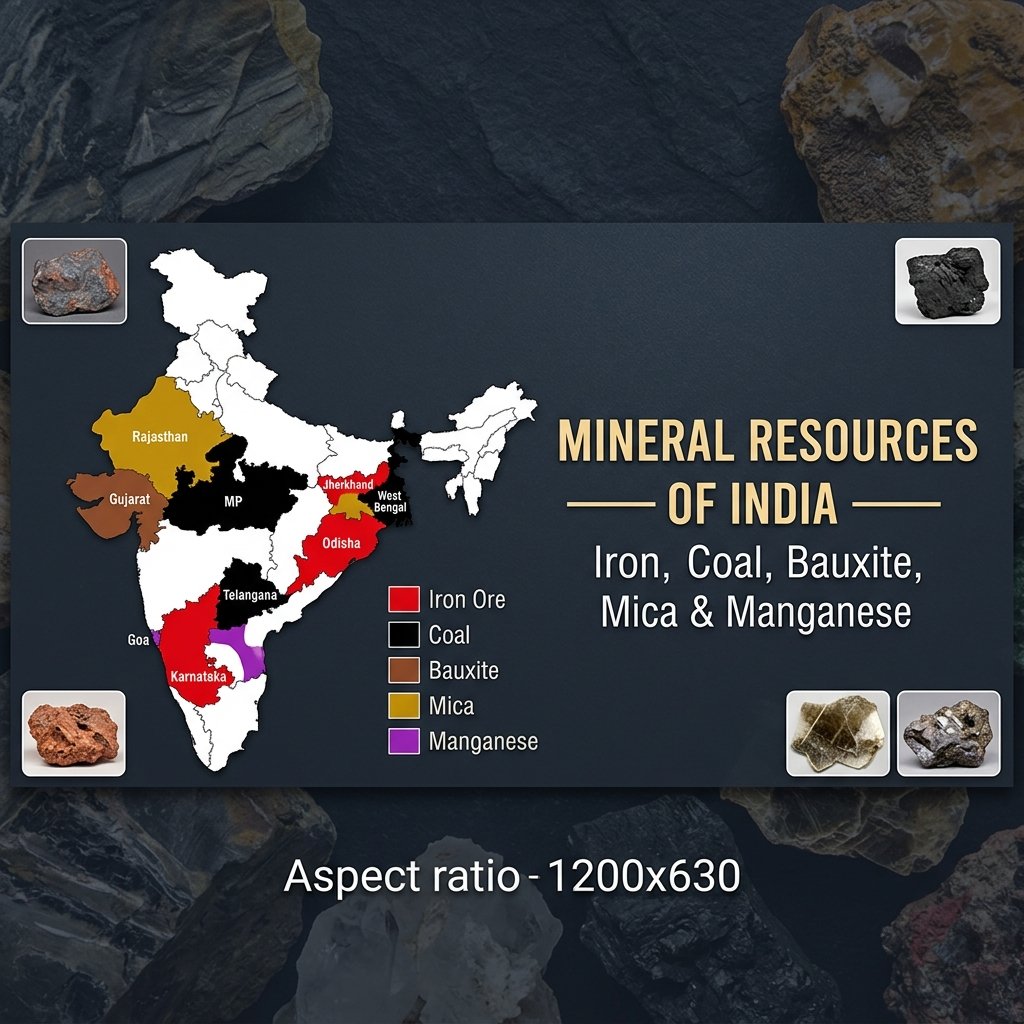
India is one of the world’s most mineral-rich nations, holding significant reserves of coal, iron ore, bauxite, mica, manganese, limestone, and petroleum. The country’s mineral wealth is largely concentrated in the Chota Nagpur Plateau (Jharkhand, Odisha, West Bengal, Chhattisgarh) — often called the “Ruhr of India” — an ancient Gondwana-age shield rich in metallic and non-metallic minerals. Understanding mineral distribution, major mining states, and the geological basis for India’s mineral wealth is essential for UPSC, SSC, State PSC, and all competitive geography and economy exams.
Classification of Minerals
| Category | Type | Examples | India’s Importance |
|---|---|---|---|
| Metallic | Ferrous (iron-based) | Iron ore, Manganese, Chromite, Nickel | Jharkhand, Odisha, Karnataka dominant |
| Metallic | Non-Ferrous | Bauxite (Al), Copper, Lead-Zinc, Gold | Odisha, Rajasthan, Karnataka key |
| Non-Metallic | Industrial minerals | Mica, Limestone, Gypsum, Dolomite | Jharkhand mica; Rajasthan stone |
| Energy minerals | Fossil fuel | Coal, Petroleum, Natural Gas, Lignite | Gondwana coal belts; Rajasthan/Mumbai oil |
| Atomic minerals | Nuclear fuels | Uranium, Thorium, Beryllium | Jaduguda (Jharkhand) uranium; Kerala thorium |
1. Iron Ore — India’s Most Important Metallic Mineral
India holds the world’s 4th largest iron ore reserves and is among the top iron ore producers globally. Indian iron ore is of high quality — particularly the haematite type with high iron content (60–65% Fe).
Types of Iron Ore
- 🔴 Haematite (Fe₂O₃): Best quality; 60–70% iron content; red; found in peninsular India
- ⬛ Magnetite (Fe₃O₄): Highest iron content (70–72%); black; magnetic; found in Karnataka, Tamil Nadu
- 🟡 Limonite & Siderite: Lower grade; less commercially important
Major Iron Ore Producing States
| State | Share | Key Mines / Regions |
|---|---|---|
| Odisha | ~52% of India | Kendujhar (Keonjhar), Sundargarh, Mayurbhanj — Barajamda, Koira belts |
| Jharkhand | ~25% | Singhbhum district — Noamundi, Gua, Baharagora mines |
| Chhattisgarh | ~15% | Bailadila range — very high grade (65% Fe); exported to Japan via Vizag port |
| Karnataka | ~5–7% | Bellary-Hospet (Sandur belt); Kudremukh (magnetite); controversy over illegal mining 2011 |
| Goa | Significant exports | Salcete, Sanguem; mostly exported through Mormugao Port; Supreme Court mining ban issues |
⛏️ Bailadila Iron Ore (Chhattisgarh): One of the world’s finest iron ore deposits — high grade (65%+ Fe), located in the Bailadila hills of the Bastar region. Ore is transported via a 260 km slurry pipeline to Vizag (Visakhapatnam) port for export to Japan under a long-standing contract since the 1960s.
2. Coal — India’s Most Abundant Fossil Fuel
India has the world’s 4th largest coal reserves and is the 2nd largest coal producer (after China). Indian coal is predominantly bituminous and sub-bituminous — suitable for coking (steel making) and thermal power generation.
Two Types of Indian Coal by Age
- 🪨 Gondwana Coal (Carboniferous–Permian, 250–300 Ma): Found in the Damodar Valley, Mahanadi Valley, Son Valley, Pranhita-Godavari Valley; best quality (higher carbon %, lower sulphur); accounts for ~98% of India’s coal reserves. Formed from ancient Gondwana forests when India was part of the Gondwana supercontinent.
- 🪨 Tertiary Coal (15–65 Ma): Found in Assam (Makum, Ledo), Meghalaya, Nagaland, Arunachal Pradesh, Rajasthan (Palana), J&K; younger, lower quality (higher moisture, sulphur), but important for local energy in NE India.
Major Coal Mining Regions
| Coalfield | State(s) | Key Mines |
|---|---|---|
| Jharia | Jharkhand | India’s largest coking coal reserve; underground fires burning for 100+ years |
| Raniganj | West Bengal | India’s oldest coalfield (mining since 1820s) |
| Bokaro | Jharkhand | Major coking coal; Bokaro Steel Plant nearby |
| Giridih | Jharkhand | High quality coal; Damodar Valley |
| East & West Bokaro | Jharkhand | Part of great Damodar Valley coalfield complex |
| Singrauli | MP/UP Border | Massive thermal coal basin; NTPC thermal plants |
| Korba | Chhattisgarh | Large open-cast mines; SECL; NTPC Korba plant |
| Talcher | Odisha | Large reserves; coal for Mahanadi coalfields |
| Wardha Valley | Maharashtra | Deccan coalfield; Chandrapur, Yavatmal |
| Godavari Valley | Telangana/AP | Singareni Collieries; major southern coalfield |
3. Bauxite — Ore of Aluminium
- 🪨 Bauxite = primary ore of aluminium; formed by intense tropical weathering (laterisation) of aluminium-rich rocks
- 📊 India has world’s 5th largest bauxite reserves
- 📍 Major producers:
- 🥇 Odisha — ~50% of India; Koraput, Kalahandi, Rayagada districts; Niyamgiri hills (Dongria Kondh tribal land — major controversy, Vedanta bauxite mining vs tribal rights)
- 🥈 Gujarat — Jamnagar, Junagarh, Amereli districts
- Maharashtra — Kolhapur, Ratnagiri (bauxite on laterite plateaus)
- Jharkhand — Lohardaga district; HINDALCO Renukoot plant uses this
- Madhya Pradesh, Chhattisgarh — Amarkantak plateau
4. Mica — India’s Global Dominance
India was once the world’s dominant mica producer, supplying 60–80% of global demand at its peak. Mica is a phyllosilicate mineral prized for its unique properties: it can be split into very thin transparent sheets, is an excellent electrical insulator, and is heat-resistant.
- 🔹 Uses: Electrical insulation (capacitors, transformers), cosmetics/makeup (shimmer), paint, rubber, welding rods
- 📍 Major mica belt:
- 🥇 Jharkhand — Koderma, Giridih, Hazaribagh — world’s best quality muscovite mica (“Ruby Mica”)
- 🥈 Rajasthan — Bhilwara, Ajmer, Jaipur districts
- Andhra Pradesh — Nellore (phlogopite mica)
- ⚠️ Child labour concern: Jharkhand and Rajasthan mica mines have been associated with child labour in informal/illegal mines — international attention from cosmetics industry supply chain audits
5. Manganese
- 🔹 Used in steel making (ferro-manganese), dry batteries, chemicals
- 📊 India = world’s 3rd largest manganese producer
- 📍 States: Odisha (47%) — Sundargarh, Keonjhar; Maharashtra — Nagpur, Bhandara; Karnataka — Sandur; Madhya Pradesh — Balaghat; Andhra Pradesh
6. Copper
- 🔹 India has limited copper reserves — a major deficit mineral; imports significant amounts
- 📍 Singhbhum (Jharkhand) — Rakha, Mosabani, Surda mines; HCL (Hindustan Copper Limited)
- 📍 Rajasthan — Khetri (Jhunjhunu) — “Copper City”; HCL’s largest mine
- 📍 Madhya Pradesh — Balaghat district (Malanjkhand copper mine)
7. Gold
- 🥇 Kolar Gold Fields (KGF) — Karnataka; historically India’s richest gold mine; one of the world’s deepest mines (3.2 km); closed in 2001 (uneconomical extraction); now world-famous from the KGF movie franchise
- 📍 Hutti Gold Mines — Raichur, Karnataka; only major active gold mine in India (Government of Karnataka)
- 📍 Rajasthan — small gold occurrence in Banswara, Bhilwara
8. Limestone — India’s Most Abundant Non-Metallic Mineral
- 🪨 Primary raw material for cement industry and steel making (flux)
- 📊 India has huge limestone reserves — sufficient for centuries
- 📍 States: Madhya Pradesh, Rajasthan, Andhra Pradesh, Gujarat, Karnataka, Himachal Pradesh — limestone found across sedimentary basins of peninsular and Himalayan India
9. Atomic Minerals
| Mineral | Location | Significance |
|---|---|---|
| Uranium | Jaduguda (Singhbhum, Jharkhand); Domiasiat (Meghalaya); Lambapur (Telangana) | Nuclear fuel; processed by UCIL (Uranium Corporation of India) |
| Thorium (Monazite) | Kerala coast (Kovalam-Varkala beach sands); Odisha, Tamil Nadu coast | India has world’s largest thorium reserves; future nuclear fuel (Stage 3 of India’s nuclear programme) |
| Ilmenite | Kerala, Tamil Nadu, Odisha coast | Titanium source; India has 27% of world’s ilmenite; IREL (Indian Rare Earths) |
The Chota Nagpur Plateau — India’s “Mineral Heartland”
The Chota Nagpur Plateau (spanning Jharkhand, Odisha, West Bengal, Chhattisgarh) is India’s most mineral-rich region, often called the “Ruhr of India” (after Germany’s industrial Ruhr Valley). It sits on the ancient Gondwana shield — Precambrian and Gondwana-age rocks that host India’s primary metallic and coal deposits.
- ⛏️ Minerals present: Coal (Jharia, Bokaro, Raniganj), Iron ore (Singhbhum), Copper (Singhbhum), Mica (Koderma, Hazaribagh), Bauxite (Lohardaga), Uranium (Jaduguda), Manganese
- 🏭 Major industries: TATA Steel (Jamshedpur), Bokaro Steel, MECON, SAIL plants all developed around this mineral base
- ⚠️ Tribal-mineral conflict: 8 of India’s 10 most mineral-rich districts are in tribal areas (Schedule V areas) — constant tension between mining companies, government, and tribal communities (Adivasis) over displacement and land rights
Key Takeaways
| Mineral | India’s World Rank | Top State | Key Deposit |
|---|---|---|---|
| Iron Ore | 4th reserves, top 5 producer | Odisha (52%) | Bailadila (CG), Barajamda (Odisha) |
| Coal | 4th reserves, 2nd producer | Jharkhand | Jharia (coking), Raniganj (oldest) |
| Bauxite | 5th reserves | Odisha (50%) | Niyamgiri Hills (Koraput) |
| Manganese | 3rd producer | Odisha | Keonjhar, Sundargarh |
| Mica | Historically #1 (Ruby mica) | Jharkhand | Koderma, Giridih |
| Thorium | Largest world reserves | Kerala | Monazite beach sands (Kovalam) |
| Uranium | Significant | Jharkhand | Jaduguda (Asia’s 1st uranium mine) |
| Gold | Minor producer | Karnataka | KGF (closed 2001), Hutti (active) |
Frequently Asked Questions (FAQs)
1. Why is most of India’s mineral wealth concentrated in Jharkhand and Odisha?
This is directly linked to geology. The Chota Nagpur Plateau is part of the ancient Gondwana shield — Precambrian rocks (2–3 billion years old) that have remained stable since the Gondwana supercontinent era. Igneous and metamorphic rocks of this shield contain metallic minerals (iron, copper, mica, gold). On top of this shield, the Gondwana-age sedimentary basins (Damodar Valley, Son Valley) contain the coal deposits formed from swamp forests ~300 million years ago when India was part of Gondwana. The combination of ancient shield + Gondwana sedimentary basins = unparalleled mineral concentration.
2. What is coking coal and why is Jharia so important?
Coking coal (also called metallurgical coal) is high-quality coal that, when heated, forms coke — a porous carbon material essential for steel manufacturing (blast furnace process). Not all coal can be turned into coke — only coal with specific properties (low sulphur, low ash, proper coking behaviour). Jharia coalfield (Jharkhand) holds India’s largest and highest-quality coking coal reserves — making it strategically crucial for India’s steel industry (TATA Steel, SAIL all depend on Jharia coal). The problem: Jharia has underground fires burning for over 100 years due to spontaneous combustion of exposed coal — displacing 500,000+ residents while trillions of rupees of coal burns underground.
3. Why does India import copper despite having deposits?
India’s copper reserves are low-grade and geographically limited. The ore concentration at Khetri (Rajasthan) and Singhbhum (Jharkhand) ranges from 0.5–1.5% copper — relatively low grade requiring large volumes of ore to be processed. India’s annual copper production meets only ~20–25% of its requirements; the rest is imported — primarily from Chile, Zambia, and Australia. India’s rapidly growing electronics sector, electric vehicle industry, and renewable energy infrastructure (all copper-intensive) will significantly increase this import dependence unless new high-grade deposits are found.
⭐ Important for Exams — Quick Revision
- 🔑 Iron ore: India = 4th largest reserves; Odisha #1 (52%); Bailadila (CG) = 65%+ Fe, exported to Japan
- 🔑 Haematite = best quality iron ore (red, 60–70% Fe); Magnetite = highest Fe (70–72%, black, Karnataka)
- 🔑 Coal: India = 4th reserves, 2nd producer; Gondwana coal = 98% of India’s coal (Jharkhand, WB, CG, MP)
- 🔑 Jharia = largest coking coal field; underground fires; Raniganj = India’s oldest coalfield (1820s)
- 🔑 Bauxite: India = 5th largest; Odisha (Niyamgiri Hills) = 50%; Vedanta controversy = tribal rights vs mining
- 🔑 Mica: Koderma/Hazaribagh (Jharkhand) = “Ruby Mica” = world’s best; Rajasthan; child labour issue
- 🔑 Manganese: India = 3rd producer; Odisha, Maharashtra, MP, Karnataka
- 🔑 Uranium: Jaduguda (Singhbhum, Jharkhand) = Asia’s FIRST uranium mine (1967)
- 🔑 Thorium: India = WORLD’S LARGEST reserves; Kerala beach sands (Monazite); future nuclear fuel
- 🔑 KGF (Kolar Gold Fields) = Karnataka; world’s deepest mine (3.2km); closed 2001; Hutti = India’s only active gold mine
- 🔑 Khetri = Rajasthan = “Copper City”; HCL’s largest mine
- 🔑 Chota Nagpur Plateau = “Ruhr of India”; Gondwana shield origin = metallic + coal minerals
- 🔑 Gondwana coal = formed from ancient Gondwana swamp forests ~300 Ma; direct link to Pangaea breakup (Geo-46)
Related Geology Articles on StudyHub
- ➡️ Pangaea & Gondwana — Why Gondwana-Age Rocks Hold India’s Coal
- ➡️ Deccan Traps — Volcanism & Mineral Formation in Peninsular India
- ➡️ Igneous Rocks — How Magmatic Processes Create Metallic Minerals
- ➡️ Laterite Soils — Connection to Bauxite Formation
- ➡️ River Systems — Damodar Valley Coalfields & Water-Energy Link