
India is one of the world’s most disaster-prone countries — its unique geography, geology, and climate make it vulnerable to a wide range of natural hazards. 68% of India’s land area is susceptible to drought, 60% to earthquakes, 12%+ to floods, and its entire eastern coastline is exposed to devastating cyclones. Understanding the causes, distribution, and management of natural disasters in India is a critical UPSC, SSC, and State PSC topic — especially after the 2005 National Disaster Management Act and establishment of NDMA (National Disaster Management Authority).
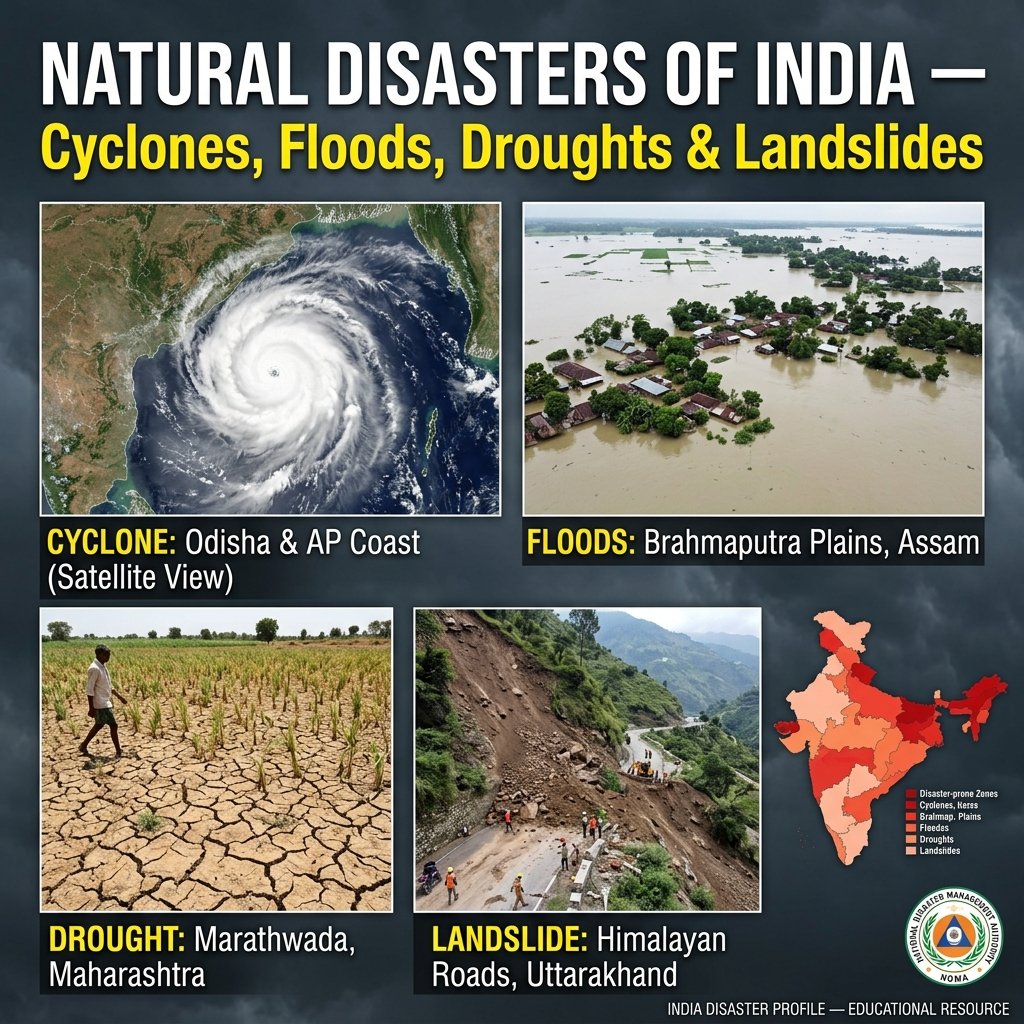
India’s Disaster Vulnerability — Overview
| Disaster Type | Area Affected | Most Vulnerable States | Season |
|---|---|---|---|
| Cyclones | Entire east coast + north Gujarat | Odisha, AP, Tamil Nadu, West Bengal, Gujarat | Pre-monsoon (Apr–Jun) & Post-monsoon (Oct–Dec) |
| Floods | ~12% of India’s total area | Assam, Bihar, UP, West Bengal, Odisha, Kerala | Monsoon (Jun–Sep) |
| Droughts | 68% of India’s area | Rajasthan, Maharashtra, Karnataka, MP, Gujarat | Failure of SW Monsoon (Jun–Sep) |
| Earthquakes | 60% of India’s area (Zones II–V) | J&K, HP, Uttarakhand, NE India, Gujarat | Year-round |
| Landslides | Himalayas + Western Ghats | Uttarakhand, HP, J&K, Kerala, NE India | Monsoon (Jun–Sep) |
| Heatwaves | Central, Northwest India | Rajasthan, UP, Bihar, Odisha, AP, Telangana | Pre-monsoon (Apr–Jun) |
| Tsunamis | Coastal areas | Tamil Nadu, Kerala, Andaman & Nicobar | Triggered by earthquakes (any time) |
1. Cyclones — India’s Coastal Menace
A tropical cyclone is a large-scale rotating storm system that forms over warm tropical oceans. In the Indian Ocean, cyclones that form over the Bay of Bengal (more frequent, more intense) or Arabian Sea (less common) and strike India’s coast can be among the most destructive weather events on Earth.
Why Bay of Bengal Has More Cyclones Than Arabian Sea
- 🌡️ Sea Surface Temperature (SST): Bay of Bengal stays warmer (28°C+) year-round = more evaporation = more cyclone energy
- 🌊 Low salinity: Bay receives huge freshwater input from major rivers (Ganga, Brahmaputra, Mahanadi, Godavari, Krishna) = warmer surface layer retained longer
- 💨 Weak vertical wind shear: Bay has weaker upper-level winds = cyclones can develop without being disrupted
- 🌍 Funnel shape: Bay of Bengal’s funnel-shaped northern geometry concentrates storm surge toward the Odisha-West Bengal coast (reason Bangladesh suffers most)
- 📊 ~80% of India’s cyclones originate in the Bay of Bengal
Major Historical Cyclones That Hit India
| Cyclone | Year | State | Deaths / Impact |
|---|---|---|---|
| Great Bhola Cyclone | 1970 | Bangladesh/WB | 300,000+ deaths; deadliest cyclone in history |
| Super Cyclone Odisha | 1999 | Odisha | 10,000+ deaths; 15 million affected; Paradip hit |
| Cyclone Phailin | 2013 | Odisha/AP | Category 5; 1 million evacuated in 48 hrs; only 45 deaths (model evacuation) |
| Cyclone Fani | 2019 | Odisha | Category 5; 1.2 million evacuated in 48 hrs; ~64 deaths; IMD won global praise |
| Cyclone Amphan | 2020 | West Bengal | Super cyclone; 128 deaths; Sundarbans devastated |
| Cyclone Tauktae | 2021 | Gujarat/Kerala | Rare Arabian Sea cyclone; oil rig P305 sank; 174 deaths |
| Cyclone Biparjoy | 2023 | Gujarat (Kutch) | Rare very severe; made landfall near Jakhau; mass evacuation; minimal deaths |
🌀 Odisha Cyclone Turnaround: The 1999 Odisha Super Cyclone killed 10,000+ people. By 2013 (Phailin) and 2019 (Fani), Odisha evacuated 1+ million people in 48 hours each time with minimal deaths — transforming from India’s worst cyclone victim to the world’s model for cyclone preparedness. This turnaround is studied globally as a case study in disaster risk reduction.
2. Floods — India’s Most Frequent Disaster
Floods are India’s most frequent and economically costly natural disaster, affecting an average of 75,000 km² of land annually and killing 1,600–2,000 people every year. India’s flood problem is driven by its monsoon climate — 75–80% of annual rainfall in 4 months.
Types of Floods in India
- 🌊 River floods (Pluvial): Rivers overflow banks during monsoon due to excessive rainfall, snowmelt, or dam releases — Ganga, Brahmaputra, Kosi, Damodar, Mahanadi, Godavari
- 🌊 Flash floods: Sudden, intense flooding in mountain streams from cloudbursts — Uttarakhand (Kedarnath 2013: 5,000+ deaths), Himachal Pradesh, NE India
- 🌊 Urban floods: City drainage overwhelmed by intense rainfall — Mumbai 2005 (944 mm rain in 24 hours), Chennai 2015, Hyderabad floods
- 🌊 Coastal floods: Storm surge from cyclones — Odisha, Bangladesh coast
Most Flood-Prone States
- 🥇 Assam — Brahmaputra and its tributaries; annual floods; Majuli Island shrinking; 2022 floods: 5+ million affected
- 🥈 Bihar — Kosi (“Sorrow of Bihar”), Gandak, Bagmati; course-shifting rivers from Nepal Himalayas
- 🥉 Uttar Pradesh — Ganga, Yamuna, Ghaghra overflow zones
- Odisha — Mahanadi, Baitarani, Brahmani; cyclone-induced coastal flooding
- Kerala — 2018 floods (worst in 100 years); Western Ghats rivers + SW Monsoon; 400+ deaths
3. Droughts — India’s Slow-Onset Disaster
A drought is a prolonged period of below-normal rainfall leading to water shortage, crop failures, and humanitarian distress. India experiences drought when the Southwest Monsoon fails or is deficient — often during El Niño years (see Geo-49: Indian Monsoon).
Types of Drought
- 🌾 Meteorological drought: Rainfall deficit ≥25% of normal in a season
- 💧 Hydrological drought: Reduced river flow, groundwater depletion
- 🌱 Agricultural drought: Soil moisture insufficient for crop growth
- 💰 Socio-economic drought: Water scarcity affects human welfare and economy
Drought-Prone Regions of India
- 🏜️ Rajasthan — Thar Desert; chronic drought; Barmer, Jaisalmer receive <20 cm/year
- 🌾 Marathwada (Maharashtra) — recurrent severe droughts; farmer suicides linked to crop failure; Osmanabad, Latur, Aurangabad
- 🌾 Vidarbha (Maharashtra) — cotton belt; drought → debt → farmer suicides; highest farmer suicide rate in India
- 🌾 Bundelkhand (UP/MP) — chronic water stress; Jhansi, Sagar region
- 🌾 Interior Karnataka, Rayalaseema (AP), Telangana — semi-arid zones; frequent drought years
4. Landslides — The Himalayan Hazard
India is one of the world’s most landslide-prone countries — the Himalayas and Western Ghats account for the majority. Landslides are primarily triggered by heavy monsoon rainfall + steep slopes + geological weakness + deforestation + road cutting.
Major Landslide-Prone Zones
- 🏔️ Zone 1 — Himalayas (highly unstable): Uttarakhand, Himachal Pradesh, J&K, Sikkim; young folded mountains + high rainfall + steep roads + seismic activity
- 🏔️ Zone 2 — Northeast India: Assam, Meghalaya, Nagaland, Manipur; high rainfall (Cherrapunji nearby), hill cultivation, road cutting
- 🌿 Zone 3 — Western Ghats: Kerala (Wayanad), Karnataka, Maharashtra; steep escarpment; heavy SW Monsoon rainfall
Major Landslide Events
- ⛰️ Kedarnath (Uttarakhand, 2013): Cloudburst + glacial lake outburst flood (GLOF) + landslides; 5,000–10,000 deaths; India’s worst Himalayan disaster
- ⛰️ Chamoli Disaster (2021): Rock avalanche + ice/glacier debris flow; wiped out Rishiganga and Dhauliganga hydropower plants; 204 deaths; GLOF triggered
- ⛰️ Wayanad Landslides (Kerala, 2024): Catastrophic landslides in tea/coffee plantation hills; 400+ deaths; one of Kerala’s worst natural disasters
- ⛰️ Joshimath (2023): Land subsidence threatening the entire Himalayan pilgrimage town; buildings cracking; linked to heavy construction + hydropower projects
5. Heatwaves — India’s Deadliest Slow-Onset Hazard
- 🌡️ IMD defines a heatwave when max temperature ≥ 40°C in plains (≥30°C in hills) AND is 4.5°C above normal
- 💀 2015 heatwave: 2,500+ deaths across Andhra Pradesh and Telangana — India’s worst recorded heatwave mortality
- 🌡️ Most affected: Rajasthan (Churu reaches 50°C+), MP, UP, Bihar, Odisha, Andhra Pradesh, Telangana; pre-monsoon May–June
- 📈 Heatwave frequency and intensity increasing due to climate change; urban heat islands worsening urban exposure
Disaster Management Framework in India
Disaster Management Act 2005
- 📜 Enacted after 2004 Indian Ocean Tsunami — India’s first comprehensive legal framework for disaster management
- 🏛️ NDMA (National Disaster Management Authority) — chaired by the Prime Minister of India; sets national DM policies and guidelines
- 🏛️ SDMA (State Disaster Management Authority) — state level; chaired by Chief Minister
- 🏛️ DDMA (District Disaster Management Authority) — district level; chaired by District Magistrate/Collector
- 🚒 NDRF (National Disaster Response Force) — India’s premier disaster response force; 16 battalions; specialised rescue in floods, cyclones, earthquakes, CBRN (Chemical/Biological/Radiological/Nuclear)
Sendai Framework (2015–2030) — India’s Commitment
- 🌐 Sendai Framework for Disaster Risk Reduction (SFDRR) — UN framework adopted at Sendai, Japan (2015)
- 🎯 4 Priorities: (1) Understand disaster risk; (2) Strengthen governance; (3) Invest in DRR; (4) Enhance preparedness
- 🎯 7 Targets including reducing disaster mortality, number of affected people, and economic losses by 2030
- 🇮🇳 India is a key signatory; was elected Vice Chair of UNDRR (2022) — recognition of India’s improved disaster management
Key Takeaways
| Disaster | Key Fact | Worst Event in India |
|---|---|---|
| Cyclones | 80% from Bay of Bengal; pre+post monsoon | Odisha Super Cyclone 1999 (10,000+ deaths) |
| Floods | Most frequent; 75,000 km²/year; Kosi = Sorrow of Bihar | Kedarnath 2013 (5,000+ deaths); Mumbai 2005 |
| Droughts | 68% India prone; El Niño trigger; Marathwada worst | 1876–78 Great Famine (5.5M deaths) |
| Landslides | Himalayas + Western Ghats; monsoon trigger | Kedarnath 2013; Wayanad 2024 |
| Heatwaves | May–June; Rajasthan 50°C+ | 2015 AP/Telangana (2,500 deaths) |
| Earthquakes | 60% India seismically active; Zones II–V | Bhuj 2001 (20,000 deaths) |
Frequently Asked Questions (FAQs)
1. Why is Odisha considered a model for cyclone disaster management?
Odisha’s transformation from disaster victim to global model is remarkable. The 1999 Super Cyclone killed over 10,000 people. Odisha then invested heavily in: (1) Cyclone shelters — 879+ multipurpose shelters on stilts along coast accommodating 6+ lakh people; (2) Early warning systems — effective IMD forecasting + community-level last-mile communication; (3) ODRAF (Odisha Disaster Rapid Action Force) — state-level response force pre-deployed; (4) Mass evacuation protocols — mandatory evacuation orders strictly enforced; (5) Effective coordination between state, NDRF, Navy, Army, Coast Guard. When Cyclone Fani (Category 5, 2019) hit with similar intensity to the 1999 cyclone, 1.2 million people were evacuated in 48 hours and deaths were limited to ~64.
2. What is a Glacial Lake Outburst Flood (GLOF) and why is it a growing threat?
A GLOF occurs when a lake formed by a glacial dam or moraine dam suddenly breaks, releasing a massive wave of water, ice, and debris downstream. As global temperatures rise, Himalayan glaciers are retreating rapidly — forming more glacial lakes behind unstable ice/moraine dams. The 2021 Chamoli disaster (Uttarakhand) began as a rock-ice avalanche that generated a GLOF, destroying the Rishiganga and Tapovan hydropower projects and killing 200+ people. India has identified over 486 potentially dangerous glacial lakes in its Himalayan states. GLOFs are expected to increase frequency and magnitude with climate change, threatening hydropower infrastructure and downstream communities across Uttarakhand, Himachal Pradesh, Sikkim, and Arunachal Pradesh.
3. What is the difference between NDMA, NDRF, and SDRF?
NDMA (National Disaster Management Authority) — the policy-making body chaired by the PM; sets guidelines, approves disaster management plans, allocates NDRF resources. It does NOT do field work itself. NDRF (National Disaster Response Force) — the operational rescue force of India; 16 battalions (12,000+ personnel) drawn from CRPF, BSF, CISF, ITBP, SSB, CISF; trained in CBRN, flood rescue, building collapse rescue, medical first response; deployed nationwide within 24 hours of any major disaster. SDRF (State Disaster Response Force) — state-level equivalent of NDRF; funded by State Disaster Response Fund; provides first and faster local response; Odisha’s ODRAF and Gujarat’s NDRF proto-model are acclaimed examples.
⭐ Important for Exams — Quick Revision
- 🔑 68% India prone to drought; 60% to earthquakes; 12%+ to floods; entire east coast to cyclones
- 🔑 80% of India’s cyclones from Bay of Bengal (warmer, lower salinity, weak shear)
- 🔑 Cyclone seasons: Pre-monsoon Apr–Jun + Post-monsoon Oct–Dec (NE Monsoon)
- 🔑 Odisha 1999 = 10,000 deaths; Fani 2019 = 1.2M evacuated, 64 deaths = model system
- 🔑 Kedarnath 2013 = cloudburst + GLOF + landslide = 5,000–10,000 deaths = India’s worst Himalayan disaster
- 🔑 Kosi = “Sorrow of Bihar”; Brahmaputra floods = annual Assam crisis; Damodar = “Sorrow of Bengal”
- 🔑 Marathwada + Vidarbha = worst drought zones; farmer suicide crisis; Maharashtra
- 🔑 2015 heatwave = 2,500+ deaths in Andhra Pradesh + Telangana = India’s worst recorded
- 🔑 Wayanad 2024 = catastrophic landslides; 400+ deaths; Kerala’s worst natural disaster
- 🔑 Disaster Management Act 2005 = enacted post-2004 Tsunami; NDMA (PM chairs) → SDMA (CM) → DDMA (DM)
- 🔑 NDRF = National Disaster Response Force; 16 battalions; from Para-military (CRPF, BSF, ITBP etc.)
- 🔑 Sendai Framework = 2015–2030; 4 priorities, 7 targets; UN framework; India Vice Chair UNDRR 2022
- 🔑 GLOF = Glacial Lake Outburst Flood; growing Himalayan threat with climate change; Chamoli 2021
Related Geology Articles on StudyHub
- ➡️ Seismic Zones of India — Earthquake Disaster Risk Map
- ➡️ Tsunamis — 2004 Indian Ocean & ITEWS Warning System
- ➡️ Indian Monsoon — El Niño, Drought & Flood Connection
- ➡️ Glaciers of India — GLOF Risk & Himalayan Hazards
- ➡️ Volcanoes in India — Barren Island & Geological Hazards