
India is one of the most earthquake-prone countries in the world. From the devastating 2001 Bhuj earthquake in Gujarat to the recurring tremors in the Himalayan region, seismic activity is a constant geological reality for India. To manage this risk, India has been divided into 5 Seismic Zones (Zone I to Zone V) based on earthquake intensity and frequency. Understanding these zones is critical for urban planning, building construction, disaster management — and for cracking exams like UPSC, SSC, and state PSCs.
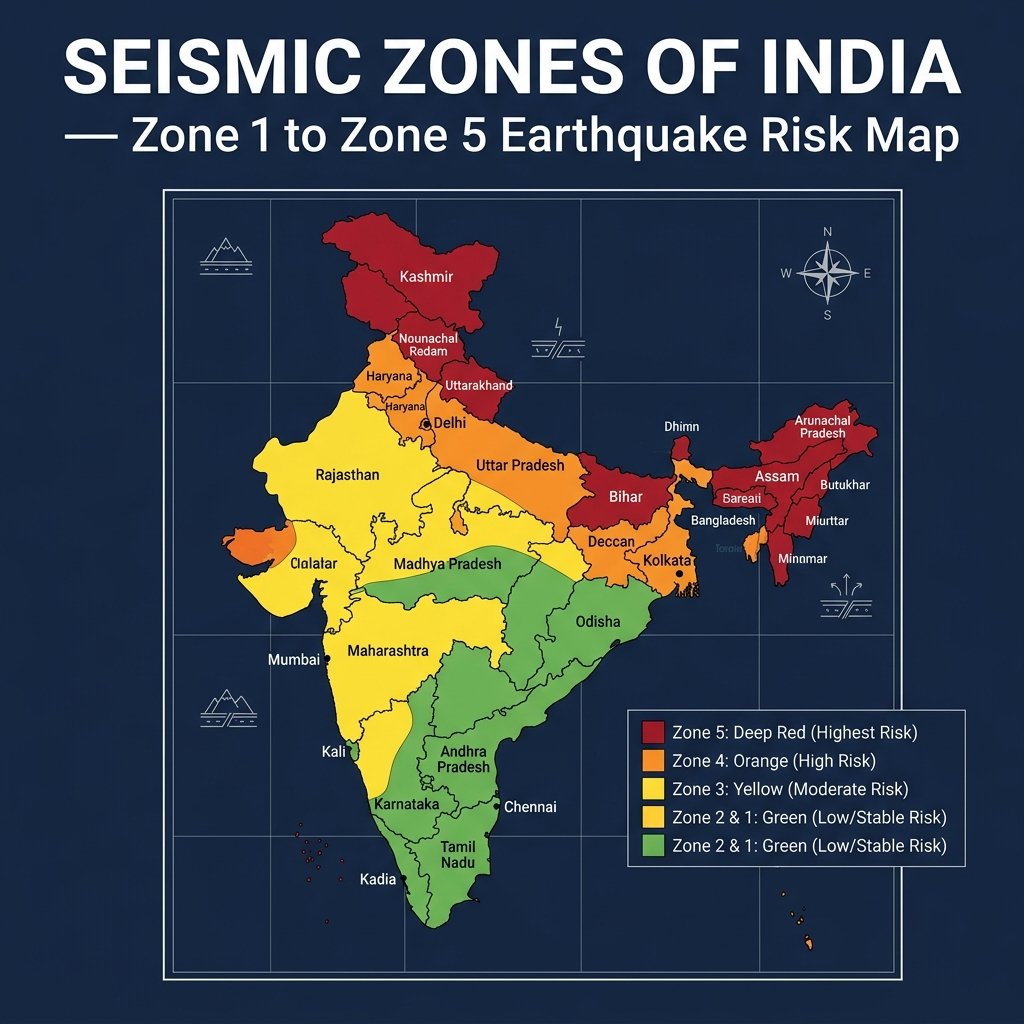
What are Seismic Zones? — Definition
A seismic zone (also called an earthquake zone) is a geographical area classified based on its expected intensity of seismic activity. The classification is done by measuring:
- Historical earthquake data (frequency and magnitude)
- Proximity to tectonic plate boundaries and major fault lines
- Geological structure and soil types
- Peak Ground Acceleration (PGA) values
In India, the seismic zonation is defined by the Bureau of Indian Standards (BIS) IS 1893:2016 — the standard used for earthquake-resistant design of structures.
Why is India Earthquake-Prone? — Geological Reason
India’s high seismic risk stems from its unique geological position:
- 🏔️ Himalayan Collision Zone: The Indian Plate is continuously moving northeast at 5 cm/year, colliding with the Eurasian Plate. This ongoing collision creates immense stress along the Himalayan arc — the most seismically active zone in India.
- 🌊 Andaman-Sumatra Subduction Zone: The eastern coast of Andaman is a subduction zone, causing frequent deep earthquakes.
- ⚡ Intraplate Faults: Even the stable Deccan Plateau has ancient fault systems (like the Kayadhu, Narmada-Son faults) that can produce catastrophic earthquakes (e.g., 1993 Latur earthquake on the Deccan Plateau).
- 🌍 Ancient Crustal Zones: The Aravalli, Eastern Ghats, and Gondwana regions have old geological scars that remain seismically active.
📊 Key Statistic: India accounts for about 10% of the world’s significant earthquakes. Over 59% of India’s total land area is vulnerable to moderate to severe seismic hazard (Zones III, IV, V).
India’s 5 Seismic Zones — Complete Classification
The BIS IS 1893 standard divides India into four active seismic zones: Zone II, Zone III, Zone IV, and Zone V. (Zone I was merged with Zone II in the 2002 revision and is now obsolete — but older textbooks still show 5 zones).
| Zone | Risk Level | MSK Intensity | States / Regions |
|---|---|---|---|
| Zone V 🔴 | Very High Risk | IX and above | J&K, Himachal Pradesh, Uttarakhand, entire Northeast (Assam, Manipur, Mizoram, Nagaland, Meghalaya, Arunachal Pradesh, Sikkim), parts of Bihar, Andaman & Nicobar Islands |
| Zone IV 🟠 | High Risk | VIII | Delhi NCR, parts of Uttar Pradesh, Haryana, Punjab, parts of Bihar, West Bengal, Gujarat (parts), Maharashtra (Konkan), Ladakh region |
| Zone III 🟡 | Moderate Risk | VII | Parts of Rajasthan, Madhya Pradesh, Goa, parts of Maharashtra, parts of Karnataka, Andhra Pradesh coast, Tamil Nadu coast, Gujarat (Saurashtra), parts of West Bengal |
| Zone II 🟢 | Low Risk | VI and below | Remaining parts of Deccan Plateau — most of Karnataka, AP interior, Tamil Nadu interior, parts of Rajasthan and MP |
MSK Scale = Medvedev–Sponheuer–Karnik Intensity Scale — measures the effects felt by people on a scale of I to XII. Zone V expects intensity IX+ (destructive to devastating).
Zone V — Most Dangerous Earthquake Zone in India
Zone V represents the highest seismic hazard in India. Buildings here must be specially engineered to withstand major earthquakes. This zone covers:
Why is Northeast India in Zone V?
- 📍 Northeast India sits at the junction of the Indian Plate, Eurasian Plate, and the Burma Plate
- The region experiences frequent earthquakes along the Himalayan Frontal Thrust
- The 1897 Shillong earthquake (M 8.1) remains one of India’s deadliest ever — killed over 1,500 people
- The 1950 Assam earthquake (M 8.6) was the largest recorded earthquake in India’s history
- Assam and Manipur have numerous active fault systems at shallow depths
Why is Kashmir (J&K) in Zone V?
Why is Uttarakhand & Himachal Pradesh in Zone V?
- These Himalayan states lie along the Main Boundary Thrust (MBT) and Main Central Thrust
- The 1991 Uttarkashi earthquake (M 6.8) and 1999 Chamoli earthquake (M 6.8) both caused massive damage
- Scientists warn of a major “gap earthquake” — stored energy along the Himalayas not yet released
Zone IV — High Risk States
Zone IV includes major population centres making it critically important for disaster policy:
- 🏙️ Delhi NCR: Sits on the Delhi-Haridwar Ridge and is close to the Himalayan seismic zone. Multiple fault lines pass under the capital. A major earthquake here would be catastrophic given the population density.
- 🌊 Bihar: The 1934 Bihar-Nepal earthquake (M 8.0) razed entire towns. Bihar’s Indo-Gangetic alluvial plains are prone to liquefaction during earthquakes.
- 🏙️ Mumbai (parts): The Konkan coast falls in Zone IV due to the West Coast Fault
- ⚡ Gujarat: The catastrophic 2001 Bhuj earthquake (M 7.7) killed ~20,000 people — one of India’s worst modern disasters. This placed parts of Gujarat in Zone V/IV classification.
Major Fault Lines of India
| Fault Line | Location | Significance |
|---|---|---|
| Main Central Thrust (MCT) | Greater Himalayas | Major tectonic boundary; Zone V earthquakes |
| Main Boundary Thrust (MBT) | Lesser Himalayas | Separates Himalayas from Sub-Himalayan hills |
| Himalayan Frontal Thrust (HFT) | Siwalik Hills | Active front of Himalayan collision |
| Narmada-Son Fault | Central India | Ancient rift zone; responsible for intraplate seismicity |
| West Coast Fault | Western Ghats/Konkan | Zone IV activity along western coast |
| Delhi-Haridwar Ridge | NCR-Uttarakhand | Major structural feature under Delhi |
| Kopili Fault | Assam-Meghalaya | Highly active; Zone V NE India |
| Andaman Trench | Andaman Sea | Subduction zone; caused 2004 earthquake |
Major Earthquakes in Indian History
| Earthquake | Year | Magnitude | Deaths | Zone |
|---|---|---|---|---|
| Assam Earthquake | 1950 | 8.6 (Mw) | 1,526 | Zone V |
| Bihar-Nepal Earthquake | 1934 | 8.0 | 10,653 | Zone IV/V |
| Kangra Earthquake (HP) | 1905 | 7.8 | 19,000+ | Zone V |
| Gujarat/Bhuj Earthquake | 2001 | 7.7 | ~20,000 | Zone V |
| Kashmir Earthquake | 2005 | 7.6 | 86,000+ | Zone V |
| Shillong Earthquake | 1897 | 8.1 | 1,542 | Zone V |
| Latur Earthquake (MH) | 1993 | 6.2 | 9,748 | Zone III |
| Uttarkashi Earthquake | 1991 | 6.8 | 768 | Zone V |
| 2004 Indian Ocean Tsunami | 2004 | 9.1–9.3 | 10,000+ (India) | Andaman Zone |
Note on Latur (1993): The Latur earthquake was remarkably destructive despite its “moderate” magnitude because it struck the Deccan Plateau — an area assumed to be geologically stable. It proved that even Zone III areas can produce devastating earthquakes from deep ancient faults. It led to major revision of India’s seismic zonation map.
BIS IS 1893:2016 — Current Standard
The Bureau of Indian Standards publishes IS 1893 — the “Criteria for Earthquake Resistant Design of Structures.” Key features of the 2016 revision:
- Zone I has been merged with Zone II — so current map has only 4 zones (II, III, IV, V)
- Updated Peak Ground Acceleration (PGA) values for each zone based on modern seismological data
- Zone V: PGA ≥ 0.36g (g = acceleration due to gravity)
- Zone IV: PGA = 0.24g
- Zone III: PGA = 0.16g
- Zone II: PGA = 0.10g
- All new buildings in Zones III, IV, and V must follow earthquake-resistant construction codes
State-Wise Seismic Zone Classification
| State / UT | Primary Zone | Notes |
|---|---|---|
| Jammu & Kashmir | Zone V | Entire region high risk; MCT, MBT active |
| Himachal Pradesh | Zone V | 1905 Kangra quake; active Himalayan fronts |
| Uttarakhand | Zone V | 1991 Uttarkashi, 1999 Chamoli quakes |
| All NE States | Zone V | Most seismically active region of India |
| Delhi NCR | Zone IV | Delhi-Haridwar Ridge; major risk to capital |
| Bihar | Zone IV/V | Alluvial plains → liquefaction risk |
| Andaman & Nicobar | Zone V | Subduction zone; 2004 tsunami epicentre |
| Gujarat | Zone III–V | Bhuj 2001; Kutch region = Zone V |
| Maharashtra | Zone III–IV | 1993 Latur; Konkan coast = Zone IV |
| Rajasthan | Zone II–III | Aravalli fault zone; eastern parts higher |
| Karnataka | Zone II–III | Stable Deccan; coastal parts higher |
| Tamil Nadu | Zone II–III | interior stable; coast = Zone III |
| Kerala | Zone III | Western Ghats fault system |
| Odisha | Zone II–III | Relatively stable; coastal strips higher |
Earthquake Preparedness — What to Do
Before an Earthquake
- ✅ Know your building’s seismic zone and construction standard
- ✅ Secure heavy furniture and appliances to walls
- ✅ Keep emergency kit: water, torch, first aid, documents
- ✅ Identify safe spots in each room (under sturdy tables, against interior walls)
- ✅ Know evacuation routes and assembly points
During an Earthquake
- 🛑 DROP, COVER, HOLD ON — the most effective survival action
- 🛑 If indoors — stay inside, get under a table or desk
- 🛑 If outdoors — move away from buildings, trees, and power lines
- 🛑 Never use elevators during or after an earthquake
- 🛑 Do NOT run outside during shaking
Key Takeaways
| Topic | Key Fact |
|---|---|
| Total Zones (current) | 4 active zones (II, III, IV, V) — Zone I merged with II |
| Highest Risk Zone | Zone V — J&K, Uttarakhand, HP, all NE India, Andaman |
| Standard Used | BIS IS 1893:2016 |
| % Land in High-Risk Zones | ~59% of India’s land area in Zone III, IV, or V |
| Largest India Earthquake | 1950 Assam earthquake — Magnitude 8.6 |
| Most Deadly Modern Quake | 2001 Gujarat/Bhuj — ~20,000 deaths |
| Most Stable Region | Deccan Plateau interior — Zone II |
| Why Himalayas are Zone V | Ongoing Indian-Eurasian plate collision at 5 cm/year |
Frequently Asked Questions (FAQs)
1. Which state in India has the highest earthquake risk?
The northeastern states (especially Assam, Manipur, Meghalaya) along with Jammu & Kashmir, Himachal Pradesh, and Uttarakhand have the highest seismic risk — all classified under Zone V. The 1950 Assam earthquake (M 8.6) remains India’s strongest recorded earthquake.
2. Is Delhi at risk of a major earthquake?
Yes. Delhi falls in Seismic Zone IV (High Risk). The city lies on the Delhi-Haridwar Ridge and is close to the Himalayan seismic sources. Seismologists have warned that Delhi has not experienced a major earthquake in centuries — suggesting accumulated stress. Given its dense population and older building stock, a major earthquake would be extremely destructive.
3. What is the difference between seismic zones and seismic intensity?
Seismic zone is a pre-determined classification based on statistical earthquake probability for an area. Seismic intensity refers to the actual shaking felt at a specific location during a specific earthquake. A Zone III area can experience Zone V-level shaking in a rare event (as Latur 1993 showed).
4. How often is India’s seismic zone map updated?
India’s BIS seismic zonation map is periodically revised — major revisions happened in 1962, 1966, 1970, 1984, 2002, and 2016. After the 1993 Latur earthquake on the “stable” Deccan Plateau and the 2001 Bhuj earthquake in Gujarat, parts of the map were significantly upgraded to higher zones.
5. Can earthquakes be predicted in India?
No earthquake (in India or globally) can be accurately predicted in terms of exact time, location, and magnitude. However, India has improved its earthquake early warning system through NDMA (National Disaster Management Authority) and IMD seismic monitoring networks. Probabilistic seismic hazard assessments help identify the most vulnerable zones for preparedness.
⭐ Important for Exams — Quick Revision
- 🔑 India’s seismic zones: Zone II (Low) → Zone V (Very High) — Zone I merged with II since 2002
- 🔑 Zone V states: J&K, HP, Uttarakhand, ALL Northeast states, Andaman & Nicobar
- 🔑 Zone IV includes: Delhi, parts of Bihar, West Bengal, UP, Konkan coast
- 🔑 Standard: BIS IS 1893:2016 governs seismic zonation
- 🔑 Highest recorded earthquake in India: 1950 Assam — M 8.6
- 🔑 Deadliest modern earthquake: 2001 Bhuj, Gujarat — ~20,000 deaths, M 7.7
- 🔑 Surprise Zone III quake: 1993 Latur (Maharashtra) — proved Deccan plateau is not fully stable
- 🔑 ~59% of India in moderate to high hazard zones (III, IV, V)
- 🔑 Seismic safety rule: DROP → COVER → HOLD during earthquake
- 🔑 Main faults: MCT, MBT, HFT (Himalayas); Narmada-Son Fault (central India); Kopili Fault (NE)
Related Geology Articles on StudyHub
- ➡️ What is an Earthquake? — Causes, Types & Measurement Scales
- ➡️ How Himalayas Formed — Indian Plate Collision with Eurasia
- ➡️ What is Plate Tectonics? — Types of Boundaries & Plate Movement
- ➡️ Volcanoes — Types, Structure, Barren Island & Deccan Traps
- ➡️ Geological History of India — 4 Billion Years Story