
India is the world’s 5th largest economy (2024, by nominal GDP ~$3.7 trillion) and the 3rd largest by Purchasing Power Parity. With a rapidly expanding export base, a massive domestic market of 1.4 billion consumers, and a strategic position at the intersection of global supply chains, India’s trade has become a critical pillar of its economic growth. Understanding India’s major exports and imports, trading partners, balance of payments, trade policy reforms (WTO, FTAs), and the shift in trade composition is essential for UPSC, SSC, and all commerce and economics examinations.
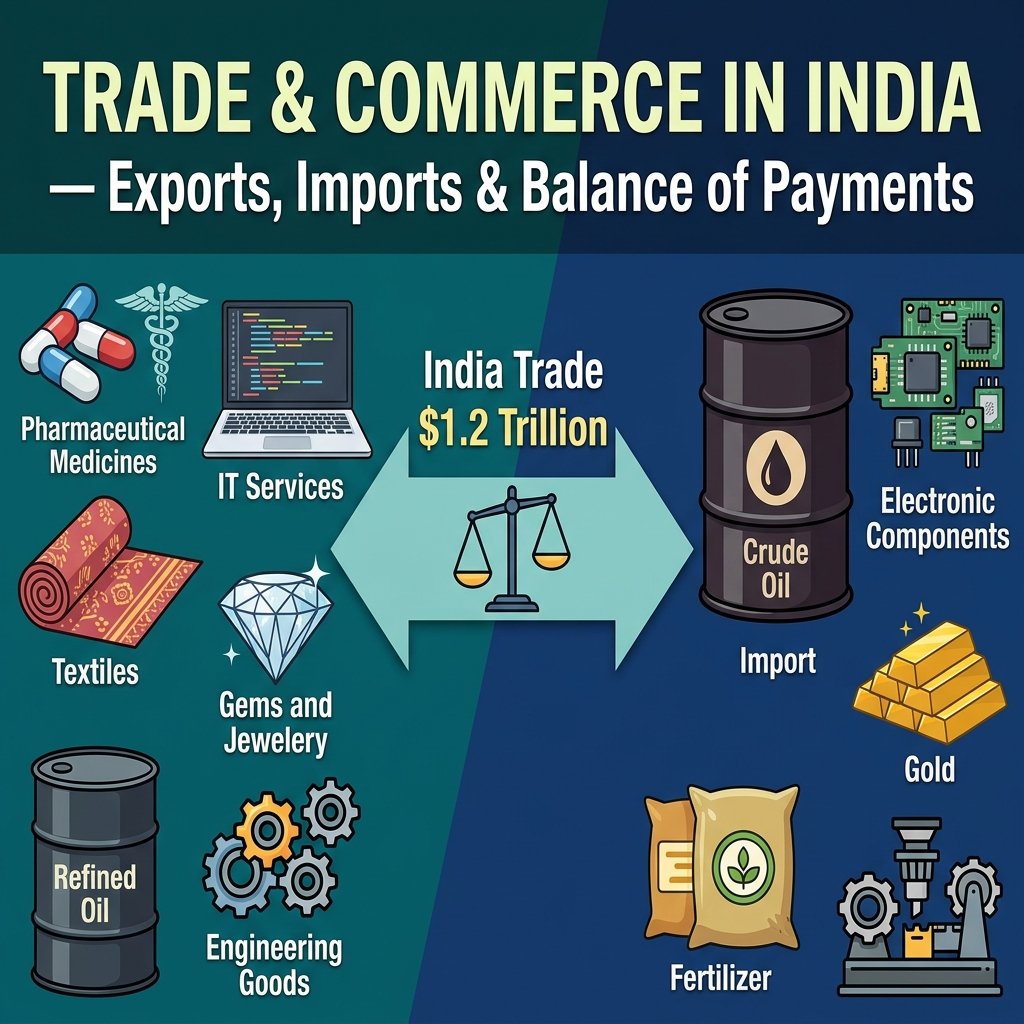
India’s Trade — Key Statistics (2023–24)
| Indicator | Value |
|---|---|
| Total Merchandise Exports | ~$437 billion (FY 2023–24) |
| Total Merchandise Imports | ~$678 billion (FY 2023–24) |
| Trade Deficit (Merchandise) | ~$241 billion |
| Services Exports | ~$341 billion (FY 2023–24, world’s 7th largest) |
| Services Imports | ~$178 billion |
| Services Surplus | ~$163 billion (offsets part of merchandise deficit) |
| Current Account Deficit (CAD) | ~$78 billion (~1.8% of GDP) |
| Foreign Exchange Reserves | ~$650 billion (2024, world’s 4th largest) |
| Remittances received | ~$125 billion (FY 2023–24, world’s LARGEST recipient) |
India’s Top Exports — What India Sells to the World
| Export Category | Value (approx.) | Key Facts |
|---|---|---|
| Petroleum Products (Refined) | ~$80 billion/year | India imports crude oil → refines → exports diesel, petrol, jet fuel; Jamnagar (Reliance) = world’s largest refinery; Russia crude (discounted) → refine → resell to Europe |
| Engineering Goods | ~$107 billion/year | Machinery, auto components, industrial equipment, boilers; fastest-growing export segment |
| Gems & Jewellery | ~$35 billion/year | India cuts & polishes 90% of world’s diamonds; Surat (Gujarat) = diamond capital of world; also gold jewellery exports |
| Pharmaceuticals (Drugs & Medicines) | ~$27 billion/year | “Pharmacy of the World” — India supplies ~20% of global generic medicines; 50%+ of Africa’s vaccines; 40% of USA’s generic drugs; Hyderabad = “Pharma Hub” |
| IT/Software Services | ~$250 billion/year (services) | India’s top service export; USA, UK, Europe = main clients; Bengaluru, Hyderabad, Chennai, Pune = IT hubs; TCS, Infosys, Wipro, HCL global leaders |
| Textiles & Apparel | ~$35 billion/year | 2nd largest textile exporter; cotton, silk, jute, technical textiles; Tirupur (TN) = knitwear capital; Surat (Gujarat) = synthetic fabrics |
| Rice (Basmati + Non-Basmati) | ~$10+ billion/year | World’s largest rice exporter (~40% of global rice trade); Basmati to Middle East; Non-Basmati to Africa |
| Chemicals | ~$25 billion/year | Basic chemicals, agrochemicals, dyes, paints |
India’s Top Imports — What India Buys from the World
| Import Category | Value (approx.) | Key Facts |
|---|---|---|
| Crude Oil & Petroleum | ~$233 billion/year | India’s single largest import (~35% of all imports); imports from Russia (40%+, post-2022), Iraq, Saudi Arabia, UAE; India imports 85% of its oil needs; strategic vulnerability |
| Electronic Components & Devices | ~$75 billion/year | Smartphones (especially from China), semiconductors, computer hardware; India running $100B+ electronics trade deficit with China; PLI scheme to build domestic capacity |
| Gold | ~$45 billion/year | India = world’s 2nd largest gold consumer; culturally driven demand; gold price directly impacts India’s CAD; wedding season peak imports |
| Coal (Coking + Thermal) | ~$25 billion/year | India imports coking coal (for steel) mainly from Australia/USA; thermal coal from Indonesia/South Africa despite being world’s 4th largest coal producer (not enough for demand) |
| Machinery & Equipment | ~$50 billion/year | Capital goods for industry; turbines, industrial equipment, aircraft; China, EU, Japan suppliers |
| Fertilisers | ~$15 billion/year | Urea, DAP, MOP (potash); from Russia, Middle East, Belarus; Russia-Ukraine war disrupted supply/prices in 2022 |
| Vegetable Oils (Edible) | ~$18 billion/year | Palm oil (Indonesia/Malaysia), soybean oil (Brazil); India imports ~60% of edible oil needs |
India’s Major Trading Partners
| Country | Trade Relationship | Notes |
|---|---|---|
| USA | India’s largest export destination (~$78B/yr exports) | IT services, pharma, engineering goods, gems; India has trade surplus with USA; US technology + FDI into India; I2U2, Quad links |
| China | India’s largest import source (~$100B+ imports); 2nd largest trade partner overall | India has massive trade deficit with China (~$85B/yr); electronic components, chemicals, machinery, API pharmaceuticals (raw materials); India trying to reduce dependency — PLI schemes |
| UAE | India’s 3rd largest trade partner ($85B+ total trade) | India-UAE CEPA (2022) = India’s first FTA in decade; Dubai = re-export hub; large Indian diaspora; gold, petroleum imports; India exports gems, food, machinery |
| Russia | India’s largest crude oil supplier (2023–24) | Post-Ukraine war, India bought discounted Russian crude (Urals crude); India-Russia trade grew from $13B (2021) to $65B+ (2024); paid in rupees/UAE dirhams |
| Saudi Arabia | Key energy supplier; large Indian diaspora (2.5M) | Crude oil + LPG imports; remittances; India-Saudi strategic partnership; Vision 2030 investment interest in India |
| EU (27 nations) | Collectively India’s 2nd largest trading partner (~$130B) | India-EU FTA under negotiation (since 2022); engineering, chemicals, pharma exports; machinery, aircraft imports |
Balance of Payments (BoP) — India’s International Financial Position
BoP Structure
- 📊 Current Account: Trade in goods + services + income + remittances
- Goods trade: India has a persistent merchandise deficit (imports > exports in goods)
- Services trade: India has a large services surplus (~$163B) from IT/software, tourism
- Remittances: India = world’s #1 recipient (~$125B/year); from Gulf countries (UAE, Saudi, Kuwait, Qatar), USA, UK; Kerala, UP, Bihar, Rajasthan = largest remittance-receiving states
- 📊 Capital Account: FDI, FPI (portfolio investment), external borrowings; India has attracted ~$400B+ FDI (2000–2024)
- 📊 Foreign Exchange Reserves: ~$650B (2024); held by RBI; provides ~11–12 months of import cover; 4th largest in world (after China, Japan, Switzerland)
Trade Policy — WTO, FTAs & Make in India
- 🌐 WTO (World Trade Organisation): India is a founding member (1995); uses WTO dispute settlement; frequently at odds with developed nations on agriculture subsidies (India protects its farmers through MSP); recently WTO-complained against USA steel tariffs
- 🤝 Free Trade Agreements (FTAs):
- India-UAE CEPA (2022) — India’s first new FTA in a decade; covers goods + services; aims $100B bilateral trade
- India-Australia ECTA (2022) — Economic Cooperation and Trade Agreement; wine, wool, coal, education access (Australia) vs. textiles, pharma, gems (India)
- India-EU FTA — under active negotiation; most significant pending FTA
- India-UK FTA — long-running negotiations; politically sensitive on migration/visas
- RCEP withdrawal (2019) — India opted out of China-led mega-FTA fearing Chinese goods flooding Indian market; remains out despite pressure
- 🏭 Make in India + PLI Schemes: Production-Linked Incentive (PLI) schemes for 14 sectors (smartphones, semiconductors, pharma, auto, solar, textiles, food processing) — aims to build India’s manufacturing export base; attract global supply chain shifts away from China
- 💰 Atmanirbhar Bharat: Self-reliance policy; reduce dependency on China for critical inputs (APIs, electronics, defence); build domestic champions; FDI + joint ventures preferred over pure imports
⭐ Important for Exams — Quick Revision
- 🔑 India merchandise exports (FY24): ~$437B; Engineering goods = largest (~$107B); Petroleum products = 2nd (~$80B)
- 🔑 India’s largest import: Crude oil (~$233B/year = ~35% of all imports; 85% of oil needs imported)
- 🔑 “Pharmacy of the World” — India = 20% of global generic medicines; 40% of USA’s generic drugs; Hyderabad = pharma hub
- 🔑 Surat = diamond capital of world; India cuts & polishes 90% of world’s diamonds
- 🔑 India = world’s largest rice exporter (~40% of global rice trade); Basmati → Middle East; Non-Basmati → Africa
- 🔑 India = world’s #1 remittance recipient (~$125B/year); Gulf countries + USA/UK main sources
- 🔑 Largest export destination: USA (~$78B/year); India has trade SURPLUS with USA
- 🔑 Largest import source: China (~$100B+); India has ~$85B trade DEFICIT with China
- 🔑 Russia = India’s largest crude oil supplier (2023–24); discounted Urals crude post-Ukraine war
- 🔑 India-UAE CEPA (2022) = India’s first FTA in decade; first FTA with a Gulf nation
- 🔑 RCEP (Regional Comprehensive Economic Partnership) — India withdrew (2019); feared Chinese goods flooding
- 🔑 India Forex reserves: ~$650B (2024) = world’s 4th largest; ~11–12 months import cover
- 🔑 India GDP: ~$3.7 trillion (2024) = world’s 5th; 3rd by PPP; fastest-growing major economy
- 🔑 PLI Schemes = Production Linked Incentive for 14 sectors; build manufacturing; reduce China dependency
Frequently Asked Questions (FAQs)
1. Why does India have such a large trade deficit despite being a major exporter?
India’s persistent merchandise trade deficit (~$240B/year) has two structural causes: (1) Crude oil dependency — India imports 85% of its oil (~$233B/year alone); this single import creates a structural deficit regardless of export performance. Every $10 rise in global oil price adds ~$14B to India’s import bill. (2) Electronics dependency on China — India imports ~$75B in electronics (phones, semiconductors) without equivalent exports. However, India’s trade picture is not as bad as the merchandise deficit suggests: India’s services surplus (~$163B from IT, BPO, tourism) and massive remittances (~$125B) broadly offset the merchandise deficit. India’s Current Account Deficit (CAD) is typically 1.5–2.5% of GDP — manageable and financed by FDI/FPI inflows. The real strategic concern is the China dependency: 60–70% of India’s pharmaceutical raw materials (APIs — Active Pharmaceutical Ingredients) come from China; if relations deteriorate, India’s “Pharmacy of the World” status is vulnerable. PLI schemes in pharma, semiconductors, and electronics manufacturing aim to break this structural dependency within the decade.
2. Why did India withdraw from RCEP and what were the consequences?
India withdrew from the RCEP (Regional Comprehensive Economic Partnership) in November 2019 — a mega-FTA comprising 15 Asia-Pacific nations (ASEAN 10 + China, Japan, South Korea, Australia, New Zealand). PM Modi cited concerns that: (1) The deal didn’t adequately protect Indian manufacturing and industry — reducing tariffs would flood India with cheap Chinese goods that Indian domestic industry couldn’t compete with; (2) India had negative trade balances with 11 of the 15 RCEP members; (3) Indian dairy and agriculture sectors feared competition from cheaper Australian/New Zealand farm products. Consequences: India has been left out of the world’s largest trade bloc (RCEP signed 2020, now operating). However, India has accelerated bilateral FTAs instead (UAE CEPA 2022, Australia ECTA 2022, EU FTA negotiating). The RCEP decision remains controversial — some economists argue India missed a manufacturing integration opportunity; the government maintains it was the right strategic call to protect domestic industry.
3. What is India’s “Russian oil trade” and why is it geopolitically significant?
After Russia’s invasion of Ukraine (February 2022), Western nations sanctioned Russia’s oil exports and G7 countries imposed a $60/barrel price cap on Russian crude. Russia, facing a collapse in European oil buyers, aggressively offered discounted crude to willing buyers — and India emerged as the biggest beneficiary. India’s share of Russian crude in total imports jumped from ~1% (2021) to 40%+ (2023–24). India’s logic: cheap energy (Russian Urals crude at $10–20 discount to global price) saves India billions on its import bill — a direct economic benefit for 1.4 billion people. India pays partly in UAE dirhams and has explored rupee-ruble trade. The geopolitical significance: India’s pragmatic approach (buying cheap Russian energy despite Western pressure) demonstrates India’s strategic autonomy — India is not aligning with the West against Russia nor with Russia against the West. India also then refines Russian crude and exports refined products (diesel, jet fuel) to Europe — making India a key middleman in the de facto bypass of Western sanctions. This has strained India-EU/USA relations somewhat but India has defended the policy on economic sovereignty grounds.
Related Geology Articles on StudyHub
- ➡️ Transport in India — How Trade Moves via Ports & Railways
- ➡️ Energy Resources — India’s Crude Oil Import Dependency
- ➡️ Mineral Resources — Iron Ore & Coal Export Geography
- ➡️ Indian Ocean — Strategic Importance for India’s Trade
- ➡️ Agriculture India — Rice Export World #1 & Edible Oil Imports