
Transport is the lifeline of India’s economy — it moves people, goods, raw materials, and finished products across a vast, diverse subcontinent. India has one of the world’s largest transport networks: the 4th largest railway network, the 2nd largest road network, 12 major seaports handling $1+ trillion in trade, and a rapidly expanding civil aviation sector. Understanding India’s transport geography — the types of transport, their distribution, significance, and key facts — is critical for UPSC, SSC, Railways, State PSC, and all major competitive examinations.
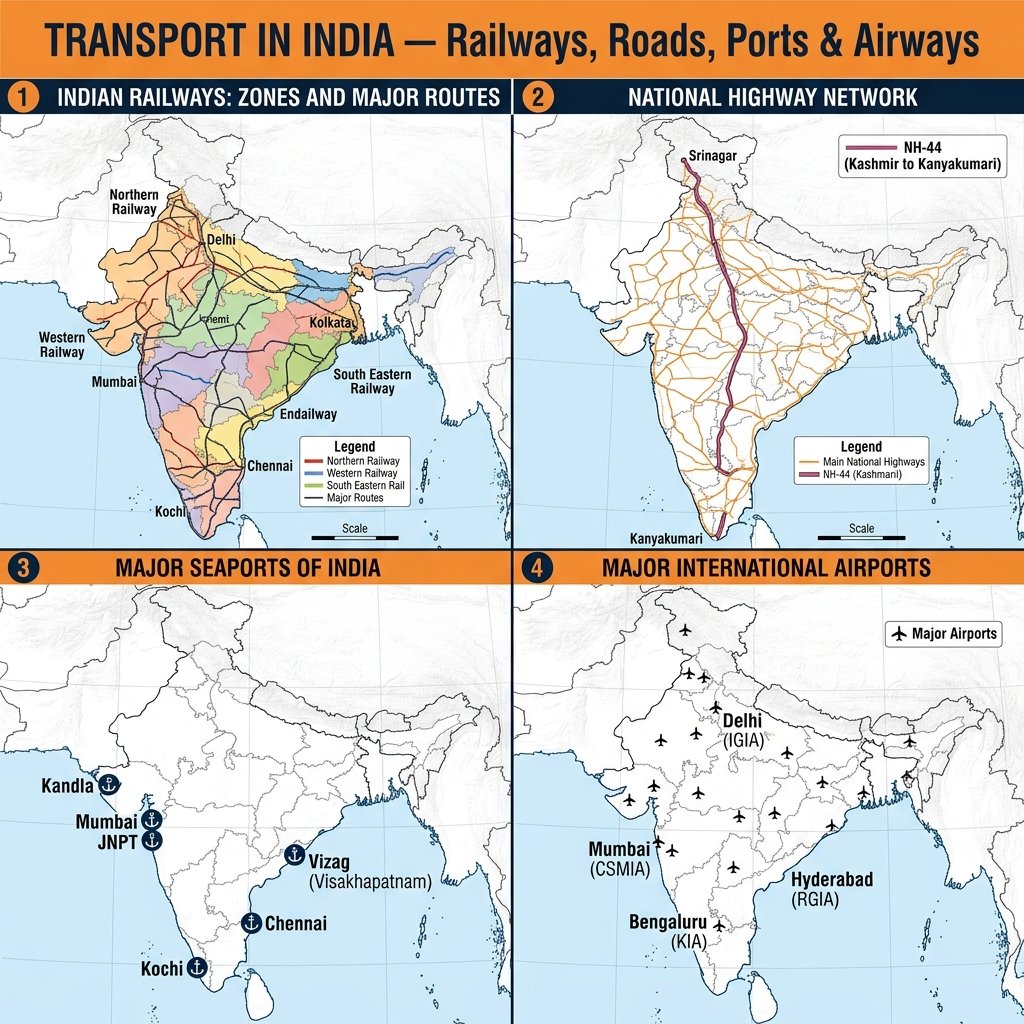
1. Indian Railways — The Nation’s Lifeline
Indian Railways (IR) is one of the world’s largest railway networks, operating under the Ministry of Railways. It is entirely government-owned and is the backbone of India’s transport system, especially for long-distance freight and passenger movement.
Key Railway Statistics
| Parameter | Data |
|---|---|
| Total route length | ~68,000 km (4th largest in world after USA, Russia, China) |
| Total track length | ~1,35,000 km (including multiple tracks) |
| Daily passengers | ~24 million (largest daily passenger carrier in world) |
| Daily trains | ~13,000+ passenger trains + 8,000+ freight trains |
| Railway stations | ~7,325 stations |
| Electrified network | ~100% electrification achieved 2024 |
| Gauge | Broad Gauge (1.676m) = ~90%; Metre Gauge & Narrow Gauge (being converted) |
Railway Zones of India (18 Zones)
| Zone | Headquarters | Zone | Headquarters |
|---|---|---|---|
| Northern Railway (NR) | New Delhi | Eastern Railway (ER) | Kolkata |
| South Central Railway (SCR) | Secunderabad | North Eastern Railway (NER) | Gorakhpur |
| Southern Railway (SR) | Chennai | Central Railway (CR) | Mumbai (CST) |
| Western Railway (WR) | Mumbai (Churchgate) | South Eastern Railway (SER) | Kolkata |
| Northeast Frontier Railway (NFR) | Maligaon (Guwahati) | East Central Railway (ECR) | Hajipur |
| North Central Railway (NCR) | Prayagraj | East Coast Railway (ECoR) | Bhubaneswar |
| South Western Railway (SWR) | Hubballi | West Central Railway (WCR) | Jabalpur |
| North Western Railway (NWR) | Jaipur | South Coast Railway (SCoR) | Visakhapatnam |
| Metro Railway Kolkata | Kolkata | South East Central Railway (SECR) | Bilaspur |
Key Railway Projects & Milestones
- 🚄 Vande Bharat Express — India’s semi-high-speed train (160 km/h); indigenous design; 100+ sets deployed (2024); replacing Shatabdi Express on key routes
- 🏔️ Udhampur-Srinagar-Baramulla Rail Link (USBRL) — world’s highest railway bridge — Chenab Bridge (359m above river level; taller than Eiffel Tower); connecting Srinagar by rail; strategic J&K project
- 🔵 Dedicated Freight Corridors (DFC): Eastern DFC (Ludhiana-Dankuni, 1,839 km) + Western DFC (Dadri-JNPT Mumbai, 1,506 km) — high-speed freight-only lines; reduce passenger-freight conflict; boost India’s logistics
- 🚅 Bullet Train Project: Ahmedabad-Mumbai High Speed Rail (508 km); Shinkansen technology (Japan collaboration); target speed 320 km/h; target completion 2028–30
- 🚇 Metro Rail: India has 20+ cities with operational metros; Delhi Metro = India’s largest (391 km); Mumbai, Bengaluru, Chennai, Hyderabad, Kochi also operational
- 🌐 100% electrification: India completed electrification of the broad-gauge network by 2024 — eliminating diesel traction on mainlines; major step for green railways
2. Roads — India’s Largest Transport Network
India has the 2nd largest road network in the world (after USA) with over 63 lakh km (6.3 million km) of roads. Roads carry ~85% of passenger traffic and ~65% of freight traffic in India — making them the dominant mode of transport.
Road Classification
| Road Type | Authority | Length | Key Facts |
|---|---|---|---|
| National Highways (NH) | MoRTH / NHAI | ~1,46,000 km | Only 2% of road network but carry 40% of traffic; NH-44 (Srinagar–Kanyakumari, 3,745 km) = India’s longest NH |
| State Highways (SH) | State PWD | ~1,76,000 km | Connect state capitals and district HQs |
| District Roads | District/Zila Parishad | ~5,47,000 km | Connect district HQs to taluks |
| Rural Roads | Gram Panchayat/PMGSY | ~33 lakh km | PMGSY = Pradhan Mantri Gram Sadak Yojana; connect villages to markets |
| Expressways | NHAI/State | ~4,000+ km operational | Access-controlled; high speed; Yamuna Expressway (165 km), Mumbai Pune Expressway, Delhi-Meerut |
Key Road Projects
- 🛣️ Bharatmala Pariyojana: India’s flagship highway development programme; 34,800 km of economic corridors, interstate corridors, ring roads, coastal roads; target investment ₹10+ lakh crore
- 🛣️ Delhi-Mumbai Expressway (1,386 km) — India’s longest expressway (under construction/partial opening); reduces travel time from 24 hrs to 12 hrs
- 🏔️ Atal Tunnel (Rohtang) — 9.02 km; world’s longest highway tunnel above 10,000 ft (3,048m); Manali-Lahaul-Spiti all-weather road; strategic for Ladakh
- 🌉 Bogibeel Bridge — India’s longest rail-cum-road bridge (4.94 km); over Brahmaputra; Assam; strategic access to Arunachal Pradesh
3. Seaports — India’s Trade Gateways
India has a coastline of 7,516 km with 12 major ports (under central government) and 200+ minor/intermediate ports (under state governments). ~90% of India’s international trade by volume and ~70% by value passes through seaports.
| Port | State | Sea | Significance |
|---|---|---|---|
| JNPT (Jawaharlal Nehru Port) | Maharashtra (Navi Mumbai) | Arabian Sea | India’s busiest container port; handles ~50% of India’s container traffic; also called Nhava Sheva |
| Mundra Port | Gujarat (Kutch) | Arabian Sea | India’s largest port by cargo volume (2023); private (Adani); handles 150+ MT/year; fastest growing |
| Kandla (Deendayal) Port | Gujarat | Arabian Sea | India’s largest port by tonnage (traditionally); handles fertilisers, food grains, petroleum; free trade zone |
| Mumbai Port | Maharashtra | Arabian Sea | Natural harbour; historic India port; now being redeveloped (Mumbai Port Land Development) |
| Visakhapatnam (Vizag) Port | Andhra Pradesh | Bay of Bengal | India’s deepest natural harbour; handles iron ore exports; Bailadila ore slurry line terminus |
| Chennai Port | Tamil Nadu | Bay of Bengal | India’s 2nd busiest container port; oldest artificial port; handles automobiles |
| Ennore (Kamarajar) Port | Tamil Nadu | Bay of Bengal | India’s first port as corporate entity; handles coal for Tamil Nadu power plants |
| Paradip Port | Odisha | Bay of Bengal | Handles iron ore from Odisha mines; coal imports for NTPC plants; major bulk cargo |
| Kochi (Cochin) Port | Kerala | Arabian Sea | Major container + cruise port; Vallarpadam International Container Transshipment Terminal |
| Mormugao Port | Goa | Arabian Sea | Main iron ore export port for Goa mines; passenger ferries |
| New Mangalore Port | Karnataka | Arabian Sea | Handles petroleum products; fertilisers; coffee exports |
| Kolkata + Haldia Port | West Bengal | Bay of Bengal | India’s only major riverine port (on Hooghly River, 130 km inland); handles tea, jute, rice; Haldia is newer deep-water port |
4. Airways — India’s Fast-Growing Aviation Sector
- ✈️ India is the world’s 3rd largest domestic aviation market (after USA and China)
- 📈 ~150+ million domestic passengers annually (2024); growing at 8–10% per year
- 🏢 AAI (Airports Authority of India) manages 137 airports; DGCA regulates civil aviation
- 🏆 Busiest airports: Delhi (IGI) — India’s busiest, world’s 10th busiest; Mumbai (CSIA) — 2nd; Bengaluru (KIAL) — 3rd; Hyderabad (RGIA) — 4th; Chennai (MAA) — 5th
- ✈️ Major airlines: IndiGo (India’s largest, ~60% market share), Air India (government reacquired by Tata 2022), Akasa Air (new entrant), Vistara (merged with Air India 2024)
- 🛫 International hubs: Delhi and Mumbai handle ~70% of India’s international traffic
- ⭐ UDAN Scheme (Ude Desh ka Aam Nagrik) — subsidised air connectivity to unserved/underserved cities; 550+ routes; regional connectivity scheme
5. Waterways — India’s Inland Water Transport
- 🚢 India has 14,500 km of navigable inland waterways; only ~3,700 km commercially used
- ⚓ National Waterways Authority of India (IWAI) manages inland waterways
- 🏆 National Waterway-1 (NW-1): Ganga-Bhagirathi-Hooghly river system (Allahabad to Haldia, 1,620 km) — India’s longest and most commercially important inland waterway
- 🚢 NW-2: Brahmaputra (Sadiya to Dhubri, 891 km) — Assam; tea, coal transport
- 🚢 NW-3: West Coast Canal + Champakara + Udyogmandal canals (Kerala, 205 km) — important for spice/coir trade
- ⚓ Sagarmala Programme — port-led development; modernising ports, coastal shipping, inland waterways; 800+ projects worth ₹6 lakh crore
⭐ Important for Exams — Quick Revision
- 🔑 Indian Railways: 4th largest network (68,000 km route); 24M daily passengers; 18 zones; 100% electrified (2024)
- 🔑 NH-44 (Srinagar to Kanyakumari, 3,745 km) = India’s longest National Highway; former NH-7 redesignated
- 🔑 India’s road network: 2nd largest world (6.3M km); roads carry 85% passengers + 65% freight
- 🔑 NHAI = National Highways Authority of India; manages NHs; MoRTH = Ministry of Road Transport & Highways
- 🔑 JNPT (Nhava Sheva) = India’s largest container port; ~50% container traffic; Navi Mumbai
- 🔑 Mundra Port = India’s largest port by cargo volume (2023); Adani; Gujarat Kutch
- 🔑 Kolkata Port = India’s only major riverine port; 130 km inland on Hooghly; Haldia = nearby deep-water satellite port
- 🔑 Visakhapatnam = India’s deepest natural harbour; Bay of Bengal; iron ore exports
- 🔑 Chenab Railway Bridge = world’s highest railway bridge (359m above river); USBRL project; J&K
- 🔑 Vande Bharat Express = India’s semi-high-speed train (160 km/h); indigenous; 100+ sets (2024)
- 🔑 DFC = Dedicated Freight Corridors (Eastern + Western); freight-only high-speed lines; DFCCIL
- 🔑 India = 3rd largest domestic aviation market (after USA, China); IndiGo = market leader (~60%)
- 🔑 UDAN Scheme = subsidised regional air connectivity; 550+ routes; “Ude Desh ka Aam Nagrik”
- 🔑 NW-1 = Ganga-Hooghly (Allahabad–Haldia, 1,620 km) = India’s longest national waterway
- 🔑 Atal Tunnel = 9.02 km; world’s longest highway tunnel above 10,000 ft; Rohtang; Himachal Pradesh
Frequently Asked Questions (FAQs)
1. Why does India’s rail network concentrate in certain regions while being sparse in others?
India’s railway density is highest in the Indo-Gangetic Plain and peninsular plateau regions — the flat terrain makes construction cheap, population density is high, and economic activity (agriculture, industry) generates traffic. The Northeast India (Assam, Meghalaya, Arunachal Pradesh) has sparse rail connectivity due to: difficult mountainous terrain, heavy rainfall causing landslides, strategic sensitivity (international borders), and historically delayed investment. The Northeast Frontier Railway (NFR) is actively extending lines to all state capitals under the 100% rail connectivity to NE capitals mission. The Himalayan region (J&K, Himachal, Uttarakhand) also has sparse rail — the USBRL project (Jammu-Srinagar-Baramulla) is the most ambitious, requiring 30+ tunnels and 900+ bridges through the Himalayas, including the record-breaking Chenab Bridge.
2. What is the Sagarmala Programme and why is it important for India?
The Sagarmala Programme (Ocean Garland) is India’s national initiative for port-led development launched in 2015. It recognises that India’s long coastline (~7,516 km) and island territories are massively underutilized economic assets. Sagarmala has 4 pillars: (1) Port Modernisation — 101 projects to expand port capacity, mechanise cargo handling, reduce turnaround time; (2) Port Connectivity — 232 projects to build road/rail/waterway connections to ports; (3) Port-led Industrialisation — 33 coastal economic zones (SEZs, industrial clusters) near ports; (4) Coastal Community Development — skill development, fisheries support for 1.5 crore coastal population. Expected outcomes: reduce logistics cost from ~14% of GDP (one of world’s highest) to ~8%; create 1 crore jobs; boost coastal shipping (currently only 7% of freight). India’s logistics cost disadvantage (vs China at 8%) is a major competitiveness gap that Sagarmala aims to bridge.
3. What are Dedicated Freight Corridors and how do they solve Indian Railways’ biggest problem?
Indian Railways’ biggest structural problem has been sharing the same tracks between passenger trains and freight trains — the two have very different requirements. Freight trains are slow, heavy, and need predictability; passenger trains must be fast and on-time. When they share tracks, both suffer: freight gets delayed (India’s average freight train speed is a dismal 23 km/h, one of world’s slowest), passengers face delays from freight. The Dedicated Freight Corridors (DFCs) solve this by creating separate, freight-only tracks: Western DFC (Dadri near Delhi → JNPT Mumbai, 1,506 km) carries India’s key import-export container traffic; Eastern DFC (Ludhiana/Sahnewal → Dankuni near Kolkata, 1,839 km) carries coal from Jharkhand/Odisha to Western power plants and Punjab/Haryana industrial goods. Benefits: freight speed rises to 60–70 km/h; passenger trains can run faster on mainlines; logistics cost falls; container double-stacking (2 container stacks) doubles capacity. DFCCIL (Dedicated Freight Corridor Corporation of India Limited) manages the project.
Related Geology Articles on StudyHub
- ➡️ Indian Ocean — Trade Routes & Port Geography
- ➡️ Energy Resources — Coal Transport on Railways
- ➡️ Mineral Resources — Iron Ore Port Exports (Bailadila-Vizag)
- ➡️ Physiography of India — How Terrain Shapes Transport Routes
- ➡️ Population Geography — Why Transport Density Follows Population