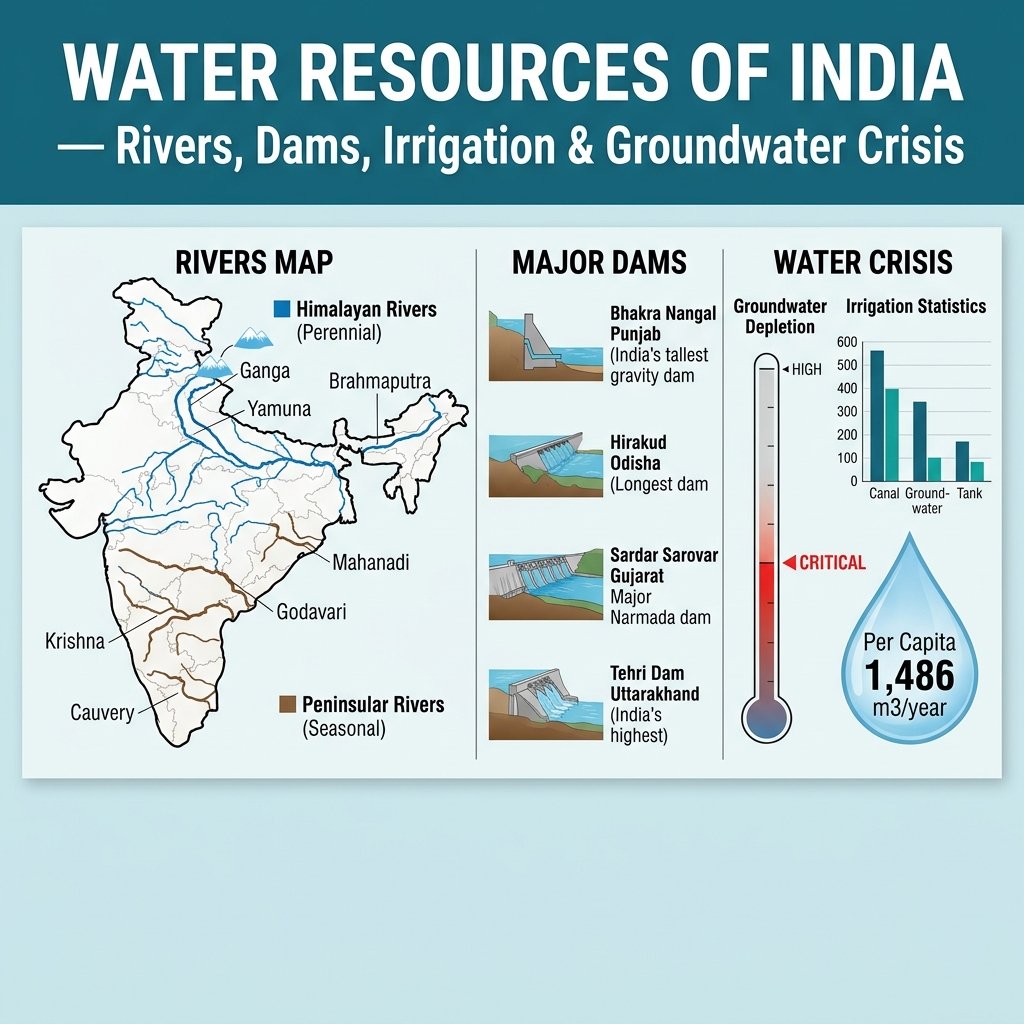
Water is India’s most critical natural resource — and its most threatened. India receives ~4,000 billion cubic metres (BCM) of total precipitation annually, making it one of the world’s higher rainfall nations by volume. Yet India faces a severe and deepening water crisis: per capita water availability has fallen from ~5,177 m³/year in 1951 to ~1,486 m³/year in 2021 — approaching the international “water stress” threshold of 1,700 m³/year. The paradox of “water rich, water poor”: India has 16% of the world’s population but only 4% of freshwater resources. Monsoonal distribution means 80% of rain falls in just 4 months, across regions with deeply uneven spatial distribution — Meghalaya receives 11,000mm/year while Rajasthan gets under 100mm. India’s rivers, dams, groundwater, and irrigation systems are the infrastructure holding agricultural civilization together for 1.4 billion people. This complete guide covers river systems, major dams, irrigation types, groundwater crisis, and water management policy — essential for UPSC, SSC, Class 10–11 NCERT, and all competitive examinations.
Water Resources of India — Rivers, Major Dams, Irrigation & Groundwater Crisis | StudyHub Geology
India’s Water Resources — Key Statistics
Parameter
Value
Context
Total annual precipitation
~4,000 BCM
Includes rainfall + snowfall
Utilizable surface water
~690 BCM
After evaporation, runoff losses
Utilizable groundwater
~433 BCM/year
Dynamic replenishable groundwater
Total utilizable water
~1,123 BCM
Surface + groundwater
Current annual water use
~750 BCM
~80% for agriculture
Per capita availability (2021)
1,486 m³/year
Down from 5,177 in 1951 (population growth)
Water stress threshold (UN)
1,700 m³/year
India approaching; some states already below
India global freshwater share
~4%
But 16% of world population
Largest groundwater user
India = #1 globally
Extracts ~25% of world’s groundwater every year
River Systems — Himalayan vs Peninsular Rivers
Feature
Himalayan Rivers
Peninsular Rivers
Origin
Young Himalayan mountains; snow + glaciers + monsoon rain
Seasonal/Rainfed (many go dry or very low in summer)
Drainage pattern
Antecedent (rivers older than mountains; cut through rising ranges)
Consequent/subsequent; follow pre-existing drainage on plateau slopes
Length & basin size
Very long (Ganga 2,525 km; Brahmaputra 2,900 km in India); massive basins
Shorter (Godavari 1,465 km = longest peninsular; Krishna 1,400 km)
Sediment load
Very high (active erosion of young mountains); forms alluvial plains
Lower (ancient, stable, hard rock catchments; less sediment)
Direction of flow
Generally west to east (Ganga, Brahmaputra); into Bay of Bengal
East-flowing (Bay of Bengal — Godavari, Krishna, Mahanadi, Cauvery); West-flowing (Arabian Sea — Narmada, Tapi only major west-flowing peninsular rivers)
Hydropower potential
Very high (steep gradients in mountain reaches); major dams in Himalayas
High in Western Ghats (short, steep rivers); Moderate in East-flowing rivers
💧 Length: 2,525 km (India); 2,704 km total; origin at Gangotri Glacier (Uttarakhand); enters Bay of Bengal at Sundarbans
🗺️ Basin: 8.6 lakh km² = largest river basin in India; covers UP, Bihar, WB, Uttarakhand, HP, Rajasthan, MP, Haryana
🌊 Major tributaries: Right bank: Yamuna (1,376 km; origin Yamunotri Glacier; joins Ganga at Prayagraj), Son, Chambal; Left bank: Ramganga, Ghaghra/Sarayu, Gandak, Kosi, Mahananda
🌾 Importance: Supports ~500 million people; India’s most sacred river; heavily irrigated (UP + Bihar wheat, rice, sugarcane); feeds the Ganga Canal system (world’s largest irrigation network)
⚠️ Pollution: Nearly 400 million people live on banks; receives raw sewage from 1,600+ towns; coliform bacteria levels 100–10,000x safe limits near Varanasi + Kanpur; Namami Gange Programme (2015, ₹20,000 crore) = India’s biggest river cleaning scheme
Brahmaputra River System
💧 Length: 2,900 km total (Tibet + India + Bangladesh); enters India from Arunachal Pradesh (called Siang/Dihang); flows through Assam as Brahmaputra; exits as Jamuna into Bangladesh
🏔️ Key fact: Originates as Yarlung Tsangpo in Tibet (at 5,300m altitude near Mansarovar); makes spectacular U-turn around Namche Barwa peak (world’s deepest gorge — 5,382m deep); flows south into India = one of world’s most dramatic river journeys
🌊 Characteristics: World’s highest sediment load river; braided channel (many shifting threads) in Assam; annually floods Assam plains; Majuli island in Brahmaputra = world’s largest river island (shrinking due to erosion)
🇨🇳 China threat: China building mega-dam on Yarlung Tsangpo (Motuo/Metog dam — potentially world’s largest at 60GW capacity); India concerned about water flow control and potential weaponising of water
💧 Length: 1,465 km; origin at Trimbakeshwar (Nashik, Maharashtra); flows east into Bay of Bengal (AP)
🙏 Called: “Dakshina Ganga” (Ganga of the South); most sacred peninsular river; major pilgrim sites at Nashik (Kumbh Mela), Bhadrachalam, Rajamahendravaram (Rajahmundry) — Pushkaram festival; Papikondalu gorge (scenic)
🌾 Basin: 3.13 lakh km²; states: Maharashtra (origin), Telangana, AP; major tributaries: Pravara, Manjira, Pranhita, Indravati (joins from MP/Chhattisgarh)
🏗️ Projects: Nagarjunasagar Dam, Srisailam Dam (on Krishna-Godavari system); Polavaram Project (under construction; India’s largest ongoing irrigation project; AP + Telangana dispute)
Krishna & Cauvery
🔵 Krishna (1,400 km): Origin Mahabaleshwar (Maharashtra, Western Ghats); flows through Karnataka, AP; joins Bay of Bengal near Vijayawada; major tributaries: Bhima, Tungabhadra; historic Tungabhadra Project (Vijayanagara Empire used its water); Nagarjunasagar Dam (between Krishna+Godavari) = world’s largest masonry dam
🟢 Cauvery (800 km): Origin Talakaveri (Brahmagiri Hills, Kodagu/Coorg district, Karnataka, Western Ghats); flows through Karnataka and Tamil Nadu; joins Bay of Bengal at Cauvery delta (Thanjavur = rice bowl of TN); Cauvery Water Dispute = India’s most bitter inter-state water conflict (Karnataka vs Tamil Nadu, ongoing since 1892, Supreme Court awards 2007 + 2018); Mettur Dam (Salem, TN) = crucial; Stanley Reservoir
Narmada & Tapi — West-Flowing Anomalies
🌊 Narmada (1,312 km): Longest west-flowing river in India; originates Amarkantak plateau (MP); flows through MP, Maharashtra, Gujarat; joins Arabian Sea at Gulf of Khambhat; flows in rift valley (faulted trough between Vindhya hills to north and Satpura hills to south = unique tectonic setting); Marble Rocks (Bhedaghat, Jabalpur) = stunning gorge; Sardar Sarovar Dam (Gujarat) = controversial; Narmada Bachao Andolan (Medha Patkar); 30 major + 135 medium dams planned
🌀 Tapi (724 km): Parallel to Narmada; also rift valley; flows through MP, Maharashtra (Surat area), Gujarat; drains into Arabian Sea; Kakrapar Weir, Ukai Dam (Gujarat)
Major Dams of India
Dam
River
State
Type / Record
Purpose
Tehri Dam
Bhagirathi (Ganga tributary)
Uttarakhand
India’s tallest dam (260.5m); 8th tallest in world; RCC gravity dam
Hydropower (2,400 MW), irrigation, drinking water for Delhi
Bhakra Nangal
Sutlej
HP/Punjab border
India’s largest gravity dam (226m height); “Temple of Modern India” (Nehru)
Irrigation (Punjab, Haryana, Rajasthan), hydropower (1,325 MW), flood control
Hirakud Dam
Mahanadi
Odisha
World’s longest earthen dam (26 km); built 1957
Flood control (Odisha delta), irrigation, hydropower (347.5 MW)
Sardar Sarovar
Narmada
Gujarat (benefits MP, Maharashtra, Rajasthan)
2nd largest concrete gravity dam in India; 30 beneficiary states
Irrigation, power; foundational for Hampi/Vijayanagara region
Mettur Dam
Cauvery
Tamil Nadu
Stanley Reservoir; one of India’s largest reservoirs by volume
Irrigation (Cauvery delta, rice); drinking water; key in Karnataka-TN water dispute
Indira Sagar
Narmada
Madhya Pradesh
India’s largest reservoir by storage capacity (12.22 BCM)
Irrigation, hydropower (1,000 MW)
Idukki Dam
Periyar
Kerala
India’s largest arch dam; double curvature arch
Hydropower (780 MW) — Kerala’s largest hydro source
Irrigation in India — Methods & Statistics
📊 India’s net irrigated area: ~68 million hectares (2020) = world’s largest irrigated area; yet only ~48% of net sown area is irrigated (remaining 52% is rain-fed)
💧 Agriculture = 80% of India’s water use — making irrigation the central water challenge
UP (Ganga canal), Punjab (Bari Doab), Rajasthan (Indira Gandhi Canal), Odisha, AP
Pro: covers large areas cheaply; Con: waterlogging + salinity in poorly drained areas; high maintenance
Tanks
~4% (declining)
Tamil Nadu, Karnataka, AP/Telangana, Maharashtra
Pro: traditional, community-managed, recharges groundwater; Con: silting, neglect; many tanks lost to encroachment
Other (drip, sprinkler, etc.)
~9%
Maharashtra (drip irrigation in sugarcane/grape), Rajasthan, Gujarat
Pro: most efficient (90% efficiency vs 40% for flood); Con: high capital cost; PM Krishi Sinchayee Yojana promotes
📌 Indira Gandhi Canal (Rajasthan Canal): World’s longest canal irrigation system; 649 km main canal + 9,060 km branch canals; diverts water from Sutlej-Beas rivers (Harike Barrage, Punjab) to Thar Desert; transformed Jaisalmer, Barmer, Bikaner areas; controversy: waterlogging + seepage in canal command area; ecological disruption in desert ecosystems
📌 Green Revolution + Irrigation Nexus (Punjab-Haryana): Punjab’s Green Revolution success in wheat (1960s-70s) = paired with massive tubewell expansion; paddy (rice) cultivation spread in Punjab (not a native crop here) = intensely water-demanding; Punjab now has the worst groundwater depletion in India; water table falling 0.5–1m/year in many districts; projected aquifer exhaustion within 20–30 years in some of Punjab’s districts
Groundwater Crisis — India’s Silent Emergency
🚨 Scale: India extracts ~250 BCM of groundwater/year = world’s single largest groundwater user (more than USA + China combined); 25% of global groundwater extraction
📉 Depletion rate: GRACE satellite data (NASA) shows India’s aquifers losing 54 BCM/year in northern India; CGWB (Central Ground Water Board) reports 1,034 of India’s 6,965 assessment units as “over-exploited” (withdrawal > recharge)
🗺️ Most critical states: Punjab (67% blocks over-exploited), Haryana (52% blocks over-exploited), Rajasthan (western districts — Jodhpur, Barmer, Jaisalmer tapping ancient “fossil water” aquifers that take 10,000+ years to recharge); Delhi NCR; parts of Tamil Nadu; Telangana
🌾 Root cause: Free/heavily subsidised electricity for agricultural pumps (especially Punjab, Haryana, UP, TN) = no economic incentive to conserve; paddy cultivation in water-scarce areas (Punjab cultivating paddy uses 5x the water needed for wheat); MSP for paddy = financial incentive to grow water-intensive rice in wrong geography
🔧 Policy responses: Jal Jeevan Mission (2019, ₹3.6 lakh crore — piped drinking water to all households by 2024); Atal Bhujal Yojana (groundwater management by communities); PM Krishi Sinchayee Yojana (micro-irrigation expansion); SC direction to Punjab to shift paddy transplanting later in season (to reduce evaporation); NITI Aayog composite water index rates states on water management
Inter-State Water Disputes
Dispute
States Involved
River
Status
Cauvery Water Dispute
Karnataka vs Tamil Nadu (+ Kerala, Puducherry)
Cauvery
Most bitter dispute; Cauvery Water Disputes Tribunal (1990); SC Award 2007; revised SC order 2018 gave Karnataka 14.75 TMC more; CWMA (Cauvery Water Management Authority) set up; periodic protests when Karnataka reduces release (TN paddy harvest at stake)
Narmada Water Dispute
MP vs Gujarat vs Maharashtra vs Rajasthan
Narmada
Narmada Water Disputes Tribunal 1969; award 1979; dispute over dam heights + submergence; Sardar Sarovar height raised to 138.68m (SC 2000); ongoing rehabilitation disputes
Krishna Water Dispute
Maharashtra vs Karnataka vs AP/Telangana
Krishna
Bachawat Tribunal 1969; Brijkumar Tribunal 2004 (pending final award); Telangana bifurcation (2014) created new AP-Telangana Krishna dispute on project allocations
Mahanadi Dispute
Odisha vs Chhattisgarh
Mahanadi
New dispute; Chhattisgarh’s construction of barrages upstream reduces Odisha’s Hirakud inflows; Mahanadi Water Disputes Tribunal constituted 2018
Ravi-Beas Dispute
Punjab vs Haryana
Ravi, Beas
SYL (Sutlej-Yamuna Link) Canal dispute; Punjab refuses to give Haryana’s share; Punjab Assembly passed law terminating 1981 agreement; SC holding; political flashpoint
⭐ Important for Exams — Quick Revision
🔑 India = world’s #1 groundwater extractor — 25% of global extraction; deepening crisis in Punjab, Haryana, Rajasthan
🔑 Per capita water fell from 5,177 m³ (1951) to 1,486 m³ (2021); approaching UN stress threshold of 1,700 m³
🔑 Tehri Dam = India’s tallest (260.5m); Uttarakhand on Bhagirathi; Bhakra Nangal = “Temple of Modern India” (Nehru); longest dam = Hirakud (26 km, Odisha)
🔑 Nagarjunasagar = world’s largest masonry dam; Idukki = India’s largest arch dam; Indira Sagar = India’s largest reservoir (storage)
1. Why is Punjab’s groundwater crisis so severe — and can it be reversed?
Punjab’s groundwater crisis is one of the clearest examples of how a successful agricultural revolution can create an environmental disaster over time. In the 1960s–70s, Punjab’s Green Revolution transformed India from a food-deficit to food-surplus nation through the introduction of High Yielding Varieties (HYV) of wheat and rice, combined with chemical fertilisers and — critically — irrigation. Punjab farmers rapidly adopted electric tubewells to access groundwater for irrigation. The Punjab government provided electricity for agricultural pumps at extremely subsidised rates (near-zero cost). With effectively free water, farmers had no incentive to conserve. The combination of two decisions then sealed Punjab’s fate: (1) The Punjab government began encouraging paddy (rice) cultivation to supply India’s rice procurement system; paddy requires 1,200–2,000mm of water per crop season, almost none of which falls naturally in Punjab (which receives 600mm annually); the deficit is made up entirely from groundwater. (2) A Punjab law prohibited paddy transplanting before June 10th (to time it with monsoon onset), but farmers had already developed the habit of heavy groundwater use. The results: NASA GRACE satellites show Punjab-Haryana losing ~17 billion m³ of groundwater annually — equivalent to draining a lake the size of the Dead Sea every three years. In Malwa region (south Punjab), the water table has fallen 1–2 metres/year. Can it be reversed? Technically yes, but politically extremely difficult: switching Punjab farmers away from paddy requires alternative crops with comparable MSP (minimum support price); changing electricity subsidy structure would be politically suicidal for any Punjab government; water-efficient paddy varieties and direct seeded rice (DSR) can reduce water use 20–30%. Some hope: the Pusa Decomposer technology to handle paddy stubble (instead of burning) combined with DSR and revised MSP structures could help — but implementation lags because farmer income sustainability must come first.
2. What is the Cauvery Water Dispute and why has it never been permanently resolved?
The Cauvery Water Dispute is India’s most emotionally charged and legally complex inter-state river conflict — with roots going back to a British-era treaty of 1892 between the Madras Presidency and the erstwhile Mysore State. The Cauvery originates in Karnataka’s Kodagu (Coorg) district, flows 800 km through Karnataka and Tamil Nadu, and forms the fertile Cauvery delta (Thanjavur) in Tamil Nadu — one of Asia’s most intensively rice-cultivated landscapes. Tamil Nadu’s Cauvery delta farmers depend entirely on Cauvery water reaching the Mettur Dam (Stanley Reservoir) by June (kuruvai rice season) and again in October (samba season). Karnataka, upstream, wants to store more water in its own reservoirs (KRS Dam near Mysuru = Krishnaraja Sagar) for Bengaluru’s growing urban water needs and its own agriculture. The dispute is fundamentally irresolvable through compromise because: (a) the Cauvery’s natural flow is insufficient for both states‘ maximum claims — the river’s total yield (~21 BCM) is claimed twice over by different states; (b) reservoir timing creates zero-sum situations — when Karnataka stores water during northeast monsoon anticipating dry spell, TN’s kuruvai crop fails; when Karnataka releases water early, Karnataka farmers miss opportunities; (c) political leverage — both Karnataka and Tamil Nadu governments depend on farmer votes; no politician can afford to appear to “give away” water. The Cauvery Water Disputes Tribunal (1990) took 17 years to give its award (2007) — Karnataka was directed to release 192 TMC to TN annually. The Supreme Court modified this in 2018 (Karnataka got 14.75 TMC additional). The Cauvery Water Management Authority (CWMA) was established to implement releases. Yet every year in September-October when Karnataka should release water for TN’s samba season, protests erupt in both states — Karnataka farmers protesting releases, Tamil Nadu farmers demanding them. The dispute highlights how India’s Constitution’s provisions (water is a state subject under Schedule 7 Entry 17) create structural tensions that no tribunal can fully resolve when total available water is insufficient.
3. What is India’s river interlinking plan, and is it feasible?
The National River Linking Project (NRLP) — also called the National Perspective Plan — is an ambitious proposal to transfer water from “surplus” river basins to “deficit” ones through a network of canals and reservoirs. Conceptualised in the 1970s by Dr. K.L. Rao (Irrigation Minister) and later developed by the National Water Development Agency (NWDA), the plan envisions linking 37 rivers through 30 links (16 in the Himalayan component + 14 in the peninsular component), creating 15,000 km of link canals, and transferring ~174 BCM of water annually. The stated benefits: irrigation of 35 million additional hectares, 34,000 MW of hydropower, flood control in surplus areas, and drought alleviation in deficit areas. The first completed link: Ken-Betwa Link Project (approved 2022; Madhya Pradesh-Uttar Pradesh; transfers water from Ken River — a Yamuna tributary — to the water-scarce Betwa region of Bundelkhand; cost ₹44,605 crore; will irrigate 10.6 lakh hectares in MP + UP’s Bundelkhand; controversial because it requires partial submergence of the Panna Tiger Reserve). However, the full NRLP faces enormous challenges: (1) Hydrology uncertainties: the concept of “surplus” rivers is contested — rivers like the Brahmaputra are surplus only during monsoon peaks; in other seasons they’re not surplus; climate change may reduce “surplus” further; (2) Ecological impacts: rivers sustain entire ecosystems, fisheries, and estuary ecology; diverting flows would damage wetlands, forest deer populations, and marine fisheries; Chilika Lake (Odisha) = India’s largest coastal lagoon sustained by Mahanadi – diverting Mahanadi could collapse it; (3) Interstate disputes: even the first Ken-Betwa link requires cooperation from UP and MP — other more ambitious links would require Odisha, WB, Bihar, and Bangladesh’s cooperation (Brahmaputra diversion to Peninsular rivers — Bangladesh’s Farakka experience shows how downstream countries fiercely resist upstream diversion); (4) Cost: total estimated cost has ballooned to ₹5.5 lakh crore (2015 estimate) — potentially the most expensive infrastructure project in Indian history. Despite decades of planning, only the Ken-Betwa link is moving forward — India’s water crisis may eventually force more difficult tradeoffs between ecology, interstate politics, and hydrology.