
A volcano is one of the most powerful and dramatic features on Earth’s surface — a vent or opening in the planet’s crust through which molten rock, gases, and ash escape from deep below. Volcanoes have shaped continents, created islands, altered Earth’s climate, and even wiped out species. For students of geography, geology, and competitive exams like UPSC, SSC, and state PSCs, understanding volcanoes is absolutely essential. This complete guide covers what volcanoes are, how they work, their types, and what India’s own volcanic history looks like.
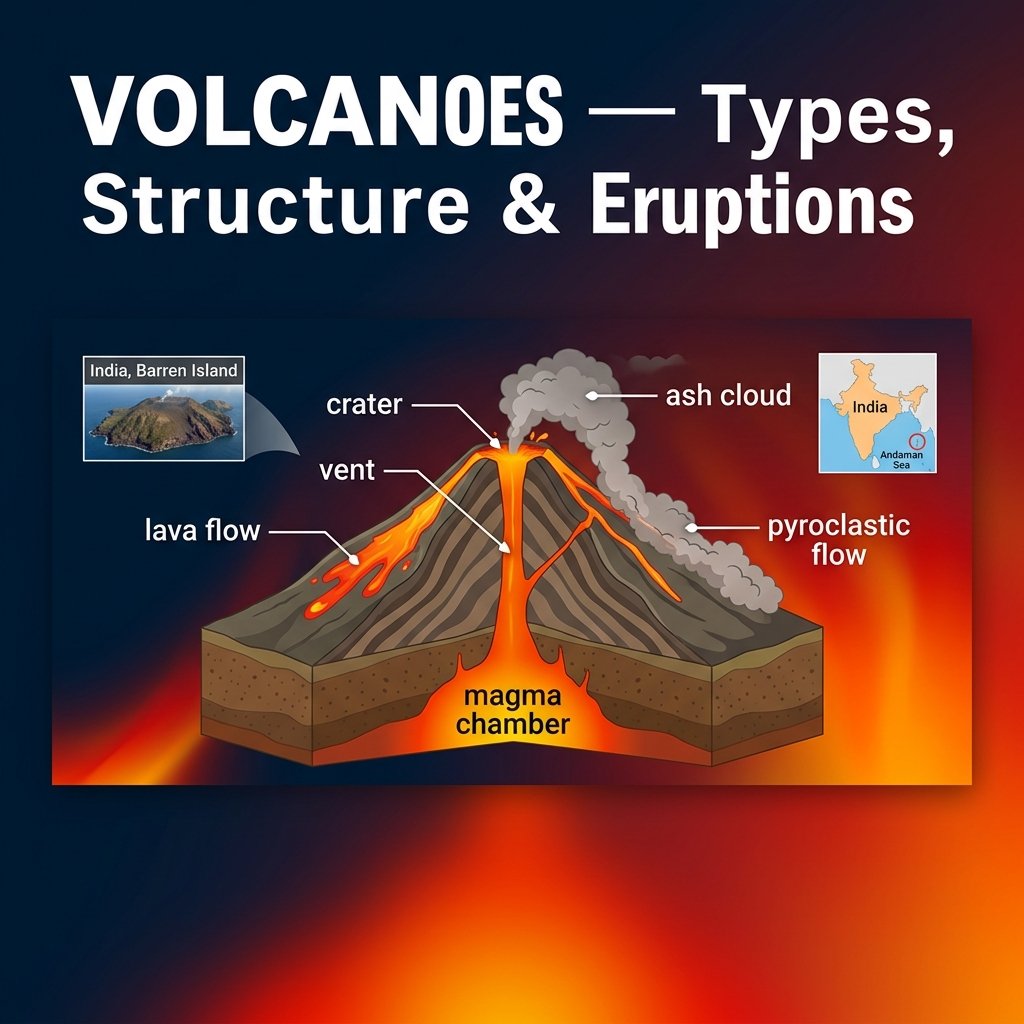
What is a Volcano? — Definition
A volcano is an opening or rupture in Earth’s crust that allows magma (molten rock from Earth’s interior), volcanic gases, and solid fragments (tephra) to escape to the surface. The word comes from Vulcan, the Roman god of fire.
When molten rock reaches the surface, it is called lava. Over repeated eruptions, lava and ash build up to form the cone-shaped mountains we usually picture when we think of a volcano.
🌋 Key Fact: There are approximately 1,500 potentially active volcanoes on Earth (above sea level). Around 50–80 erupt every year. About 500 million people live within dangerous range of an active volcano.
Structure of a Volcano — Labeled Parts
Understanding the internal structure of a volcano helps explain how eruptions happen:
| Part | Description |
|---|---|
| Magma Chamber | Underground reservoir of molten rock deep below the volcano |
| Vent | The channel through which magma travels to the surface |
| Crater | Bowl-shaped opening at the top of the volcano |
| Caldera | Large depression formed when volcano collapses after eruption |
| Lava Flow | Streams of molten rock flowing down the volcano’s sides |
| Ash Cloud | Plume of volcanic ash and gas rising into atmosphere |
| Pyroclastic Flow | Fast-moving cloud of hot gas, ash, and rock fragments |
| Flank | The side slope of the volcanic cone |
| Sill / Dyke | Intrusions of magma into surrounding rock layers |
How Do Volcanoes Erupt? — The Process
Volcanic eruptions are driven by pressure buildup. Here is the step-by-step process:
- Magma Formation: Deep in Earth’s mantle (50–200 km below surface), rocks melt due to extreme heat and pressure to form magma. This often happens at tectonic plate boundaries.
- Magma Rises: Being less dense than surrounding rock, magma rises upward through fractures and weaknesses in the crust, collecting in a magma chamber.
- Pressure Builds: As magma accumulates, pressure increases. Dissolved gases (CO₂, SO₂, H₂O vapour) in magma expand as pressure drops near the surface.
- Eruption: Eventually pressure exceeds the strength of surrounding rock — magma forces its way to the surface through the vent, becoming lava.
- Building: Over many eruptions, lava, ash, and pyroclastic material accumulate, gradually building up the volcanic cone.
Types of Volcanoes — Complete Classification
1. Shield Volcanoes
Shield volcanoes are broad, gently sloping volcanoes with a shape resembling a warrior’s shield laid flat on the ground. They form from low-viscosity basaltic lava that flows easily and spreads far before cooling.
- 🌺 Example: Hawaiian volcanoes — Mauna Loa (world’s largest volcano by volume)
- Eruptions are relatively gentle — lava flows rather than explodes
- Form over hot spots (Hawaii) or at divergent plate boundaries (Iceland)
- They erupt frequently but rarely cause large casualties
2. Composite Volcanoes (Stratovolcanoes)
Composite volcanoes are the classic steep, cone-shaped mountains most people visualize. They are built from alternating layers of lava, ash, and pyroclastic material — hence the name “strato” (layers).
- 🏔️ Examples: Mount Fuji (Japan), Mount Vesuvius (Italy), Mount Pinatubo (Philippines)
- Built from high-viscosity, silica-rich lava that traps gases → causes explosive eruptions
- Found at convergent plate boundaries (subduction zones)
- Most dangerous type — explosive eruptions with pyroclastic flows
- Form the famous Ring of Fire around the Pacific Ocean
3. Cinder Cone Volcanoes
Cinder cones are the smallest and simplest type of volcano. They form when gas-charged lava is blown into the air, breaking into small fragments (cinders or scoria) that fall back around the vent, building a steep cone.
- 🔴 Example: Paricutin (Mexico) — grew 9 metres in one day in 1943!
- Usually have a single eruption episode and then go extinct
- Steep sides (30–40°) with a bowl-shaped crater at the top
- Rarely more than 300 metres tall
4. Supervolcanoes (Caldera Volcanoes)
Supervolcanoes do not look like typical cone volcanoes — they are enormous collapsed depressions (calderas) formed when a massive underground magma chamber empties catastrophically and the ground collapses.
- 🔥 Example: Yellowstone (USA), Toba (Indonesia)
- Eruption can have a Volcanic Explosivity Index (VEI) of 8 — eject 1,000+ km³ of material
- Toba eruption (74,000 years ago) nearly wiped out early humans — volcanic winter
- Last Yellowstone eruption was ~640,000 years ago
5. Fissure Volcanoes (Flood Basalt)
Instead of a central vent, lava erupts through long cracks (fissures) in Earth’s crust, flooding vast areas with basaltic lava. These create lava plateaus.
- 🏔️ India’s Deccan Traps — one of the largest flood basalt events ever (65 million years ago)
- Covered 500,000 km² of India with lava up to 2 km thick
- Linked to the Cretaceous–Paleogene extinction (along with asteroid impact)
| Type | Shape | Lava Type | Eruption Style | Example |
|---|---|---|---|---|
| Shield | Broad, flat | Basaltic (low viscosity) | Gentle, effusive | Mauna Loa, Hawaii |
| Composite/Strato | Steep cone | Andesitic (high viscosity) | Explosive | Mount Fuji, Vesuvius |
| Cinder Cone | Small, steep | Scoria/cinders | Moderate | Paricutin, Mexico |
| Supervolcano | Caldera depression | Rhyolitic | Catastrophic | Yellowstone, Toba |
| Fissure/Flood | Plateau forming | Basaltic | Effusive, vast | Deccan Traps, India |
Magma vs Lava — What’s the Difference?
| Property | Magma | Lava |
|---|---|---|
| Location | Below Earth’s surface | On Earth’s surface |
| Temperature | 700°C – 1,300°C | 700°C – 1,200°C (cools rapidly) |
| Gas Content | Rich in dissolved gases (CO₂, SO₂, H₂O) | Most gas has escaped |
| Rock Formed | Intrusive igneous rocks (granite) | Extrusive igneous rocks (basalt) |
| Speed | Rises slowly over years | Flows at 1–60+ km/h |
Active, Dormant & Extinct Volcanoes
- 🔴 Active Volcano: Has erupted recently OR is currently erupting. Scientists consider a volcano active if it has erupted in the last 10,000 years. (~1,500 worldwide)
- 🟡 Dormant Volcano: Currently inactive but has erupted in historical times and is expected to erupt again. (e.g., Mount Kilimanjaro)
- ⚫ Extinct Volcano: Has not erupted for over 10,000 years and is unlikely to erupt again. (e.g., Ben Nevis, Scotland)
The Ring of Fire — Where Most Volcanoes Are
The Ring of Fire is a horse-shoe shaped zone around the Pacific Ocean that contains 75% of the world’s volcanoes and generates 90% of world’s earthquakes. It follows the boundaries of the Pacific Plate.
- Stretches from New Zealand → Philippines → Japan → Alaska → USA West Coast → Mexico → South America
- Contains famous volcanoes: Mount Fuji, Mount Pinatubo, Mount St. Helens, Popocatépetl
- Formed along convergent plate boundaries where oceanic plates subduct under continental plates
- Home to the deepest ocean trenches: Mariana, Java, Peru-Chile
Volcanoes in India — Barren Island & Deccan Traps
India has a surprisingly rich volcanic history, both ancient and active:
Barren Island — India’s Only Active Volcano
- 📍 Located in the Andaman Sea, about 135 km from Port Blair
- It is the only confirmed active volcano in South Asia
- Type: Stratovolcano — steep cone with explosive eruptions
- Was considered dormant for 150+ years before erupting in 1991
- It has erupted multiple times since: 1994–95, 2005, 2008–2009, 2017
- The island is uninhabited. Belongs to India’s Union Territory of Andaman & Nicobar Islands
- Part of the Andaman volcanic arc, connected to the Indo-Burmese convergent zone
Narcondam Island — Dormant Volcano
- 📍 Also in Andaman Sea, about 255 km northeast of Port Blair
- A dormant stratovolcano — no eruption in recorded history
- Home to the endemic Narcondam Hornbill (endangered)
- Has no permanent human settlement
Deccan Traps — Ancient Flood Basalt
- 📍 Covers large parts of Maharashtra, Goa, Madhya Pradesh, Karnataka, Andhra Pradesh
- Formed 66 million years ago from successive fissure eruptions
- One of the largest volcanic features on Earth — once covered ~1.5 million km²
- Created the black cotton soil (Regur) — extremely fertile, ideal for cotton cultivation
- Linked to debates about the extinction of dinosaurs (alongside Chicxulub asteroid)
- Rock type: Tholeiitic basalt — fine-grained dark igneous rock
Volcanic Hazards — What Makes Volcanoes Deadly
| Hazard | Description | Example |
|---|---|---|
| Pyroclastic Flow | Fast-moving (700 km/h) avalanche of hot gas, ash & rock (700°C) | Mt. Pinatubo 1991 |
| Lahar | Volcanic mudflow mixing ash with water — travels far from volcano | Nevado del Ruiz 1985 |
| Lava Flow | Molten rock that incinerates everything in path | Kilauea, Hawaii |
| Ash Fall | Fine volcanic ash disrupts aviation, farming, health | Eyjafjallajökull 2010 |
| Volcanic Gases | CO₂, SO₂, H₂S — can asphyxiate in valleys | Lake Nyos 1986 |
| Volcanic Tsunami | Underwater eruptions trigger giant waves | Krakatoa 1883 |
| Volcanic Winter | SO₂ aerosols block sunlight → global cooling | Tambora 1815 |
Benefits of Volcanoes — Not All Bad!
- 🌱 Fertile Soil: Volcanic soil (andisol) is extremely rich in minerals — why farmers live near volcanoes in Indonesia, Italy, and India’s Deccan region
- ⚡ Geothermal Energy: Iceland generates 66% of its energy from volcanic heat
- 💎 Minerals & Gems: Diamonds come from kimberlite (deep volcanic rock); copper, gold, and silver deposit near volcanic vents
- 🏝️ Island Formation: Hawaii, Iceland, and the Maldives are all volcanic in origin
- 🌡️ Climate Regulation: Volcanic CO₂ has contributed to Earth’s greenhouse warming for billions of years (long-term carbon cycle)
- 🔬 Scientific Research: Volcanoes provide window into Earth’s interior chemistry
Important Famous Volcanic Eruptions
| Eruption | Year | VEI | Impact |
|---|---|---|---|
| Tambora (Indonesia) | 1815 | 7 | Largest historic eruption; “Year Without Summer” 1816; 71,000+ killed |
| Krakatoa (Indonesia) | 1883 | 6 | Global temperature drop; 36,000 killed; heard 5,000 km away |
| Mount Pinatubo (Philippines) | 1991 | 6 | Cooled Earth by 0.5°C for 2 years; 800 killed |
| Mount St. Helens (USA) | 1980 | 5 | Lateral blast; reduced mountain by 400 m; 57 killed |
| Vesuvius (Italy) | 79 AD | 5 | Buried Pompeii & Herculaneum under ash |
| Eyjafjallajökull (Iceland) | 2010 | 4 | Shut European airspace for 8 days; €1.3 billion loss |
| Toba (Indonesia) | 74,000 BC | 8 | Near-extinction of humans; global volcanic winter |
Key Takeaways
| Topic | Key Fact |
|---|---|
| Definition | Opening in Earth’s crust that releases magma, gas & ash |
| India’s Active Volcano | Barren Island, Andaman & Nicobar Islands |
| Most Dangerous Type | Composite/Stratovolcano (explosive eruptions) |
| Largest Volcano by Volume | Mauna Loa, Hawaii (shield volcano) |
| India’s Ancient Volcanism | Deccan Traps — 66 million years ago; formed black cotton soil |
| Ring of Fire | Pacific rim — 75% of world’s volcanoes |
| Biggest Benefit | Extremely fertile volcanic soil + geothermal energy |
| Most Catastrophic Eruption | Toba, Indonesia — ~74,000 years ago (VEI 8) |
Frequently Asked Questions (FAQs)
1. Is there any active volcano in India?
Yes! Barren Island in the Andaman & Nicobar Islands is India’s only active volcano and the only active volcano in South Asia. It erupted most recently in 2017 and is continuously monitored by the Geological Survey of India (GSI).
2. What is the difference between a volcano and an earthquake?
A volcano is a geological feature (a vent) that releases magma, while an earthquake is a sudden release of seismic energy from rock movement along a fault. However, they are related — volcanic eruptions can trigger earthquakes, and tectonic movement can trigger volcanic activity.
3. What caused the Deccan Traps?
The Deccan Traps were caused by a massive hotspot or mantle plume beneath the Indian plate, combined with tectonic adjustments as India moved north. Eruptions occurred over a period of ~1 million years, starting around 66 million years ago — coinciding with the extinction of dinosaurs.
4. Can scientists predict volcanic eruptions?
Scientists cannot predict eruptions perfectly, but they can identify warning signs: increased seismic activity near a volcano, ground deformation (swelling), changes in gas emissions, and changes in temperature of volcanic lakes. Monitoring these signals allows evacuation warnings days to weeks in advance.
5. Why do people live near volcanoes if they are dangerous?
Despite the danger, millions of people live near volcanoes worldwide because volcanic soil is extraordinarily fertile — rich in minerals like potassium, phosphorus, and calcium. Countries like Indonesia, Italy, Japan, and India’s Deccan region support dense farming populations near volcanoes. Additionally, eruptions are infrequent and often give warning signs.
⭐ Important for Exams — Quick Revision Points
- 🔑 India’s active volcano = Barren Island (Andaman Sea) — only active volcano in South Asia
- 🔑 India’s dormant volcano = Narcondam Island (Andaman Sea)
- 🔑 Deccan Traps = Flood basalt eruption, 66 Ma ago, Maharashtra → Karnataka → MP
- 🔑 Deccan Traps soil = Black cotton soil (Regur) — best for cotton cultivation
- 🔑 Ring of Fire = 75% volcanoes + 90% earthquakes — around Pacific Ocean
- 🔑 Composite volcanoes = Most explosive, found at convergent boundaries
- 🔑 Shield volcanoes = Gentlest, broadest, found at hot spots (Hawaii)
- 🔑 Pyroclastic flow = Most deadly volcanic hazard (700°C, 700 km/h)
- 🔑 Largest eruption = Tambora 1815 (VEI 7) — caused 1816 “Year Without Summer”
- 🔑 Mauna Loa = Largest volcano by volume; shield type; Hawaii
- 🔑 VEI = Volcanic Explosivity Index (0–8 scale)
- 🔑 Caldera = Large depression after volcano empties and collapses
Related Geology Articles on StudyHub
- ➡️ What is Plate Tectonics? — Theory, Types of Boundaries & Evidence
- ➡️ What is an Earthquake? — Seismic Zones & Fault Types Explained
- ➡️ Deccan Traps — India’s Ancient Flood Basalt & Dinosaur Extinction Link
- ➡️ Ring of Fire — Pacific Ocean’s Volcanic & Earthquake Zone
- ➡️ Igneous Rocks — Types, Classification & Examples from India