Indian Penal Code, 1860
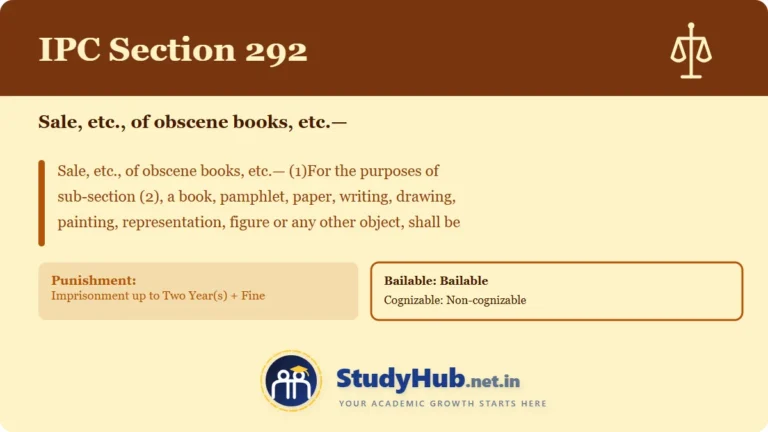
Sale, etc., of obscene books, etc.—
Section
292
Punishment
Imprisonment up to Two Year(s) + Fine
Cognizable
Non-cognizable
Bailable
Bailable
Compoundable
Non-Compoundable (Refer to CrPC 320 for exceptions)
Trial Court
Any Magistrate
Bare Act Text
292. Sale, etc., of obscene books, etc.—
(1)For the purposes of sub-section (2), a book, pamphlet, paper, writing, drawing, painting, representation, figure or any other object, shall be deemed to be obscene if it is lascivious or appeals to the prurient interest or if its effect, or (where it comprises two or more distinct items) the effect of any one of its items, is, if taken as a whole, such as to tend to deprave and corrupt person, who are likely, having regard to all relevant circumstances, to read, see or hear the matter contained or embodied in it.(2)Whoever—(a)sells, lets to hire, distributes, publicly exhibits or in any manner puts into circulation, or for purposes of sale, hire, distribution, public exhibition or circulation, makes, produces or has in his possession any obscene book, pamphlet, paper, drawing, painting, representation or figure or any other obscene object whatsoever, or(b)imports, exports or conveys any obscene object for any of the purposes aforesaid, or knowing or having reason to believe that such object will be sold, let to hire, distributed or publicly exhibited or in any manner put into circulation, or(c)takes part in or receives profits from any business in the course of which he knows or has reason to believe that any such obscene objects are for any of the purposes aforesaid, made, produced, purchased, kept, imported, exported, conveyed, publicly exhibited or in any manner put into circulation, or(d)advertises or makes known by any means whatsoever that any person is engaged or is ready to engage in any act which is an offence under this section, or that any such obscene object can be procured from or through any person, or(e)offers or attempts to do any act which is an offence under this section, shall be punished on first conviction with imprisonment of either description for a term which may extend to two years, and with fine which may extend to two thousand rupees, and, in the event of a second or subsequent conviction, with imprisonment of either description for a term which may extend to five years, and also with fine which may extend to five thousand rupees.(Exception)— This section does not extend to—(a)any book, pamphlet, paper, writing, drawing, painting, representation or figure—(i)the publication of which is proved to be justified as being for the public good on the ground that such book, pamphlet, paper, writing, drawing, painting, representation or figure is in the interest of science, literature, art or learning or other objects of general concern, or (ii) which is kept or used bona fide for religious purposes;(b)any representation sculptured, engraved, painted or otherwise represented on or in—(i)any ancient monument within the meaning of the Ancient Monuments and Archaeological Sites and Remains Act, 1958 (24 of 1958), or (ii) any temple, or on any car used for the conveyance of idols, or kept or used for any religious purpose.
What is IPC Section 292 ?
According to the official bare act, this legal offense is defined as: 292. Sale, etc., of obscene books, etc.—
(1)For the purposes of sub-section (2), a book, pamphlet, paper, writing, drawing, painting, representation, figure or any other object, shall be deemed to be obscene if it is lascivious or appeals to the prurient interest or if its effect, or (where it comprises two or more distinct items) the effect of any one of its items, is, if taken as a whole, such as to tend to deprave and corrupt person, who are likely, having regard to all relevant circumstances, to read, see or hear the matter contained or embodied in it.(2)Whoever—(a)sells, lets to hire, distributes, publicly exhibits or in any manner puts into circulation, or for purposes of sale, hire, distribution, public exhibition or circulation, makes, produces or has in his possession any obscene book, pamphlet, paper, drawing, painting, representation or figure or any other obscene object whatsoever, or(b)imports, exports or conveys any obscene object for any of the purposes aforesaid, or knowing or having reason to believe that such object will be sold, let to hire, distributed or publicly exhibited or in any manner put into circulation, or(c)takes part in or receives profits from any business in the course of which he knows or has reason to believe that any such obscene objects are for any of the purposes aforesaid, made, produced, purchased, kept, imported, exported, conveyed, publicly exhibited or in any manner put into circulation, or(d)advertises or makes known by any means whatsoever that any person is engaged or is ready to engage in any act which is an offence under this section, or that any such obscene object can be procured from or through any person, or(e)offers or attempts to do any act which is an offence under this section, shall be punished on first conviction with imprisonment of either description for a term which may extend to two years, and with fine which may extend to two thousand rupees, and, in the event of a second or subsequent conviction, with imprisonment of either description for a term which may extend to five years, and also with fine which may extend to five thousand rupees.(Exception)— This section does not extend to—(a)any book, pamphlet, paper, writing, drawing, painting, representation or figure—(i)the publication of which is proved to be justified as being for the public good on the ground that such book, pamphlet, paper, writing, drawing, painting, representation or figure is in the interest of science, literature, art or learning or other objects of general concern, or (ii) which is kept or used bona fide for religious purposes;(b)any representation sculptured, engraved, painted or otherwise represented on or in—(i)any ancient monument within the meaning of the Ancient Monuments and Archaeological Sites and Remains Act, 1958 (24 of 1958), or (ii) any temple, or on any car used for the conveyance of idols, or kept or used for any religious purpose.
What is the punishment for Dhara 292 ?
The punishment for this specific offense is outlined under the law as: Imprisonment up to Two Year(s) + Fine
Is IPC 292 bailable or non-bailable?
Under the Indian Penal Code, this specific offense is classified as a Bailable offense.
Is Dhara 292 a cognizable offense?
The legal status regarding police arrest without a warrant is that this offense isNon-cognizable.
Which court has the jurisdiction to try IPC 292 cases?
Cases pertaining to this specific IPC section are triable by the Any Magistrate.
Can IPC Section 292 be compromised (Compoundable)?
The compoundable nature of this offense, meaning whether the parties can settle it out of court, is classified as: Non-Compoundable (Refer to CrPC 320 for exceptions).
Pramod Editor-in-Chief
Pramod is the Founder and Editor-in-Chief of StudyHub. He holds a Master's degree and is currently pursuing a Ph.D. in Geology, alongside more than 7+ years spent building and verifying competitive exam content for Indian aspirants. He leads StudyHub's editorial process across Indian Polity, the Constitution, Indian Economy, History, Geography, Science, and the platform's other subject areas — checking every article against primary sources (bare act text and Gazette notifications for constitutional topics, government and Economic Survey data for economy content, standard reference material elsewhere) and flagging it for re-verification whenever a relevant amendment, policy, or data update makes an earlier version outdated.