India’s natural vegetation is one of the most diverse in the world — spanning from dense tropical rainforests in the Western Ghats and Northeast India to dry thorny scrublands in Rajasthan, from alpine meadows in the Himalayas to tidal mangrove forests in the Sundarbans. With over 47,000 plant species and accounting for about 7% of the world’s total plant species, India is one of the world’s 17 mega-biodiversity countries. The type of vegetation in any region is directly determined by rainfall, temperature, soil type, and altitude — making this topic a perfect application of everything learned in Indian climate, soils, and monsoon.
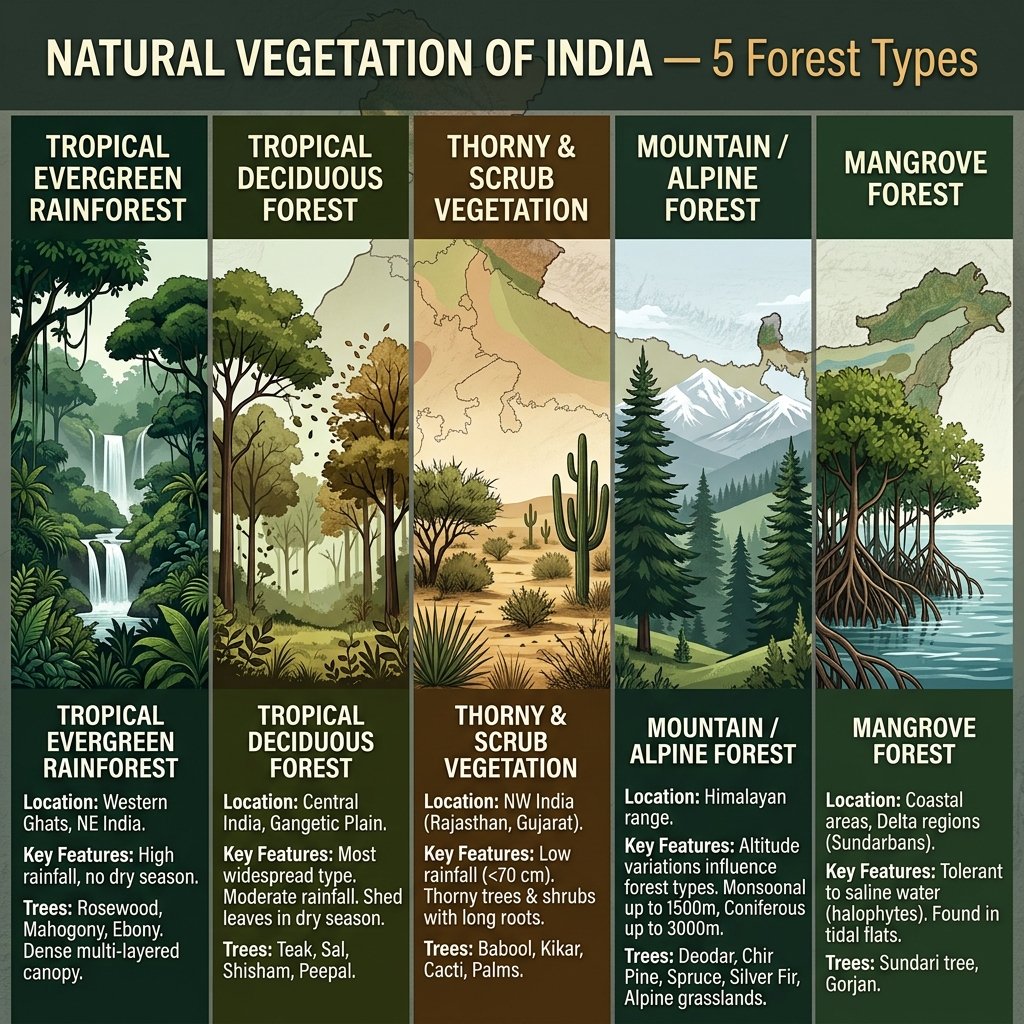
Overview — Natural Vegetation Types of India
| Vegetation Type | Rainfall Required | Main States / Regions | Key Species |
|---|---|---|---|
| Tropical Evergreen | ≥ 200 cm/year | Western Ghats, NE India, Andaman | Ebony, Rosewood, Mahogany, Rubber |
| Tropical Deciduous (Moist) | 100–200 cm/year | Central India, NE, Eastern Ghats | Teak, Sal, Bamboo, Arjuna |
| Tropical Deciduous (Dry) | 70–100 cm/year | MP, UP, Rajasthan (eastern) | Teak, Tendu, Palas, Amaltas |
| Thorny/Scrub | < 70 cm/year | Rajasthan, Gujarat (Kutch), parts of UP/MP | Acacia, Babool, Khejri, Cactus |
| Mountain/Alpine | Varies by altitude | Himalayas, NE hills, Nilgiris | Oak, Rhododendron, Deodar, Pine, Birch |
| Mangrove/Tidal | Coastal tidal zones | Sundarbans (WB), Mahanadi, Godavari, Gujarat | Sundari, Goran, Rhizophora, Avicennia |
1. Tropical Evergreen Forests (Tropical Rainforests)
Tropical Evergreen Forests are the most luxuriant and species-rich forests on Earth. In India, they are found wherever annual rainfall exceeds 200 cm and there is no distinct dry season — so the trees never shed all their leaves simultaneously (hence “evergreen”).
Distribution in India
- 🌿 Western Ghats — windward slopes of Kerala, Karnataka (Coorg/Kodagu), Maharashtra (Sahyadri)
- 🌿 Northeast India — Assam, Meghalaya, Nagaland, Mizoram, Manipur, Arunachal Pradesh
- 🌿 Andaman & Nicobar Islands — dense rainforest; one of India’s most pristine ecosystems
Characteristics
- 🌳 Multi-layered canopy — 4–5 layers of vegetation; tallest trees 45–60 m
- 🍃 Trees do NOT shed leaves all at once — evergreen year-round
- 🐛 Highest biodiversity in India — insects, reptiles, amphibians, birds, mammals
- 🌱 Dense undergrowth — ferns, mosses, climbers, epiphytes
- 🪵 Economically important trees: Ebony (Diospyros), Rosewood (Dalbergia latifolia), Ironwood, Mahogany, Rubber (Hevea brasiliensis)
- ⚠️ Commercially difficult to exploit — high tree diversity (many species per hectare) but few of each species; difficult terrain
2. Tropical Deciduous Forests (Monsoon Forests)
India’s most widespread forests — these are the “monsoon forests” that shed their leaves during the hot, dry season (March–June) to conserve moisture. They cover most of peninsular India and are subdivided into Moist and Dry types.
A. Moist Deciduous Forests (100–200 cm rainfall)
- 📍 Distribution: Eastern slopes of Western Ghats, Madhya Pradesh, Chhattisgarh, Jharkhand, Odisha, Assam foothills, Andaman Islands
- 🌳 Dominant tree: TEAK (Tectona grandis) — India’s most commercially valuable timber; also SAL (Shorea robusta) in northern/eastern India
- 🎋 Bamboo — found extensively in NE India; India has the world’s 2nd largest bamboo resource
- 🌿 Other species: Arjuna, Ain, Haldu, Palas (flame of the forest), Mahua, Ber
- 🐯 Tiger habitat — most of India’s tiger reserves (Jim Corbett, Pench, Bandhavgarh, Kanha, Ranthambore) are in moist deciduous forests
B. Dry Deciduous Forests (70–100 cm rainfall)
- 📍 Distribution: Large parts of Madhya Pradesh, Rajasthan (eastern), Uttar Pradesh, Andhra Pradesh interior, Karnataka interior
- 🌳 Trees: Teak, Tendu (Diospyros melanoxylon — leaves used to wrap bidi cigarettes), Palas, Amaltas, Bel
- 🌾 More open canopy; grassy clearings; transitions into thorny scrub
- 🦁 Asiatic Lion habitat — Gir Forest (dry deciduous) in Gujarat is the last refuge of Asiatic lions
🇮🇳 Teak-Sal Geography: A useful exam rule — Teak dominates in western and central peninsular India (Madhya Pradesh, Maharashtra, Karnataka); Sal dominates in eastern and northeastern India (Jharkhand, Odisha, Uttarakhand foothills, Assam). Where they overlap (MP, Chhattisgarh), you find mixed forests.
3. Thorny/Scrub Vegetation (Desert and Semi-Arid)
In areas receiving less than 70 cm of annual rainfall, trees give way to thorny shrubs, cacti, and drought-adapted plants. These vegetation types are adapted to conserve water through thick bark, reduced leaf size, deep roots, and thorns (to prevent water loss and animal grazing).
Distribution
- 🏜️ Rajasthan — Thar Desert and surrounding semi-arid belt
- 🏜️ Gujarat — Rann of Kutch, Saurashtra semi-arid areas
- 🏜️ Parts of Uttar Pradesh, Madhya Pradesh, Maharashtra leeward (rain shadow) areas
- 🏜️ Ladakh — cold desert; sparse vegetation (distinct from Rajasthan hot desert)
Key Species
- 🌵 Khejri (Prosopis cineraria) — State Tree of Rajasthan; survives extreme drought; provides fodder, fuel, timber; sacred to Bishnoi community
- 🌵 Babool / Acacia — thorny; widespread in dry regions; gum arabic source
- 🌵 Cactus & Euphorbia — succulent; stores water in stem
- 🌾 Sevan grass — native to Thar; excellent livestock fodder
- 🪵 Ber (Indian Jujube), Neem, Rohida — found in semi-arid transition zone
4. Mountain and Alpine Forests
Himalayan and high-altitude forests change dramatically with altitude — each zone has a distinct vegetation community. This altitudinal zonation mirrors the latitudinal shift from tropical to polar climates as you go from lowland to Himalayan summit.
| Altitude Zone | Vegetation Type | Key Species | Notes |
|---|---|---|---|
| Up to 1,000 m | Subtropical Broadleaf | Sal, Bamboo, Teak | Himalayan foothills, Duars region |
| 1,000–2,000 m | Subtropical Pine | Chir Pine (Pinus roxburghii), Oak | Lower Himachal, Uttarakhand, J&K |
| 2,000–3,000 m | Temperate Broadleaf | Oak, Rhododendron, Maple, Alder | Key zone for Darjeeling tea; highest biodiversity in Himalayas |
| 2,500–3,500 m | Temperate Coniferous | Deodar (Cedrus deodara), Blue Pine, Spruce, Fir | Deodar = “Tree of God” in Sanskrit; J&K, HP, Uttarakhand |
| 3,500–4,000 m | Subalpine | Silver Fir, Juniper, Birch | Opens into meadows (bugyals) |
| 4,000–5,000 m | Alpine/Tundra | Cushion plants, mosses, lichens | Above treeline; grazed by yaks, sheep in summer |
| Above 5,000 m | Permanent Snow/Glaciers | Virtually no vascular plants | Some extremophile lichens only |
Nilgiri Biosphere Reserve — “Shola” Forests
- 🌿 Shola forests — unique montane, stunted evergreen forests interspersed with grasslands on the Nilgiri, Anamalai, and Palani hills of South India
- 📍 Found above 1,500 m in Tamil Nadu, Kerala (Munnar area)
- 🌊 Act as water towers — shola-grassland ecosystem captures monsoon rain and releases it slowly through streams
- 🐘 Nilgiri Biosphere Reserve (UNESCO) — includes parts of Mudumalai, Wayanad, Bandipur, Nagarhole; largest continuous tiger habitat in South Asia
5. Mangrove/Tidal Forests
Mangrove forests grow in inter-tidal zones — the area between high and low tide along sheltered coasts, river deltas, and estuaries. They are unique forests adapted to saline/brackish waterlogged conditions with oxygen-poor sediment.
Adaptations of Mangrove Trees
- 🌊 Aerial roots (pneumatophores): Stick up above the mud to breathe oxygen (soil is waterlogged and anoxic)
- 🌊 Prop/stilt roots: Arch down from the trunk to provide stability in soft, waterlogged sediment
- 🍃 Salt exclusion/secretion: Some species excrete excess salt through leaves; others block uptake at roots
- 🌱 Vivipary: Seeds germinate ON the parent tree (propagule) before dropping into water — increases survival in tidal conditions
Major Mangrove Areas in India
| Location | State | Status | Key Notes |
|---|---|---|---|
| Sundarbans | West Bengal | UNESCO World Heritage; Ramsar Site | World’s largest mangrove forest (~10,000 km²); Bengal Tiger; Sundari (Heritiera fomes) tree = name origin |
| Bhitarkanika | Odisha | Ramsar Site; National Park | 2nd largest mangrove in India; Saltwater crocodile nesting |
| Godavari-Krishna Delta | Andhra Pradesh | Large coastal mangrove | Coringa Wildlife Sanctuary |
| Pichavaram | Tamil Nadu | Asia’s 2nd largest mangrove | Near Chidambaram; lagoon ecosystem |
| Andaman & Nicobar | UT | Pristine island mangroves | Diverse species; limited human pressure |
| Kharwada/Gulf of Kutch | Gujarat | India’s 3rd largest | Dry climate mangroves — unusual ecology |
Why Mangroves Matter
- 🌊 Coastal protection: 2004 tsunami — mangrove areas had significantly fewer casualties; mangroves absorb wave energy
- 🐟 Fish nurseries: 80%+ of commercial marine fish species spend juvenile stage in mangroves
- 🌱 Carbon storage: Among the highest carbon biomass per unit area of any ecosystem (“blue carbon”)
- 🦀 Habitat for unique species: Bengal Tiger (Sundarbans), Estuarine Crocodile, Irrawaddy Dolphin, Fiddler Crab, Mudskipper
- ⚠️ Threatened: ~40% of world’s mangroves destroyed in 50 years; aquaculture ponds, coastal development, pollution
Sacred Groves — India’s Ancient Conservation Tradition
India has a centuries-old tradition of sacred groves (Dev Vans / Sacred Groves) — patches of forest left untouched due to religious/cultural protection. These act as biodiversity refugia in otherwise modified landscapes.
- 🌿 Kerala: Kavus — sacred grove patches protected by temples
- 🌿 Rajasthan: Orans — protected by Bishnoi community (first tree-hugger movement, Chipko, also started in Rajasthan/Uttarakhand)
- 🌿 Karnataka: Devarakadu — forest near temples, untouched
- 🌿 Meghalaya: Law Kyntangs — sacred forest groves of Khasi tribe
- 📊 India has an estimated 100,000+ sacred groves across the country
Key Takeaways — Summary
| Forest Type | Rainfall | Key Region | Iconic Species |
|---|---|---|---|
| Tropical Evergreen | >200 cm | Western Ghats, NE India, A&N | Ebony, Rosewood, Mahogany |
| Moist Deciduous | 100–200 cm | Central India, Eastern Ghats | Teak, Sal, Bamboo |
| Dry Deciduous | 70–100 cm | MP, UP, Rajasthan (east) | Teak, Tendu, Palas |
| Thorny/Scrub | <70 cm | Thar Desert, Gujarat, Kutch | Khejri, Babool, Acacia |
| Mountain (Himalayan) | Altitude-dependent | Himalayas, NE hills, Nilgiris | Deodar, Oak, Rhododendron, Chir Pine |
| Mangrove | Tidal zones | Sundarbans, Odisha, AP, TN | Sundari, Rhizophora, Avicennia |
Frequently Asked Questions (FAQs)
1. Why is the Sundarbans named after the “Sundari” tree?
The name “Sundarbans” comes from the Sundari tree (Heritiera fomes), the dominant mangrove species of this delta. Sundari means “beautiful” in Bengali. The tree’s dense, hard wood was historically prized for boat-building. The Sundarbans — spanning ~10,000 km² across India (West Bengal) and Bangladesh — is the world’s largest single block of tidal halophytic (salt-tolerant) mangrove forest. It is a UNESCO World Heritage Site, a Ramsar Wetland, a Tiger Reserve, and a habitat for Irrawaddy dolphins, estuarine crocodiles, Gangetic dolphins, and dozens of other species.
2. What is the “Chipko Movement” and what type of forest does it involve?
The Chipko Movement (1973, Uttarakhand) was a nonviolent resistance movement where villagers — led by Sundarlal Bahuguna and women like Gaura Devi — literally embraced (chipko = “hug/cling” in Hindi) trees to prevent them from being felled by commercial loggers. The forests involved were temperate mountain forests (oak, rhododendron, deodar) in the Garhwal Himalayas of Uttarakhand. The movement highlighted the crucial role of these forests in preventing landslides, maintaining river flow (especially the Alaknanda-Ganga system), and sustaining the livelihoods of mountain communities.
3. Why does India have such diverse natural vegetation?
India’s vegetation diversity is driven by three major factors: (1) Climate range — from tropical rainforest (Kerala, getting 400+ cm rain) to cold desert (Ladakh) — the entire climatic spectrum exists within one country. (2) Topographic variation — from sea level to 8,611 m (K2), creating distinct altitudinal zones. (3) Geological history — India’s Gondwana origin, the closure of the Tethys Sea, and isolation before Himalayan formation allowed unique evolutionary lineages to develop. India lies at the junction of three major biogeographic zones: Indomalaya, Palearctic (via Himalayas), and Afrotropical (some species from Gondwana linkage).
4. What is the difference between endemic and endangered species?
Endemic species are those found only in a particular geographic area and nowhere else in the world. India has ~33% endemic plant species — notably high in the Western Ghats, NE India, and Andaman Islands (all biodiversity hotspots). Endangered species are those facing high risk of extinction due to habitat loss, hunting, or other pressures. All endemic species are NOT necessarily endangered, and endangered species may not be endemic. The Western Ghats + Sri Lanka is one of the 36 global biodiversity hotspots — with exceptionally high endemism + high threat.
⭐ Important for Exams — Quick Revision
- 🔑 India: 47,000+ plant species; 7% of world’s plants; 17 mega-biodiversity countries
- 🔑 Tropical Evergreen = rainfall >200cm; Western Ghats + NE India + A&N; Ebony, Rosewood
- 🔑 Moist Deciduous = 100–200cm; TEAK (west/central India) + SAL (east India); most of India’s tiger reserves
- 🔑 Dry Deciduous = 70–100cm; Tendu (bidi leaves), Palas; GUJRAT GIR = Asiatic Lion (dry deciduous)
- 🔑 Thorny/Scrub = <70cm; Rajasthan + Gujarat; Khejri (State Tree Rajasthan, sacred to Bishnoi)
- 🔑 Deodar = State Tree of Himachal Pradesh; “Tree of God”; temperate coniferous 2,500–3,500m
- 🔑 Shola forests = stunted montane evergreen; Nilgiris + Palani hills; water towers for South India
- 🔑 Mangrove adaptations = pneumatophores (breathing roots) + prop roots + vivipary + salt exclusion
- 🔑 Sundarbans = world’s largest mangrove; Sundari tree; UNESCO WHC; Bengal Tiger; India+Bangladesh
- 🔑 Bhitarkanika (Odisha) = India’s 2nd largest mangrove; Saltwater Crocodile nesting
- 🔑 Chipko Movement (1973, Uttarakhand) = tree-hugging/hug movement; Sundarlal Bahuguna; Himalayan mountain forests
- 🔑 Sacred Groves = Kavus (Kerala), Orans (Rajasthan), Law Kyntangs (Meghalaya/Khasi); ~1,00,000 in India
- 🔑 India’s Biodiversity Hotspots: Western Ghats + Sri Lanka ✅; Eastern Himalayas ✅; Indo-Burma ✅; Sundaland (partial) ✅ — 4 out of 36 global hotspots
Related Geology Articles on StudyHub
- ➡️ Indian Monsoon — How Rain Determines Vegetation Types
- ➡️ Soil Types of India — Vegetation-Soil Relationship
- ➡️ Coastal Geomorphology — Mangrove Coasts & Deltaic Vegetation
- ➡️ River Systems — How Rivers Create Riparian Forest Habitats
- ➡️ Glaciers of India — Alpine & Subalpine Vegetation Above Treeline