Rocks are the solid foundation of our planet — every mountain, valley, ocean floor, and continent is made of rock. A rock is defined as a naturally occurring, solid aggregate of one or more minerals (or occasionally organic material like coal). Rocks are classified into three fundamental types based on how they form: Igneous (formed from cooling magma/lava), Sedimentary (formed from compressed sediments), and Metamorphic (formed when existing rocks transform under heat and pressure). These three types are linked by the Rock Cycle — one of geology’s most important concepts. Understanding rocks is foundational for all geology, UPSC, SSC, Class 9–11 NCERT, and every earth science examination.
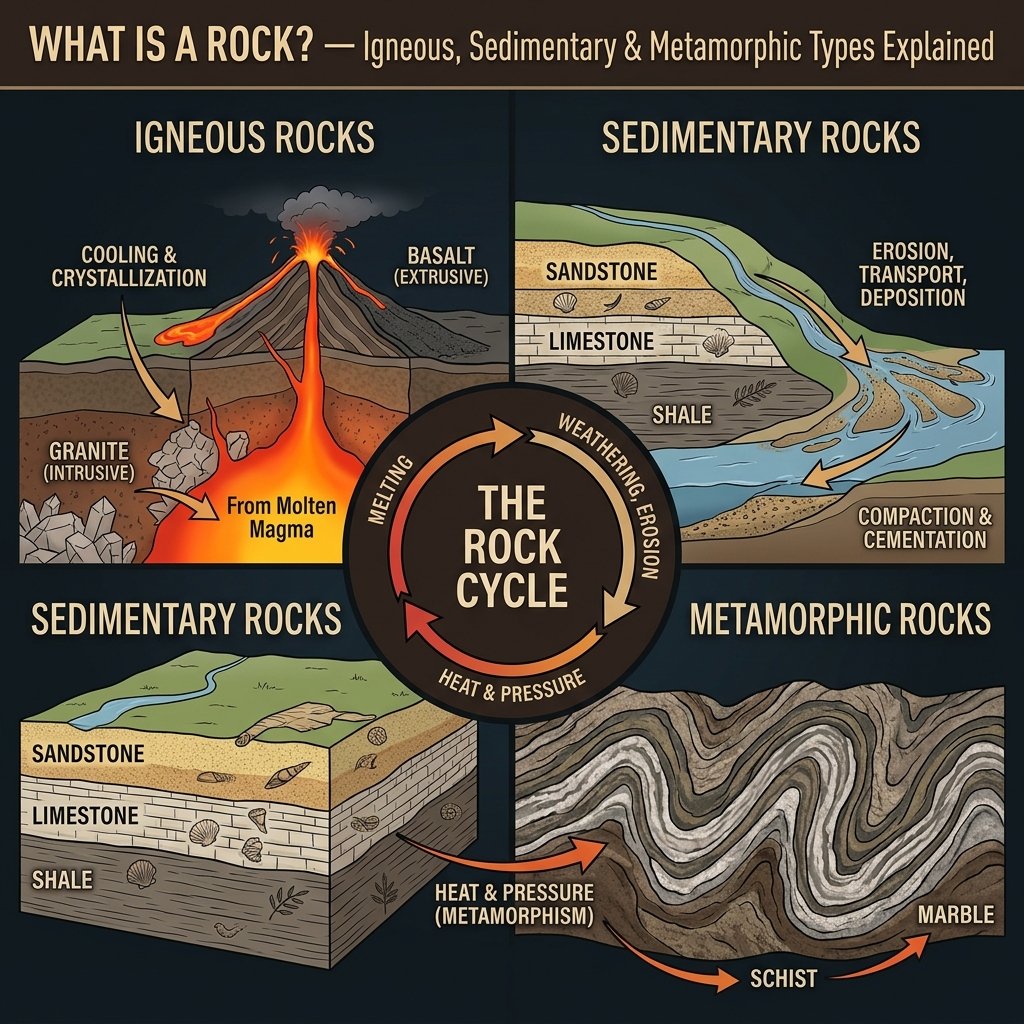
What is a Rock? — Definition & Key Facts
- 🪨 A rock = a naturally occurring solid aggregate of minerals, mineraloids, or organic material
- 🪨 Rocks ≠ Minerals: a mineral is a pure chemical compound (e.g., quartz = SiO₂); a rock can contain MANY minerals (granite contains quartz + feldspar + mica)
- 🪨 Petrology = the branch of geology that studies rocks (their composition, origin, structure, distribution)
- 🪨 Petrography = describing and classifying rocks using microscopic analysis
- 🪨 Rocks cover Earth’s entire crust and make up the bulk of Earth’s mantle — they record billions of years of Earth’s history
The Three Types of Rocks — Overview
| Property | Igneous | Sedimentary | Metamorphic |
|---|---|---|---|
| Origin | Cooling of magma/lava | Compaction of sediments (weathered rock + organic material) | Transformation of existing rocks by heat + pressure |
| Location formed | Underground (intrusive) or at surface (extrusive) | At Earth’s surface — river beds, ocean floors, deserts | Deep crust at subduction zones, mountain roots, contact with magma |
| Fossils? | ❌ Never (heat destroys organic material) | ✅ Yes — most fossils found in sedimentary rocks | ⚠️ Rarely (heat/pressure destroys fossils) |
| Texture | Crystalline (slow cooling = large crystals; fast cooling = fine/glassy) | Layered/stratified; clastic (grains cemented together) or chemical | Foliated (layered, banded) or non-foliated (uniform texture) |
| % of Earth’s crust | ~65% | ~75% of surface rocks (by area) but only 8% of crust by volume | ~27% of crust |
| Common examples | Granite, Basalt, Obsidian, Pumice, Gabbro | Sandstone, Limestone, Shale, Coal, Conglomerate, Chalk | Marble, Slate, Quartzite, Schist, Gneiss, Phyllite |
| Economic importance | Building stone (granite), road aggregate (basalt), gemstones | Coal (energy), limestone (cement), iron ore, oil & gas (shale) | Marble (sculpture/tiles), slate (roofing), quartzite (pavements) |
1. Igneous Rocks — Born from Fire
Igneous rocks (Latin: ignis = fire) form when magma (molten rock underground) or lava (magma that reaches the surface) cools and solidifies. They are Earth’s original rock type — all other rocks ultimately derive from igneous precursors.
Intrusive vs Extrusive Igneous Rocks
| Feature | Intrusive (Plutonic) | Extrusive (Volcanic) |
|---|---|---|
| Where formed | Underground, inside Earth’s crust (plutons, batholiths) | At Earth’s surface (lava flows, volcanic eruptions) |
| Cooling rate | Very slow (thousands to millions of years) | Very fast (hours to years) |
| Crystal size | Large, visible crystals (coarse-grained; phaneritic texture) | Very small or no crystals (fine-grained/aphanitic or glassy) |
| Best examples | Granite, Gabbro, Diorite, Peridotite | Basalt, Rhyolite, Obsidian, Pumice, Andesite |
| Indian examples | Rajasthan granites; Bundelkhand granitic complex | Deccan Traps basalt (Maharashtra, MP, Gujarat) |
Key Igneous Rocks — Properties & Uses
- 🔴 Granite — coarse-grained, intrusive; quartz + feldspar + mica; light pink/grey; used for countertops, monuments, buildings; found extensively in South India (Tamil Nadu, Rajasthan)
- ⚫ Basalt — fine-grained, extrusive; dark grey to black; most abundant volcanic rock; makes up ocean floor; Deccan Traps = largest basalt province in India; fertile black soil (Regur/Black Cotton Soil) formed from basalt weathering
- 💎 Obsidian — volcanic glass; forms when lava cools extremely rapidly; jet black; no crystals; used as cutting tool by ancient humans; sharper than surgical steel
- 🪶 Pumice — extremely porous/vesicular igneous rock; so light it floats on water; forms from gas-rich volcanic eruptions; used in cosmetics (exfoliant), construction, water filtration
- 🟤 Gabbro — coarse-grained, intrusive equivalent of basalt; dark; makes up much of oceanic crust lower layer
2. Sedimentary Rocks — Earth’s History Books
Sedimentary rocks form at or near Earth’s surface through the accumulation, compaction, and cementation of sediments — broken fragments of other rocks, minerals, or organic material. They cover ~75% of Earth’s land surface area and contain virtually all known fossils, making them the primary record of past life and environments.
Formation Process (Lithification)
- 1️⃣ Weathering — existing rocks break down into fragments (mechanical) or dissolve (chemical)
- 2️⃣ Erosion & Transport — wind, water, ice carry sediments to new locations
- 3️⃣ Deposition — sediments settle out in layers (strata) in rivers, lakes, ocean, deserts
- 4️⃣ Compaction — weight of overlying sediments compresses lower layers
- 5️⃣ Cementation — minerals (calcite, silica, iron oxide) precipitate and “glue” grains together → solid rock
- ⏰ The entire process of lithification (turning sediment into rock) can take thousands to millions of years
Types of Sedimentary Rocks
| Type | Formation | Examples |
|---|---|---|
| Clastic (Detrital) | Broken fragments of other rocks cemented together; classified by grain size | Conglomerate (gravel), Sandstone (sand), Siltstone (silt), Shale (clay = finest grains) |
| Chemical | Minerals precipitate out of water solution | Rock Salt (halite), Gypsum, Flint, Travertine (limestone in hot springs) |
| Biochemical/Organic | Organic material accumulates; often from shells/organisms | Limestone (from shells/coral), Chalk (microscopic algae shells), Coal (from plant material), Chert |
Key Sedimentary Rocks — Properties & Importance
- 🟡 Sandstone — cemented sand grains; porous (stores groundwater and oil); red/tan/grey; Rajasthan’s red sandstone used in Agra Fort, Red Fort; major aquifer rock
- ⬜ Limestone — calcium carbonate (CaCO₃); from marine shells and coral; used for cement production; dissolves to form karst caves; Meghalaya has India’s longest limestone caves
- ⚫ Shale — compressed clay; most abundant sedimentary rock; source of shale gas (fracking); splits into thin plates; contains most oil and gas globally in shale formations
- ⬛ Coal — organic sedimentary rock; compressed plant material over millions of years; stages: peat → lignite → bituminous → anthracite (increasing C%); Gondwana coalfields of Jharkhand-Odisha = India’s largest
- 🤍 Chalk — soft, white; composed of shells of microscopic organisms (coccolithophores); white cliffs of Dover; used for school chalk (actually mostly calcium carbonate)
3. Metamorphic Rocks — Transformed by Heat & Pressure
Metamorphic rocks form when existing rocks (igneous, sedimentary, or other metamorphic rocks) are subjected to intense heat, pressure, or chemically active fluids — transforming their mineralogy and texture WITHOUT melting. The original rock is called the protolith. The word “metamorphic” comes from Greek: meta (change) + morphe (form).
Types of Metamorphism
- 🏔️ Regional (Barovic) Metamorphism — large-scale; occurs deep in Earth’s crust during mountain-building (orogenesis); both heat + pressure applied; produces foliated rocks (schist, gneiss) over vast areas; most common type; Himalayan metamorphic zones
- 🌋 Contact Metamorphism — local; when magma intrudes into surrounding rock, baking it; only heat (not much pressure); produces non-foliated rocks (marble, quartzite, hornfels); aureole = zone of contact metamorphism around igneous intrusion
- 💥 Dynamic Metamorphism — along fault zones; intense pressure without much heat; produces mylonite (crushed, sheared rock)
Key Metamorphic Rocks
| Rock | Protolith (Original Rock) | Properties | Uses/Examples |
|---|---|---|---|
| Marble | Limestone | Non-foliated; white/coloured; recrystallised calcite; hard and polishable | Taj Mahal, sculptures, tiles; Makrana marble (Rajasthan) = most famous Indian marble |
| Slate | Shale/Mudstone | Foliated; splits into flat sheets; low-grade metamorphism | Roofing tiles, flooring, school blackboards; produced in Andhra Pradesh, Himachal Pradesh |
| Quartzite | Sandstone | Non-foliated; extremely hard; interlocked quartz crystals; resistant to erosion | Aravalli ridges in Rajasthan; road aggregate; construction; resistant to acid rain |
| Schist | Shale (higher grade than slate) | Medium-grade; medium-scale foliation; platy mica minerals visible; shiny | Decorative stone; Delhi Ridge contains quartzite and schist of Aravalli; Rajasthan, Himalayas |
| Gneiss | Granite or shale (high-grade) | Coarse-grained; alternating dark and light bands (gnessic banding); high-grade | Building stone; Peninsular India’s ancient basement rocks = gneissic complex; 2.5+ billion years old |
The Rock Cycle — Nature’s Recycling System
The Rock Cycle describes how rocks continuously transform from one type to another over geological time — driven by Earth’s internal heat (plate tectonics) and external energy (Sun-driven weathering and erosion). No rock type is permanent — given enough time, any rock can become any other type.
- 🌋 Igneous → Sedimentary: Igneous rock exposed at surface → weathered into fragments → transported → deposited as sediments → compacted → sedimentary rock
- ⛏️ Sedimentary → Metamorphic: Sedimentary rock buried deep → subjected to heat + pressure → mineralogy changes → metamorphic rock (WITHOUT melting)
- 🌡️ Metamorphic → Igneous: Metamorphic rock heated beyond metamorphic stage → melts → becomes magma → cools → igneous rock
- ♻️ Any rock → Any rock: The cycle has no fixed starting point — any rock type can transform into any other given appropriate conditions of burial, exposure, heating, cooling
- ⏰ Timescale: A complete rock cycle can take tens to hundreds of millions of years; the atoms in a Himalayan granite may have previously been part of a Gondwana sediment, before that an ancient seafloor basalt
⭐ Important for Exams — Quick Revision
- 🔑 3 rock types: Igneous (magma/lava), Sedimentary (compacted sediments), Metamorphic (heat + pressure transformation)
- 🔑 Intrusive igneous = slow cooling = large crystals (granite); Extrusive = fast cooling = small/no crystals (basalt, obsidian)
- 🔑 Basalt = most common volcanic rock; makes up ocean floor; Deccan Traps = India’s largest basalt province → formed Black/Regur soil
- 🔑 Granite = most common intrusive rock; forms continental crust; large pink/grey crystals of quartz + feldspar + mica
- 🔑 Pumice = only rock that floats on water (vesicular/porous volcanic rock)
- 🔑 Sedimentary rocks = cover 75% of land surface; contain all fossils; formed by WEEDC: Weathering → Erosion → deposition → compaction → Cementation
- 🔑 Shale = most abundant sedimentary rock; made of clay; source of shale gas (fracking target)
- 🔑 Coal = organic sedimentary rock; peat→lignite→bituminous→anthracite (increasing carbon %); Gondwana coalfields = India’s largest
- 🔑 Limestone = calcium carbonate; from marine organisms; used for cement; forms karst caves; Meghalaya limestone caves
- 🔑 Marble = metamorphosed limestone; non-foliated; Makrana (Rajasthan) = Taj Mahal marble source
- 🔑 Slate = metamorphosed shale; foliated; splits into flat sheets; roofing tiles; lowest-grade metamorphic
- 🔑 Gneiss = highest-grade metamorphic; banded; forms ancient basement of Peninsular India (2.5B+ years old)
- 🔑 Regional metamorphism = large-scale; mountain-building; heat + pressure; produces schist/gneiss
- 🔑 Contact metamorphism = local; magma intrusion bakes surrounding rock; no pressure; produces marble/quartzite/hornfels
- 🔑 Rock Cycle = continuous transformation of rocks; driven by plate tectonics (internal) + weathering/erosion (external); no beginning or end
Frequently Asked Questions (FAQs)
1. What is the difference between a rock and a mineral?
This is one of geology’s most fundamental distinctions. A mineral is a naturally occurring, inorganic, solid substance with a definite chemical composition and a crystalline structure. Examples: quartz (SiO₂), calcite (CaCO₃), halite (NaCl), mica [KAl₂(AlSi₃O₁₀)(OH)₂]. Minerals are the “building blocks” of rocks. A rock is a naturally occurring solid aggregate of one or more minerals — it does NOT have a fixed, uniform chemical composition. Granite, for example, contains quartz + feldspar + mica — three different minerals in variable proportions. Coal is a rock made of organic carbon, not a true mineral (lacks crystalline structure). Obsidian is technically a “mineraloid” (volcanic glass) with no crystalline structure. The key test: can you describe it with a single chemical formula? If yes → mineral. If it’s a mix → rock.
2. Why do igneous rocks have different crystal sizes?
Crystal size in igneous rocks is entirely controlled by cooling rate. When magma cools slowly (deep underground, insulated by surrounding rock), mineral grains have time to grow large — crystals nucleate slowly and grow steadily, producing coarse-grained rocks like granite with crystals visible to the naked eye (up to several centimetres). When lava erupts and cools rapidly at the surface, crystals nucleate simultaneously but have almost no time to grow, producing fine-grained rocks like basalt where crystals are microscopic. Extreme rapid cooling (lava quenched in seawater or air) produces volcanic glass like obsidian with no crystal structure at all. A special texture called porphyritic forms when magma cools slowly at depth, growing large crystals (phenocrysts), then erupts and the remaining melt cools rapidly — producing large crystals embedded in a fine groundmass. This is why porphyritic rocks record a two-stage cooling history.
3. Why do sedimentary rocks contain fossils while igneous and metamorphic rocks do not?
Fossils form when organic material (bones, shells, plant material, tracks) is buried by sediment before it can completely decay. Sedimentary rocks form at or near Earth’s surface — exactly where organisms live and die — and form at relatively low temperatures that preserve organic matter. When an organism dies and is rapidly buried by river sediment, lake mud, or ocean ooze, the soft parts decay but hard parts (shells, bones) can be replaced by minerals over time → fossil. Igneous rocks form from magma at 700–1300°C — any organic material in the path of magma is instantly incinerated. Even if an organism were somehow incorporated, the temperatures would destroy all organic molecules. Metamorphic rocks form under intense heat + pressure deep in Earth’s crust — these same conditions destroy fossils. Even if a sedimentary rock containing fossils is metamorphosed, the fossils are obliterated as the rock’s texture completely recrystallises. This is why all of Earth’s geological record of past life — every dinosaur bone, trilobite, ancient leaf print — comes from sedimentary rocks.
Related Geology Articles on StudyHub
- ➡️ Igneous Rocks — Granite, Basalt & Deccan Traps of India
- ➡️ Mineral Resources India — Economic Importance of Rock Types
- ➡️ Geological Time Scale — How Rocks Record Earth’s History
- ➡️ Plate Tectonics — How Rocks are Created and Destroyed
- ➡️ Deccan Traps — India’s Greatest Igneous Rock Province