At a remote site on the Kola Peninsula in northwestern Russia, barely 10 kilometres from the Norwegian border, there exists a rusted metal cap bolted over what appears to be an ordinary wellhead. Beneath it lies the Kola Superdeep Borehole (SG-3) — the deepest hole humans have ever drilled into Earth, plunging 12,262 metres (12.26 km) into the planet’s crust. Drilled between 1970 and 1994 as a Cold War scientific prestige project by the Soviet Union, the Kola borehole penetrated farther below Earth’s surface than any other physical object created by humanity — and in doing so, overturned several fundamental assumptions that geophysicists had held about Earth’s crust. The rocks at 12 km depth were not the expected basalt of the lower crust — they were still granite, refuting the Conrad Discontinuity model of crust composition. The temperatures were nearly twice what models had predicted (180°C instead of 100°C), drastically changing estimates of what lies deeper. And most astonishingly, liquid water was found at 10 km depth — in rocks so deep and hot that no water was expected to exist there. The Kola borehole also put Earth’s depth in humbling perspective: its 12.26 km represents just 0.19% of the distance to Earth’s centre. The story of the Kola borehole is a story of scientific ambition, Cold War competition, unexpected discoveries, and the realisation that even with the best drilling technology, Earth guards most of its secrets far beyond our reach.
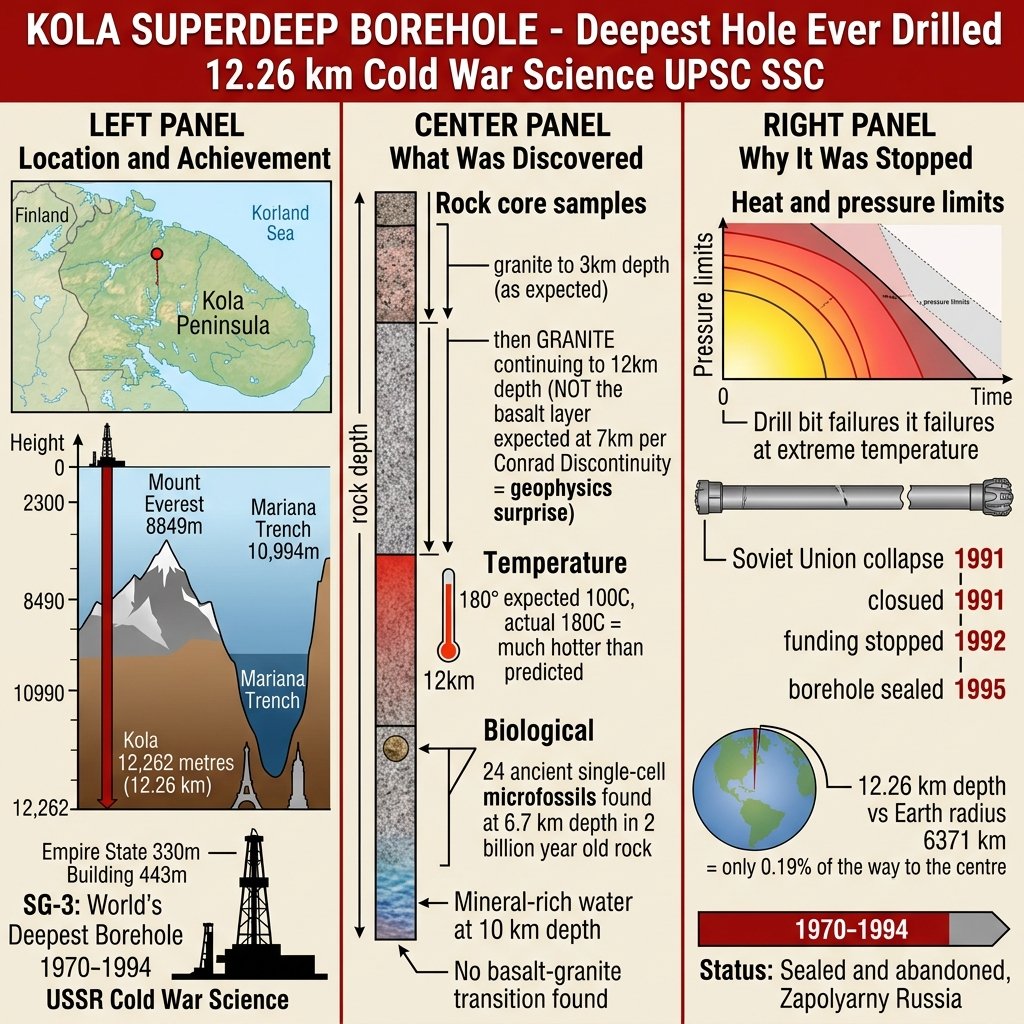
The Kola Superdeep Borehole — Key Facts
| Parameter | Data |
|---|---|
| Official designation | SG-3 (Скважина Г-3; Russian: Скважина = Borehole, Г = abbreviation for geological); also called Kola Superdeep Borehole (KSDB) |
| Location | Kola Peninsula, Murmansk Oblast, Russia; coordinates approximately 69°23’N, 30°36’E; near the town of Zapolyarny; approximately 10 km from the Norwegian border; above the Arctic Circle |
| Depth achieved | 12,262 metres (12.26 km; 40,230 feet; 7.6 miles); reached in 1989; deepest point in drilling history as of 2026 |
| Drilling period | 1970 to 1994; began May 24, 1970; deepest point reached in 1989; drilling suspended 1992 (funding collapse after Soviet Union dissolution); borehole sealed 1995; site abandoned; building demolished 2008 |
| Diameter | Started at 92 cm at surface; narrowed to 21.5 cm at its deepest point (the borehole is not a straight cylinder — it widens at the top and narrows toward the bottom as successive drill casings reduce diameter) |
| Temperature at bottom | ~180°C (356°F) at 12 km depth; predicted by pre-drilling models = ~100°C; actual = nearly twice predicted; temperature gradient in Kola Peninsula crust = ~17–20°C per km (much higher than global average ~25–30°C/km at shallow depths but then rising faster with depth) |
| Rock type at bottom | Archean metamorphic rocks (approximately 2.7–2.8 billion years old); primarily gneis ses and schists; full granite all the way to bottom — no basalt encountered despite expectation of basalt below ~7 km |
| Why drilling stopped | At 180°C and extraordinary pressure, drill bits and casings failed rapidly; drilling rate had fallen to nearly zero; the rock at depth was plastic (flowing slowly under heat and pressure) rather than solid; Soviet Union collapsed 1991; Interdepartmental Scientific Council for Superdeep Drilling ceased funding 1992; technically impossible to go deeper with 1990s technology |
| Depth as fraction of Earth | 12.26 km of 6,371 km = 0.19% of distance to Earth’s centre; 12.26 km of ~35 km average crustal thickness = penetrated approximately 35% of the crustal thickness under this location; did not reach the Moho |
Other Deep Boreholes — Global Comparison
| Borehole | Country | Depth | Purpose | Note |
|---|---|---|---|---|
| Kola SG-3 | Russia (USSR) | 12,262 m (12.26 km) | Scientific; Cold War prestige; Earth crust research | Deepest borehole in the world (vertical depth) |
| Z-44 Chayvo well (Sakhalin) | Russia | 12,376 m measured depth (but ~7 km vertical) | Petroleum (Sakhalin-1, ExxonMobil/Rosneft) | Longest measured-length borehole (directional drilling); Kola still deepest vertical |
| KTB (Kontinentales Tiefbohrprogramm) | Germany | 9,101 m (9.1 km) | Scientific; Continental Scientific Drilling; crust composition research | 1987–1994; Bavaria; found unexpected hot temperatures similar to Kola; also found water at depth |
| Bertha Rogers well (Oklahoma) | USA | 9,583 m (9.58 km) | Petroleum exploration; natural gas | Deepest petroleum well in USA (1974) until surpassed; still in gas-bearing Anadarko Basin |
| IODP (International Ocean Discovery Program) boreholes | International | ~2,000–2,500 m below ocean floor | Scientific; ocean crust and mantle drilling | Deepest ocean floor drill cores; Hole 1256D (East Pacific Rise) penetrated ~1,500 m into oceanic crust reaching gabbro (lower oceanic crust) |
Cold War Context — Why the USSR Drilled So Deep
- 🛠️ Scientific Cold War rivalry: The Kola borehole was conceived in the late 1950s and early 1960s during the same period the USA was planning “Project Mohole” — a US National Science Foundation project to drill through the ocean floor (where the crust is only 5–10 km thick) to reach the mantle and sample it directly; the USSR, unable to match American oceanographic drilling technology for ocean floor operations, chose to drill deep into the continental crust instead; Project Mohole was cancelled by the US Congress in 1966 over budget concerns — the USSR’s Kola project pressed on alone
- 🛠️ Soviet scientific structure: The project was managed by the Interdepartmental Scientific Council for the Study of the Earth’s Interior (a uniquely Soviet institution with no Western equivalent); drilling was carried out by the All-Union Scientific Research Institute for the Technique of Exploration Drilling (VITР); the Kola borehole was fundamentally a scientific project, not a petroleum exploration project — its primary goals were to directly sample, measure temperature, and characterise rocks down to the deepest possible depth within the continental crust
- 🛠️ Soviet drilling innovations: To drill so deep, the Soviets developed a unique drilling technique: instead of rotating the entire drill string (all the pipe from the surface to the drill bit) as is done in conventional rotary drilling, they used a downhole turbodrill — a turbine-driven drill bit at the bottom of the borehole powered by drilling mud (fluid pumped down from the surface); only the bit rotated, not the entire column of pipe; this allowed much less mechanical stress on the drill string at extreme depths; the turbodrill technology was later adopted globally for deep drilling
The Scientific Discoveries — What the Kola Borehole Revealed
- 🔬 No basalt layer found — Conrad Discontinuity revised: Before the Kola borehole, the standard model of continental crust held that there was a compositional boundary at approximately 7 km depth between granite-type upper crust (SIAL, rich in Silicon and Aluminium) and basalt-type lower crust (SIMA, rich in Silicon and Magnesium); this boundary, detected by a P-wave velocity change, was identified as the Conrad Discontinuity (identified by V. Conrad in 1925); it was assumed to represent a literal compositional change from granite to basalt; the Kola borehole penetrated well past the equivalent depth for the Conrad Discontinuity in the Kola Peninsula (approximately 3–4 km) and found nothing but granite all the way to 12.26 km; the Conrad Discontinuity apparently does not represent a compositional boundary from granite to basalt everywhere — in the ancient Archean crust of the Kola Peninsula, it reflects a metamorphic facies change within granite-type rocks (a change in rock structure due to increasing temperature and pressure) rather than a compositional granite-to-basalt transition; this fundamentally revised geologists’ interpretation of the Conrad Discontinuity from universal to context-dependent
- 🔬 Temperatures far higher than predicted: Pre-drilling thermal models of the Kola Peninsula predicted temperatures would reach approximately 100°C at 12 km depth. The actual measured temperature at 12,262 m was approximately 180°C — nearly twice the prediction. This had enormous implications: the geothermal gradient in the deep crust is steeper than models assumed; the zone where rocks remain solid (rather than becoming plastic and flowing) extends to shallower depths than expected in some regions; the heat flow from deep in the crust is higher than surface measurements suggested; the Kola results contributed to revised global geothermal models of crustal heat production
- 🔬 Liquid water at 10 km depth: At approximately 10 km depth, the drilling team found mineral-rich water — hydrogen and oxygen squeezed out of rocks by the enormous pressure — flowing through fractures in the metamorphic rock. This was completely unexpected: at these depths and temperatures, no free water was predicted to exist; the prevailing model assumed all pore spaces and fractures would be crushed closed by the enormous lithostatic pressure at 10 km. The water found at Kola was not meteoric (rainwater that had percolated down) — isotopic analysis showed it was primordial water that had been trapped in the rock for billions of years and was being released by the dehydration of water-bearing minerals (hydrous minerals like amphiboles and micas) under the heat and pressure of depth
- 🔬 Ancient microfossils at 6.7 km depth: At approximately 6,700 metres depth, in rocks dated at approximately 2 billion years old, geologists found 24 species of ancient microfossils — single-celled organisms preserved despite the extreme conditions; their carbon-based shells (made of organic carbon proteins rather than calcium carbonate) were remarkably intact; finding fossils this deep (and this old) in ancient crystalline rock was completely unexpected and changed understanding of how far into the deep Earth life’s record extends
- 🔬 Rocks fractured and porous at depth: The deep rocks (below ~9 km) were more fractured (broken along fault planes and joints) and porous than expected; pre-drilling models predicted that the lithostatic pressure at these depths would crush all pores and fractures closed; instead, the rocks showed open fracture networks — partly explaining the existence of the deep water found flowing through them
- 🔬 Hydrogen gas seeps: Notable quantities of hydrogen gas were encountered at various depths throughout the borehole — the drilling mud returning to the surface contained measurable hydrogen; this was not expected and contributed to understanding of deep crustal geochemistry and abiogenic gas generation (the possibility that some natural gas originates from deep inorganic chemical reactions rather than solely from biological decay of organic matter)
Why the Kola Borehole Could Not Go Deeper
- 🔥 Temperature and rock plasticity: The fundamental limit on all deep drilling is temperature. At 180°C and the pressures at 12 km depth (approximately 30,000–40,000 atmospheres), the Archean metamorphic rocks of the Kola crust were behaving plastically — like very stiff putty rather than rigid brittle rock; as the drill bit cut through rock, the walls of the borehole slowly flowed inward, narrowing and eventually collapsing the hole; drill casings were squeezed and deformed; extracting broken drill equipment from plastic flowing rock at 12 km became an unsolvable engineering problem in the early 1990s
- 🔥 Drill bit failures: At 180°C, standard drill bits (made of tungsten carbide) wore out extremely rapidly; lubricants (drilling mud) lose their effectiveness at high temperatures; the thermal expansion of metal components caused mechanical failures; bit runs (the distance drilled per bit before replacement) decreased from kilometres at shallow depths to just metres at maximum depth; changing a drill bit required withdrawing 12 km of drill string from the borehole — a process taking 24+ hours — and then re-running it
- 🔥 Economic and political collapse: By 1989 when the deepest point was reached, drilling had slowed dramatically due to the above technical problems. The Soviet Union was in the early stages of economic collapse. A fire in 1992 destroyed some surface equipment. The Interdepartmental Scientific Council’s funding was discontinued as part of post-Soviet budget restructuring. The borehole was officially sealed in 1995. The research facility was progressively abandoned; the main building was demolished in 2008, leaving only the wellhead cap visible at the site today
- 🔥 The fundamental depth limit of drilling technology: Current drilling technology — even the most advanced systems used in 2026 in petroleum exploration — cannot reliably operate at temperatures above approximately 300°C or pressures above approximately 300 MPa (3,000 atmospheres). The Kola borehole was already near these limits at 12 km in the Kola Peninsula’s particular thermal regime. In hotter geothermal environments (e.g., below Iceland or Hawaii), these temperature limits would be reached at much shallower depths (perhaps 5–8 km). New materials science research (ultra-high-temperature drill bits, thermally-stable ceramics, high-temperature electronics) may eventually extend drilling depth capabilities, but penetrating even to the Moho (35 km on continents) appears decades away from technological feasibility
⭐ Important for Exams — Quick Revision
- 🔑 Kola Superdeep Borehole (SG-3): World’s deepest borehole; 12,262 m (12.26 km); Kola Peninsula, Russia; drilled 1970–1994 by Soviet Union
- 🔑 Depth comparison: 12.26 km vs Earth radius 6,371 km = only 0.19% of the way to Earth’s centre; deeper than Mariana Trench (10,994 m) but still only in upper crust
- 🔑 Drilling period: Began May 24, 1970; deepest point reached 1989; drilling suspended 1992 (Soviet collapse funding cut); borehole sealed 1995; site demolished 2008
- 🔑 Temperature surprise: Expected ~100°C at 12 km; actual = ~180°C; nearly TWICE predicted; rock was plastic (flowing), not solid; fundamental technical limit
- 🔑 No basalt layer found: Conrad Discontinuity at ~7 km was expected to be a granite-to-basalt compositional change; Kola found ONLY GRANITE all the way to 12.26 km; Conrad Discontinuity is a metamorphic facies change in ancient Archean crust, NOT a compositional granite-to-basalt boundary
- 🔑 Liquid water at 10 km: Primordial water squeezed from rocks by pressure; hydrogen + oxygen from dehydrating hydrous minerals (amphiboles, micas); completely unexpected; showed deep crustal fractures remain open despite pressure
- 🔑 Ancient microfossils: 24 species of single-celled organisms at 6.7 km depth in 2-billion-year-old Archean rock; carbon-based shells intact; oldest fossils found in deep crystalline rock
- 🔑 Hydrogen gas: Found at multiple depths; contributed to understanding of abiogenic gas generation (natural gas from deep inorganic reactions, not only biological decay)
- 🔑 Conrad Discontinuity revision: The Kola discovery showed the Conrad Discontinuity does not universally represent a granite-to-basalt transition; in old Archean cratons it represents a metamorphic facies change; Conrad Discontinuity is absent in oceanic crust and some younger continental regions
- 🔑 Soviet drilling innovation: Turbodrill system = downhole turbine powered by drilling mud; only the bit rotates (not the whole drill string); reduced mechanical stress; later adopted globally
- 🔑 Z-44 Chayvo (Russia, 12,376 m): Longest measured-length borehole (directional/slant drilling for Sakhalin-1 petroleum); Kola SG-3 remains deepest VERTICAL borehole
- 🔑 KTB borehole (Germany, 9,101 m): German continental scientific drilling (1987–1994); Bavaria; also found unexpectedly high temperatures and water at depth; confirmed Kola findings
- 🔑 Project Mohole (USA): 1960s US project to drill through thin ocean crust (5–10 km) to reach the mantle; cancelled by US Congress 1966 over budget; prompted Soviet Kola project as continental alternative
- 🔑 Current drilling limits: Maximum reliable temperature ~300°C; maximum pressure ~300 MPa; reaching the continental Moho (35 km) = not feasible with current technology
- 🔑 IODP ocean drilling: International Ocean Discovery Program; drilled ~2,000–2,500 m below ocean floor; Hole 1256D reached gabbro (lower oceanic crust) = closest approach to oceanic Moho
Frequently Asked Questions (FAQs)
1. What did the Kola borehole discover — and why were the findings so surprising to geologists?
The Kola Superdeep Borehole was one of the most productive scientific experiments of the 20th century — not because it confirmed what geologists expected, but because virtually every major finding contradicted prevailing models of Earth’s continental crust. Each surprise forced a fundamental reassessment of how we interpret geophysical data and what we can infer about Earth’s interior from measurements taken at the surface. Discovery 1 — No basalt below 7 km (Conrad Discontinuity is not what we thought): The most significant geological surprise at Kola was the complete absence of basalt at depth. Pre-drilling models based on seismic refraction data predicted that at approximately 7 km depth in the Kola Peninsula, the P-wave velocity would jump from the typical granite velocity (~6.0–6.5 km/s) to the typical basalt velocity (~6.8–7.0 km/s) — a seismic boundary known as the Conrad Discontinuity since V. Conrad identified it in 1925. This jump was universally interpreted as a compositional change from silicon-aluminium-rich granite-type upper crust to silicon-magnesium-rich basalt-type lower crust. Every continental crust model in the 1960s assumed the lower crust was basaltic. The Kola borehole found no such transition. Drilling through the depth where the Conrad Discontinuity should have appeared, the coretakers found the same Archean gneiss and granite continuing uninterrupted to the maximum depth of 12.26 km. The P-wave velocity increase that seismologists detected at this depth was real — but it was caused by a change in the metamorphic grade (mineral stability and crystal structure within the same rock types changing under increasing temperature and pressure) rather than a change from granite to basalt. The implication was profound: the Conrad Discontinuity does not universally represent a compositional boundary. In old, cold, stable Archean cratons (like the Kola Peninsula, the Canadian Shield, the Dharwar Craton of India), the velocity jump represents a metamorphic facies change — rocks of the same bulk composition reorganising their mineral assemblage as pressure and temperature increase with depth. In younger, hotter crustal regions, the Conrad Discontinuity may indeed reflect a compositional change, but this is not universal. This finding forced geologists to reinterpret seismic velocity models of continental crust globally: what velocity changes imply must be cross-calibrated with borehole data; seismic velocity alone cannot definitively determine rock composition. Discovery 2 — Temperature was nearly twice predicted at 12 km: The Kola geothermal models were built from two sources: laboratory measurements of thermal conductivity in rock samples (how well they conduct heat), and surface heat flow measurements (how much heat escapes from the ground per unit area). These data were combined to extrapolate temperature with depth. The models predicted approximately 100°C at 12 km depth. The actual temperature measured was ~180°C — 80°C higher than prediction. This discrepancy arose because the rocks at depth had much higher concentrations of radioactive elements (uranium, thorium, potassium) than surface samples suggested — elements that generate heat within the rock as they decay. The deep Archean rocks of the Kola Peninsula appear to be richer in heat-generating radioactive elements than laboratory samples predicted, contributing an additional ~7–10°C/km of heat production-driven temperature increase beyond what the surface heat flow measurements implied. The practical consequence: the zone of plasticity (where rock stops being brittle and starts flowing) was reached at shallower depth than expected. At ~180°C and ~360 MPa, the metamorphic rocks began behaving like extremely viscous plastic material, causing the borehole walls to flow inward and making further drilling progressively impossible. Discovery 3 — Liquid water at 10 km depth: The discovery of saline, mineral-rich water flowing through fractures at approximately 10 km depth was perhaps the most counterintuitive finding of the entire project. Standard models of the deep crust held that all pore spaces and fracture systems would be closed by the lithostatic pressure at these depths (>3 × 10⁸ Pa). There should be no room for fluids. Yet the Kola drilling mud returned to the surface carrying unmistakable evidence of free water from fractures at 10 km. Isotopic analysis (measuring the ratio of deuterium to hydrogen and oxygen-18 to oxygen-16) showed this water was not modern meteoric water that had percolated down from the surface — its isotopic composition was distinctly different from surface rainwater. Instead, it appeared to be “juvenile” or “primary” water — water that had been chemically combined within hydrous minerals (amphiboles like hornblende, micas like biotite, and chlorite) for billions of years and was now being expelled as the minerals broke down under the heat and pressure of depth. This dehydration water, expelled from hydrous minerals as they transformed into anhydrous minerals (the process called “devolatilisation”), collected in open fractures. The fractures themselves were open because: (a) the rocks had high intrinsic strength despite high pressure; and (b) the fluid pressure within the fractures partially counteracted the lithostatic pressure, preventing complete compaction. This finding showed that deep crustal fluids — chemically reactive, mineral-laden water — exist at depths previously considered completely dry, potentially playing important roles in deep crustal geochemistry and mineral deposit formation.
2. Why can’t we just drill deeper — what are the fundamental limits of deep drilling?
The question “why can’t we just drill deeper into Earth?” is one of the most common responses to learning about the Kola borehole. After all, if we can send spacecraft to Pluto and sequence the human genome, why can’t we drill 20, 50, or 100 km into our own planet? The answer reveals several fascinating intersections of physics, materials science, engineering, and economics — and teaches an important lesson about why Earth science must rely primarily on indirect methods (seismology, gravity, geomagnetism) rather than direct sampling to understand deep Earth structure. The temperature problem — everything melts or softens: Temperature is the dominant fundamental limit on deep drilling. The geothermal gradient — the rate at which temperature increases with depth — varies across Earth between roughly 10°C/km (in old, cold, stable cratons like the Dharwar Craton of India’s Deccan Plateau) and 100+°C/km (in volcanic regions like Iceland’s mid-ocean ridge). The global average is approximately 25–30°C/km in the upper crust. At some depth, temperature in any location reaches the temperature limits of drilling equipment. Standard drill bits (tungsten carbide composite) begin failing reliably at approximately 200–250°C. Electronics in measurement-while-drilling (MWD) tools — the sensors that measure rock properties, navigate the borehole direction, and detect petroleum signatures — fail at approximately 175°C in standard form (high-temperature electronics extend this to ~250°C at great additional cost). Drill pipe steel undergoes accelerated corrosion and fatigue at high temperature. Drilling mud (the fluid pumped down to lubricate the bit, carry rock cuttings to the surface, and maintain borehole pressure) loses its rheological properties (viscosity and gel strength) at high temperatures and must be reformulated for each temperature range. The Kola borehole’s 180°C at 12 km was near the technical limits of 1980s technology. In cooler geological settings (thick Archean cratons with low geothermal gradients), deeper drilling might be thermally feasible — but in the more geologically interesting environments (subduction zones, volcanic rifts, mid-ocean ridges), temperature limits are reached much sooner. The pressure problem — rocks flow and boreholes collapse: At 12 km depth and lithostatic pressure of approximately 360 MPa (3,600 atmospheres), even granitic rock was behaving plastically at the Kola temperatures. Plastic rock flows slowly under differential stress — meaning the walls of the borehole gradually squeezed inward over timescales of days to weeks. If drilling stopped for any time (to change a drill bit, fix mechanical problems, or conduct measurements), the open borehole would begin to close. The rock was not fracturing (brittle failure) but flowing (ductile creep). Drill pipe stuck in closing boreholes is an irreversible catastrophe — 12 km of drill pipe lost in a closing rock formation cannot be recovered. This happened repeatedly at Kola and was a significant factor in drilling termination. Preventing ductile closure requires either maintaining drilling continuously (impossible with the bit failures at 12 km) or cementing casing into the borehole walls — but casing and cement also have temperature and pressure limits. The mechanical problem — rotating 12 km of pipe: In conventional rotary drilling, the entire drill string (all the pipe from the surface to the bit) is rotated from the surface. At 12 km, the drill string weighs approximately 200,000 kgs and is subject to enormous torsional (twisting), tensile (stretching), and compressional forces along its entire length. The string can develop resonant vibrations (harmonics) that cause catastrophic fatigue failures. Differential thermal expansion along the 12 km string length causes additional mechanical stress. The Soviet turbodrill innovation (rotating only the downhole drill bit, not the whole string) largely solved this — but turbodrill bits still fail rapidly at high temperature. The economic problem — cost per metre increases exponentially with depth: Drilling cost increases roughly as an exponential function of depth. At shallow depths (0–2 km), petroleum drilling might cost $1,000–5,000 per metre. At 5 km, costs rise to $10,000–50,000/m due to the need for high-temperature equipment, larger rigs, and slower drilling rates. At 10+ km scientific drilling, costs approach $100,000–$500,000 per metre (very rough estimate given that scientific drilling must also conduct detailed measurements and preserve cores). The Kola project cost approximately $1 billion in Soviet resources over 24 years — a fraction of its Western equivalent cost, but still an extraordinary investment. Could future technology drill deeper: Yes — but not dramatically deeper with current engineering approaches. Research programmes investigating: ultra-high-temperature drill bits based on polycrystalline diamond and cubic boron nitride; high-temperature downhole electronics using silicon carbide semiconductors; new high-temperature polymers for drilling mud; directed energy drilling (using lasers to vaporise rock without a mechanical bit) — these may extend reliable drilling to ~300°C, potentially reaching 20–25 km in cold geological settings. Reaching the Moho (35 km) on continents, or drilling through oceanic crust (5–10 km, more thermally accessible) to sample the mantle, remains a medium-term scientific goal of the international IODP and ICDP (International Continental Scientific Drilling Program) communities.
3. What is the Conrad Discontinuity — and why did the Kola borehole change how we understand it?
The Conrad Discontinuity is a seismic boundary within the continental crust — identified as a velocity increase in P-wave data — that was once universally interpreted as the compositional boundary between granite-rich upper crust and basalt-rich lower crust. The Kola borehole’s failure to find basalt at the depth where the Conrad Discontinuity appeared destroyed this simple interpretation and led to a far more nuanced understanding of crustal structure. Historical background — how the Conrad Discontinuity was discovered: Austrian seismologist Victor Conrad (1925) analysed records from the 1923 Tauern earthquake in Austria and identified a second P-wave arrival — called Pg (from the upper crust) and a faster P* wave (also called Pb, from a faster layer below). The P* phase was interpreted as a wave travelling as a headwave along the top of a distinctly faster-velocity layer within the crust. Conrad placed this faster layer at approximately 10–20 km depth in the Eastern Alps. By the 1950s, global refraction surveys (using controlled explosions to generate seismic waves) had identified what appeared to be a comparable velocity jump at typically 15–25 km depth across many continental regions. This was named the Conrad Discontinuity. Geophysicists interpreted it as the boundary between: Upper crust = granitic composition (SIAL = Silicon + Aluminium; density ~2,700 kg/m³; P-wave velocity ~6.0–6.5 km/s) → Lower crust = basaltic composition (SIMA = Silicon + Magnesium; density ~2,900 kg/m³; P-wave velocity ~6.8–7.2 km/s). This two-layer continental crust model was incorporated into standard earth science textbooks and taught as established fact for decades. It formed the basis for the calculation of Earth’s bulk composition, models of crustal formation and differentiation, and estimates of how much granite vs basalt the continental crust contains overall. What the Kola borehole found instead: The Kola Peninsula shows a clear Conrad-Discontinuity-type velocity increase in seismic refraction data at approximately 3–4 km depth in this particular region (the Kola Peninsula’s Precambrian Shield has some of the world’s oldest, densest, coldest crust, so the Conrad Discontinuity appears relatively shallow). The pre-drilling expectation was that drilling through this depth would reveal a transition from gneiss and granite to dolerite or basalt. Instead, the rock cores brought up from progressively deeper levels showed: at 3–4 km = same Archean gneisses and grey granites but slightly more metamorphosed (higher metamorphic grade: amphibolite facies transitioning toward granulite facies); at 7–9 km = similar Archean metamorphic rocks, now in granulite facies (high pressure-temperature mineral assemblage with pyroxene, garnet, and feldspar predominating — but still bulk granitic chemistry, not basaltic); at 12 km = still metamorphic granites and gneisses in granulite facies. The velocity increase at the Conrad Discontinuity depth was caused by: a change in mineralogy within the same rock type (granite-composition gneiss gains denser, high-pressure minerals like garnet and pyroxene in the granulite facies, increasing density and hence P-wave velocity) AND closure of fractures and microcracks under pressure (at depth, small fractures in rock close under burial pressure; fractures dramatically reduce seismic velocity, so closing them increases velocity — even in the same composition rock). The revised understanding of the Conrad Discontinuity: The Kola findings confirmed what some geologists had suspected: the Conrad Discontinuity is NOT a universal compositional boundary. In different geological settings it may represent: (a) A metamorphic facies change (Kola-type Archean cratons) — same rock composition, different mineral assemblage; (b) A real compositional change from igneous granitic upper crust to mafic (basalt/gabbro-type) lower crust (in some younger Phanerozoic crust regions, especially in extensional terrains); (c) A structural boundary where deformation fabrics change (shear zones at mid-crustal levels); (d) A crack-closure depth where pores and fractures close under pressure creating an apparent velocity jump. The Conrad Discontinuity is now recognised as being geologically heterogeneous — its origin must be determined case-by-case for each geological province, and should NOT be assumed to represent a global compositional lower crust without independent evidence. This has substantially complicated estimates of the continental crust’s bulk composition, since the earlier assumption that P-wave velocities above and below the Conrad could be directly converted to granite and basalt fractions is no longer valid everywhere. India’s Dharwar Craton (southern Indian Shield), like the Kola Peninsula, is an Archean craton where the Conrad Discontinuity may similarly represent a metamorphic grade change rather than a granite-to-basalt transition — making the Kola findings directly relevant to understanding the constitution of India’s ancient Precambrian basement.
Related Geology Articles on StudyHub
- ➡️ Lehmann Discontinuity — Earth’s Internal Boundaries
- ➡️ Seismic Waves — How We Know Earth’s Structure
- ➡️ Isostasy — Crustal Structure & The Moho
- ➡️ Gravity Anomalies — Exploring Earth’s Crust
- ➡️ Metamorphic Rocks — Facies & Mineral Assemblages at Depth