Earth’s tectonic plates do not move randomly — they are driven by a combination of forces originating in the deep mantle and at plate boundaries. The dominant mechanism is mantle convection: the slow, thermally driven circulation of solid-but-ductile mantle rock over millions of years, carrying heat from Earth’s interior to the surface. Two primary forces drive the plates themselves: slab pull — the dominant force, where dense cooling oceanic crust sinks into the mantle under gravity and pulls the rest of the plate behind it — and ridge push — the gravitational sliding of plates away from elevated mid-ocean ridges. Together, these forces sustain the constant reorganisation of Earth’s surface through plate tectonics. Understanding mantle convection, plate driving forces, and global plate velocities is essential for UPSC, SSC, and competitive examinations in physical geography.
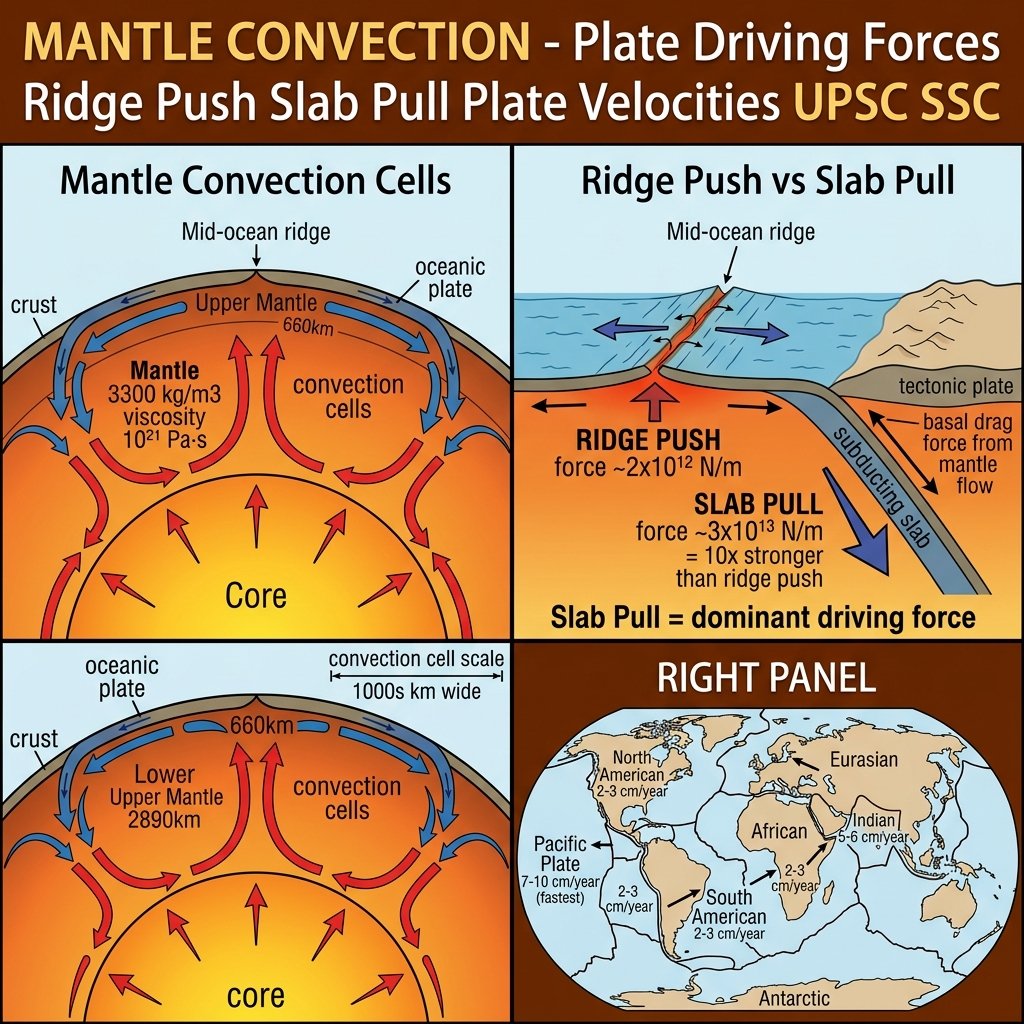
Mantle Convection — The Engine of Plate Tectonics
- 🌍 What is mantle convection: The mantle (~2,890 km thick, density ~3,300 kg/m³, viscosity ~10²¹ Pa·s) behaves as a solid over short timescales (seismic waves pass through it) but flows slowly as a viscous fluid over millions of years; hot mantle material near the core rises (lower density = buoyant), spreads laterally at the top, cools, becomes denser, and sinks — forming large convection cells that carry heat from Earth’s interior to the surface
- 🌍 Heat sources driving convection: (1) Primordial heat trapped from Earth’s accretion and core formation (~4.5 billion years ago); (2) Radioactive decay of uranium, thorium, and potassium-40 within the mantle and crust (generates ~50% of Earth’s current heat flow); combined = ~47 terawatts (TW) of total heat flow from Earth’s interior
- 🌍 Whole-mantle vs layered convection debate: Two competing models exist: Whole-mantle convection — one large convection system spanning upper + lower mantle (660 km boundary crossed freely); Layered convection — separate upper and lower mantle convection cells separated by the 660 km phase transition; current seismic tomography shows some slabs penetrating to the lower mantle = evidence for whole-mantle or at least partially-coupled convection; debate ongoing
- 🌍 Convection cell geometry: Convection cells rise at mid-ocean ridges (divergent boundaries), spread laterally as oceanic lithosphere, cool and thicken as they age, and sink at subduction zones (convergent boundaries); typical cell dimensions = hundreds to thousands of km wide; the Pacific basin contains several major convection cells; the relationship between surface plate motion and underlying convection cell motion is complex — plates and convection cells are not perfectly aligned
Ridge Push vs Slab Pull — The Two Driving Forces
| Force | Mechanism | Magnitude | Relative Importance |
|---|---|---|---|
| Ridge Push | Mid-ocean ridges sit ~2–3 km above the surrounding ocean floor because hot, buoyant newly-formed oceanic crust is thermally elevated; as the plate spreads away from the ridge, it slides down this thermal gradient under gravity; the elevated ridge exerts a gravitational “push” on the plate away from the ridge axis | ~2–3 × 10¹² N/m (per metre of ridge length) | Secondary force; accounts for roughly 5–10% of total plate driving force; all plates have ridges but ridge push alone cannot explain observed plate velocities |
| Slab Pull | As oceanic lithosphere ages and cools (moving away from the mid-ocean ridge), it contracts, becomes denser (~3,300 kg/m³ vs asthenosphere ~3,200 kg/m³), and eventually becomes negatively buoyant; at subduction zones it sinks under gravity, and the weight of the descending slab pulls the rest of the plate behind it like a chain pulling a tablecloth | ~3 × 10¹³ N/m (per metre of trench length); ~10× greater than ridge push | DOMINANT driving force; plates with long subduction zones (Pacific, Nazca, Philippine) move faster than plates without (African, Antarctic); slab pull explains why oceanic plates move faster than continental plates |
| Basal Drag | Viscous drag from the flowing mantle on the base of the lithosphere; can be either driving (if mantle flows faster than the plate = mantle drags plate forward) or resistive (if plate moves faster than mantle = mantle resists plate motion); magnitude and direction vary by region | ~10¹² N/m; comparable to ridge push | Uncertain role; some models show basal drag drives plates (mantle drags continental plates lacking subducting slabs); others show it mostly resists fast-moving plates; key area of active research |
| Trench Suction | As a slab sinks, it induces flow in the mantle wedge above the slab (the “corner flow”); this mantle flow can suck the overriding plate toward the trench — a back-arc extension force; also called “trench rollback suction” | ~10¹² N/m | Important in back-arc basin formation (Japan Sea, Mariana Trough, Aegean Sea); explains why some overriding plates are in extension (back-arc spreading) rather than compression |
| Collisional Resistance | Where continents collide (e.g., India-Eurasia), the buoyant continental crust resists subduction, creating a resistive force opposing convergence; also called “collision resistance” or “continental resistance” | ~10¹² N/m; partially offsets slab pull | Explains why Indian Plate slowed dramatically from ~20 cm/year to ~5 cm/year when it collided with Eurasia ~50 Ma; the buoyant Indian continental crust resists sinking into the mantle |
Global Plate Velocities
| Plate | Velocity (cm/yr) | Direction | Key Feature |
|---|---|---|---|
| Pacific Plate | 7–10 cm/yr | NW (toward Japan/Kamchatka) | Fastest major plate; large subducting margins (Japan, Tonga, Alaska) = strong slab pull |
| Nazca Plate | 7–8 cm/yr | E (toward South America) | Fast; entire eastern margin subducts under South America = strong slab pull; drives Andes uplift |
| Indian Plate | 5–6 cm/yr | NNE (toward Eurasia) | Currently colliding with Eurasia; was ~15–20 cm/yr before collision (fastest plate in geological record) |
| Australian Plate | 6–7 cm/yr | NNE | Merged with Indian Plate ~50 Ma; moving toward SE Asia; subducting under Indonesia |
| Arabian Plate | 2–3 cm/yr | NNE | Colliding with Eurasia; driving Zagros Mountains; Red Sea = new divergent boundary forming |
| North American Plate | 2–3 cm/yr | WSW | Subducting Juan de Fuca plate at Cascadia; Atlantic spreading at ~2.5 cm/yr; no large subducting slab = slower |
| Eurasian Plate | 2–3 cm/yr | Varies by region | Large continental plate; slow due to limited subduction; spreading in Atlantic, subducting in Mediterranean |
| African Plate | 2–3 cm/yr | NNE | Surrounded by divergent boundaries; almost no subduction = no slab pull = slow; East Africa Rift forming |
| Antarctic Plate | 1–2 cm/yr | Outward (all directions) | Slowest major plate; surrounded by divergent boundaries on all sides; no subducting slabs; no slab pull |
| South American Plate | 2–3 cm/yr | W | Passive Atlantic margin; active Pacific margin = drives Andes; moderate slab pull from Nazca subduction |
Evidence That Slab Pull Dominates
- 📊 Correlation with subduction length: A statistical analysis of all major plates shows a strong positive correlation between the length of a plate’s subducting margin (trench length) and the plate’s velocity; plates with long subduction zones (Pacific ~28,000 km of trenches = 7–10 cm/yr) move much faster than plates with no subduction (Antarctic = ~0 km of active trenches = 1–2 cm/yr)
- 📊 No correlation with ridge length: Conversely, there is NO significant correlation between the length of a plate’s spreading ridge and its velocity; the African Plate has the Mid-Atlantic Ridge and the Southwest Indian Ridge but moves very slowly (2–3 cm/yr) because it has no subducting slabs; if ridge push dominated, Africa should move fast
- 📊 Indian Plate speed change: The Indian Plate moved at ~15–20 cm/yr across the Tethys Ocean before colliding with Eurasia (most energetic plate motion ever recorded); when the buoyant Indian continental crust reached the Eurasian margin ~50 Ma and could no longer subduct, the driving slab pull component collapsed, and the plate slowed to ~5 cm/yr; this dramatic deceleration recorded in palaeomagnetic data is the clearest evidence that slab pull (not ridge push or mantle drag) was driving Indian Plate’s fast motion
⭐ Important for Exams — Quick Revision
- 🔑 Mantle convection: Thermally driven slow flow of mantle rock (viscosity ~10²¹ Pa·s); hot material rises at ridges, spreads, cools, sinks at subduction zones; drives ~47 TW total heat flow from Earth
- 🔑 Heat sources: (1) Primordial accretionary heat; (2) Radioactive decay of U, Th, K-40 (~50% of current heat flow)
- 🔑 Ridge push: Plates slide down the thermal gradient away from elevated ridges; ~2–3 × 10¹² N/m; SECONDARY force (~5–10% of driving)
- 🔑 Slab pull: Dense cooling oceanic slab sinks, pulls plate behind it; ~3 × 10¹³ N/m; DOMINANT force (~90% of driving); 10× greater than ridge push
- 🔑 Slab pull evidence: Plates with long subduction zones move fastest (Pacific 7–10 cm/yr); African Plate has ridges but no slabs = moves slowly (2–3 cm/yr); Indian Plate decelerated 15–20 cm/yr → 5 cm/yr when continental crust stopped subducting
- 🔑 Fastest plates: Pacific (7–10 cm/yr), Nazca (7–8 cm/yr), Australian (6–7 cm/yr) — all have long subducting margins
- 🔑 Slowest plates: Antarctic (1–2 cm/yr) — surrounded entirely by spreading ridges, no active subduction zones, no slab pull
- 🔑 Indian Plate velocity history: ~15–20 cm/yr during Tethys ocean crossing (fastest ever recorded); slowed to ~5 cm/yr at India-Eurasia collision ~50 Ma; currently ~5–6 cm/yr NNE
- 🔑 Basal drag: Mantle viscous drag on plate base; can drive (mantle faster than plate) or resist (plate faster than mantle); important for slow-moving continental plates lacking slab pull
- 🔑 Trench suction: Sinking slab creates corner flow in mantle wedge, pulling overriding plate toward trench; drives back-arc basin extension (Japan Sea, Mariana Trough)
- 🔑 Collisional resistance: Buoyant continental crust resists subduction; resists slab pull; caused India-Eurasia collision slowdown
- 🔑 Whole vs layered convection: Whole-mantle = upper + lower convection coupled (seismic evidence of slabs penetrating 660 km); Layered = separate cells; debate ongoing
- 🔑 African Plate: Surrounded by spreading ridges; almost no subduction = no slab pull = slow (~2–3 cm/yr); East African Rift = new spreading beginning; future ocean forming in Afar
- 🔑 Back-arc basins: Japan Sea, Mariana Trough, Aegean Sea; form when trench suction pulls overriding plate toward trench faster than convergence rate; crust stretches and new oceanic crust forms
- 🔑 GPS plate velocity measurement: Modern plate velocities measured precisely by GPS; ITRF (International Terrestrial Reference Frame) defines global velocity field; velocities confirmed to mm/year precision
Frequently Asked Questions (FAQs)
1. How does mantle convection work — and what drives it?
The Basic Mechanism
Mantle convection is the thermally-driven circulation of Earth’s solid-but-ductile mantle rock over geological timescales. Despite being solid (seismic S-waves pass through it), the mantle behaves as an extremely viscous fluid (~10²¹ Pa·s) over millions of years, flowing at rates of centimetres per year.
Hot mantle rock near the core-mantle boundary is less dense (thermally expanded) and rises buoyantly. As it rises and reaches shallower, lower-pressure depths, it partially melts (decompression melting), erupting at mid-ocean ridges. The remaining solid material spreads laterally beneath the plates, cools, contracts, becomes denser, and eventually sinks back into the mantle at subduction zones — completing the convection circuit.
Heat Sources
- Primordial heat: Residual heat from Earth’s accretion (gravitational energy converted to heat) and core formation ~4.5 billion years ago; estimated ~50% of current heat flow
- Radioactive decay: Decay of long-lived isotopes ²³⁸U, ²³⁵U, ²³²Th, ⁴⁰K in the mantle and crust; generates ~50% of Earth’s current heat; these isotopes have half-lives of billions of years so will continue for billions of years more
- Total heat flow: Earth loses ~47 terawatts (TW) of heat from its interior to the surface; ~70% through oceanic crust (thin, young, high heat flow at ridges); ~30% through continental crust
Viscosity and Timescales
The mantle’s viscosity (~10²¹ Pa·s) is about 10²⁴ times more viscous than water. A typical mantle convection circuit (rising at a ridge, spreading, cooling, sinking at a trench) takes approximately 100–300 million years to complete. Despite this extreme slowness, convection is the dominant mechanism transferring heat from Earth’s deep interior to its surface.
Whole-Mantle vs Layered Convection
Whether mantle convection operates as a single whole-mantle system or as two separate layered systems (upper mantle 0–660 km + lower mantle 660–2890 km) is one of Earth science’s most debated questions. The 660 km seismic discontinuity (caused by a phase transition from spinel to perovskite structure in olivine) was thought to block material exchange. However, seismic tomography images show cold dense slabs penetrating through 660 km into the lower mantle in several locations (e.g., the Farallon slab under North America; the Tethys slab under Eurasia) — suggesting at least partial whole-mantle convection coupling.
2. What is the difference between ridge push and slab pull — which dominates and why?
Ridge Push — The Gravitational Slide
Mid-ocean ridges stand 2–3 km higher than the surrounding ocean floor because newly-formed oceanic crust is hot, thermally expanded, and therefore less dense and more buoyant. As the plate moves away from the ridge, the rock cools, contracts, and the seafloor subsides — creating a broad thermal slope. Gravity drives the plate away from the ridge down this slope, like water running off a roof. This is ridge push.
Ridge push force magnitude is approximately 2–3 × 10¹² N per metre of ridge length. It is a real force, but it is limited because its maximum effect is constrained by the ridge height and the plate’s thickness — both relatively small numbers compared to slab pull.
Slab Pull — The Dominant Engine
As oceanic lithosphere ages after formation at the ridge, it cools, thickens, and becomes progressively denser through thermal contraction. By the time oceanic crust is 80–100 million years old, it is denser than the underlying asthenosphere (~3,300 vs ~3,200 kg/m³) and becomes gravitationally unstable — it wants to sink. At subduction zones, this dense slab does sink, and the weight of the subducting slab acts as a powerful gravitational anchor that pulls the rest of the plate toward the trench.
Slab pull force magnitude is approximately 3 × 10¹³ N/m — roughly 10 times greater than ridge push. This dominance is directly demonstrated by the observation that plate velocity correlates strongly with subduction trench length but not with ridge length.
The Clearest Evidence: African vs Pacific Plates
- African Plate: Bounded almost entirely by spreading ridges (Mid-Atlantic Ridge, Southwest Indian Ridge, Southeast Indian Ridge); almost no active subduction zones; despite being surrounded by ridge push sources, it moves at only 2–3 cm/yr = ridge push alone cannot drive plates fast
- Pacific Plate: Surrounded by subduction zones on three sides (Japan Trench, Mariana Trench, Tonga-Kermadec Trench, Peru-Chile Trench); moves at 7–10 cm/yr = slab pull from multiple subducting margins drives rapid motion
- Indian Plate deceleration: Moved at 15–20 cm/yr while oceanic Tethys crust was subducting; slowed to 5 cm/yr when buoyant Indian continental crust arrived at the subduction zone and could no longer sink = slab pull collapsed = plate decelerated dramatically
The Role of Basal Drag
A third force — basal drag — arises from the viscous coupling between the base of the lithosphere and the flowing mantle beneath. If the mantle moves faster than the plate, it drags the plate forward (driving force). If the plate moves faster than the mantle (as fast Pacific-type plates may do), basal drag resists plate motion. For slow-moving continental plates lacking slab pull (e.g., the African Plate), basal drag from large mantle convection cells may be the primary driving mechanism.
3. Why do different plates move at such different speeds — what controls plate velocity?
The Fundamental Control: Subduction Margin Length
The single most important factor controlling a plate’s velocity is the total length of its active subduction margins — the total length of trenches where it or another plate is subducting. This reflects the dominance of slab pull as the driving force. More subduction trench length = more slab weight pulling the plate = faster plate motion.
The Pacific Plate, with ~28,000 km of active subduction margins around three-quarters of its perimeter, moves at 7–10 cm/yr. The Antarctic Plate, with essentially zero active subduction (it is surrounded by spreading ridges on all sides), moves at only 1–2 cm/yr despite having the world’s longest spreading ridges contributing ridge push.
Age and Density of Oceanic Crust
Older oceanic crust is denser and sinks faster. Plates carrying old, cold, dense oceanic crust (like the Pacific Plate, which has crust up to 180 Ma old near the western Pacific) have stronger slab pull forces than plates with younger oceanic crust. This is why the oldest oceanic plates (with the densest, most gravitationally unstable slabs) tend to be the fastest-moving.
Plate Size and Geometry
- Large oceanic plates: Generally fast because large ocean floor area means old, dense crust available for subduction
- Continental plates: Generally slow because continental crust is too buoyant to subduct; once a plate’s leading edge becomes continental, slab pull weakens
- Mixed plates (continental + oceanic): Intermediate speeds; oceanic portion provides slab pull, continental portion provides collisional resistance; Indian Plate is a classic example
GPS Measurement and Real-Time Monitoring
Modern plate velocities are measured with extraordinary precision using the Global Positioning System (GPS) and Very Long Baseline Interferometry (VLBI) networks. The International Terrestrial Reference Frame (ITRF) defines a global coordinate system relative to which plate velocities are measured to millimetre-per-year accuracy. GPS stations on different continents drift apart at measurable rates that exactly match geological estimates of plate motion from seafloor magnetic anomaly stripes. This real-time confirmation of plate tectonics is one of geodesy’s greatest achievements.
Related Geology Articles on StudyHub
- ➡️ Mantle Plumes & Hotspots — Deep Earth Heat Sources
- ➡️ Plate Boundaries — Divergent, Convergent & Transform
- ➡️ Isostasy — Mantle Rheology & Viscosity
- ➡️ Seismic Waves — Tomography of Mantle Convection