Madhya Pradesh is home to one of India’s largest Scheduled Tribe populations, with communities whose histories, languages, livelihoods and cultural traditions are closely connected to the state’s diverse landscapes. The tribes in Madhya Pradesh include the Gond, Bhil, Bhilala, Korku, Baiga, Kol and Sahariya, among others. According to the 2011 Census, Scheduled Tribes accounted for approximately 21.09% of the state’s population and represented about 14.7% of India’s total Scheduled Tribe population. This guide explains the official classification, population statistics, major tribal communities, regional distribution, Particularly Vulnerable Tribal Groups and defining features of tribal societies.
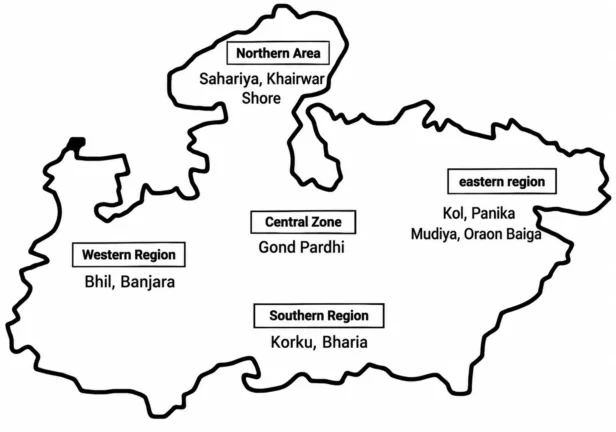
Tribes in Madhya Pradesh:
The term tribe is commonly used to describe a community connected through shared histories, cultural practices, kinship, language or other social relationships. However, tribal communities are diverse, and no single set of characteristics describes every community equally well.
In India, Scheduled Tribe (ST) is a constitutional classification. Article 342 of the Constitution establishes the process for specifying the tribes and tribal communities recognised as Scheduled Tribes in relation to particular states or Union territories. Parliament can subsequently amend the relevant lists by law.
This distinction matters because cultural identity and legal recognition are not interchangeable. A community’s recognition as a Scheduled Tribe depends on the applicable official list and any conditions attached to its entry.
The Ministry of Tribal Affairs publishes the state-wise list of Scheduled Tribes. Madhya Pradesh is commonly listed as having 43 main Scheduled Tribe entries, some of which include related names or subgroups. Certain entries also specify geographical conditions, so the official list should be consulted when determining eligibility for administrative purposes.
Official reference: https://tribal.nic.in/downloads/statistics/LatestListofScheduledtribes.pdf
Scheduled Tribe Population in Madhya Pradesh: Census 2011 Figures
The 2011 Census provides the principal published baseline for comparing the Scheduled Tribe population of Madhya Pradesh with the national population. The figures demonstrate the size of the state’s tribal population and its importance in India’s overall Scheduled Tribe demographic profile.
| Indicator | India | Madhya Pradesh |
|---|---|---|
| Total Scheduled Tribe population | 10,42,81,034 | 1,53,16,784 |
| Share of total population | 8.6% | 21.09% |
| Share of India’s Scheduled Tribe population | Not applicable | Approximately 14.70% |
| Rural Scheduled Tribe population | 9,38,19,162 | 1,42,76,874 |
| Urban Scheduled Tribe population | 1,04,61,872 | 10,39,910 |
| Decadal population growth | 23.66% | 25.20% |
| Sex ratio, females per 1,000 males | Approximately 990 | 984 |
| Overall literacy rate | 59.00% | 50.55% |
| Male literacy rate | 68.50% | 59.55% |
| Female literacy rate | 49.40% | 41.47% |
Source: Census of India 2011 Scheduled Tribe tables. Rural and urban percentages can be calculated from the population counts.
Reference: https://censusindia.gov.in/nada/index.php/catalog/12526
What the Census Figures Tell Us
Madhya Pradesh has India’s largest Scheduled Tribe population by absolute numbers, based on the 2011 Census. Its Scheduled Tribe population of approximately 1.53 crore represented about 14.7% of the national total.
Tribal communities are predominantly rural in the state. About 93.2% of the Scheduled Tribe population lived in rural areas, while approximately 6.8% lived in urban areas in 2011.
The literacy figures also highlight an educational gap. Scheduled Tribe literacy in Madhya Pradesh stood at 50.55%, compared with 59% nationally. Within the state’s Scheduled Tribe population, female literacy was 41.47%, below the male literacy rate of 59.55%.
These historical figures are useful for understanding demographic patterns, but they should not be presented as current population estimates. Census 2027 preparations are underway, and the 2011 figures should be replaced only when relevant official results become available.
Major Tribes in Madhya Pradesh
Tribal communities live across western, central, southern and eastern parts of Madhya Pradesh. Their geographical concentrations vary, and many communities extend across district and state boundaries.
Gond
The Gond are one of the most prominent tribal communities in Madhya Pradesh. They are associated with several districts in the state’s central, eastern and southern regions, including Mandla, Dindori, Balaghat, Seoni and Chhindwara.
Gond communities have diverse local traditions, social histories and cultural practices. Gondi is an important language associated with the community, although language use and identity vary across locations.
Bhil and Bhilala
The Bhil and Bhilala communities have significant concentrations in western Madhya Pradesh, particularly around Jhabua, Alirajpur, Dhar, Barwani and parts of the Nimar region.
Their regional heritage includes distinctive forms of art, music, dance and community celebrations. Bhil and Bhilala appear in the official Scheduled Tribe list alongside other recognised communities and groups.
Korku
The Korku community is associated with the Satpura region, including parts of Betul, Khandwa, Burhanpur and the wider southern-central belt.
Agriculture, forest-related livelihoods and wage labour are among the activities found in Korku areas. Livelihoods differ between households and locations, depending on access to land, markets, education and employment.
Baiga
Baiga communities are found in parts of Madhya Pradesh, especially in the eastern and central tribal belt. Their traditional knowledge, cultural practices and relationships with the natural environment form an important part of their heritage.
Baiga is also one of the three Particularly Vulnerable Tribal Groups recognised in Madhya Pradesh. This classification is relevant to the design of targeted development programmes.
Kol and Panika
Kol communities are associated with eastern and northeastern parts of Madhya Pradesh, including areas around Rewa, Satna and neighbouring districts. Panika communities are also associated with parts of the eastern region.
The official classification of Panika includes geographical conditions. This illustrates why general descriptions of regional distribution should not replace the government notification when legal status needs to be established.
Bharia and Sahariya
Bharia communities are particularly associated with the Patalkot area of Chhindwara district. Sahariya communities are concentrated in parts of northwestern Madhya Pradesh, including the wider Sheopur, Shivpuri and Guna region.
Both communities are recognised as Particularly Vulnerable Tribal Groups in the state. Their locations, histories and development needs differ, so they should be understood as distinct communities rather than treated as a single group.
Regional Distribution of Tribes in Madhya Pradesh
For study purposes, the tribal distribution of Madhya Pradesh can be grouped into three broad geographical zones. These are useful reference areas, not fixed boundaries. Individual communities may live in several districts, and administrative boundaries change over time.
| Region | Major communities associated with the region | Important areas |
|---|---|---|
| Western Madhya Pradesh | Bhil, Bhilala and related communities | Jhabua, Alirajpur, Dhar, Barwani and parts of the Nimar region |
| Southern and central tribal belt | Gond, Korku, Baiga and Bharia | Mandla, Dindori, Balaghat, Seoni, Chhindwara and Betul |
| Eastern and northeastern Madhya Pradesh | Kol, Panika, Agaria and Kherwar, among others | Rewa, Satna, Sidhi, Shahdol and surrounding districts |
These broad patterns are helpful for examinations and introductory study, but the distribution of a particular community should be checked against Census tables or official tribal lists when precise district-level information is required.
The legal classification may be more specific than the geographical description. For example, the official list identifies particular locations for certain community entries. A community name alone is therefore not sufficient to determine Scheduled Tribe recognition in every location.
Particularly Vulnerable Tribal Groups in Madhya Pradesh
Particularly Vulnerable Tribal Groups (PVTGs) are a category of Scheduled Tribes identified for focused support because of specific vulnerabilities and development challenges.
Three PVTGs are recognised in Madhya Pradesh:
- Baiga
- Bharia
- Sahariya
These communities have distinct settlement patterns, cultural histories and socioeconomic circumstances. Their inclusion in the PVTG category supports targeted interventions, including measures relating to livelihoods, education, healthcare, housing and access to essential services.
The needs and priorities of each community should be assessed separately rather than assuming that one programme will suit all three.
The term PVTG is the appropriate category to use in place of older labels such as “Primitive Tribal Group” or broad descriptions such as “special backward tribes.” It identifies an official classification rather than suggesting that a community’s culture or way of life is inherently inferior.
Reference: https://ncst.nic.in/
Salient Features of Tribal Societies
Tribal societies in Madhya Pradesh are varied, but several social and cultural themes help explain their historical organisation. These features are best understood as broad patterns, not universal rules that apply to every community or household.
1. Family and Kinship Networks
Family relationships often play an important role in social organisation. Kinship, lineage, marriage customs and shared responsibilities can shape community relationships and the transmission of traditions between generations.
Family structures differ across communities and continue to change with education, migration, employment and wider social developments.
2. Association with a Geographical Area
Many communities have longstanding connections with particular landscapes, villages or regions. Access to land, forests, water and other local resources may be closely related to their history and livelihoods.
However, a community does not necessarily live in only one area. Migration and settlement across district and state boundaries mean that geographical association should not be treated as an absolute defining condition.
3. Community Names and Identities
Community names carry historical and cultural significance. Some official entries incorporate alternative names, local designations or subgroups, which can make classification more complex than a simple list of distinct names suggests.
Understanding these naming conventions is especially useful when comparing cultural descriptions with the legally notified Scheduled Tribe list.
4. Languages and Dialects
Language contributes to cultural identity and the preservation of oral traditions. Gondi is associated with Gond communities, while Bhili is associated with Bhil communities.
Not everyone in a community necessarily speaks the same language or dialect. Multilingualism, regional influence and language change are part of contemporary life, so language should be considered alongside other aspects of identity.
5. Shared Cultural Traditions
Community traditions can include forms of music, dance, visual art, storytelling, clothing, marriage practices, festivals and other social customs.
These practices help sustain cultural knowledge, but they are not identical throughout a large community. Local variations, individual preferences and changing circumstances are all part of tribal cultural life.
6. Traditional Leadership and Community Institutions
Historically, many tribal communities maintained customary systems for local leadership, dispute resolution and collective decision-making. Elders, community leaders and other recognised figures could have important roles in these systems.
Traditional arrangements differ from one community to another and may coexist with formal village institutions and the wider legal system. It is inaccurate to assume that every tribal community follows the same political or administrative structure.
7. Livelihoods and Economic Activities
The traditional economies of many tribal communities have been connected to agriculture, forest produce, animal husbandry, craft production and exchange within local markets.
Economic life is not necessarily self-contained. Today, tribal households may also depend on wage employment, formal-sector jobs, small businesses, education and migration. Access to land, natural resources, infrastructure and markets influences the opportunities available to different communities.
8. Religious Beliefs and Relationships with Nature
Religious practices and spiritual traditions vary substantially across tribal communities. In some traditions, forests, rivers, hills, plants, ancestors and other elements of the natural environment have important cultural or spiritual significance.
These relationships may be expressed through ceremonies, community celebrations and customary practices. Tribal belief systems should not be described as uniform, because practices and affiliations differ across communities and individuals.
Tribal Research, Education and Cultural Heritage in Madhya Pradesh
Madhya Pradesh has institutions that support higher education, research and public understanding of tribal heritage.
Indira Gandhi National Tribal University, Amarkantak
Indira Gandhi National Tribal University is located at Amarkantak in Madhya Pradesh. Established under the Indira Gandhi National Tribal University Act, 2007, the university became operational in July 2008. It is a central university whose jurisdiction extends across India.
Official website: https://new.igntu.ac.in/about-us
Madhya Pradesh Tribal Museum, Bhopal
The Madhya Pradesh Tribal Museum in Bhopal presents aspects of tribal life and cultural heritage through galleries, installations, objects and representations of traditional dwellings. The museum provides an opportunity to learn about the diversity of tribal communities through visual and material displays.
Shri Badal Bhoi State Tribal Museum, Chhindwara
The Shri Badal Bhoi State Tribal Museum in Chhindwara was established in 1954 and received state museum status in 1975. It showcases aspects of tribal cultures in Madhya Pradesh and Chhattisgarh, including traditional houses, clothing, crafts, tools, musical instruments and cultural practices.
Official visitor information: https://chhindwara.nic.in/en/tourist-place/shri-badal-bhoi-state-tribal-museum/
These institutions provide useful settings for students, researchers and visitors seeking to learn about tribal history and cultural diversity beyond textbook descriptions.
Frequently Asked Questions
How many Scheduled Tribes are there in Madhya Pradesh?
The official Scheduled Tribe list for Madhya Pradesh is commonly presented as containing 43 main entries. Some entries include several related names or subgroups, and certain classifications have geographical conditions. For legal, administrative or eligibility questions, consult the current state-specific list rather than relying only on a simplified count.
Which are the major tribes in Madhya Pradesh?
Prominent tribal communities include the Gond, Bhil, Bhilala, Korku, Baiga, Kol, Bharia and Sahariya, among others. Their regional concentrations, languages and cultural practices differ. These names are a useful starting point for study, but the official list contains additional communities and related names that should also be considered.
What percentage of Madhya Pradesh’s population belongs to Scheduled Tribes?
According to the 2011 Census, Scheduled Tribes accounted for 21.09% of Madhya Pradesh’s total population. The state had 1,53,16,784 Scheduled Tribe residents, approximately 14.7% of India’s total Scheduled Tribe population. These are historical census figures, not a current-year population estimate.
Which Particularly Vulnerable Tribal Groups are found in Madhya Pradesh?
Madhya Pradesh has three recognised Particularly Vulnerable Tribal Groups: Baiga, Bharia and Sahariya. The designation supports focused development interventions for communities facing particular vulnerabilities. Their geographical distribution and socioeconomic circumstances vary, so programmes intended to improve access to healthcare, education, housing and livelihoods should account for these differences.
Are the 2011 Census figures still the latest available population statistics?
As of October 2026, Census 2011 remains the baseline used here for comparable Scheduled Tribe population and literacy figures. Census 2027 preparations are underway, but preparations do not themselves establish new population totals. Check official Census of India releases before replacing the historical figures with newer statistics.
Continue Exploring the Tribes in Madhya Pradesh
Understanding the tribes in Madhya Pradesh requires more than memorising names and population totals. Regional distribution, constitutional recognition, cultural diversity and the circumstances of PVTGs are all important parts of the subject.
For civil-services preparation, continue with related study guides on Madhya Pradesh history, polity and cultural heritage, using official Census tables and Scheduled Tribe notifications to verify factual details.