Indian Penal Code, 1860
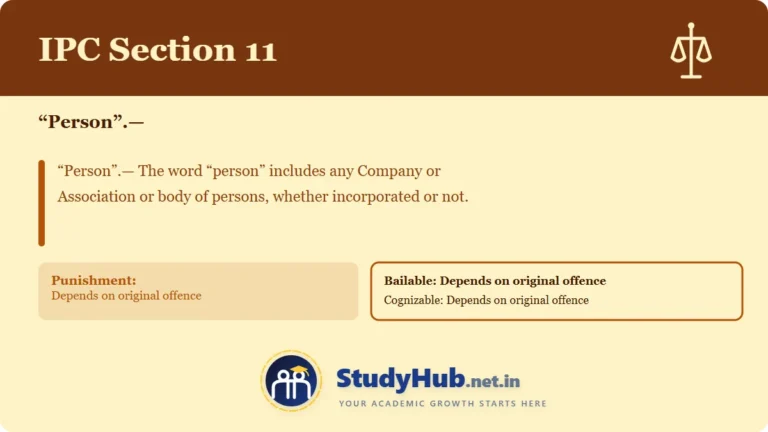
“Person”.—
Section
11
Punishment
Depends on original offence
Cognizable
Depends on original offence
Bailable
Depends on original offence
Compoundable
Non-Compoundable (Refer to CrPC 320 for exceptions)
Trial Court
Depends on original offence
Bare Act Text
11. “Person”.—
The word “person” includes any Company or Association or body of persons, whether incorporated or not.
What is IPC Section 11 ?
According to the official bare act, this legal offense is defined as: 11. “Person”.—
The word “person” includes any Company or Association or body of persons, whether incorporated or not.
What is the punishment for Dhara 11 ?
The punishment for this specific offense is outlined under the law as: Depends on original offence
Is IPC 11 bailable or non-bailable?
Under the Indian Penal Code, this specific offense is classified as a Depends on original offence offense.
Is Dhara 11 a cognizable offense?
The legal status regarding police arrest without a warrant is that this offense isDepends on original offence.
Which court has the jurisdiction to try IPC 11 cases?
Cases pertaining to this specific IPC section are triable by the Depends on original offence.
Can IPC Section 11 be compromised (Compoundable)?
The compoundable nature of this offense, meaning whether the parties can settle it out of court, is classified as: Non-Compoundable (Refer to CrPC 320 for exceptions).
Pramod Editor-in-Chief
Pramod is the Founder and Editor-in-Chief of StudyHub. He holds a Master's degree and is currently pursuing a Ph.D. in Geology, alongside more than 7+ years spent building and verifying competitive exam content for Indian aspirants. He leads StudyHub's editorial process across Indian Polity, the Constitution, Indian Economy, History, Geography, Science, and the platform's other subject areas — checking every article against primary sources (bare act text and Gazette notifications for constitutional topics, government and Economic Survey data for economy content, standard reference material elsewhere) and flagging it for re-verification whenever a relevant amendment, policy, or data update makes an earlier version outdated.