Indian Penal Code, 1860

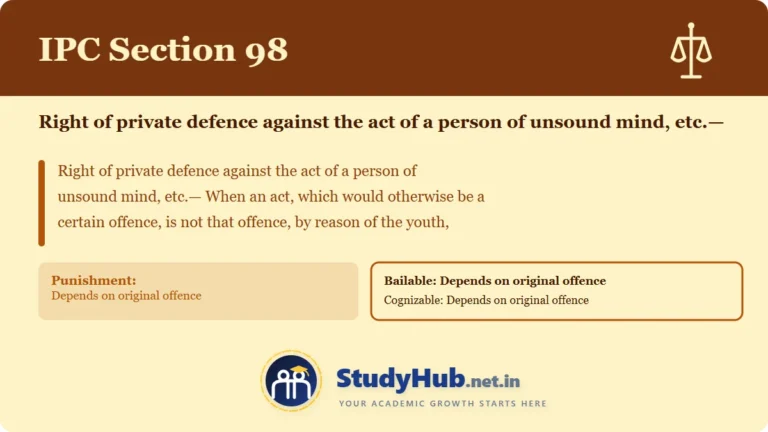
Right of private defence against the act of a person of unsound mind, etc.—

Section

98

Punishment

Depends on original offence

Cognizable

Depends on original offence

Bailable

Depends on original offence

Compoundable

Non-Compoundable (Refer to CrPC 320 for exceptions)

Trial Court

Depends on original offence

Bare Act Text

98. Right of private defence against the act of a person of unsound mind, etc.— When an act, which would otherwise be a certain offence, is not that offence, by reason of the youth, the want of maturity of understanding, the unsoundness of mind or the intoxication of the person doing that act, or by reason of any misconception on the part of that person, every person has the same right of private defence against that act which he would have if the act were that offence.Illustrations(a)Z, under the influence of madness, attempts to kill A; Z is guilty of no offence. But A has the same right of private defence which he would have if Z were sane.(b)A enters by night a house which he is legally entitled to enter Z, in good faith, taking A for a house-breaker, attacks A. Here Z, by attacking A under this misconception, commits no offence. But A has the same right of private defence against Z, which he would have if Z were not acting under that misconception.
According to the official bare act, this legal offense is defined as: 98. Right of private defence against the act of a person of unsound mind, etc.— When an act, which would otherwise be a certain offence, is not that offence, by reason of the youth, the want of maturity of understanding, the unsoundness of mind or the intoxication of the person doing that act, or by reason of any misconception on the part of that person, every person has the same right of private defence against that act which he would have if the act were that offence.Illustrations(a)Z, under the influence of madness, attempts to kill A; Z is guilty of no offence. But A has the same right of private defence which he would have if Z were sane.(b)A enters by night a house which he is legally entitled to enter Z, in good faith, taking A for a house-breaker, attacks A. Here Z, by attacking A under this misconception, commits no offence. But A has the same right of private defence against Z, which he would have if Z were not acting under that misconception.
The punishment for this specific offense is outlined under the law as: Depends on original offence
Under the Indian Penal Code, this specific offense is classified as a Depends on original offence offense.
The legal status regarding police arrest without a warrant is that this offense isDepends on original offence.
Cases pertaining to this specific IPC section are triable by the Depends on original offence.
The compoundable nature of this offense, meaning whether the parties can settle it out of court, is classified as: Non-Compoundable (Refer to CrPC 320 for exceptions).

Leave a Comment

Scroll to Top