Indian Penal Code, 1860
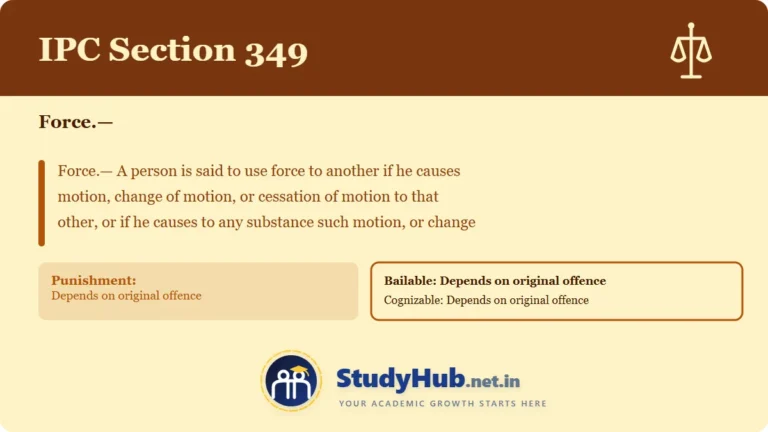
Force.—
Section
349
Punishment
Depends on original offence
Cognizable
Depends on original offence
Bailable
Depends on original offence
Compoundable
Non-Compoundable (Refer to CrPC 320 for exceptions)
Trial Court
Depends on original offence
Bare Act Text
349. Force.—
A person is said to use force to another if he causes motion, change of motion, or cessation of motion to that other, or if he causes to any substance such motion, or change of motion, or cessation of motion as brings that substance into contact with any part of that other’s body, or with anything which that other is wearing or carrying, or with anything so situated that such contact affects that other’s sense of feeling: Provided that the person causing the motion, or change of motion, or cessation of motion, causes that motion, change of motion, or cessation of motion in one of the three ways hereinafter described.(First)— By his own bodily power.(Secondly)— By disposing any substance in such a manner that the motion or change or cessation of motion takes place without any further act on his part, or on the part of any other person.(Thirdly)— By inducing any animal to move, to change its motion, or to cease to move.
Editor-in-Chief Pramod
Founder and Editor-in-Chief at StudyHub. Pramod has spent over 7 years tracking Indian government recruitments and analyzing exam trends. He oversees the StudyHub editorial board, managing a dedicated team of subject-matter experts across History, Polity, Geography, Geology, and General Sciences. His mission is to ensure that every job alert and study resource published on StudyHub is 100% verified, accurate, and helpful for competitive exam aspirants.