Indian Penal Code, 1860

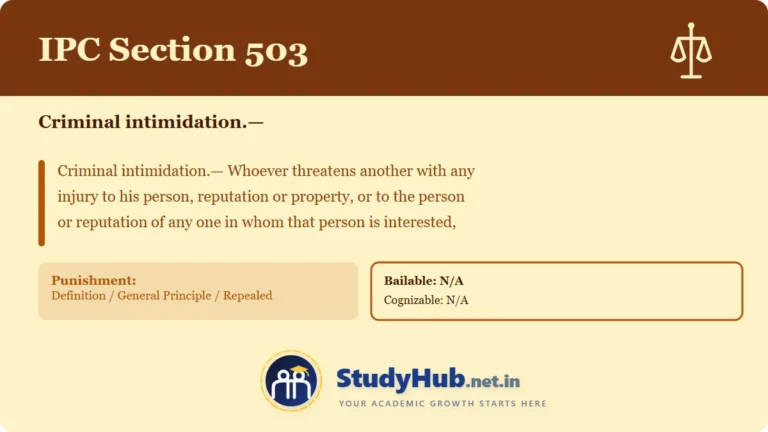
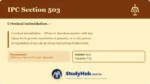
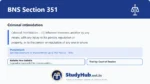
Criminal intimidation.—

Section

503

Punishment

Definition / General Principle / Repealed

Cognizable

N/A

Bailable

N/A

Compoundable

Non-Compoundable (Refer to CrPC 320 for exceptions)

Trial Court

N/A

Bare Act Text

503. Criminal intimidation.— Whoever threatens another with any injury to his person, reputation or property, or to the person or reputation of any one in whom that person is interested, with intent to cause alarm to that person, or to cause that person to do any act which he is not legally bound to do, or to omit to do any act which that person is legally entitled to do, as the means of avoiding the execution of such threat, commits criminal intimidation.Explanation.— A threat to injure the reputation of any deceased person in whom the person threatened is interested, is within this section.IllustrationA, for the purpose of inducing B to desist from prosecuting a civil suit, threatens to burn B’s house. A is guilty of criminal intimidation.
According to the official bare act, this legal offense is defined as: 503. Criminal intimidation.— Whoever threatens another with any injury to his person, reputation or property, or to the person or reputation of any one in whom that person is interested, with intent to cause alarm to that person, or to cause that person to do any act which he is not legally bound to do, or to omit to do any act which that person is legally entitled to do, as the means of avoiding the execution of such threat, commits criminal intimidation.Explanation.— A threat to injure the reputation of any deceased person in whom the person threatened is interested, is within this section.IllustrationA, for the purpose of inducing B to desist from prosecuting a civil suit, threatens to burn B’s house. A is guilty of criminal intimidation.
The punishment for this specific offense is outlined under the law as: Definition / General Principle / Repealed
Under the Indian Penal Code, this specific offense is classified as a N/A offense.
The legal status regarding police arrest without a warrant is that this offense isN/A.
Cases pertaining to this specific IPC section are triable by the N/A.
The compoundable nature of this offense, meaning whether the parties can settle it out of court, is classified as: Non-Compoundable (Refer to CrPC 320 for exceptions).
Section (dhara) 503

Leave a Comment

Scroll to Top