When two oceanic plates collide, the older and denser one sinks beneath the other — and the result is a curved chain of volcanic islands rising from the ocean floor. These chains are called Island Arcs. They are among the most geologically active places on Earth — generating powerful earthquakes, explosive eruptions, and tsunamis. The Aleutian Islands of Alaska, the Mariana Islands, the Japanese archipelago, the Kuril Islands, Indonesia, the Philippines, Tonga, and the Caribbean’s Lesser Antilles are all island arcs. They are always curved (because subduction on a sphere creates arcs, not straight lines), always paralleled by a deep ocean trench on the subducting side, and always volcanic. Understanding how island arcs form, why they are curved, and how they differ from continental arcs is essential for UPSC, SSC, and all competitive geology examinations.
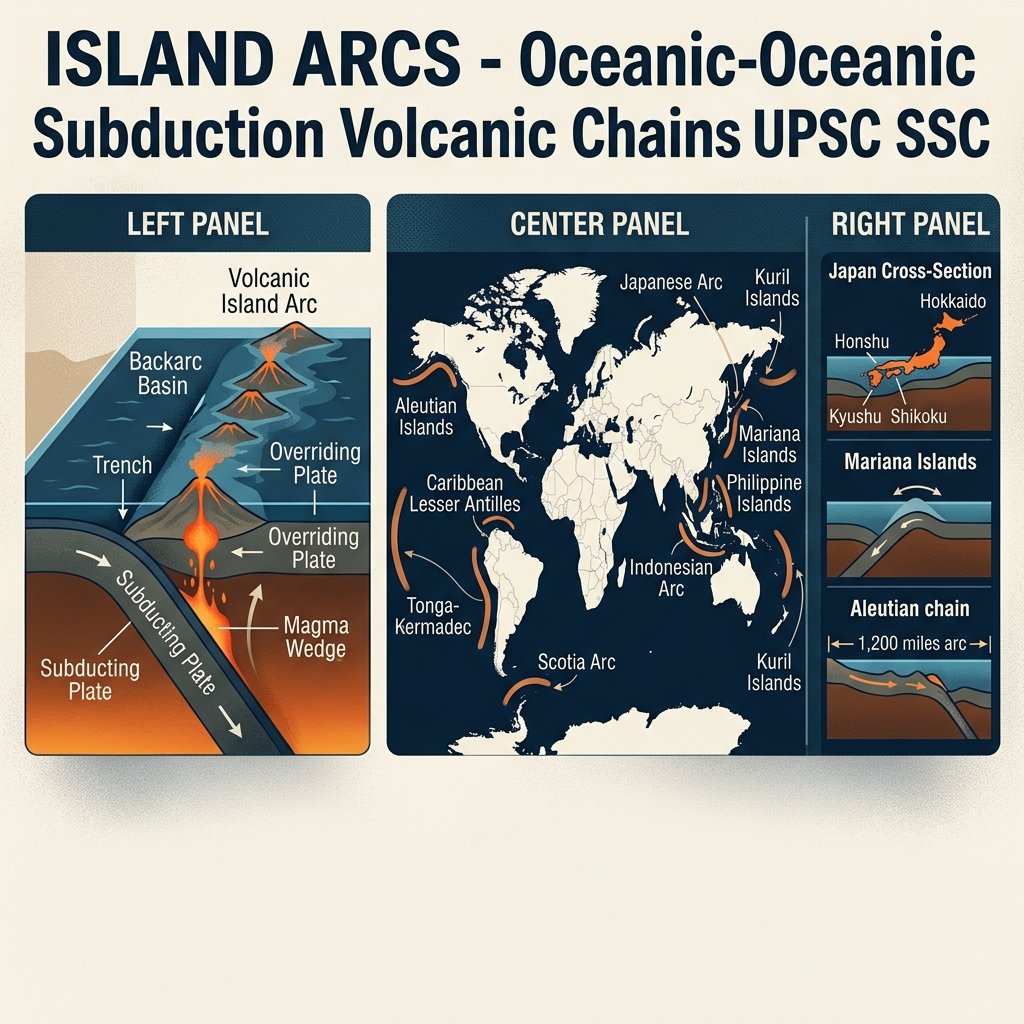
What is an Island Arc?
An island arc is a chain of volcanic islands that forms above a subduction zone where one oceanic plate dives beneath another oceanic plate. The name comes from their characteristic curved shape — they always form arcs, not straight lines.
- • Island arcs form exclusively at oceanic-oceanic convergent boundaries — where both colliding plates are oceanic crust.
- • The older, colder, and denser oceanic plate subducts beneath the younger, warmer, and lighter one.
- • As the subducting plate reaches 80–150 km depth, water released from its hydrous minerals lowers the melting point of the overlying mantle wedge — causing partial melting.
- • The resulting magma rises through the overriding oceanic plate and erupts at the surface, building volcanic islands.
- • These volcanoes are arranged in a curved chain parallel to the ocean trench, typically 100–200 km behind (inland from) the trench.
How do Island Arcs form? — Step by Step
- Collision begins: Two oceanic plates converge. The plate with older, colder, denser crust begins to bend and descend beneath the other plate.
- Trench forms: Where the subducting plate bends downward, a deep ocean trench forms at the surface — marking the exact boundary between the two plates.
- Slab descends: The subducting slab sinks into the mantle at angles of 30–70°. Earthquakes occur within the cold, brittle slab — forming the Benioff Zone (inclined plane of earthquake foci from 0 to 700 km depth).
- Water released: At 80–150 km depth, hydrous minerals (serpentine, amphibole, chlorite) in the subducting slab break down and release water into the overlying mantle wedge.
- Mantle melts: This water dramatically lowers the melting point of peridotite in the mantle wedge (from ~1,300°C to ~900°C). Partial melting produces basaltic to andesitic magma.
- Volcanoes erupt: The buoyant magma rises through the thin overriding oceanic plate and erupts on the seafloor. Over time, repeated eruptions build the volcanic cones above sea level — forming the island arc.
- Backarc basin opens: Behind the volcanic arc (on the side away from the trench), extensional forces may stretch and thin the overriding plate — creating a backarc basin with its own seafloor spreading.
Why are Island Arcs curved?
This is one of the most commonly asked questions in geology — and the answer is elegant. When a rigid plate subducts into the mantle on a sphere, the line of subduction cannot be straight. Think of pressing a ping-pong ball inward with your thumb — the indent is always curved, never a straight line. This geometric principle (called the “Euler pole” relationship) means that any line of subduction on a spherical surface must follow a small circle — producing a curved arc.
- • The curvature is always convex toward the subducting plate (the trench bows outward toward the oncoming plate).
- • Tighter curves (smaller radius arcs) occur where the subducting plate descends steeply.
- • Gentler curves (larger radius arcs) occur where subduction is shallow.
- • The Mariana Arc has very tight curvature (steep ~60–70° subduction); the Aleutian Arc has gentler curvature (shallower subduction angle).
Major Island Arcs of the World
| Island Arc | Location | Trench | Key Facts |
|---|---|---|---|
| Aleutian Islands | Alaska, USA (Pacific) | Aleutian Trench (7,822m) | ~1,900 km long chain of 14 large + 55 small volcanic islands; ~80 volcanoes, 40 active; Pacific Plate subducting under North American Plate; Alaska 1964 Mw 9.2 nearby |
| Mariana Islands | Western Pacific | Mariana Trench (10,994m) | Classic simple oceanic arc; Pacific Plate under Philippine Plate; deepest trench on Earth; Mariana Trough backarc basin; 15 volcanic islands |
| Japanese Arc | East Asia | Japan Trench (~9,000m) | Complex arc; 4 main islands (Honshu, Hokkaido, Shikoku, Kyushu); Pacific + Philippine plates subducting under Eurasian; 2011 Tohoku Mw 9.0; Mount Fuji (3,776m) |
| Kuril Islands | Russia (N Pacific) | Kuril Trench (10,542m) | 56 islands stretching from Hokkaido to Kamchatka; ~40 active volcanoes; Pacific under Okhotsk Plate; disputed between Russia and Japan |
| Philippine Arc | Southeast Asia | Philippine Trench (10,540m) | 7,641 islands; complex multi-arc system; Mount Pinatubo 1991 VEI 6; Mayon (most active); Philippine Plate under Eurasian Plate |
| Indonesian Arc (Sunda) | Southeast Asia | Java/Sunda Trench (7,258m) | 17,000+ islands; world’s largest archipelago; Krakatau, Tambora (VEI 7, 1815), Merapi; Australian/Indian under Eurasian; 2004 tsunami |
| Tonga-Kermadec | South Pacific | Tonga Trench (10,882m) | Fastest subduction on Earth (~24 cm/yr); 170+ islands; Pacific under Australian; Hunga Tonga 2022 eruption; deepest Benioff Zone earthquakes (~700 km) |
| Lesser Antilles | Caribbean | Puerto Rico Trench (8,376m) | Atlantic/N American Plate under Caribbean Plate; active volcanoes: Soufriere Hills (Montserrat, erupting since 1995), Mount Pelee (killed 29,000 in 1902 pyroclastic flow) |
| Scotia Arc | South Atlantic | South Sandwich Trench (8,428m) | Connects South America to Antarctic Peninsula; South American Plate under Scotia Plate; South Sandwich Islands are active volcanic arc; isolated, uninhabited |
Island Arc vs Continental Arc — What is the difference?
| Feature | Island Arc (Oceanic-Oceanic) | Continental Arc (Oceanic-Continental) |
|---|---|---|
| Overriding plate | Oceanic crust (thin, ~7 km, dense) | Continental crust (thick, ~35–70 km, buoyant) |
| Volcanic chain | Chain of volcanic islands in the ocean | Mountain range with volcanoes on a continent |
| Magma type | Primarily basaltic to andesitic (less silica) | Andesitic to rhyolitic (more silica, more explosive) |
| Explosivity | Moderate to high | High to extreme (thicker crust = more contamination = more silica = more explosive) |
| Trench depth | Usually deeper (Mariana 10,994m) | Usually shallower (Peru-Chile 8,065m) |
| Backarc basin | Common (Japan Sea, Mariana Trough) | Less common (Andes has no backarc basin) |
| Examples | Mariana, Aleutian, Tonga, Lesser Antilles | Andes, Cascades (USA), Sunda Arc (partly) |
What happens inside an Island Arc? — The Backarc Basin
Behind most island arcs (on the side away from the trench), the overriding plate is stretched and thinned. This creates a depression called a backarc basin. In many cases, the stretching is severe enough to split the overriding plate and create new oceanic crust — essentially a mini mid-ocean ridge operating behind the volcanic arc.
- • Japan Sea — The classic backarc basin. Formed ~15–30 Ma ago when the Japanese Arc rifted away from the Asian mainland. It is floored by oceanic crust and is up to 3,742m deep.
- • Mariana Trough — Active backarc spreading behind the Mariana Arc. New oceanic crust forming at ~3–4 cm/yr. Contains hydrothermal vents with chemosynthetic ecosystems.
- • Aegean Sea — Behind the Hellenic Arc (Greece). Actively extending; explains the high earthquake frequency in the Aegean region.
- • Why backarc basins form: As the subducting slab sinks and rolls back (trench retreat), it pulls the overriding plate toward the trench. The back part of the overriding plate cannot keep up — so it stretches and thins, creating the basin.
Do Island Arcs grow into continents?
Yes — over geological time, island arcs can be accreted (added) onto continental margins, progressively building up the continents. This process is called accretionary tectonics or terrane accretion.
- An island arc forms in the ocean through oceanic-oceanic subduction.
- The arc is carried toward a continental margin by plate motion.
- The buoyant arc crust cannot subduct (too thick, too light) — so it collides with and is welded onto the continent.
- The continent grows larger. A new subduction zone may form outboard of the accreted arc.
- Over hundreds of millions of years, repeated accretion of island arcs, oceanic plateaus, and microcontinents builds up continental crust.
Much of western North America (British Columbia, Alaska, California) was built by the accretion of island arcs and oceanic terranes over the past 200 million years. The “Wrangellia Terrane” — an accreted island arc — makes up large parts of Alaska and British Columbia today. Japan itself is a complex of multiple accreted arcs built up over 500+ million years.
⭐ Important for Exams — Quick Revision
- 🔑 Island arc: Curved chain of volcanic islands formed by oceanic-oceanic subduction; older/denser plate subducts under younger/lighter plate.
- 🔑 Why curved: Subduction on a sphere always produces arcs (ping-pong ball analogy); convex toward subducting plate.
- 🔑 Formation mechanism: Subducting slab releases water at 80–150 km depth; water lowers mantle melting point; magma rises; builds volcanic islands 100–200 km from trench.
- 🔑 Backarc basin: Extensional basin behind the volcanic arc; caused by trench rollback; Japan Sea, Mariana Trough, Aegean Sea are examples.
- 🔑 Trench + arc pair: Every island arc has a parallel ocean trench on the subducting side (Mariana Arc + Mariana Trench; Aleutian Arc + Aleutian Trench).
- 🔑 Benioff Zone: Inclined plane of earthquake foci within the subducting slab; 0–700 km depth; traces the path of the sinking plate.
- 🔑 Island arc vs continental arc: Island arc = oceanic overriding plate, basaltic-andesitic magma, volcanic islands. Continental arc = continental overriding plate, andesitic-rhyolitic magma, mountain volcanoes (Andes, Cascades).
- 🔑 Magma composition: Less silicic than continental arcs because no thick continental crust to contaminate the magma.
- 🔑 Accretionary tectonics: Island arcs can be welded onto continents; western North America, Japan built from accreted arcs over 200+ Ma.
- 🔑 Fastest subduction: Tonga-Kermadec at ~24 cm/yr; produces deepest Benioff Zone earthquakes (700 km).
- 🔑 Deepest trench at island arc: Mariana Trench (10,994m) — oceanic-oceanic subduction.
- 🔑 Mount Pelee 1902: Lesser Antilles island arc; pyroclastic flow killed 29,000 in St. Pierre, Martinique; worst volcanic disaster of 20th century.
- 🔑 Hunga Tonga 2022: Tonga island arc; underwater eruption; fastest atmospheric shockwave ever recorded (490 km/h); global tsunami.
Frequently Asked Questions (FAQs)
1. Why does the older oceanic plate always subduct — and not the younger one?
This comes down to density. When oceanic crust forms at a mid-ocean ridge, it is hot, expanded, and relatively buoyant — similar in density to the underlying asthenosphere.
As it moves away from the ridge and ages, two things happen:
- It cools — thermal contraction makes it denser. A plate that is 10 Ma old is significantly denser than one that is 5 Ma old.
- Its lithospheric mantle thickens — as the plate cools, the base of the lithosphere extends deeper into the mantle, adding dense mantle rock to the plate’s total mass.
By about 80–100 Ma, oceanic lithosphere has become denser than the underlying asthenosphere. It is now gravitationally unstable — it wants to sink. When two oceanic plates converge, the older one is always denser, so it is the one that subducts.
This is also why no oceanic crust older than ~200 Ma exists anywhere on Earth — all older oceanic crust has been subducted back into the mantle. Continental crust, by contrast, is too buoyant to subduct (density ~2,700 kg/m³ vs oceanic ~3,000–3,300 kg/m³), which is why continental rocks up to 4,000 Ma old still exist.
2. Is Japan an island arc? If so, why is it so much larger than the Mariana Islands?
Yes — Japan is an island arc, but a very mature and complex one. The key differences from a simple arc like the Mariana Islands:
- • Age: Japan has been building through subduction and arc accretion for over 500 million years. The Mariana Arc is relatively young (~50 Ma). Time = more volcanism = more material accumulated.
- • Multiple subduction zones: Japan sits above the junction of two subducting plates — the Pacific Plate (from the east, at the Japan Trench) and the Philippine Plate (from the south, at the Nankai Trough). Double subduction = double magma production = larger arc.
- • Continental crust fragments: Japan contains ancient continental crustal fragments (older than 500 Ma) that were originally part of the Asian mainland and rifted away when the Japan Sea backarc basin opened ~15–30 Ma ago. It is not purely volcanic.
- • Sediment input: Japan receives enormous sediment loads from Asian rivers via the Japan Sea, adding material to the arc.
In contrast, the Mariana Islands are a simple, young, purely oceanic island arc — thin overriding plate, limited magma volumes, no continental fragments, minimal sediment supply. They represent what Japan may have looked like 400 Ma ago.
3. What was the Mount Pelee disaster — and what did it teach us about volcanic hazards?
The eruption of Mount Pelee on the island of Martinique (Lesser Antilles island arc) on May 8, 1902, was the deadliest volcanic disaster of the 20th century. It fundamentally changed how the world understood volcanic hazards.
What happened
- Mount Pelee had been showing warning signs for weeks — small eruptions, sulfurous gas, ash fall, a 3m tsunami in the harbour (May 5).
- On May 8, 1902, at 7:52 AM, the volcano erupted with a massive pyroclastic flow — a superheated cloud of gas, ash, and rock fragments travelling at 670 km/h at temperatures exceeding 1,000°C.
- The pyroclastic flow descended the volcano’s flank and engulfed the city of Saint-Pierre (population ~28,000) in less than one minute.
- Nearly everyone in the city died instantly — burned, asphyxiated, or crushed. Only 2–3 survivors were found, including a prisoner named Louis-Auguste Cyparis who survived in his underground jail cell.
- The death toll: approximately 29,000 people.
What it taught us
- • Pyroclastic flows are the deadliest volcanic hazard — far more dangerous than lava flows. Lava moves slowly; pyroclastic flows travel at hundreds of km/hr and are impossible to outrun.
- • Evacuation is the only defence — no building can withstand a pyroclastic flow (temperature >700°C, pressure from moving mass, suffocating gas).
- • Warning signs must be heeded — Saint-Pierre’s population was warned by scientists but local authorities refused to evacuate due to upcoming elections.
- • Island arc volcanoes are explosive — subduction-zone magma (andesitic, high silica, high gas content) produces violent explosive eruptions, not gentle lava flows like Hawaiian basalt volcanoes.
Related Geology Articles on StudyHub
- ➡️ Subduction Zones — Complete Guide to Benioff Zone and Megathrust
- ➡️ Ring of Fire — All 452 Active Volcanoes
- ➡️ Ocean Trenches — Mariana Trench and Challenger Deep
- ➡️ Mid-Ocean Ridges — Where New Ocean Floor is Born
- ➡️ Plate Boundaries — Divergent, Convergent, Transform