Indian Penal Code, 1860

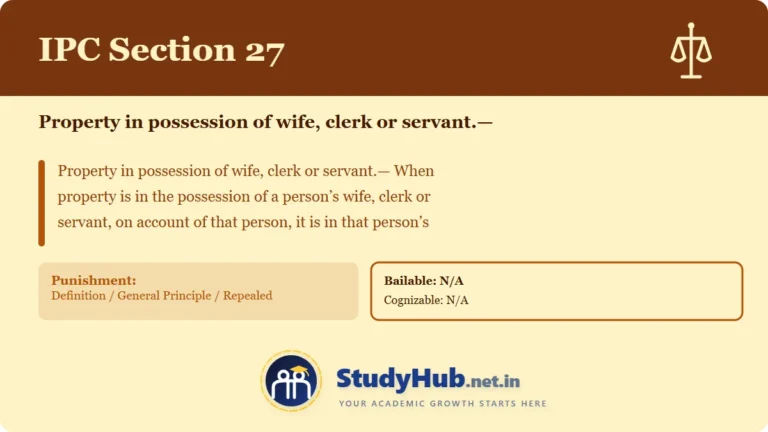
Property in possession of wife, clerk or servant.—

Section

27

Punishment

Definition / General Principle / Repealed

Cognizable

N/A

Bailable

N/A

Compoundable

Non-Compoundable (Refer to CrPC 320 for exceptions)

Trial Court

N/A

Bare Act Text

27. Property in possession of wife, clerk or servant.— When property is in the possession of a person’s wife, clerk or servant, on account of that person, it is in that person’s possession within the meaning of this Code.Explanation.— A person employed temporarily or on a particular occasion in the capacity of a clerk or servant, is a clerk or servant within the meaning of this section.
According to the official bare act, this legal offense is defined as: 27. Property in possession of wife, clerk or servant.— When property is in the possession of a person’s wife, clerk or servant, on account of that person, it is in that person’s possession within the meaning of this Code.Explanation.— A person employed temporarily or on a particular occasion in the capacity of a clerk or servant, is a clerk or servant within the meaning of this section.
The punishment for this specific offense is outlined under the law as: Definition / General Principle / Repealed
Under the Indian Penal Code, this specific offense is classified as a N/A offense.
The legal status regarding police arrest without a warrant is that this offense isN/A.
Cases pertaining to this specific IPC section are triable by the N/A.
The compoundable nature of this offense, meaning whether the parties can settle it out of court, is classified as: Non-Compoundable (Refer to CrPC 320 for exceptions).

Leave a Comment

Scroll to Top