Indian Penal Code, 1860

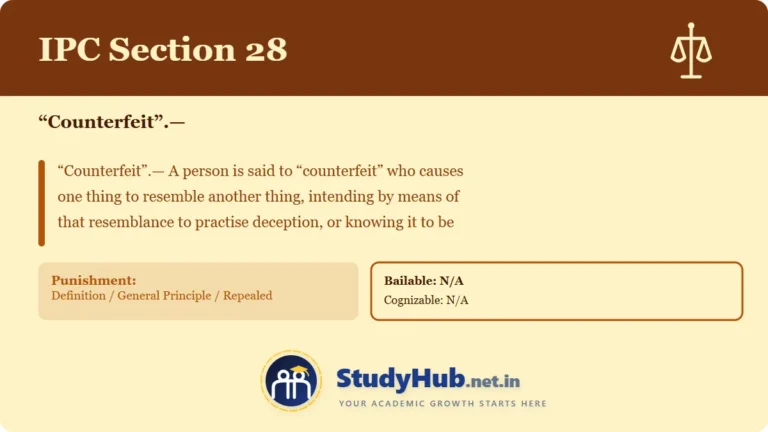
“Counterfeit”.—

Section

28

Punishment

Definition / General Principle / Repealed

Cognizable

N/A

Bailable

N/A

Compoundable

Non-Compoundable (Refer to CrPC 320 for exceptions)

Trial Court

N/A

Bare Act Text

28. “Counterfeit”.— A person is said to “counterfeit” who causes one thing to resemble another thing, intending by means of that resemblance to practise deception, or knowing it to be likely that deception will thereby be practised.Explanation 1.— It is not essential to counterfeiting that the imitation should be exact.Explanation 2.— When a person causes one thing to resemble another thing, and the resemblance is such that a person might be deceived thereby, it shall be presumed, until the contrary is proved, that the person so causing the one thing to resemble the other thing intended by means of that resemblance to practise deception or knew it to be likely that deception would thereby be practised.
According to the official bare act, this legal offense is defined as: 28. “Counterfeit”.— A person is said to “counterfeit” who causes one thing to resemble another thing, intending by means of that resemblance to practise deception, or knowing it to be likely that deception will thereby be practised.Explanation 1.— It is not essential to counterfeiting that the imitation should be exact.Explanation 2.— When a person causes one thing to resemble another thing, and the resemblance is such that a person might be deceived thereby, it shall be presumed, until the contrary is proved, that the person so causing the one thing to resemble the other thing intended by means of that resemblance to practise deception or knew it to be likely that deception would thereby be practised.
The punishment for this specific offense is outlined under the law as: Definition / General Principle / Repealed
Under the Indian Penal Code, this specific offense is classified as a N/A offense.
The legal status regarding police arrest without a warrant is that this offense isN/A.
Cases pertaining to this specific IPC section are triable by the N/A.
The compoundable nature of this offense, meaning whether the parties can settle it out of court, is classified as: Non-Compoundable (Refer to CrPC 320 for exceptions).

Leave a Comment

Scroll to Top