Indian Penal Code, 1860

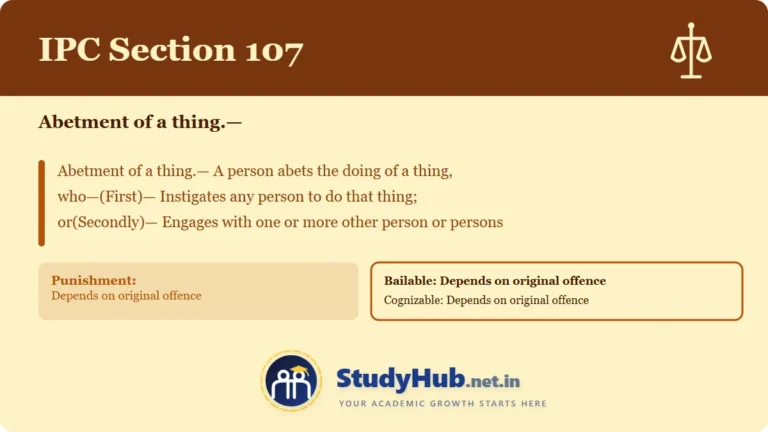
Abetment of a thing.—

Section

107

Punishment

Depends on original offence

Cognizable

Depends on original offence

Bailable

Depends on original offence

Compoundable

Non-Compoundable (Refer to CrPC 320 for exceptions)

Trial Court

Depends on original offence

Bare Act Text

107. Abetment of a thing.— A person abets the doing of a thing, who—(First)— Instigates any person to do that thing; or(Secondly)— Engages with one or more other person or persons in any conspiracy for the doing of that thing, if an act or illegal omission takes place in pursuance of that conspiracy, and in order to the doing of that thing; or(Thirdly)— Intentionally aids, by any act or illegal omission, the doing of that thing.Explanation 1.— A person who, by wilful misrepresentation, or by wilful concealment of a material fact which he is bound to disclose, voluntarily causes or procures, or attempts to cause or procure, a thing to be done, is said to instigate the doing of that thing.IllustrationA, a public officer, is authorized by a warrant from a Court of Justice to apprehend Z. B, knowing that fact and also that C is not Z, wilfully represents to A that C is Z, and thereby intentionally causes A to apprehend C. Here B abets by instigation the apprehension of C.Explanation 2.— Whoever, either prior to or at the time of the commission of an act, does anything in order to facilitate the commission of that act, and thereby facilitate the commission thereof, is said to aid the doing of that act.
According to the official bare act, this legal offense is defined as: 107. Abetment of a thing.— A person abets the doing of a thing, who—(First)— Instigates any person to do that thing; or(Secondly)— Engages with one or more other person or persons in any conspiracy for the doing of that thing, if an act or illegal omission takes place in pursuance of that conspiracy, and in order to the doing of that thing; or(Thirdly)— Intentionally aids, by any act or illegal omission, the doing of that thing.Explanation 1.— A person who, by wilful misrepresentation, or by wilful concealment of a material fact which he is bound to disclose, voluntarily causes or procures, or attempts to cause or procure, a thing to be done, is said to instigate the doing of that thing.IllustrationA, a public officer, is authorized by a warrant from a Court of Justice to apprehend Z. B, knowing that fact and also that C is not Z, wilfully represents to A that C is Z, and thereby intentionally causes A to apprehend C. Here B abets by instigation the apprehension of C.Explanation 2.— Whoever, either prior to or at the time of the commission of an act, does anything in order to facilitate the commission of that act, and thereby facilitate the commission thereof, is said to aid the doing of that act.
The punishment for this specific offense is outlined under the law as: Depends on original offence
Under the Indian Penal Code, this specific offense is classified as a Depends on original offence offense.
The legal status regarding police arrest without a warrant is that this offense isDepends on original offence.
Cases pertaining to this specific IPC section are triable by the Depends on original offence.
The compoundable nature of this offense, meaning whether the parties can settle it out of court, is classified as: Non-Compoundable (Refer to CrPC 320 for exceptions).

Leave a Comment

Scroll to Top