Indian Penal Code, 1860

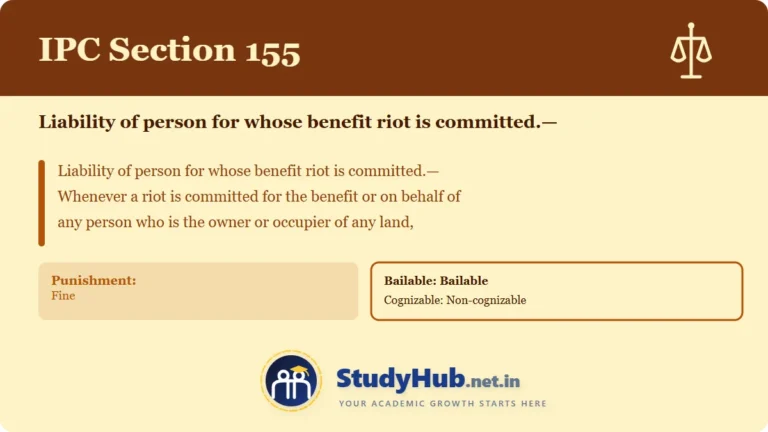
Liability of person for whose benefit riot is committed.—

Section

155

Punishment

Fine

Cognizable

Non-cognizable

Bailable

Bailable

Compoundable

Non-Compoundable (Refer to CrPC 320 for exceptions)

Trial Court

Any Magistrate

Bare Act Text

155. Liability of person for whose benefit riot is committed.— Whenever a riot is committed for the benefit or on behalf of any person who is the owner or occupier of any land, respecting which such riot takes place or who claims any interest in such land, or in the subject of any dispute which gave rise to the riot, or who has accepted or derived any benefit therefrom, such person shall be punishable with fine, if he or his agent or manager, having reason to believe that such riot was likely to be committed or that the unlawful assembly by which such riot was committed was likely to be held, shall not respectively use all lawful means in his or their power to prevent such assembly or riot from taking place, and for suppressing and dispersing the same.
According to the official bare act, this legal offense is defined as: 155. Liability of person for whose benefit riot is committed.— Whenever a riot is committed for the benefit or on behalf of any person who is the owner or occupier of any land, respecting which such riot takes place or who claims any interest in such land, or in the subject of any dispute which gave rise to the riot, or who has accepted or derived any benefit therefrom, such person shall be punishable with fine, if he or his agent or manager, having reason to believe that such riot was likely to be committed or that the unlawful assembly by which such riot was committed was likely to be held, shall not respectively use all lawful means in his or their power to prevent such assembly or riot from taking place, and for suppressing and dispersing the same.
The punishment for this specific offense is outlined under the law as: Fine
Under the Indian Penal Code, this specific offense is classified as a Bailable offense.
The legal status regarding police arrest without a warrant is that this offense isNon-cognizable.
Cases pertaining to this specific IPC section are triable by the Any Magistrate.
The compoundable nature of this offense, meaning whether the parties can settle it out of court, is classified as: Non-Compoundable (Refer to CrPC 320 for exceptions).

Leave a Comment

Scroll to Top