Indian Penal Code, 1860

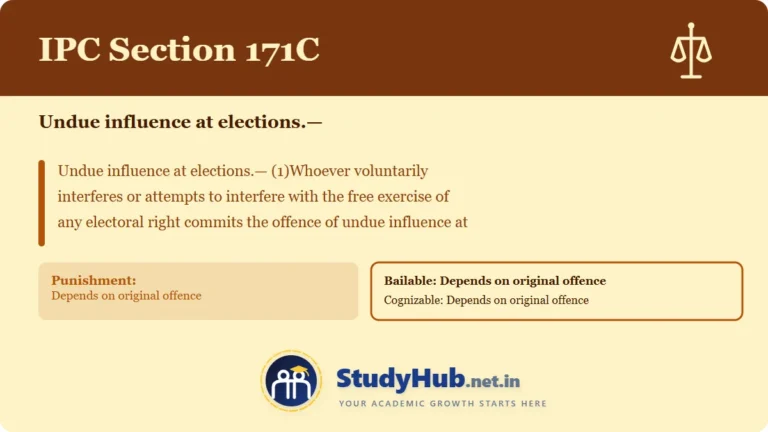
Undue influence at elections.—

Section

171C

Punishment

Depends on original offence

Cognizable

Depends on original offence

Bailable

Depends on original offence

Compoundable

Non-Compoundable (Refer to CrPC 320 for exceptions)

Trial Court

Depends on original offence

Bare Act Text

171C. Undue influence at elections.— (1)Whoever voluntarily interferes or attempts to interfere with the free exercise of any electoral right commits the offence of undue influence at an election.(2)Without prejudice to the generality of the provisions of sub-section (1), whoever—(a)threatens any candidate or voter, or any person in whom a candidate or voter is interested, with injury of any kind, or(b)induces or attempts to induce a candidate or voter to believe that he or any person in whom he is interested will become or will be rendered an object of Divine displeasure or of spiritual censure,shall be deemed to interfere with the free exercise of the electoral right of such candidate or voter, within the meaning of sub-section (1).(3)A declaration of public policy or a promise of public action, or the mere exercise of a legal right without intent to interfere with an electoral right, shall not be deemed to be interference within the meaning of this section.
According to the official bare act, this legal offense is defined as: 171C. Undue influence at elections.— (1)Whoever voluntarily interferes or attempts to interfere with the free exercise of any electoral right commits the offence of undue influence at an election.(2)Without prejudice to the generality of the provisions of sub-section (1), whoever—(a)threatens any candidate or voter, or any person in whom a candidate or voter is interested, with injury of any kind, or(b)induces or attempts to induce a candidate or voter to believe that he or any person in whom he is interested will become or will be rendered an object of Divine displeasure or of spiritual censure,shall be deemed to interfere with the free exercise of the electoral right of such candidate or voter, within the meaning of sub-section (1).(3)A declaration of public policy or a promise of public action, or the mere exercise of a legal right without intent to interfere with an electoral right, shall not be deemed to be interference within the meaning of this section.
The punishment for this specific offense is outlined under the law as: Depends on original offence
Under the Indian Penal Code, this specific offense is classified as a Depends on original offence offense.
The legal status regarding police arrest without a warrant is that this offense isDepends on original offence.
Cases pertaining to this specific IPC section are triable by the Depends on original offence.
The compoundable nature of this offense, meaning whether the parties can settle it out of court, is classified as: Non-Compoundable (Refer to CrPC 320 for exceptions).

Leave a Comment

Scroll to Top