Indian Penal Code, 1860

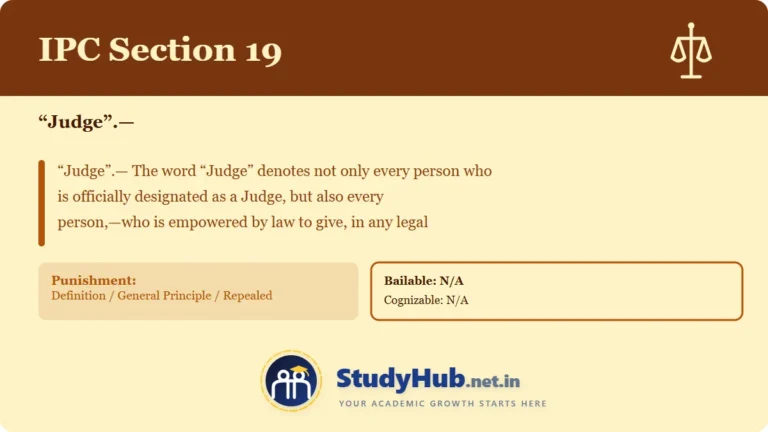
“Judge”.—

Section

19

Punishment

Definition / General Principle / Repealed

Cognizable

N/A

Bailable

N/A

Compoundable

Non-Compoundable (Refer to CrPC 320 for exceptions)

Trial Court

N/A

Bare Act Text

19. “Judge”.— The word “Judge” denotes not only every person who is officially designated as a Judge, but also every person,—who is empowered by law to give, in any legal proceeding, civil or criminal, a definitive judgment, or a judgment which, if not appealed against, would be definitive, or a judgment which, if confirmed by some other authority, would be definitive, orwho is one of a body of persons, which body of persons is empowered by law to give such a judgment.Illustrations(a)A Collector exercising jurisdiction in a suit under Act 10 of 1859, is a Judge.(b)A Magistrate exercising jurisdiction in respect of a charge on which he has power to sentence to fine or imprisonment, with or without appeal, is a Judge.(c)A member of a panchayat which has power, under 21 Regulation VII, 1816, of the Madras Code, to try and determine suits, is a Judge.(d)A Magistrate exercising jurisdiction in respect of a charge on which he has power only to commit for trial to another Court, is not a Judge.
According to the official bare act, this legal offense is defined as: 19. “Judge”.— The word “Judge” denotes not only every person who is officially designated as a Judge, but also every person,—who is empowered by law to give, in any legal proceeding, civil or criminal, a definitive judgment, or a judgment which, if not appealed against, would be definitive, or a judgment which, if confirmed by some other authority, would be definitive, orwho is one of a body of persons, which body of persons is empowered by law to give such a judgment.Illustrations(a)A Collector exercising jurisdiction in a suit under Act 10 of 1859, is a Judge.(b)A Magistrate exercising jurisdiction in respect of a charge on which he has power to sentence to fine or imprisonment, with or without appeal, is a Judge.(c)A member of a panchayat which has power, under 21 Regulation VII, 1816, of the Madras Code, to try and determine suits, is a Judge.(d)A Magistrate exercising jurisdiction in respect of a charge on which he has power only to commit for trial to another Court, is not a Judge.
The punishment for this specific offense is outlined under the law as: Definition / General Principle / Repealed
Under the Indian Penal Code, this specific offense is classified as a N/A offense.
The legal status regarding police arrest without a warrant is that this offense isN/A.
Cases pertaining to this specific IPC section are triable by the N/A.
The compoundable nature of this offense, meaning whether the parties can settle it out of court, is classified as: Non-Compoundable (Refer to CrPC 320 for exceptions).

Leave a Comment

Scroll to Top