Indian Penal Code, 1860

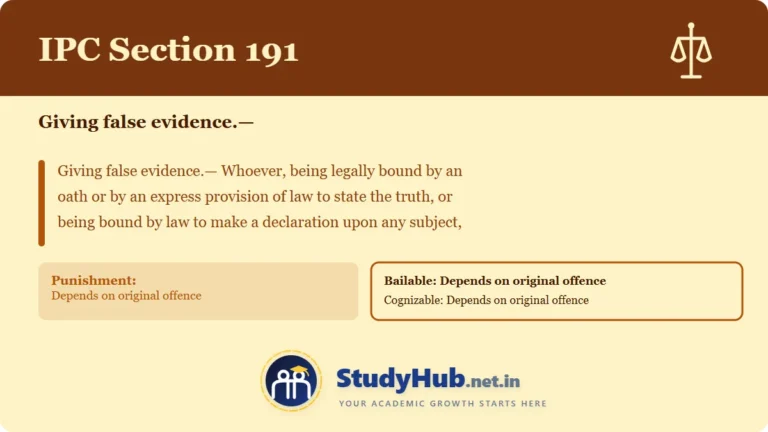
Giving false evidence.—

Section

191

Punishment

Depends on original offence

Cognizable

Depends on original offence

Bailable

Depends on original offence

Compoundable

Non-Compoundable (Refer to CrPC 320 for exceptions)

Trial Court

Depends on original offence

Bare Act Text

191. Giving false evidence.— Whoever, being legally bound by an oath or by an express provision of law to state the truth, or being bound by law to make a declaration upon any subject, makes any statement which is false, and which he either knows or believes to be false or does not believe to be true, is said to give false evidence.Explanation 1.— A statement is within the meaning of this section, whether it is made verbally or otherwise.Explanation 2.— A false statement as to the belief of the person attesting is within the meaning of this section, and a person may be guilty of giving false evidence by stating that he believes a thing which he does not believe, as well as by stating that he knows a thing which he does not know.Illustrations(a)A, in support of a just claim which B has against Z for one thousand rupees, falsely swears on a trial that he heard Z admit the justice of B’s claim. A has given false evidence.(b)A, being bound by an oath to state the truth, states that he believes a certain signature to be the handwriting of Z, when he does not believe it to be the handwriting of Z. Here A states that which he knows to be false, and therefore gives false evidence.(c)A, knowing the general character of Z’s handwriting, states that he believes a certain signature to be the handwriting of Z; A in good faith believing it to be so. Here A’s statement is merely as to his belief, and is true as to his belief, and therefore, although the signature may not be the handwriting of Z, A has not given false evidence.(d)A, being bound by an oath to state the truth, states that he knows that Z was at a particular place on a particular day, not knowing anything upon the subject. A gives false evidence whether Z was at that place on the day named or not.(e)A, an interpreter or translator, gives or certifies as a true interpretation or translation of a statement or document which he is bound by oath to interpret or translate truly, that which is not and which he does not believe to be a true interpretation or translation. A has given false evidence.
According to the official bare act, this legal offense is defined as: 191. Giving false evidence.— Whoever, being legally bound by an oath or by an express provision of law to state the truth, or being bound by law to make a declaration upon any subject, makes any statement which is false, and which he either knows or believes to be false or does not believe to be true, is said to give false evidence.Explanation 1.— A statement is within the meaning of this section, whether it is made verbally or otherwise.Explanation 2.— A false statement as to the belief of the person attesting is within the meaning of this section, and a person may be guilty of giving false evidence by stating that he believes a thing which he does not believe, as well as by stating that he knows a thing which he does not know.Illustrations(a)A, in support of a just claim which B has against Z for one thousand rupees, falsely swears on a trial that he heard Z admit the justice of B’s claim. A has given false evidence.(b)A, being bound by an oath to state the truth, states that he believes a certain signature to be the handwriting of Z, when he does not believe it to be the handwriting of Z. Here A states that which he knows to be false, and therefore gives false evidence.(c)A, knowing the general character of Z’s handwriting, states that he believes a certain signature to be the handwriting of Z; A in good faith believing it to be so. Here A’s statement is merely as to his belief, and is true as to his belief, and therefore, although the signature may not be the handwriting of Z, A has not given false evidence.(d)A, being bound by an oath to state the truth, states that he knows that Z was at a particular place on a particular day, not knowing anything upon the subject. A gives false evidence whether Z was at that place on the day named or not.(e)A, an interpreter or translator, gives or certifies as a true interpretation or translation of a statement or document which he is bound by oath to interpret or translate truly, that which is not and which he does not believe to be a true interpretation or translation. A has given false evidence.
The punishment for this specific offense is outlined under the law as: Depends on original offence
Under the Indian Penal Code, this specific offense is classified as a Depends on original offence offense.
The legal status regarding police arrest without a warrant is that this offense isDepends on original offence.
Cases pertaining to this specific IPC section are triable by the Depends on original offence.
The compoundable nature of this offense, meaning whether the parties can settle it out of court, is classified as: Non-Compoundable (Refer to CrPC 320 for exceptions).
Section (dhara) 191
Disclaimer:

This article is for general legal information only and is not a substitute for professional legal advice. Please consult a qualified advocate for your specific case.

Leave a Comment

Scroll to Top