Indian Penal Code, 1860

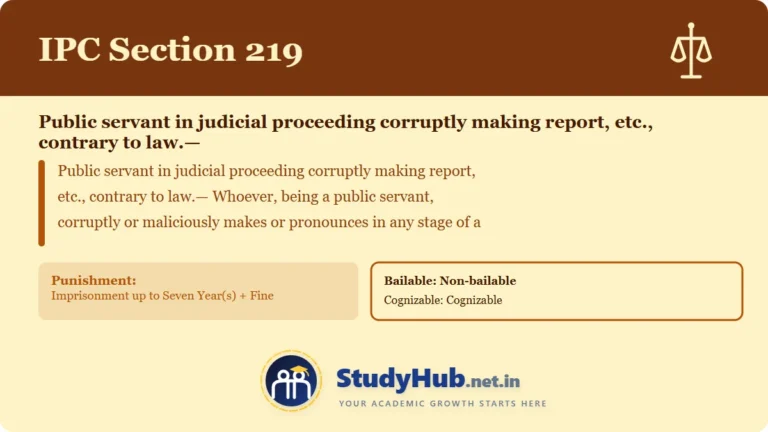
Public servant in judicial proceeding corruptly making report, etc., contrary to law.—

Section

219

Punishment

Imprisonment up to Seven Year(s) + Fine

Cognizable

Cognizable

Bailable

Non-bailable

Compoundable

Non-Compoundable (Refer to CrPC 320 for exceptions)

Trial Court

Court of Session

Bare Act Text

219. Public servant in judicial proceeding corruptly making report, etc., contrary to law.— Whoever, being a public servant, corruptly or maliciously makes or pronounces in any stage of a judicial proceeding, any report, order, verdict, or decision which he knows to be contrary to law, shall be punished with imprisonment of either description for a term which may extend to seven years, or with fine, or with both.
According to the official bare act, this legal offense is defined as: 219. Public servant in judicial proceeding corruptly making report, etc., contrary to law.— Whoever, being a public servant, corruptly or maliciously makes or pronounces in any stage of a judicial proceeding, any report, order, verdict, or decision which he knows to be contrary to law, shall be punished with imprisonment of either description for a term which may extend to seven years, or with fine, or with both.
The punishment for this specific offense is outlined under the law as: Imprisonment up to Seven Year(s) + Fine
Under the Indian Penal Code, this specific offense is classified as a Non-bailable offense.
The legal status regarding police arrest without a warrant is that this offense isCognizable.
Cases pertaining to this specific IPC section are triable by the Court of Session.
The compoundable nature of this offense, meaning whether the parties can settle it out of court, is classified as: Non-Compoundable (Refer to CrPC 320 for exceptions).

Leave a Comment

Scroll to Top