Indian Penal Code, 1860

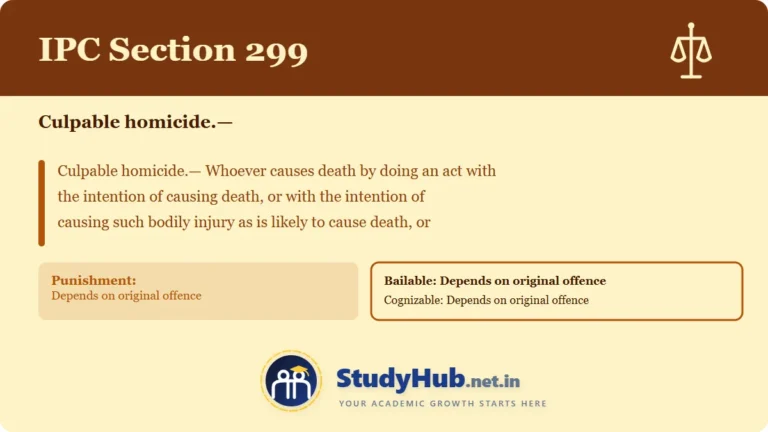
Culpable homicide.—

Section

299

Punishment

Depends on original offence

Cognizable

Depends on original offence

Bailable

Depends on original offence

Compoundable

Non-Compoundable (Refer to CrPC 320 for exceptions)

Trial Court

Depends on original offence

Bare Act Text

299. Culpable homicide.— Whoever causes death by doing an act with the intention of causing death, or with the intention of causing such bodily injury as is likely to cause death, or with the knowledge that he is likely by such act to cause death, commits the offence of culpable homicide.Illustrations(a)A lays sticks and turf over a pit, with the intention of thereby causing death, or with the knowledge that death is likely to be thereby caused. Z believing the ground to be firm, treads on it, falls in and is killed. A has committed the offence of culpable homicide.(b)A knows Z to be behind a bush. B does not know it A, intending to cause, or knowing it to be likely to cause Z’s death, induces B to fire at the bush. B fires and kills Z. Here B may be guilty of no offence; but A has committed the offence of culpable homicide.(c)A, by shooting at a fowl with intent to kill and steal it, kills B who is behind a bush; A not knowing that he was there. Here, although A was doing an unlawful act, he was not guilty of culpable homicide, as he did not intend to kill B, or to cause death by doing an act that he knew was likely to cause death.Explanation 1.— A person who causes bodily injury to another who is labouring under a disorder, disease or bodily infirmity, and thereby accelerates the death of that other, shall be deemed to have caused his death.Explanation 2.— Where death is caused by bodily injury, the person who causes such bodily injury shall be deemed to have caused the death, although by resorting to proper remedies and skilful treatment the death might have been prevented.Explanation 3.— The causing of the death of child in the mother’s womb is not homicide. But it may amount to culpable homicide to cause the death of a living child, if any part of that child has been brought forth, though the child may not have breathed or been completely born.
According to the official bare act, this legal offense is defined as: 299. Culpable homicide.— Whoever causes death by doing an act with the intention of causing death, or with the intention of causing such bodily injury as is likely to cause death, or with the knowledge that he is likely by such act to cause death, commits the offence of culpable homicide.Illustrations(a)A lays sticks and turf over a pit, with the intention of thereby causing death, or with the knowledge that death is likely to be thereby caused. Z believing the ground to be firm, treads on it, falls in and is killed. A has committed the offence of culpable homicide.(b)A knows Z to be behind a bush. B does not know it A, intending to cause, or knowing it to be likely to cause Z’s death, induces B to fire at the bush. B fires and kills Z. Here B may be guilty of no offence; but A has committed the offence of culpable homicide.(c)A, by shooting at a fowl with intent to kill and steal it, kills B who is behind a bush; A not knowing that he was there. Here, although A was doing an unlawful act, he was not guilty of culpable homicide, as he did not intend to kill B, or to cause death by doing an act that he knew was likely to cause death.Explanation 1.— A person who causes bodily injury to another who is labouring under a disorder, disease or bodily infirmity, and thereby accelerates the death of that other, shall be deemed to have caused his death.Explanation 2.— Where death is caused by bodily injury, the person who causes such bodily injury shall be deemed to have caused the death, although by resorting to proper remedies and skilful treatment the death might have been prevented.Explanation 3.— The causing of the death of child in the mother’s womb is not homicide. But it may amount to culpable homicide to cause the death of a living child, if any part of that child has been brought forth, though the child may not have breathed or been completely born.
The punishment for this specific offense is outlined under the law as: Depends on original offence
Under the Indian Penal Code, this specific offense is classified as a Depends on original offence offense.
The legal status regarding police arrest without a warrant is that this offense isDepends on original offence.
Cases pertaining to this specific IPC section are triable by the Depends on original offence.
The compoundable nature of this offense, meaning whether the parties can settle it out of court, is classified as: Non-Compoundable (Refer to CrPC 320 for exceptions).
Section (dhara) 299
Disclaimer:

This article is for general legal information only and is not a substitute for professional legal advice. Please consult a qualified advocate for your specific case.

Leave a Comment

Scroll to Top