Indian Penal Code, 1860
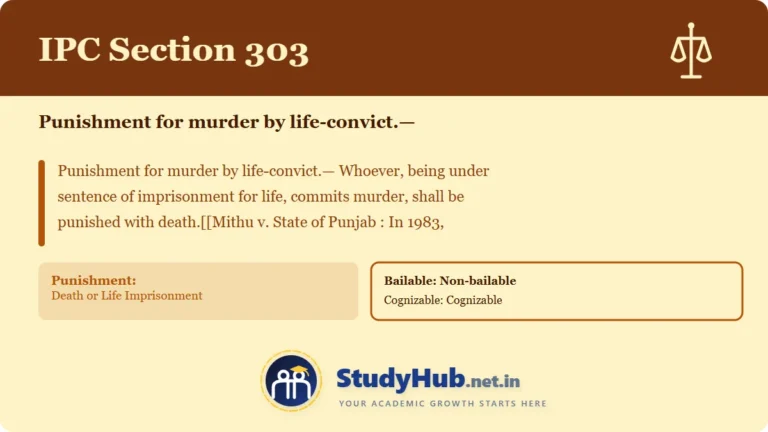
Punishment for murder by life-convict.—
Section
303
Punishment
Death or Life Imprisonment
Cognizable
Cognizable
Bailable
Non-bailable
Compoundable
Non-Compoundable (Refer to CrPC 320 for exceptions)
Trial Court
Court of Session
Bare Act Text
303. Punishment for murder by life-convict.—
Whoever, being under sentence of imprisonment for life, commits murder, shall be punished with death.[[Mithu v. State of Punjab : In 1983, Section 303 of the Indian Penal Code (IPC) was struck down. This section provided capital punishment for murder by a person serving a life term in another case. It was held unconstitutional in Mithu v. State of Punjab. The Supreme Court explained that the punishment was not based on rational principle as no judicial discretion was available to a life convict.A five-Judge Bench of the SC struck down Section 303 of the IPC, holding that the provision violated Articles 14 and 21 of the Constitution. As per Section 303, if a person undergoing life imprisonment committed murder, they would mandatorily be sentenced to death. The SC held that the provision drew an arbitrary distinction between persons committing murder and persons undergoing life imprisonment who committed murder. There was no rationale behind this distinction. Further, a mandatory death sentence prevents courts from exercising their discretion.(https:legalserviceindia.com/legal/article-8500-case-note-mithu-v-s-state-of-punjab-1983-.html, https:indiankanoon.org/doc/590378/)]]
Editor-in-Chief Pramod
Pramod is the Founder and Editor-in-Chief of StudyHub. He holds a Master's degree and is currently pursuing a Ph.D. in Geology, alongside more than 7+ years spent building and verifying competitive exam content for Indian aspirants. He leads StudyHub's editorial process across Indian Polity, the Constitution, Indian Economy, History, Geography, Science, and the platform's other subject areas — checking every article against primary sources (bare act text and Gazette notifications for constitutional topics, government and Economic Survey data for economy content, standard reference material elsewhere) and flagging it for re-verification whenever a relevant amendment, policy, or data update makes an earlier version outdated.