Indian Penal Code, 1860

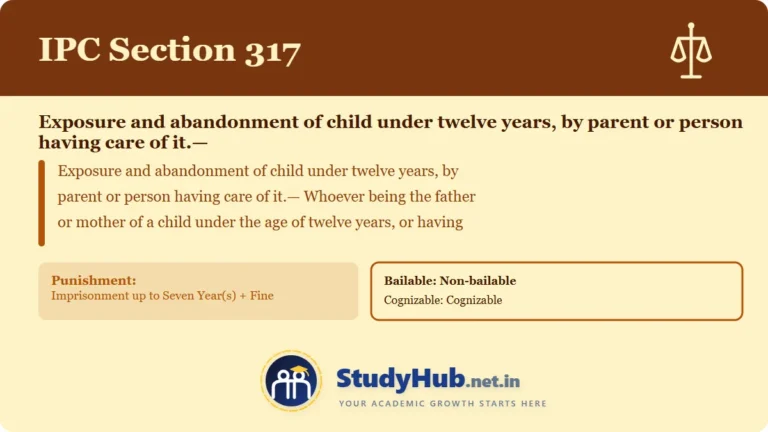
Exposure and abandonment of child under twelve years, by parent or person having care of it.—

Section

317

Punishment

Imprisonment up to Seven Year(s) + Fine

Cognizable

Cognizable

Bailable

Non-bailable

Compoundable

Non-Compoundable (Refer to CrPC 320 for exceptions)

Trial Court

Court of Session

Bare Act Text

317. Exposure and abandonment of child under twelve years, by parent or person having care of it.— Whoever being the father or mother of a child under the age of twelve years, or having the care of such child, shall expose or leave such child in any place with the intention of wholly abandoning such child, shall be punished with imprisonment of either description for a term which may extend to seven years, or with fine, or with both.Explanation.— This section is not intended to prevent the trial of the offender for murder or culpable homicide, as the case may be, if the child dies in consequence of the exposure.
According to the official bare act, this legal offense is defined as: 317. Exposure and abandonment of child under twelve years, by parent or person having care of it.— Whoever being the father or mother of a child under the age of twelve years, or having the care of such child, shall expose or leave such child in any place with the intention of wholly abandoning such child, shall be punished with imprisonment of either description for a term which may extend to seven years, or with fine, or with both.Explanation.— This section is not intended to prevent the trial of the offender for murder or culpable homicide, as the case may be, if the child dies in consequence of the exposure.
The punishment for this specific offense is outlined under the law as: Imprisonment up to Seven Year(s) + Fine
Under the Indian Penal Code, this specific offense is classified as a Non-bailable offense.
The legal status regarding police arrest without a warrant is that this offense isCognizable.
Cases pertaining to this specific IPC section are triable by the Court of Session.
The compoundable nature of this offense, meaning whether the parties can settle it out of court, is classified as: Non-Compoundable (Refer to CrPC 320 for exceptions).
Section (dhara) 317
Disclaimer:

This article is for general legal information only and is not a substitute for professional legal advice. Please consult a qualified advocate for your specific case.

Leave a Comment

Scroll to Top