Indian Penal Code, 1860

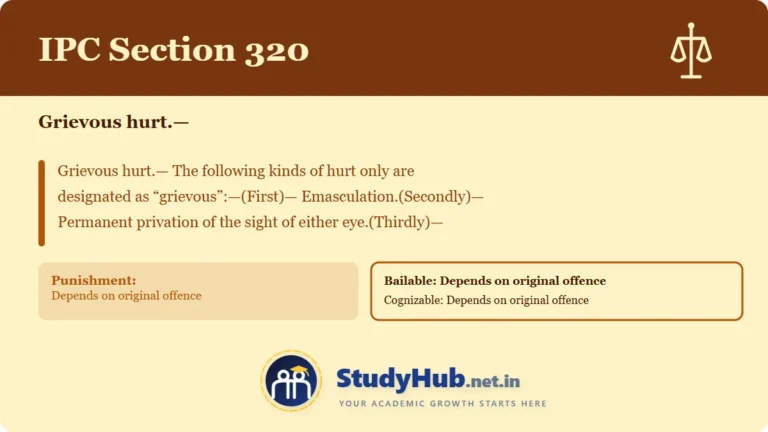
Grievous hurt.—

Section

320

Punishment

Depends on original offence

Cognizable

Depends on original offence

Bailable

Depends on original offence

Compoundable

Non-Compoundable (Refer to CrPC 320 for exceptions)

Trial Court

Depends on original offence

Bare Act Text

320. Grievous hurt.— The following kinds of hurt only are designated as “grievous”:—(First)— Emasculation.(Secondly)— Permanent privation of the sight of either eye.(Thirdly)— Permanent privation of the hearing of either ear,(Fourthly)— Privation of any member or joint.(Fifthly)— Destruction or permanent impairing of the powers of any member or joint.(Sixthly)— Permanent disfiguration of the head or face.(Seventhly)— Fracture or dislocation of a bone or tooth.(Eighthly)— Any hurt which endangers life or which causes the sufferer to be during the space of twenty days in severe bodily pain, or unable to follow his ordinary pursuits.
According to the official bare act, this legal offense is defined as: 320. Grievous hurt.— The following kinds of hurt only are designated as “grievous”:—(First)— Emasculation.(Secondly)— Permanent privation of the sight of either eye.(Thirdly)— Permanent privation of the hearing of either ear,(Fourthly)— Privation of any member or joint.(Fifthly)— Destruction or permanent impairing of the powers of any member or joint.(Sixthly)— Permanent disfiguration of the head or face.(Seventhly)— Fracture or dislocation of a bone or tooth.(Eighthly)— Any hurt which endangers life or which causes the sufferer to be during the space of twenty days in severe bodily pain, or unable to follow his ordinary pursuits.
The punishment for this specific offense is outlined under the law as: Depends on original offence
Under the Indian Penal Code, this specific offense is classified as a Depends on original offence offense.
The legal status regarding police arrest without a warrant is that this offense isDepends on original offence.
Cases pertaining to this specific IPC section are triable by the Depends on original offence.
The compoundable nature of this offense, meaning whether the parties can settle it out of court, is classified as: Non-Compoundable (Refer to CrPC 320 for exceptions).
Section (dhara) 320
Disclaimer:

This article is for general legal information only and is not a substitute for professional legal advice. Please consult a qualified advocate for your specific case.

Leave a Comment

Scroll to Top