Indian Penal Code, 1860

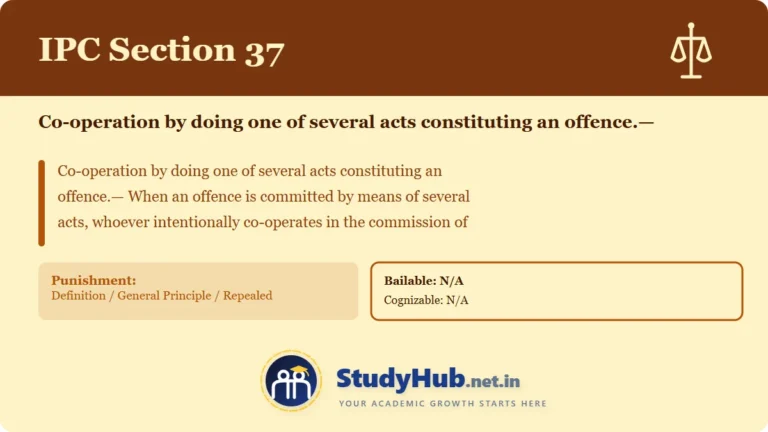
Co-operation by doing one of several acts constituting an offence.—

Section

37

Punishment

Definition / General Principle / Repealed

Cognizable

N/A

Bailable

N/A

Compoundable

Non-Compoundable (Refer to CrPC 320 for exceptions)

Trial Court

N/A

Bare Act Text

37. Co-operation by doing one of several acts constituting an offence.— When an offence is committed by means of several acts, whoever intentionally co-operates in the commission of that offence by doing any one of those acts, either singly or jointly with any other person, commits that offence.Illustrations(a)A and B agree to murder Z by severally and at different times giving him small doses of poison. A and B administer the poison according to the agreement with intent to murder Z. Z dies from the effects of the several doses of poison so administered to him. Here A and B intentionally co-operate in the commission of murder and as each of them does an act by which the death is caused, they are both guilty of the offence though their acts are separate.(b)A and B are joint jailors, and as such have the charge of Z, a prisoner, alternatively for six hours at a time. A and B, intending to cause Z’s death, knowingly co-operate in causing that effect by illegally omitting, each during the time of his attendance, to furnish Z with food supplied to them for that purpose, Z dies of hunger. Both A and B are guilty of the murder of Z.(c)A, a jailor, has the charge of Z, a prisoner. A, intending to cause Z’s death, illegally omits to supply Z with food; in consequence of which Z is much reduced in strength, but the starvation is not sufficient to cause his death. A is dismissed from his office, and B succeeds him. B, without collusion or co-operation with A, illegally omits to supply Z with food, knowing that he is likely thereby to cause Z’s death. Z dies of hunger. B is guilty of murder, but, as A did not co-operate with B. A is guilty only of an attempt to commit murder.
According to the official bare act, this legal offense is defined as: 37. Co-operation by doing one of several acts constituting an offence.— When an offence is committed by means of several acts, whoever intentionally co-operates in the commission of that offence by doing any one of those acts, either singly or jointly with any other person, commits that offence.Illustrations(a)A and B agree to murder Z by severally and at different times giving him small doses of poison. A and B administer the poison according to the agreement with intent to murder Z. Z dies from the effects of the several doses of poison so administered to him. Here A and B intentionally co-operate in the commission of murder and as each of them does an act by which the death is caused, they are both guilty of the offence though their acts are separate.(b)A and B are joint jailors, and as such have the charge of Z, a prisoner, alternatively for six hours at a time. A and B, intending to cause Z’s death, knowingly co-operate in causing that effect by illegally omitting, each during the time of his attendance, to furnish Z with food supplied to them for that purpose, Z dies of hunger. Both A and B are guilty of the murder of Z.(c)A, a jailor, has the charge of Z, a prisoner. A, intending to cause Z’s death, illegally omits to supply Z with food; in consequence of which Z is much reduced in strength, but the starvation is not sufficient to cause his death. A is dismissed from his office, and B succeeds him. B, without collusion or co-operation with A, illegally omits to supply Z with food, knowing that he is likely thereby to cause Z’s death. Z dies of hunger. B is guilty of murder, but, as A did not co-operate with B. A is guilty only of an attempt to commit murder.
The punishment for this specific offense is outlined under the law as: Definition / General Principle / Repealed
Under the Indian Penal Code, this specific offense is classified as a N/A offense.
The legal status regarding police arrest without a warrant is that this offense isN/A.
Cases pertaining to this specific IPC section are triable by the N/A.
The compoundable nature of this offense, meaning whether the parties can settle it out of court, is classified as: Non-Compoundable (Refer to CrPC 320 for exceptions).
Section (dhara) 37
Disclaimer:

This article is for general legal information only and is not a substitute for professional legal advice. Please consult a qualified advocate for your specific case.

Leave a Comment

Scroll to Top