Indian Penal Code, 1860

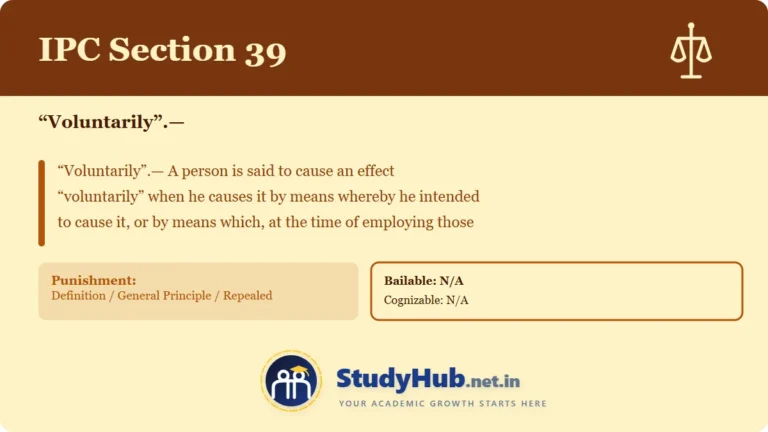
“Voluntarily”.—

Section

39

Punishment

Definition / General Principle / Repealed

Cognizable

N/A

Bailable

N/A

Compoundable

Non-Compoundable (Refer to CrPC 320 for exceptions)

Trial Court

N/A

Bare Act Text

39. “Voluntarily”.— A person is said to cause an effect “voluntarily” when he causes it by means whereby he intended to cause it, or by means which, at the time of employing those means, he knew or had reason to believe to be likely to cause it.IllustrationA sets fire, by night, to an inhabited house in a large town, for the purpose of facilitating a robbery and thus causes the death of a person. Here, A may not have intended to cause death; and may even be sorry that death has been caused by his act; yet, if he knew that he was likely to cause death, he has caused death voluntarily.
According to the official bare act, this legal offense is defined as: 39. “Voluntarily”.— A person is said to cause an effect “voluntarily” when he causes it by means whereby he intended to cause it, or by means which, at the time of employing those means, he knew or had reason to believe to be likely to cause it.IllustrationA sets fire, by night, to an inhabited house in a large town, for the purpose of facilitating a robbery and thus causes the death of a person. Here, A may not have intended to cause death; and may even be sorry that death has been caused by his act; yet, if he knew that he was likely to cause death, he has caused death voluntarily.
The punishment for this specific offense is outlined under the law as: Definition / General Principle / Repealed
Under the Indian Penal Code, this specific offense is classified as a N/A offense.
The legal status regarding police arrest without a warrant is that this offense isN/A.
Cases pertaining to this specific IPC section are triable by the N/A.
The compoundable nature of this offense, meaning whether the parties can settle it out of court, is classified as: Non-Compoundable (Refer to CrPC 320 for exceptions).

Leave a Comment

Scroll to Top