Indian Penal Code, 1860

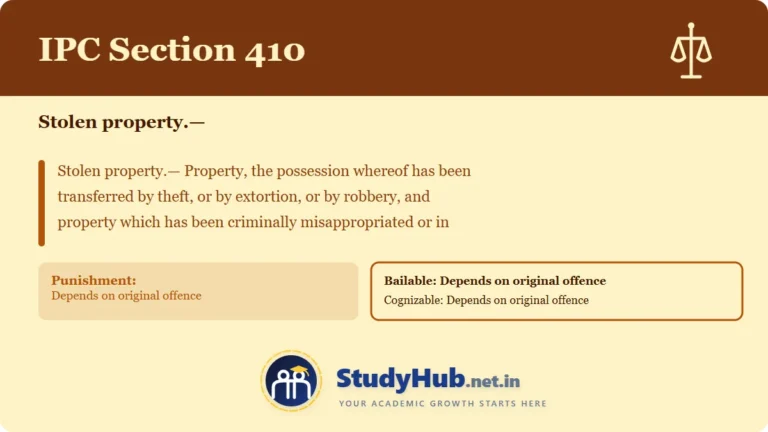
Stolen property.—

Section

410

Punishment

Depends on original offence

Cognizable

Depends on original offence

Bailable

Depends on original offence

Compoundable

Non-Compoundable (Refer to CrPC 320 for exceptions)

Trial Court

Depends on original offence

Bare Act Text

410. Stolen property.— Property, the possession whereof has been transferred by theft, or by extortion, or by robbery, and property which has been criminally misappropriated or in respect of which criminal breach of trust has been committed, is designated as “stolen property”, whether the transfer has been made, or the misappropriation or breach of trust has been committed, within or without India. But, if such property subsequently comes into the possession of a person legally entitled to the possession thereof, it then ceases to be stolen property.
According to the official bare act, this legal offense is defined as: 410. Stolen property.— Property, the possession whereof has been transferred by theft, or by extortion, or by robbery, and property which has been criminally misappropriated or in respect of which criminal breach of trust has been committed, is designated as “stolen property”, whether the transfer has been made, or the misappropriation or breach of trust has been committed, within or without India. But, if such property subsequently comes into the possession of a person legally entitled to the possession thereof, it then ceases to be stolen property.
The punishment for this specific offense is outlined under the law as: Depends on original offence
Under the Indian Penal Code, this specific offense is classified as a Depends on original offence offense.
The legal status regarding police arrest without a warrant is that this offense isDepends on original offence.
Cases pertaining to this specific IPC section are triable by the Depends on original offence.
The compoundable nature of this offense, meaning whether the parties can settle it out of court, is classified as: Non-Compoundable (Refer to CrPC 320 for exceptions).

Leave a Comment

Scroll to Top